A Nine-Year-Old Handed Bikers Flyers to Find a Marrow Donor for Her Brother — The Only Match Carried the Name Her Mother Feared Most
The first thing we learned was that a motorcycle club cannot run a donor search by itself. We could find a room, put up tables, and ask people to come. The registration process, eligibility questions, testing, follow-up, and decisions about donation belonged to trained staff and the donor organization. Frank understood that as soon as he spoke with its coordinator. He wrote down what they needed from us and came back to the garage with a list.
We needed a venue with accessible entrances, enough space for private conversations, volunteers to guide people through the line, and a way to reach the community beyond our usual friends. We also needed to speak carefully. A person who registered that day might help Daniel, might help somebody else later, or might never be asked to donate. We could invite people to learn and join the registry. We could not promise Sophie that a crowd would produce a match.
Frank told her so when we met again.
Sophie was sitting with Daniel in the hospital family room. He was smaller than he looked in the flyer, partly because the photograph had been taken months earlier and partly because he was curled against the arm of the couch. He had a notebook open to a page of dinosaurs. Sophie showed Frank the newest one, a long-necked creature with motorcycle wheels instead of feet. Daniel had drawn it for us because she had told him about the bikes.
“Can the people who come see this?” he asked.
Frank told him they could put it on the welcome table if he wanted. Daniel considered that, then said he needed to color the wheels first. For the rest of our visit, while the adults discussed the event, he shaded them in with a blue pencil.
Elena came to the meeting with questions of her own. She wanted to know whether Sophie’s picture of Daniel would be used and where it might appear. She wanted the family to review anything we shared. She also wanted people to understand that registration was voluntary and private. Her children had already had enough strangers asking personal questions. We agreed that the donor organization’s staff would supply the medical information and that Elena would approve anything about Daniel.
I went home thinking about how much she was carrying. Her husband, Rafael, had died in a road crash three years before. She had been raising both children since then. Now Daniel was ill, and Sophie had found a way to help that put her in front of thousands of people. Elena was grateful for her daughter’s determination, but she worried about the hours Sophie spent thinking about donors. She told me she had begun setting limits: Sophie could help with flyers when she wanted, but she also had to see friends, do her schoolwork, and have days that did not belong to the search.
Our brothers understood jobs with clear edges. Malik handled tables, parking, and signs for the venue. Boone contacted people who could provide water and food for volunteers waiting in line. Frank worked with the donor coordinator on the schedule. I went to the print shop Sophie had used and asked the owner whether we could pay for a new batch of flyers. He remembered her. She had brought a small stack of coins in a plastic bag the first time she came in.
The owner offered to print the approved event information at cost. When I told Sophie, she asked whether the flyer could still show Daniel smiling. Elena said yes after checking the layout. Sophie also asked to add a line that told people they could register to help someone they might never meet. She had learned that through the donor organization and thought it mattered. Her first six thousand flyers had asked people to help her brother. The next batch would make room for other families too.
At our garage, I pinned the new flyer beside the cash register. Customers read it while they waited. Some asked whether their age or health history might affect eligibility. I sent them to the organization’s information page or told them to ask staff at the event. I was learning to say “I don’t know” without feeling I had failed Sophie. She needed reliable answers more than she needed me to sound certain.
One evening she visited the garage with Elena to see the motorcycles. Daniel had sent along his dinosaur drawing, its wheels now colored blue. We put it in a clear sleeve on the welcome table while we tested the room layout. Sophie walked the route a visitor would take from the entrance to the registration desks. Halfway through, she stopped and looked at the empty chairs.
“What if nobody comes?” she asked.
Frank stood beside her. “Then the people who do come will still matter.”
She nodded, though she kept looking at the chairs. I did too. We had invited far more people than could fit in the room at once. We would find out in ten days how many chose to walk through the door.
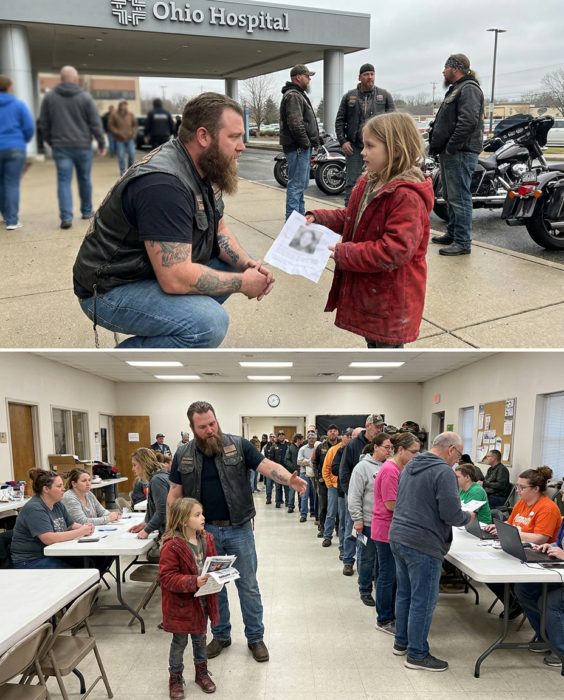
The line began forming before we opened. It reached from the community center entrance to the sidewalk, then turned along the fence toward the parking lot. Frank went outside with the donor coordinator to make sure people knew there might be a wait. A few had driven from neighboring towns after seeing the event shared by friends. Others had walked over after noticing our sign.
By noon we needed extra chairs. By midafternoon Malik had given up estimating the line and was helping staff keep the entrance clear. Sophie arrived with Elena for a short visit. We had agreed she would not spend the day working the crowd. She stood at the welcome table for a while, looking at Daniel’s drawing, and watched people take information from the trained volunteers.
Some recognized her from the flyers. They thanked her. One woman told her she had joined the registry years before but had come to learn how to encourage her adult children to consider it. A man said he had taken one of Sophie’s flyers at a bus stop and kept it folded in his wallet until he looked up the event. Sophie listened, then went to sit with Elena when the attention grew too much.
At closing, the donor organization counted 1,400 new registrations from the day. Its staff told us it was the largest single-day donor registration event the city had held with them. Frank repeated the number twice to make sure he had heard correctly. Sophie wrote it on the back of the copy of Daniel’s drawing that she kept in her bag. It was an extraordinary day. We still did not know whether any person there could donate to her brother.
The wait for results lasted five weeks. That is a short sentence to describe a long stretch of mornings. At the garage, someone asked for news almost every day. We told them we had none. We did not ask Elena to become our source of updates. When she wanted company, she called. When she wanted the week to belong to the children, we left her alone.
Daniel had treatment appointments during that time. His doctors continued caring for him and searching through the channels available to them. A community event was one part of a larger process. I reminded myself of that whenever I caught sight of his blue-wheeled dinosaur behind the garage counter. Sophie visited less often. Elena told me she had gone back to an after-school art group. She still asked about the results at home, but she was drawing things besides flyers again.
In the fifth week, Elena called Frank. Staff had identified one volunteer from the event for further consideration as a strong match for Daniel. More medical checks, counseling, and decisions were still ahead. Frank let her tell him as much as she wished. He did not ask for the person’s name. He called me afterward and said we had reason to hope, carefully.
A few days later, Elena asked me to come over. Sophie was at a friend’s house and Daniel was with Mrs. Alvarez, the neighbor who sometimes helped with rides. Elena sat at her kitchen table with a folder closed in front of her. I recognized the way she held it down with her palm, as though it might move if she let go.
She told me the potential donor was a forty-four-year-old man. He had come to the event after seeing one of Sophie’s flyers posted at a bus stop. He had not known Daniel’s surname from the photograph or connected the flyer to Rafael’s family. The donor team had contacted him and begun the further steps with him. As the process moved forward, Elena had learned his name through the discussions her care team arranged.
She said it once. I knew it too.
Three years earlier, he had been driving the vehicle involved in the crash that killed Rafael. He had served eighteen months in prison and had recently been released. Elena had sat through the proceedings after the crash. She had heard his name read aloud in rooms where she was trying to understand how her husband had gone to work and never come home.
For a while I looked at the closed folder because I couldn’t look directly at her.
“He really didn’t know?” I asked.
“The flyer had Daniel’s picture and first name. He says he didn’t.”
She believed that part was possible. Sophie’s first flyers had reached places far beyond the hospital. The event had brought in people who knew nothing about our family or club. This man had seen a child’s photograph at a bus stop, gone to the community center, and registered. The possibility that he could help Daniel emerged afterward.
Elena asked what I thought she should do. I told her I could stay and listen, but I could not make that decision for her. She pressed her hand against the folder. She knew a match did not erase what had happened to Rafael. She also knew Daniel needed every suitable option his doctors could offer.
She asked me to call Frank and tell him only that she needed time. For three days, she spoke with Daniel’s care team, the donor professionals, and people she trusted. She asked questions about the medical process and about privacy. At night, after Sophie went to bed, she sat with Rafael’s photograph on the table.
On the third day, she called the hospital.
Elena said yes to moving forward with the donor, provided the medical teams completed every necessary check and both sides still chose to proceed. She told me afterward that she had spent three days trying to separate two truths she could barely hold together. The man’s actions on the road had taken Rafael from the children. A donation, if it proved possible, might help keep Daniel with them. She did not need to call one truth less real to act on the other.
The donor, whose name was Thomas Ward, completed the additional steps required by the transplant team and donor organization. Staff handled the arrangements and protected the privacy of both sides. Elena did not meet him before Daniel’s transplant. Thomas did not ask to meet her. The doctors explained what they could about the match and the procedure; they also explained that an encouraging result was not a guarantee. Elena listened, asked questions, and went home to pack Daniel’s bag for the hospital.
Sophie knew that a donor had been found. Elena chose how and when to tell her who he was. They sat together one evening with Rafael’s photograph nearby. Sophie remembered the crash in fragments: a phone ringing, her mother’s face, relatives coming through the door. She did not remember Thomas from the legal proceedings. Elena told her his name and what had happened. She also told her what he had offered to do for Daniel.
Sophie asked, “Does he know Dad was our dad?”
“He does now.”
“Does he know Daniel is my brother?”
“Yes.”
Sophie went to her room. Elena let her have time. Later Sophie came back and asked whether accepting a donation meant they had to forgive him. Elena told her no. They could decide about the donation because of Daniel’s needs. Their feelings about Rafael and Thomas did not have to be settled that night, or on any schedule.
I heard this from Elena later. I wasn’t in the room, and I’m glad she and Sophie had it to themselves. What I did see was Sophie at the hospital a few days later, carrying Daniel’s dinosaur notebook and a fresh pack of blue pencils. She sat beside his bed drawing another creature with wheels while he told her she had made its tail too short.
The transplant went ahead. Thomas followed the donor team’s instructions; Daniel followed a much longer course under his own doctors’ care. Our club’s role was small and ordinary compared with theirs. We brought meals when Elena wanted them, gave rides when her car was unavailable, and kept the garage phone close enough to hear. We did not crowd the hospital hallway or tell people that Sophie’s story had found an easy ending.
There were difficult weeks after the procedure. Daniel was tired. Elena was tired. Sophie did homework in waiting areas and sometimes wanted to go outside and play rather than sit under hospital lights. Elena found people who could take her. The brothers learned to offer specific help: “I can bring dinner Thursday,” or “I can drive you to the appointment at nine.” Elena could accept or decline without having to invent a job for us.
Thomas did not send a message while Daniel was receiving treatment. Through the proper channels, he let the team know he hoped the boy was doing well and did not expect a reply. Later, after the donation process had ended and communication could be handled appropriately, he left one letter for the family. Elena could choose whether to receive it. She waited until Daniel was home and asked the team to send it.
The letter was short. Thomas said he had first seen the flyer at a bus stop on his way to work. He had seen a child with a gap-toothed smile and learned where to register. When he later understood whose child Daniel was, he had been afraid Elena would feel trapped by the offer. He said he was sorry for Rafael’s death and for the pain he had caused the family. He did not ask to be welcomed into their lives. He did not ask them to answer him.
Elena folded the letter and put it in a drawer. She told me she could hear the apology and still feel angry. I said she was allowed both. She gave me a look that made it clear she had not asked permission. Then she smiled for the first time that day and asked whether I would pick up Sophie from art group.
Daniel’s recovery took time. Fourteen months after the transplant, Elena told us his doctors had said he was doing well and no longer needed the treatment that had shaped their days before. She chose her words with the care of someone who had learned how quickly a hopeful sentence could travel. He had appointments ahead. He also had school, friends, and the chance to complain about ordinary things again.
At the garage, Frank opened a drawer and found the blue-wheeled dinosaur we had kept safe since the registration day. We returned it to Daniel. He looked at the drawing, decided the wheels were badly proportioned, and promised to make us a better one. He did, with four enormous tires and a rider whose beard looked suspiciously like mine.
Two years after the transplant, Elena called me on a Wednesday evening. Daniel’s birthday was coming up. He wanted pizza, a dinosaur cake, and the people who had helped organize the donor event. Sophie had made a list. Thomas’s name was on it, though nobody had written him an invitation yet.
Elena had talked with both children. Daniel knew that Thomas had been his donor and knew, in the way a child grows able to understand a painful family history, that Thomas had also been involved in the crash that killed his father. Sophie was older by then. She had questions for her mother that were different from the ones she asked at nine. Elena answered what she could and admitted when she did not know.
They decided to invite Thomas. Elena wanted me to know that she was doing it because her children wanted to mark Daniel’s birthday with the people who had helped him. She had not forgotten Rafael. She had not decided every feeling she would ever have about Thomas. I told her I understood as much as an outsider could and asked what she needed from me. She said, “Help Frank carry the tables.”
The party was at the community center where we had held the registration day. By then the room looked smaller to me. Perhaps I remembered the line of 1,400 people winding out the door. Perhaps I was simply seeing it set up for a boy’s birthday instead of a donor event. We pushed tables together, hung paper decorations, and put Daniel’s new dinosaur drawing beside the cake. Sophie took charge of the candles.
Thomas arrived before most of the guests. I saw him through the glass entrance doors, standing on the walkway with an envelope in his hand. He came close to the door, looked through it, then stepped back. I went outside, partly because I had been asked to keep an eye on arrivals and partly because he had been there long enough that I worried he might leave.
He was an ordinary-looking man of forty-six, with a dark jacket and a face drawn tight by nerves. He recognized my vest from the donor event. I told him Elena knew he was coming. He asked if she had changed her mind. I said I hadn’t spoken to her in the last twenty minutes and offered to go in and ask. He shook his head. He wanted to stand a little longer.
So I stood with him. People passed us carrying presents and folding chairs. He watched them enter. After about twenty minutes, Sophie came out. She had grown taller since the day she stood outside St. Agnes with a stack of flyers, but she still walked straight toward someone when she had something to say.
“Mom said you can come in,” she told him. “Daniel wants everybody there before we light the candles.”
Thomas thanked her. He held the door for Sophie and followed her inside.
He did not try to approach Elena at once. He stayed near the back while children gathered around the pizza boxes. When Daniel noticed him, he came over holding a paper plate. He knew who Thomas was. He said hello and asked whether Thomas liked pepperoni. Thomas said yes. Daniel handed him a slice, then went back to his friends.
Elena watched from beside the cake table. After a while she walked over. I was close enough to see them speak, though I stepped farther away rather than listen. They stood facing each other for a few minutes. Thomas offered the envelope. Elena took it and set it aside unopened. Then she pointed him toward a chair.
Later, she told me what she had said. She thanked him for choosing to be a donor and for respecting the family’s space afterward. She also told him Rafael was missed every day. Thomas said he knew the donation changed nothing about that loss. He was grateful to have been invited and would leave whenever she wanted. Elena said he could stay for cake.
When Sophie brought out the candles, the whole room sang. Thomas joined in quietly at the back. Daniel blew them out in one breath and insisted someone had helped with the last one. Boone claimed responsibility. The children argued about it until the first slices were served.
Thomas left before the party ended. Elena walked him to the door. She did not promise another invitation. He did not ask for one. After he was gone, she came back to help Sophie collect paper plates. Daniel was already showing Frank a toy dinosaur that made a grinding noise when it walked.
The club kept working with the donor organization after Daniel’s transplant. We held a registration event the next year and another the year after that. Sophie no longer stood outside the hospital handing out flyers. Sometimes she came to the community center for an hour, introduced the staff, and told people why she had once started counting pieces of paper. Other years she chose to spend the day with her family, and we were glad she could.
We learned to be careful when telling people what the events achieved. The organization handled registration and follow-up. A match depended on factors none of us could see by looking at a line of volunteers. Our job was to make it easier for eligible people to learn about the process and decide whether to join. Frank kept a box of approved information at the garage. If a customer asked a medical question, we directed them to the people qualified to answer it.
Over four years, the donor organization told us that 22 successful transplants had resulted from donors who had joined through the annual events. Each number represented people and families whose stories were their own. We celebrated the update without asking for their names. Sophie wrote “22” on a small card and placed it near Daniel’s old dinosaur drawing in the garage. She said she wished she could tell her nine-year-old self that the line outside the community center would keep helping people.
Daniel grew. He returned to school, made friends who knew him as a boy who liked dinosaurs and soccer, and sometimes rolled his eyes when adults spoke about how brave he had been. Elena tried to let him be ordinary. Sophie helped with the events when she wanted to. She also learned an instrument, went to parties, and stopped counting flyers. The old tally remained on the refrigerator for years because nobody thought to take it down. One day Elena found it while cleaning, showed Sophie, and put it in a box with family photographs.
I still have the first flyer Sophie handed me. It is folded along the edge and stained where my work gloves touched it. I keep it in a drawer at the shop, beneath the registration information we give people now. Sometimes I take it out when the event planning gets tangled in tables and schedules. Daniel’s gap-toothed smile reminds me why we began. The folded paper also reminds me that he was a child Sophie loved, with a life far beyond what any flyer could hold.
On a cold Saturday four years after we met her, Sophie came by the garage with Daniel. She looked at the row of motorcycles and asked whether I could teach her to check tire pressure. I showed her. Daniel wanted to know why the valve cap was so small that a person could lose it in a second. Frank told him that was exactly why we kept spares. They spent the next half hour looking for a spare cap Frank had put down somewhere in the shop.
The last time I saw Thomas was from across the community center parking lot. He had come to one of the annual registration events to speak with the donor organization’s staff, then left without approaching Sophie or Daniel. Elena knew he was there. She chose not to speak with him that day. He respected it.
People have asked me what happened between them after the birthday party. I tell them only what Elena has chosen to share. She invited him once. He came. They spoke honestly. Their family carried on with Rafael still part of it. Daniel got older, and the donor program continued. Those facts are enough.
At this year’s event, Sophie helped a volunteer replace a sign that had slipped from its stand. I watched her smooth the paper and step back to check whether it was easy to see. She was no longer the nine-year-old bracing a stack of flyers against the wind, but I recognized the careful way she handled each sheet.
The doors opened. People began coming in. Frank waved me toward the welcome table, where we needed another pair of hands to direct the line. I folded Sophie’s old flyer and put it safely back in my pocket.
Follow this page for more biker stories about the people we meet, the choices they carry, and the lives that continue long after a single day ends.