A Twelve-Year-Old Brought Four Years of Savings to Buy Back His Father’s Motorcycle — I Knew Where It Had Been Waiting All Along
Frank reached Wade’s shop twenty minutes later. He had driven his truck because the morning roads were slick, and he came in without his club vest. Evan looked up when the door opened. He didn’t know Frank by sight. He knew his father’s photograph, the plate number, and the amount in his tin. That was all he had brought to defend his search against another dead end.
I introduced them. Frank crouched to see the photograph Wade had placed on the counter. He pointed to Daniel’s hand on Evan’s shoulder, then smiled at something he remembered. Daniel used to call Evan his “little navigator” because, at four, he insisted on telling his father which direction to turn when they drove to the grocery store.
Evan asked Frank the question Wade had not been able to answer: “Do you know where his motorcycle is?”
Frank looked at the boy’s tin. “I do.”
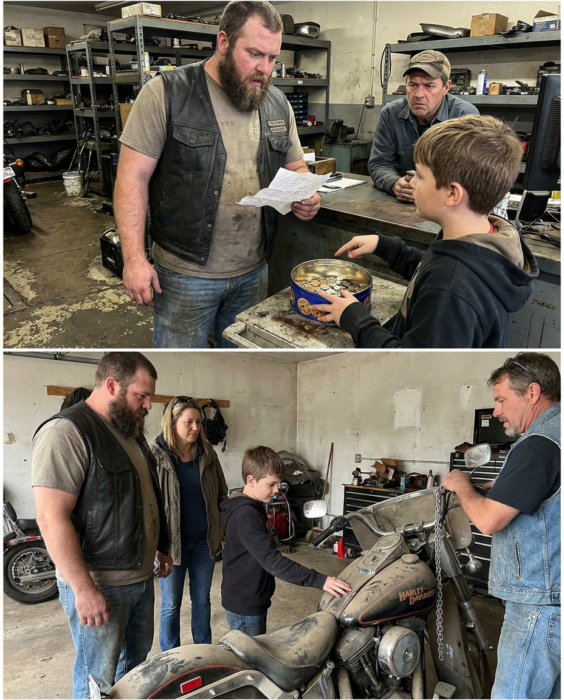
Wade set down the pen he had been holding. Evan stood so still that I could hear the shop heater click on. Frank said the bike was safe at the Iron Vale Riders’ garage. He had bought it when it was offered for sale four years earlier. Evan asked whether Frank would sell it back. Frank told him they needed to speak with his mother and show him the bike first. He did not give a price.
Evan wanted to leave at once. We called his mother, Sarah, from the shop. She had known he was visiting Wade, but she had not expected us to find the bike that day. When Frank explained who he was, she remembered his name. He had visited Daniel while he was ill and had helped bring meals to their home afterward. Sarah asked where the bike had been all this time. Frank said it had stayed covered in the club garage. She went quiet, then told him she would meet us there.
While we waited, Evan told us about the tin. He started saving when he was eight, after watching the Harley leave their driveway. Sarah had explained why she needed to sell it. The medical bills had kept coming, and she needed to pay them while keeping their household running. Evan understood the words but could not imagine someone else owning the bike. He found the old plate number among Daniel’s papers and wrote it down before the original sheet was packed away.
Every birthday, he put aside part of the money relatives gave him. When family friends handed him cash during the holidays, most of it went in the tin. At eleven, he began helping at the neighborhood diner on weekend mornings with jobs the owner and Sarah agreed were safe for him: wiping menus, filling napkin holders, and carrying light bags from the storeroom. People sometimes gave him a few dollars. He saved those too.
“I still bought things,” he told Frank. “I just counted first.”
For two years he visited used-motorcycle shops when an adult could take him. He carried the same plate number. Some owners checked what they could. Most had no way to find a particular bike from an old plate. A few suggested he buy a similar model one day. Evan thanked them and kept looking.
At the clubhouse, I rode ahead to open the gate. Our garage is a brick building outside Dayton with patched concrete and a coffee machine nobody admits to buying. Daniel used to know every shelf in it. Some of our younger members had never met him. They knew the covered shape in the back corner as a bike Frank had bought and refused to part out, restore, or ride.
I had helped him put it there. That memory returned as I rolled the garage door up for Evan and Sarah. Four years earlier, we had pushed the Harley across the floor with its engine off. Frank placed a tarp over it and told us to keep the corner clear. I thought he needed time to decide what to do with a dead friend’s motorcycle.
Years went by. When someone asked again, Frank would say, “The boy will come looking. Sooner or later.”
I had taken it as a way of saying Frank missed Daniel. At Wade’s shop, after watching Evan open his tin, I understood Frank had meant the words exactly. Now the boy stood outside the garage with his mother, staring past my shoulder toward the covered bike.
Sarah asked Frank to wait before removing the tarp. She wanted to speak with Evan first. They walked a short way along the side of the garage while Frank and I stayed near the door. She had sold the motorcycle herself. However much she understood why she had done it, she did not want Evan entering the room believing Frank had rescued it from a choice she should never have made.
I couldn’t hear all of their conversation. I saw Evan hold up the tin and Sarah gently push his hands down so he would listen. Later she told me she had explained it again: Daniel had needed care, bills needed paying, and the family had come first. Evan said he knew. He had saved the money because he wanted the bike back, not because he was angry with her. She hugged him with the tin pressed awkwardly between them.
They came inside together.
Frank led them toward the corner. The tarp had gathered dust across its top but was still tucked beneath the wheels the way he had left it. A younger member, Ben, had arrived for a repair job and stopped near the workbench when he saw us. Frank waved him over. Ben had asked more than once why that motorcycle stayed covered. He deserved to see who had come for it.
Frank asked Evan whether he wanted to pull the tarp down. Evan shook his head. His hands were full, and I could tell he was frightened of what might be underneath. Frank said he would do it. He loosened the cloth near the rear tire and drew it slowly over the seat, the tank, and the handlebars.
The Harley stood where Daniel had left it. Four years had not made it new. There was dust in places the tarp had not sealed, and the tires would need careful attention before the bike moved under its own power. But the tank carried the same narrow scratch Evan had described at Wade’s shop. A small chain hung from the handlebar, with a plain metal ring at its end. Daniel used to loop it there while he worked so it wouldn’t catch on tools.
Evan set the tin on the floor. He walked forward, stopping before he reached the tank. I watched his eyes move from the scratch to the chain and back again. He asked if he could touch it. Frank told him he could. Evan put two fingers on the scratch as if checking whether a photograph had turned solid.
Sarah stood behind him. She recognized the chain. Daniel had worn it for years, she said, and had hung it on the handlebar during the last summer he worked on the bike. Evan lifted the ring slightly, then let it settle. It made a small sound against the metal beneath it. He looked at Frank.
“You didn’t fix the scratch.”
“Your dad knew how to fix it,” Frank said. “He chose to leave it.”
Evan asked how Frank had got the bike. Frank told him about the sale, the paperwork, and why he had bought it. Daniel had been a club brother. Sarah needed the money; Frank had the means to purchase the motorcycle. He did not tell Sarah then what he planned to do with it because she had more urgent decisions to make, and he was not sure she would want one more promise to carry. He bought it, stored it safely, and waited to see whether Evan would one day ask.
Sarah listened without looking away. “You could have told me,” she said.
“I should have,” Frank answered.
He did not ask her to thank him. He did not say keeping the bike made the years without Daniel easier. He said he had believed Evan might want it, and he had been afraid that if the club sold it or changed it, there would be no way to undo that.
Evan picked up the tin again. “How much?”
Frank shook his head. Evan tried to lift the lid. He wanted Frank to see how much was inside, as though the rolls of coins could prove how long he had been looking. Frank put a hand on the closed lid.
“I bought it for you to have when your mother and you were ready,” he said. “Keep your money.”
Evan frowned. He said he had saved it to pay for the bike. Frank told him the savings were his; they could discuss what to do with them, but the club was not charging him for his father’s motorcycle. Sarah asked to see the ownership papers before any decision was made. Frank took them from his office. They talked through what could be transferred and when, since Evan was twelve and not ready to ride on the road. Frank wanted the family to decide how the bike would be held until he was older.
Evan looked from the papers to the Harley. “Can I come back?”
“As often as your mom says,” Frank replied.
That was when Evan finally cried. He did it quietly, with one hand still resting on the scratched tank. None of us moved toward him until he reached back for Sarah. She stepped beside him and stayed there while the garage settled around them.
The motorcycle remained at the clubhouse with Sarah’s agreement. Frank arranged the ownership paperwork with her so the family’s claim to the bike was clear, and we kept it stored while Evan grew old enough to learn about it safely. He was welcome in the garage, but he would not ride it until he was legally old enough, properly licensed, trained, and ready. Evan accepted the rule more readily than some of the brothers expected. He had spent four years looking for that exact motorcycle. Waiting beside it was different from not knowing where it was.
On his first Saturday visit, Evan brought a notebook. The tin stayed at home. He sat at a workbench while Frank showed him how to identify the bike’s parts and what prolonged storage could do to rubber, fluids, and metal. Frank didn’t start the engine for him. Evan had imagined hearing it again, but Frank explained that a motorcycle stored for years needed proper work before anybody tried. Evan wrote down the jobs in the order Frank described them.
I watched the two of them move around the Harley. Frank had known Daniel as an adult, a stubborn mechanic who brought burned coffee to meetings and argued for half an hour about a five-dollar part. Evan had known him as a father who sometimes came home smelling of oil and let him polish the mirror with a soft cloth. Both versions belonged in the garage. They talked over each other at first, correcting the details of a story neither one had heard the same way. Eventually they learned to ask.
Every weekend Evan came if Sarah could bring him or if one of us picked him up with her permission. He swept the floor, sorted bolts into labeled drawers, and learned why a tool returned to the wrong place slowed the next repair. Some days he worked on bicycles for our community program before he came near the Harley. Frank said caring for any machine began with noticing what it needed, not just wanting to hear it run.
Sarah visited too. At first she stayed by the door. The motorcycle brought back the last months of Daniel’s illness and the morning she arranged its sale. She was glad Evan had found it. She also needed time before she could stand beside it without feeling those decisions gather around her again. No one pressed her. When she was ready, she came in, touched the handlebar chain, and told Evan where Daniel had bought it.
Evan’s savings became another conversation between them. He had counted $1,840 before bringing the tin to Wade’s shop and had kept the notebook showing where each amount came from. Frank suggested they put the money somewhere more secure than a cookie tin, so it could help Evan later. Evan refused at first. He was afraid that if the coins went into an account, the four years of saving would disappear into a number on a statement.
Sarah found a compromise. They photographed the contents, counted them together, and opened an account in Evan’s name with guidance from their bank. They kept the tin itself, along with a note recording the amount and what he had saved for. Evan held back a few coins that had come from the first holiday envelope after Daniel died. He placed them in a small sealed packet inside the tin. The rest of the money could support training, equipment, or whatever he chose when he was older.
Frank asked whether the club could display the tin at the clubhouse one day. Evan said he would think about it. He wanted to be certain nobody would look at it and assume a twelve-year-old had bought himself a motorcycle. He had tried to. Frank had given him something he could not have priced.
The first time the club gathered to work on the Harley, Ben took photographs at Evan’s request. We removed and inspected parts that needed attention after storage, keeping the original pieces organized. Evan learned to clean and preserve what could be kept. He asked before anyone touched the tank or the chain. We did not treat every scratch like a holy relic; it was a motorcycle that would someday have to run safely. We also understood why certain marks mattered to him.
By the end of the first year, Evan could explain more about the bike than some newer members. He still made mistakes. Once he placed a small part on the wrong tray and we spent twenty minutes finding it. He apologized until Frank put the part in his hand and told him to write down where it belonged. Daniel had misplaced far more expensive things, Frank said. Evan asked for an example. Frank gave him three.
Sometimes Evan came to the garage and did no work at all. He sat beside the Harley doing homework while the brothers repaired other machines. The sound of tools and talk filled the room. Every so often he glanced up at the covered bike, as if checking it was still there. After a while, he stopped checking so often. He knew where to find it.
At thirteen, Evan learned to change a bicycle tire. At fourteen, he could help diagnose a charging problem when Frank talked him through the checks. At fifteen, he began a safety course appropriate to his age and spent more time learning road rules than he wanted to admit to the brothers. He was not allowed to ride Daniel’s Harley on public roads. He asked questions about riding, watched careful riders, and learned that confidence could arrive long before skill.
There were six years between the day he entered Wade’s shop and the day he could ride his father’s bike. The years did not pass in one neat line of Saturday afternoons. School projects came first some weekends. Sarah changed jobs, and their schedules shifted. Evan made friends who knew nothing about motorcycles. He played baseball for a season and discovered he preferred watching from the stands. Once, after an argument with Frank over a repair, he stayed away for three weeks. Frank gave him space, then phoned to ask whether he wanted to come help with a charity breakfast.
He returned. They talked through the repair before they touched it again.
By then the club had made the Harley roadworthy without erasing the details Evan asked us to keep. The tank scratch remained. The chain hung from the handlebar when the motorcycle was parked, though Evan removed and secured it before any ride so it could not interfere with the controls. We replaced what safety required and kept records of the work. Evan helped at each stage he was ready for. Frank would explain a decision, then ask Evan to tell it back in his own words. If he couldn’t, they slowed down.
Daniel’s name returned to the clubhouse in other ways. People who had ridden with him told Evan stories when he asked. Some were tender; others were about small mistakes or jokes that had grown better in the telling. Evan learned his father had sometimes lost patience, sometimes shown up late, and often been the first to stay after a long day when someone else needed help. Those stories gave him a fuller person to remember than the one illness had narrowed during their last months together.
Sarah kept a photograph at home of Daniel standing beside the Harley with eight-year-old Evan. For years she had not wanted to look at it. One evening she brought it to the garage so Frank could see the date written on the back. Evan was sixteen. He lined the photograph up with the motorcycle, noticing which parts Daniel had changed afterward. Sarah stayed to hear Frank describe the day it was taken. Daniel had complained that the light was wrong, then asked for three more pictures.
The tin came back to the clubhouse that year. Evan and Sarah had decided together to place it in a small display case beside Daniel’s club photograph. Its lid remained closed, with the sealed packet of coins inside. Beneath it we put a short caption Evan approved: he had saved for four years to find his father’s motorcycle. We did not list the amount in large letters or make the money the center of the story. If someone asked, Evan could tell them about $1,840 and the notebook. He often told them about the plate number first.
At seventeen, he asked Frank whether he was ready to ride the Harley when the time came. Frank did not answer immediately. He said readiness depended on training, judgment, and how Evan handled a machine on the day, not on a birthday alone. That annoyed Evan. A month later he came back after a lesson on a smaller training motorcycle and said he understood what Frank had meant. There were things he could describe perfectly at the workbench that felt different once a bike moved beneath him.
On his eighteenth birthday, Evan had completed the required training and licensing steps. Frank and Sarah agreed on a short first ride in good weather, on a familiar route, with experienced riders giving him room. We prepared the Harley in the morning. Evan checked it himself, then asked Frank to check after him. When they were satisfied, he went inside to change into his riding gear.
I stood beside the bike with Sarah. She put two fingers against the scratch on the tank. She told me Daniel had made it while carrying a toolbox out of the garage, then spent ten minutes pretending he didn’t know how it happened. Evan had been there. Sarah was glad he had remembered enough to describe it at Wade’s shop.
Sixty Harleys were gathered by the time Evan came back out. Some riders had known Daniel; many knew only Evan. They had come because Frank invited them to accompany a young rider on the first careful circuit he would make on his father’s motorcycle. Evan stopped in the doorway when he saw the line. He looked at Sarah, then at Frank.
“We’re going slow,” Frank said.
“I was going to,” Evan answered.
He fastened his helmet and started the engine. The sound filled the garage entrance. For a moment he sat still with both boots on the ground. Then Frank led him toward the road, with plenty of space ahead and the others falling in behind.
Evan’s first ride was a short loop, not a test of distance. Frank chose roads with light traffic and places to pull over if needed. I rode farther back in the group and watched Evan keep an even pace. At the first planned stop, he shut off the engine, took off his helmet, and looked at the Harley as if he needed to confirm it had carried him there.
Sarah had driven ahead with Wade and was waiting. She hugged him before he could find a clever thing to say. Frank asked how the bike felt. Evan mentioned the weight, the controls, and one sound he wanted us to check back at the garage. Then he smiled. “It sounds like I remember,” he said.
We inspected the bike after the ride. The sound was nothing serious, but Evan wanted to understand it. He had spent six years learning to care for the Harley while it stood still. Riding it did not end that work. It gave the work a new purpose. He returned on weekends to clean it, check it, and help with other repairs. He kept his tin in its case and sometimes brought younger visitors over to see it.
When children asked whether he had really saved all that money, Evan said yes. When they asked whether he bought the motorcycle with it, he told them Frank had kept the bike for him. Then he showed them the scratched tank and the old photograph, depending on which question they asked next. He never told the story exactly the same way twice. Some days he spoke more about Sarah and why she had sold it. Other days he spoke about Daniel’s chain. I liked that he had room to tell all of it.
The club still uses the back corner where the Harley spent four years under a tarp. Ben keeps spare helmets there now. The floor shows an old mark where the kickstand rested. Frank says we ought to repaint it. Evan says he doesn’t mind the mark. Neither has made it a serious argument.
Wade visits the clubhouse now and then. He always asks Evan whether he still carries the plate number. Evan does. The original slip, too fragile for his wallet, is protected with the photograph and the first page of his savings notebook. He has the number memorized. He learned it at eight and repeated it in shop after shop until it brought him to us.
I was at Wade’s Motors last week when another child came in looking for a bicycle part. The door still stuck. I stepped over to help and remembered Evan pushing through it with a heavy tin held against his chest. Wade saw me look at the counter. He knew what I was thinking without asking.
Evan is older now. He sometimes rides Daniel’s Harley to the club and sometimes arrives in a car when he has other errands. He still checks the tank before a long ride. The scratch remains beneath the polish. He knows where every important part of that motorcycle has been, including the four years it stood covered while Frank waited.
Sarah comes to our club breakfasts. At first she came to watch Evan work. Now she has people to talk to of her own. She once told Frank she wished he had called her when he bought the bike. He agreed. They can speak about it without protecting each other from the truth: she did what her family needed, and he kept a place for Evan’s future choice.
At the end of each meeting, I pass the display case. The dented tin sits beside Daniel’s photograph with its lid closed. Evan’s first handwritten page is near it, the amounts too small to read unless you lean in. Beyond the case, the garage door opens onto the road.
Follow this page for more biker stories about the people we remember, the promises we keep, and the long roads that bring someone home.