A Single Mother Was Ordered Off a Flight Because Her Autistic Son Wouldn’t Stop Screaming—Then a Tattooed Aviation Inspector Revealed What the Boy Had Smelled Beneath the Floor
By the time the flight attendant asked Marisol Vega to gather their belongings, her eight-year-old son had screamed “yellow hot” twenty-three times.
Marisol knew because counting gave her hands something to do besides shake.
Flight 218 from Nashville to Denver had left the gate eleven minutes earlier and was moving slowly along the taxiway. Rain streaked the oval windows. The engines produced a low vibration beneath the floor, while air hissed steadily from the vents above row fourteen.
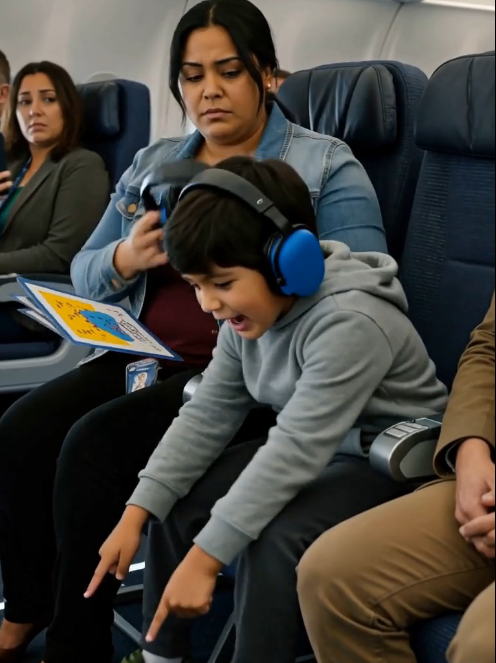
Eli sat in 14A with his knees pulled toward his chest. His blue noise-reduction headphones hung crookedly around his neck. Thick black hair clung to his forehead, and his gray hoodie had twisted around one shoulder. Every few seconds, he struck the heels of his green sneakers against the floor and cried the same phrase.
“Yellow hot! Yellow hot!”
Marisol sat beside him in 14B.
At thirty-four, she was accustomed to strangers evaluating her parenting within seconds. She was a Latina single mother with medium-brown skin, dark eyes made heavier by an overnight shift, and black hair tied in a low ponytail. She worked as an emergency-department registrar at Cumberland Medical Center, where she could locate an insurance error faster than most administrators and calm frightened adults who had forgotten their own addresses.
None of those skills made an airline cabin easier for Eli.
He was autistic, communicated verbally, and understood far more than unfamiliar adults assumed. When overwhelmed, however, his language narrowed. He repeated colors, fragments, or phrases connected to sensations only he could organize.
Marisol carried a laminated ring of picture cards: bathroom, water, quiet, pain, stop, headphones, home.
She held them in front of him.
“Show me what you need.”
Eli slapped the yellow card downward.
“Yellow hot.”
“Is it the light?”
He kicked the floor.
“Is something hurting?”
“Under! Yellow under!”
The passenger in 14C leaned away. He was a white businessman in his late forties, wearing a pale dress shirt and wireless earbuds. His name, Marisol later learned, was Gregory Lane.
“Can you make him stop kicking?” he asked.
“I’m trying.”
“You should have prepared him before bringing him on a plane.”
Marisol looked at the visual schedule taped inside the seat pocket. It showed twelve photographs: airport entrance, security, gate, jet bridge, seat, belt, taxi, takeoff, clouds, landing, baggage, Aunt Rosa.
They had practiced with it for six weeks.
She had requested preboarding, explained Eli’s needs to the gate agent, packed his preferred crackers, downloaded his familiar train videos, brought two kinds of headphones, and selected seats away from the lavatory.
Preparation did not mean control.
Lead flight attendant Tessa Morgan approached from the forward cabin. She was forty-five, Black, with short natural hair and the controlled expression of someone balancing safety, policy, and an aircraft full of growing impatience.
“Ms. Vega, I need him seated with his belt fastened.”
“It is fastened.”
“He cannot continue striking the floor or screaming during takeoff.”
“I understand. Something is wrong.”
“Is he in pain?”
“I’m trying to find out.”
Gregory removed one earbud. “He’s been doing this since the door closed.”
Another passenger held up a phone. Marisol saw her own face on its screen.
“Please don’t film him.”
The woman lowered the phone slightly but did not stop recording.
Eli pulled his hoodie over his nose.
“Yellow hot! Bad yellow!”
Marisol touched his wrist.
He recoiled.
That frightened her more than the screaming. Eli usually sought pressure during overload. He would place Marisol’s hand against his forearm or ask her to squeeze his shoulders. Now he did not want her touching him.
He was not simply overwhelmed.
He was trying to move away from something.
The aircraft paused near the runway.
Tessa looked toward the front, listening to her interphone earpiece. Then she crouched beside Marisol.
“The captain has been informed that we have a passenger who may not be able to comply during takeoff. We can return to the gate and arrange another flight.”
The word we tried to make removal sound shared.
“I can settle him,” Marisol said.
“You have been trying.”
“He keeps pointing down.”
“He may be reacting to vibration.”
“He likes vibration.”
Eli kicked the floor again.
“Hot!”
Gregory exhaled loudly. “There are a hundred people who need to get somewhere.”
Marisol stared at the picture of Aunt Rosa on the visual schedule. Her older sister was scheduled for surgery in Denver the following morning. Marisol was the only family member available to help during recovery. She had saved for six months, traded shifts, and accepted a connection she normally avoided because the direct flight cost too much.
If removed, they might miss the surgery.
That fact did not entitle her to compromise safety. But safety was exactly what Eli seemed to be describing.
A man rose from seat 32D.
He was tall, broad through the shoulders, and wore a plain black short-sleeve shirt despite the cold cabin. His head was shaved. A thick gray-brown beard covered his jaw. Tattoos extended from both shoulders to his wrists—aircraft schematics, uneven stars, thin waveforms, and a child’s name woven through a row of clouds.
Several passengers watched him approach with new caution.
Tessa straightened.
“Sir, please return to your seat.”
The man stopped beside row fourteen.
“My name is Jonah Reed,” he said. “I need to ask the mother one question.”
“You need to sit down.”
He looked at Marisol rather than Eli.
“Has he used ‘yellow hot’ before?”
Marisol shook her head. “He says yellow when a sound or smell feels sharp.”
“Smell?”
“Yes.”
Jonah crouched without moving closer to Eli. He placed his palm against the cabin floor beside the aisle.
Tessa said his name more firmly.
He stood and removed a credential wallet from his pocket.
“I am an aviation safety inspector assigned to cabin systems and airworthiness investigations. I am traveling off duty.”
Tessa examined the card.
Jonah did not claim authority he did not possess.
“I cannot direct your captain,” he said. “I am reporting a faint electrical odor and localized floor warmth near row fourteen. That information needs to reach the cockpit before takeoff.”
Gregory leaned into the aisle.
“I don’t smell anything.”
Jonah looked at him. “That does not cancel another person’s report.”
Tessa inhaled near the floor. “I don’t smell it either.”
“Neither do I clearly. I smell something faint near the recirculation return, but the child may be more sensitive.”
The woman with the phone whispered, “Is he saying the kid can smell electricity?”
“No,” Jonah replied. “I’m saying he may notice an odor sooner than we do.”
Eli’s kicking stopped for two seconds.
He pointed at Jonah’s right forearm.
Among the tattoos was a yellow star with one bent point.
“Yellow girl,” Eli said.
Jonah’s face tightened.
Tessa carried the report forward.
Less than a minute later, the aircraft began turning away from the runway.
Captain Daniel Cho spoke over the cabin system. He was fifty-one, Asian American, and his voice remained calm.
“Ladies and gentlemen, we have received a report of a possible abnormal odor in the cabin. As a precaution, we are returning to the gate for maintenance evaluation.”
Groans moved through the cabin.
Gregory looked at Marisol as though the delay remained her fault.
Jonah returned to the last row.
At the gate, technicians boarded. Passengers were asked to remain seated while the crew assessed the cabin. One technician used a thermal camera along the floor. Another inspected the seat-power outlets.
Near row fourteen, the thermal image showed an abnormal warm area.
The crew deplaned everyone.
Eli ran into the terminal and pressed his face against Marisol’s coat. Jonah stood several yards away, both tattooed hands closed into fists.
Forty minutes later, a maintenance supervisor approached the captain with a sealed evidence bag containing a darkened section of wire insulation.
A cable bundle beneath row fourteen had chafed against a seat-track bracket. The fault had not produced open flames, but heat and a failing recirculation-fan motor created an electrical odor beneath the floor.
Captain Cho looked at Eli.
“You were telling us something important.”
Eli covered his ears.
Marisol answered for him.
“He was telling us the only way he could.”
The captain turned toward Jonah.
“You recognized the phrase?”
“No,” Jonah said.
He looked down at the yellow star tattooed on his forearm.
“My daughter called it burning rain.”
His voice became quieter.
“I told the crew she was only afraid.”
Part 2, The Card That Did Not Command the Captain
The airline moved passengers to another gate while maintenance removed the aircraft from service.
Confusion became anger before it became gratitude. People checked connections, called family members, and crowded the service desk. Some spoke about the damaged wiring as though they had personally discovered it.
Marisol sat on the floor near an unused gate with Eli beneath her denim jacket. He was no longer screaming, but his breathing remained shallow. He rubbed the yellow card between two fingers until its laminated edge bent.
A customer-service supervisor offered them seats on the replacement aircraft.
Marisol declined.
“Not today.”
“If you leave the secure area, we may not be able to confirm tomorrow’s availability.”
“I understand.”
She called Rosa and explained they would miss the surgery.
Her sister responded without hesitation.
“Stay with Eli. My neighbor can bring me home.”
Marisol began apologizing.
Rosa stopped her.
“You didn’t break the plane.”
Across the waiting area, Jonah spoke with Captain Cho, Tessa, and maintenance personnel. He never suggested that his credential had forced the return. The official decision belonged to the captain after the crew received an abnormal-odor report.
That distinction mattered to him.
When he finished, he approached Marisol slowly.
“May I sit here?”
She nodded toward a chair rather than the floor.
Jonah sat.
Up close, the tattoos looked less aggressive than intricate. One arm showed cutaway drawings of aircraft cabins. The other held crooked stars, strips of musical notation, and small objects—a red shoe, a paper airplane, a cup with two handles.
Eli studied them.
“Yellow girl,” he said again.
Jonah touched the bent star.
“Her name was Grace.”
“Where?”
Jonah understood the question.
“She died.”
Eli returned to rubbing the card.
Marisol asked, “Was she autistic?”
“Yes.”
“How old?”
“Twelve.”
He did not explain further.
The woman who had filmed Eli approached. Her name was Courtney Bell, a twenty-nine-year-old travel blogger. She apologized and offered to delete the video.
“Delete it from recently deleted too,” Marisol said.
Courtney hesitated.
“I didn’t post it.”
“Show me.”
Courtney did. The file disappeared from both folders.
Marisol did not thank her. Correcting a violation did not require gratitude from the person harmed.
Gregory passed them on his way to the service desk.
“Looks like the kid saved us,” he said.
Eli covered his ears.
Marisol looked up.
“Please don’t call him that.”
Gregory frowned. “I was being nice.”
“He reported something. He isn’t responsible for turning your behavior into a happy ending.”
Gregory walked away, offended.
Jonah almost smiled.
Then the airline’s station manager arrived with a written incident form. It described Eli as an “uncontrolled special-needs passenger whose escalation coincided with identification of an aircraft odor.”
Marisol read it twice.
“Coincided?”
The manager explained that maintenance had not yet established whether Eli reacted to the odor or to ordinary aircraft stimulation.
“I’m not asking you to call him a hero,” Marisol said. “I’m asking you not to write him out.”
Jonah requested a separate safety report. He documented Eli’s repeated phrase, location, pointing behavior, the odor report, thermal findings, and maintenance action in chronological order.
The station manager looked uncomfortable.
“Mr. Reed, since you are traveling privately—”
“I am submitting a passenger safety observation. My occupation does not make it true. The evidence does.”
He placed a copy in Marisol’s hand.
His writing was small and exact.
At the bottom, he had written:
The child’s communication was initially categorized as behavioral disruption rather than possible hazard information.
Marisol looked at him.
“You’ve written that sentence before.”
Jonah’s hand closed around his credential wallet.
“Twelve years ago.”
He left before she could ask more.
That evening, the airline paid for a hotel near the airport. Eli refused to enter the shuttle because its floor smelled of rubber. Marisol called a rideshare and spent forty dollars she could not spare.
Inside the hotel room, she searched Jonah’s name.
His official biography identified him as a former avionics engineer and federal cabin-systems safety inspector. A professional article described his work on odor-reporting protocols and electrical-fire risk.
Another result was an archived newspaper story.
The headline described a small charter aircraft that made an emergency landing in Missouri twelve years earlier after smoke entered the cabin.
One passenger died following the evacuation.
Her name was Grace Reed.
A photograph showed Jonah carrying a backpack beside a twelve-year-old girl with red hair, noise-reduction headphones, and a yellow star drawn on her hand.
The article quoted him.
He had told investigators that Grace’s distress before takeoff appeared consistent with her usual fear of flying.
Marisol looked toward Eli.
He was drawing the aircraft floor in yellow crayon.
Beneath row fourteen, he added a black line.
Then he drew Jonah at the back of the plane with both hands covering his face.
Part 3, Burning Rain
Jonah returned to the airport the following morning.
He had rebooked himself on a different airline but did not board. Instead, he found Marisol and Eli near a quiet sensory room beside Concourse C.
In his hands was a thin gray binder.
“I owe you an explanation,” he said.
Marisol did not invite him to sit.
“You don’t owe me your daughter’s death.”
“No. But I owe Eli accuracy.”
Grace Reed had been diagnosed as autistic at four. She communicated verbally, read above grade level, disliked questions with several possible answers, and described smells as weather.
Bleach was white wind.
Gasoline was purple fog.
Overheated wiring was burning rain.
Jonah knew this.
He had spent his career designing and inspecting aircraft electrical systems. At home, however, he often interpreted Grace’s sensory reports as obstacles to schedules.
He loved her. He attended school meetings, modified clothing tags, learned which grocery stores dimmed their lights, and built a quiet corner beneath the basement stairs.
He also wanted proof that preparation could make every environment manageable.
On the day of the charter flight, Grace began saying “burning rain” during boarding. Jonah checked the reading light, seat outlet, and air vent. He smelled nothing.
The crew asked whether she was having a behavioral episode.
Jonah said yes.
That answer followed him for twelve years.
Twenty minutes after takeoff, an electrical fault developed into smoke behind the cabin wall. The pilots diverted. The landing was successful, but confusion during the evacuation separated Jonah and Grace.
Grace had a respiratory condition. Smoke exposure and delayed treatment caused complications she did not survive.
Jonah did not blame autism, the crew, or a single wire alone.
The investigation identified multiple failures: degraded insulation, incomplete maintenance documentation, inconsistent odor reporting, unclear evacuation communication, and delayed recognition of Grace’s warning.
Jonah’s statement was one of those failures.
“I thought admitting I smelled nothing made her observation meaningless,” he said.
Marisol looked at the binder.
“What is that?”
“The investigation report.”
“Why bring it?”
“Because after yesterday, the airline asked permission to use my personal history in a training announcement. I said no. Then I realized I was still deciding whose part of the story could be heard.”
He placed the binder on a table but did not push it toward Eli.
“I won’t show him unless you both want it.”
Eli glanced up from his tablet.
“Yellow girl died?”
“Yes,” Jonah said.
“Plane broke?”
“Yes.”
“You didn’t listen?”
Jonah’s face tightened. “Not soon enough.”
Eli considered this, then returned to his drawing.
Children sometimes gave adults less punishment than adults believed they deserved. That was not the same as forgiveness.
Marisol opened the binder.
Several details had never appeared in the newspaper. Grace’s description was documented in a human-factors appendix but excluded from the executive summary because investigators could not prove she detected the electrical fault before instruments or other passengers.
Her warning remained scientifically uncertain.
Its dismissal was not.
A human-factors specialist wrote that sensory or atypical communication should not be treated as irrelevant merely because the speaker could not express it in standard technical language.
Jonah had spent the next decade trying to move that principle into safety practice.
“Why the tattoos?” Marisol asked.
He rotated his left arm.
The crooked stars came from Grace’s drawings. The waveform represented her recorded laugh. Aircraft lines marked systems changed after the investigation. The cup with two handles was the first adaptive object he built for her.
The yellow star covered a scar from the evacuation.
“I thought if I carried every detail, I couldn’t simplify her again.”
“That sounds heavy.”
“It is.”
“You could remember her without punishing yourself every morning.”
Jonah looked at Marisol.
“That sounds like something someone told you.”
She thought of every stranger who had praised her for managing alone, every relative who called her strong while declining to babysit, and every night she believed exhaustion proved devotion.
“My sister says sacrifice can become vanity if nobody is allowed to help.”
Jonah smiled faintly. “Your sister sounds unpleasantly useful.”
The replacement flight was scheduled for noon.
Eli refused to board.
Marisol accepted the refusal, though it meant renting a car and driving eighteen hours to Denver after almost no sleep.
Jonah offered to drive them.
“No,” she said.
“I wasn’t offering charity.”
“You’re a stranger.”
“That is a sensible objection.”
The airline arranged a private aircraft walk-through before boarding. Captain Cho, who had volunteered to operate the replacement flight, met Eli at the jet bridge. A maintenance technician showed him a thermal camera and explained that a different aircraft had been fully inspected.
No one promised there would be no smells.
They showed him what adults would do if he reported one.
Eli asked to see the floor beneath row fourteen.
That was not possible without maintenance access, but the technician showed him photographs of the inspected compartment.
Eli boarded.
Marisol followed.
Jonah did not. He remained at the gate holding Grace’s report.
Before the door closed, Eli handed him the yellow card.
On its back, he had drawn two crooked stars.
Part 4, The Thing Jonah Had Not Admitted
The flight to Denver landed without incident.
Eli wore his headphones, watched train videos, and asked every thirty minutes whether the floor was normal. Tessa answered each time.
Gregory, seated several rows away, never complained.
When the aircraft reached the gate, Captain Cho invited Eli to see the cockpit from the doorway. Eli declined. He wanted baggage claim.
Adults had begun treating every choice he made as meaningful. Sometimes a child simply wanted his suitcase.
Marisol spent ten days helping Rosa recover from surgery. During that time, the story from Flight 218 spread online.
Someone had filmed Jonah raising his credential. Another passenger posted a photograph of the damaged wire bundle after seeing maintenance carry it away. Headlines described a tattooed passenger who “forced” a captain to turn around and an autistic boy who “smelled danger no one else could.”
Both claims distorted what happened.
Jonah had not forced the captain.
Eli had not diagnosed a cable fault.
He reported a sensation using language available to him. Jonah translated the report into aviation terminology. Tessa conveyed it. Captain Cho made a precautionary decision. Maintenance found the defect.
The truth required several people.
That made it less attractive to social media.
The airline issued a statement praising its crew and passengers. Eli’s name was not used, which Marisol appreciated. But the statement described the original attempt to remove them as “a routine evaluation of passenger readiness.”
Marisol did not appreciate that.
An attorney contacted her offering a lawsuit. A television producer offered travel money in exchange for an interview with Eli wearing his headphones. A sensory-product company offered a year of free merchandise if Marisol photographed him using it.
She declined all three.
Then Jonah called.
He had obtained internal records showing that the gate agent had added a note to Eli’s reservation before boarding:
Potential disruptive behavior—mother appears anxious.
The notation was entered after Marisol requested preboarding and explained that Eli might use repetitive language under stress.
The accommodation request had been converted into a warning label.
“I need your permission before I include this in my safety submission,” Jonah said.
“Why do you have the record?”
“I was assigned as an observer after disclosing my involvement. Another office is conducting the formal investigation to avoid conflict.”
“You’re investigating yourself?”
“No. My decision to intervene is also being reviewed.”
That surprised her.
Jonah admitted he had waited nearly forty seconds after first noticing the faint odor. He watched the crew prepare to remove Marisol and Eli before standing.
“Why?”
“I was afraid Grace was making me see danger where none existed.”
Marisol sat on Rosa’s balcony, listening.
Jonah’s loss had not made him instantly brave. It had made him distrust his own perception. He checked the floor twice and rehearsed the wording in his head while Eli screamed.
“I almost stayed seated,” he said.
“But you didn’t.”
“That does not erase the almost.”
“No. It tells you where the work still is.”
The airline investigation found another failure. A flight attendant seated near the rear had smelled something faint during boarding but assumed it came from cleaning chemicals. She did not document it because the odor disappeared when ventilation increased.
The maintenance log also showed an intermittent fan fault reported four days earlier. Technicians reset the system but did not find the chafed cable hidden beneath the seat track.
Eli was not the first warning.
He was the warning that became impossible to ignore.
The airline offered Marisol a settlement covering travel expenses, missed work, and counseling. The agreement included broad confidentiality language.
She hired independent counsel.
“I am not trying to become rich,” she told the attorney.
“Then decide what you are trying to change.”
Marisol requested three things: removal of behavioral labels from accommodation requests unless tied to specific documented conduct; mandatory reporting of unusual odors in plain language without requiring certainty; and training that separated communication difficulty from noncompliance.
The airline rejected the changes as too broad.
It increased the financial offer.
Marisol refused.
Jonah supported her safety recommendations but warned that permanent policy required testing, union consultation, maintenance review, and regulatory approval.
“You’re telling me to wait,” she said.
“I’m telling you a good rule can fail if people don’t know how to use it.”
“Families have already waited.”
“Yes.”
The word held no defense.
They developed a smaller pilot program at Nashville and Denver. Gate staff would record accommodations neutrally. Cabin crews would ask three questions during unexplained distress:
What changed? Where is it? Is there a smell, heat, pain, or sound?
The questions did not mention autism.
They applied to anyone whose communication differed from crew expectations.
The pilot needed a name.
Executives suggested Sensory Safety Initiative.
Marisol disliked it.
Eli overheard the discussion and said, “Ask before move.”
The program became Ask Before Moving.
The airline agreed to test it for six months.
Then Jonah showed Marisol a sealed personnel file.
Grace’s former speech therapist had applied to lead the training.
Her name was Dr. Helen Reed.
Jonah’s ex-wife.
Part 5, The Mother Jonah Blamed for Leaving
Helen Reed had not left Jonah after Grace died.
Jonah left her.
For twelve years, he told colleagues only that the marriage ended under grief neither person knew how to carry. That was true, but incomplete.
Helen was fifty-one, white, with shoulder-length red-gray hair and a quiet voice Grace had inherited. She worked as a speech-language pathologist specializing in augmentative communication.
After the accident, Helen wanted the investigation to include Grace’s sensory phrase prominently. Jonah objected.
He feared that public focus on “burning rain” would turn Grace into a mystical autistic child or allow investigators to avoid technical maintenance failures by celebrating her unusual perception.
His concern was valid.
His method was not.
He pressured Helen to stop speaking to reporters and asked attorneys to limit release of Grace’s therapy records. When Helen refused, Jonah accused her of using their daughter’s death to build a professional platform.
Helen moved out.
“I did what airlines did to Grace,” Jonah told Marisol. “I decided that because I understood one risk, I could control her voice.”
Helen’s application to lead training placed Jonah in a conflict. He withdrew from the selection committee.
Marisol met Helen before deciding whether to support the appointment.
Their conversation lasted two hours.
Helen did not present Jonah as a villain. She described a father who loved Grace, built adaptive tools, and sometimes became so focused on preventing discomfort that he stopped asking what Grace wanted.
“He believed every problem could be engineered smaller,” Helen said. “After the accident, he tried to engineer grief.”
“Why apply now?”
“Because a training built around my daughter’s death should not be taught by people who remember only the report.”
“Jonah doesn’t want it built around Grace.”
“Neither do I.”
Helen proposed using several scenarios: a passenger with limited English reporting heat through gestures, an older adult with dementia repeating a phrase, a child pointing toward an odor, and a flight attendant uncertain whether a smell was chemical or ordinary.
Grace and Eli would not become training mascots.
Their experiences would shape the questions without becoming public property.
Marisol supported Helen.
Jonah did too, from outside the room.
The pilot training exposed resistance. Some employees worried that every distressed passenger could delay a flight by claiming a smell. Maintenance staff warned that odor descriptions were subjective. Disability advocates objected to any process that implied autistic people existed primarily as safety detectors.
All concerns were documented.
The final protocol made no claim that autistic senses were universally stronger. It required crew to separate two assessments:
Can the passenger follow essential safety instructions?
Is the passenger communicating information about a possible hazard?
One answer did not erase the other.
A person might need assistance and still report something important.
Gregory Lane became an unexpected participant.
His employer had seen the video of him complaining. He was not fired, but a coworker whose son was autistic confronted him. Gregory wrote Marisol an apology describing himself as tired and worried about a connection.
Marisol returned it with one sentence:
Your reason explains your impatience; it does not make Eli responsible for it.
Gregory responded differently the second time.
He volunteered at an airport accessibility simulation organized by a parent group. He did not ask to meet Eli or post photographs. His task involved carrying equipment and timing how long families waited during preboarding.
He discovered that passengers requesting assistance were often invited to board early only after general boarding had begun.
His spreadsheet helped the airport change staffing at two gates.
Marisol did not forgive him publicly.
She did not need to.
Courtney, the passenger who filmed Eli, turned her phone over during the airline investigation to confirm she had deleted the video. Months later, she produced an article about consent and viral travel content without naming Marisol or Eli.
She admitted that she initially saw a distressed child as material.
The article did not transform her into a hero.
It made one exploitative habit harder for her to ignore.
Ask Before Moving reduced unnecessary removals during its six-month test, but it also revealed limitations. Some crews rushed through the questions mechanically. One gate agent used them to pressure a nonspeaking passenger to provide verbal answers.
Helen revised the training.
Picture cards and pointing options were added. Crews practiced waiting ten seconds after a question. Reports could come through caregivers without assuming caregivers were always correct.
Marisol’s own mistake became part of one anonymous scenario.
Before Flight 218, she had sometimes translated Eli too quickly. When he said yellow, she often supplied possible meanings until he selected one, which could make adults believe his communication depended entirely on her interpretation.
After the flight, Helen helped Eli build a personalized sensory dictionary.
Yellow could mean sharp light, warm plastic, lemon cleaner, or a high electrical hum.
The dictionary did not turn his perceptions into technical facts. It gave adults more ways to ask.
At home, Marisol began doing the same with emotions.
Instead of saying, “You’re anxious,” she asked what changed.
Sometimes Eli answered.
Sometimes he said, “No questions.”
She learned to accept that too.
A year after the incident, federal safety guidance cited Flight 218 anonymously in a human-factors bulletin. It recommended treating atypical communication as potential operational information until reasonably assessed.
No child’s name appeared.
Jonah received no award.
Captain Cho received no medal.
Tessa helped write the crew procedure and publicly acknowledged that asking Marisol to deplane had narrowed her attention away from Eli’s repeated reference to the floor.
“I followed the passenger-management process,” she said. “I failed to treat him as a source of information.”
Her honesty mattered because it did not require pretending the cabin had been easy or that safety rules were unnecessary.
The retired aircraft seat from row fourteen was eventually released for training use. Maintenance mounted the damaged cable and bracket beneath it so trainees could see how little of the defect had been visible.
Beside the seat rested one laminated yellow card.
Eli’s original remained with Jonah.
The training card was blank.
Each class had to write what question they would ask before deciding what the color meant.
Part 6, The Flight Jonah Could Not Take
Jonah did not fly for nearly eight months after Flight 218.
He continued inspecting aircraft on the ground and reviewing reports, but every boarding announcement brought back Grace’s last flight. He had hidden this from his supervisors for years by volunteering for work within driving distance.
His credential told airlines he understood safety systems.
It did not mean he felt safe.
Helen knew. Marisol learned when Jonah declined an invitation to observe the Denver expansion of Ask Before Moving.
“You expect families to board again,” she told him.
“I don’t expect anything from them.”
“You helped Eli board.”
“I stood at the gate.”
“Exactly.”
Jonah looked at the yellow card Eli had given him. Its corner had begun separating.
Marisol did not tell him courage required flying. Avoidance was not hypocrisy simply because his work involved aircraft. But Jonah realized fear had started determining which parts of his job he could perform.
He entered trauma therapy.
Six months later, he booked a short flight from Nashville to Charlotte. Helen agreed to travel with him, not as his wife—they had never reconciled—but as the person who understood the history without needing it explained.
Marisol and Eli came to the airport.
At security, Eli asked whether Jonah would scream.
“Maybe,” Jonah said.
“People don’t like that.”
“I know.”
“You can still tell them what is wrong.”
Jonah nodded.
The aircraft smelled of coffee, fabric cleaner, and cold air from the jet bridge. Jonah stopped at the door.
Helen waited.
She did not pull him forward.
A flight attendant asked whether he needed assistance.
Jonah showed no credential.
“I need a minute.”
The line moved around him.
After twenty-eight seconds, he boarded.
Nothing dramatic occurred during the flight. No warning proved his fear useful. No crew member recognized him.
He spent ninety minutes gripping the armrest and listening to ordinary ventilation.
On landing, Helen asked how he felt.
“Embarrassed.”
“Why?”
“Because nothing happened.”
“That is what you wanted.”
“I know.”
Grief had trained him to expect that fear must justify itself through danger. An uneventful flight felt almost insulting.
Back in Nashville, Eli examined Jonah’s yellow star tattoo.
“Plane okay?”
“Yes.”
“You okay?”
“Not the whole time.”
Eli nodded. “Still went.”
Jonah returned the yellow card.
Eli pushed it back.
“You keep Grace side.”
The two crooked stars remained on the reverse.
Marisol watched Jonah place it inside his credential wallet. The safety card and the credential occupied opposite sides, visible whenever he opened it.
Two forms of authority.
Only one reminded him to listen.
Ask Before Moving expanded to additional airports. Marisol joined its advisory panel but remained an emergency-department registrar. She did not become a full-time advocate or turn Eli’s childhood into a career.
She attended meetings when paid for her time.
That rule mattered.
Too many organizations expected mothers of disabled children to donate labor because the work was personal.
Eli grew taller. His language expanded, though stress still narrowed it. He remained sensitive to electrical smells, certain cleaning products, and high-frequency sounds.
He was not always correct about their sources.
At eleven, he evacuated his classroom because he smelled “silver sharp.” The odor came from a new dry-erase marker, not a dangerous fault.
The teacher did not ridicule him.
She checked.
Then she explained what she found.
Safety did not require every report to reveal a hidden cable. It required a report to receive an appropriate response.
At thirteen, Eli helped Helen create sensory-report cards for passengers. He rejected the original design because it used cartoon faces labeled calm, worried, and upset.
“Smell isn’t a feeling,” he said.
They redesigned the cards around location, change, heat, sound, pain, and odor.
The yellow card remained blank until the passenger marked it.
No symbol was assigned in advance.
Captain Cho retired five years after Flight 218. At his final safety seminar, he brought the damaged wire section in its evidence case.
He did not say Eli saved an airplane.
He described a chain of ordinary decisions: one child reported, one mother persisted, one inspector translated, one flight attendant relayed, one captain returned, and one maintenance team found.
Afterward, he gave Eli a small brass plate removed from the retired seat-track bracket.
The edge still showed the place where the cable had rubbed.
Eli turned it in his hands.
“It broke the wire?”
“It helped damage the insulation.”
“Are you mad at it?”
Captain Cho smiled. “It’s metal.”
Eli placed it beside the yellow card.
Objects did not carry blame.
They carried evidence.
Part 7, What the Boy Smelled Years Later
Ten years after Flight 218, Eli Vega returned to the Nashville airport as an engineering student.
He was eighteen, long-limbed, with the same thick black hair and a pair of smaller noise-filtering earbuds he controlled from his watch. He studied human-factors engineering because machines interested him less than the moments when people misunderstood what machines were telling them.
Marisol came with him.
She was forty-four now, silver appearing near her temples. She still carried visual cards in her purse even though Eli had not used the original set in years.
Mothers kept objects after their purpose changed.
Jonah met them near the training center. His beard had turned almost white. The tattoos remained dark in some places and faded in others. Grace’s yellow star had softened at the edges.
Helen walked beside him.
They were not remarried. They had become something quieter: two people able to speak their daughter’s name without fighting over who carried her correctly.
Inside the training room stood the retired row-fourteen seat. Beneath it, the damaged cable and bracket remained mounted behind clear acrylic.
Eli crouched.
“I remember it being bigger.”
“You were smaller,” Marisol said.
A new class of flight attendants entered. None knew Eli was the child from the case. The instructor did not introduce him.
He preferred it that way.
During a scenario, a trainee played a passenger repeating an unclear phrase while pointing toward the floor. Another trainee began by asking whether the passenger could remain seated.
The instructor paused the exercise.
“What information are you missing?”
The trainee looked at the blank yellow card.
“What changed?”
“Where is it?”
“Is there heat, smell, sound, or pain?”
The scenario continued.
No one praised the questions.
They had become procedure.
After the class, Jonah removed his credential wallet. The leather had cracked along the fold. Inside remained Eli’s original card with two crooked stars.
“I think this belongs to you,” he said.
Eli shook his head.
“I gave it to Grace side.”
Jonah looked at the tattoo.
“You never met her.”
“No.”
“Then why?”
Eli struggled with the question longer than he once would have.
“Because she said it first.”
Not the same words.
Not the same aircraft.
But the same kind of warning adults found inconvenient.
Jonah returned the card to the wallet.
Marisol touched the brass seat-track plate displayed beside the damaged wire. Below it, a small label described the maintenance finding. Eli’s name did not appear.
Neither did Grace’s.
Their privacy had survived the policy built partly from their lives.
On the way out, an electrical maintenance cart passed through the corridor. Eli stopped.
“Hot plastic,” he said.
Marisol felt her body tighten from old memory.
A technician nearby heard him.
Instead of dismissing the remark or sounding an alarm, she unplugged the cart, checked the battery compartment, and found a warm charging adapter. It was operating within limits but had been left connected longer than recommended.
She tagged it for inspection.
“Thanks for mentioning it,” she said.
Then she returned to work.
No aircraft turned around.
No passengers gathered.
No cameras appeared.
Eli continued toward the exit.
Jonah walked several steps behind him, no longer the man who needed every warning to become a disaster before believing the person who gave it.
At the glass doors, sunlight stretched across the terminal floor in a long yellow rectangle.
Eli paused, looked down, and smiled.
“Good yellow,” he said.
Marisol opened the door.
This time, everyone understood enough to follow.
Follow this page for more heartfelt stories about misunderstood people, quiet courage, family, and the small warnings that matter when someone finally listens. 🌷
#FamilyDrama #AutismAcceptance #QuietCourage #AviationSafety #ListenFirst