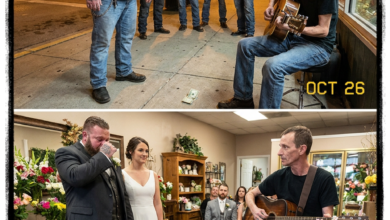
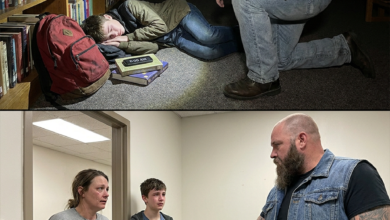
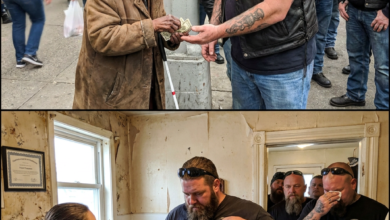
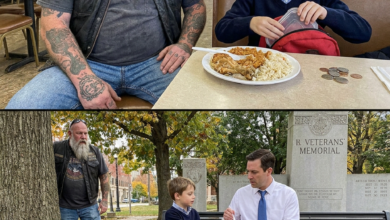
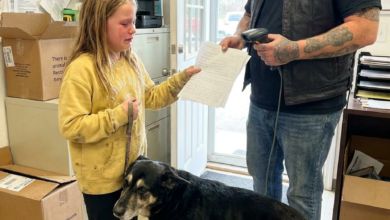
Police Stopped a Tattooed Biker for Following a Young Woman Across a Dark Parking Lot — Then His Still-Connected 911 Call Revealed Which Man He Had Actually Been Watching
Part 2 — What Hammer Saw in the Freezer Door
My shift at the pharmacy ended at nine that Tuesday night.
I had planned to drive home, eat cereal over the sink, and sleep. Instead, I stopped at Miller’s Market because my refrigerator contained mustard, half a lemon, and milk whose smell had become a legal warning.
The store occupied an old shopping center beside Route 66. One entrance had automatic doors. The other had been locked after eight because the business could not staff both sides.
I parked beneath the best light I could find.
That detail matters.
Women do not always announce every safety calculation we make. We choose the illuminated row, place keys where they can be reached, avoid parking beside vans, and check reflections without turning our heads.
Most nights, those calculations lead nowhere.
That night, a man noticed mine.
I saw him first near the pharmacy counter inside the grocery store. Mid-forties. Tan jacket. Gray cap. No cart.
He asked an employee where the restrooms were, though the sign hung above him. He looked toward my work badge, then toward my face.
I moved away.
By frozen foods, I had forgotten him.
That was when Hammer saw the reflection.
Ray Dawson had entered the store for coffee, oatmeal, and dog food. He did not own a dog. The bag was for a one-eyed cattle dog living behind his welding shop that refused to enter buildings but appeared every morning at six.
Hammer was fifty-six, six-foot-four, and nearly 285 pounds. His shaved head, heavy beard, tattooed arms, scarred knuckles, and plain black leather vest made him visible before he spoke.
He had spent years allowing that visibility to work for him.
Sometimes it cleared a crowded aisle. Sometimes it made men reconsider an argument. Sometimes it caused cashiers to watch his hands.
That night, being noticed became the tool he had available.
He saw Gray Cap raise a phone as I bent toward a freezer case. The man appeared to photograph a sale sign. The camera angle followed me.
Hammer did not act immediately.
That mattered too.
A single strange movement can have innocent explanations. Good intentions become dangerous when men turn suspicion into certainty and appoint themselves judge.
Hammer watched the freezer-door reflection.
I moved to the next aisle.
Gray Cap waited, then followed.
Hammer took out his phone and called the store.
He asked for security.
The assistant manager answered because the loss-prevention employee was dealing with a broken bottle near the front. Hammer gave the man’s description and asked whether someone could accompany me to my car.
The manager said he would look into it.
Hammer waited beside an endcap.
Gray Cap appeared again.
This time, he held his phone low and angled toward my legs. When I turned, he faced a display of cereal.
Hammer called 911.
His voice remained calm because his sister had trained it into him.
Ray’s younger sister, Mara Dawson, lived in Tucson and coordinated volunteers for a family-safety center. Years earlier, an ex-boyfriend had followed her to work, watched her apartment, and appeared outside places she had not told him about.
Ray responded badly.
He found the man.
He beat him behind a bar.
The assault placed Ray in jail and complicated Mara’s attempt to obtain legal protection. The ex-boyfriend’s lawyer used Ray’s violence to recast the situation as a conflict between aggressive families.
Mara remained the person at risk.
Ray became the story.
After his release, she did not thank him.
She said, “You protected your anger. You never asked what I needed.”
Ray carried those words longer than his sentence.
Their relationship took years to repair. Mara did not forgive him because he joined a motorcycle club charity ride or made one large apology. She gave him boundaries. He learned to keep them.
Eventually, she let him attend volunteer training.
He learned that stalking often looked ordinary in fragments. A person lingered. Adjusted pace. Reappeared. Tested whether anyone noticed. Used a phone as camouflage.
He also learned what not to do.
Do not touch the person you believe is in danger.
Do not insist she trust you.
Do not force confrontation.
Call trained help. Preserve information. Remain a witness.
Make options larger, not smaller.
In Miller’s Market, Hammer followed those rules as well as fear allowed.
He sent the manager a photograph showing the man’s jacket and cap. He did not photograph my face. He reported the black sedan after seeing Gray Cap unlock it, place something inside, then return to the entrance without driving away.
I reached checkout.
Gray Cap stood near a vending machine.
Hammer positioned himself at the edge of the seasonal aisle.
From where I stood, I could see Hammer.
I could not see the other man.
When the cashier handed me my receipt, Hammer told dispatch, “She’s leaving now.”
The dispatcher repeated the instruction not to confront anyone.
“I understand.”
“If you can remain inside, do that.”
Hammer looked toward the locked secondary exit and the unstaffed customer-service desk. The assistant manager was still searching the wrong aisle.
Gray Cap moved toward the doors.
Hammer made the decision that would put him against a police cruiser seven minutes later.
He walked outside.
Part 3 — Six Rows of Darkness
Cold wind hit me as the automatic doors closed.
The plastic handles of my grocery bags cut into my fingers. A cart rattled across the entrance and struck a curb. Music from the store speakers disappeared behind the glass.
I heard boots.
Slow.
Heavy.
Keeping time with mine.
I looked back and saw Hammer.
Inside the store, he had been a large stranger near checkout. Outside, beneath missing lights, he became every warning I had ever heard.
I changed direction toward a busier row.
He changed direction too.
What I did not see was Gray Cap emerging ten seconds later, walking along the building rather than directly behind me. He used parked SUVs to break my sightline.
Hammer saw him in the store window.
He moved diagonally, staying far enough back that he would not close the distance between us while placing himself inside the path the other man would have to use.
It was careful.
It was imperfect.
I was still afraid.
When I called 911, Hammer heard the first words.
“A man is following me.”
He knew I meant him.
The dispatch operator in his ear confirmed a second call had arrived. Hammer asked whether he should stop.
“Remain where you are. Keep your hands visible.”
He stopped beneath the broken light.
Gray Cap stopped too.
I continued toward my car.
The dispatcher asked whether I could return to the store. Doing so would have required crossing the lane between Hammer and me. I said no.
“Stay where the cameras can see you,” Hammer called.
The words sounded like an order.
Fear does not pause to examine intent.
I moved behind my Honda, placing metal between us.
Hammer stepped sideways, not closer. He wanted a clear view of the sedan.
Gray Cap moved from the passenger side toward the driver’s door. If he entered the car, he would have a direct path past my row.
Hammer gave dispatch the plate.
The first cruiser arrived.
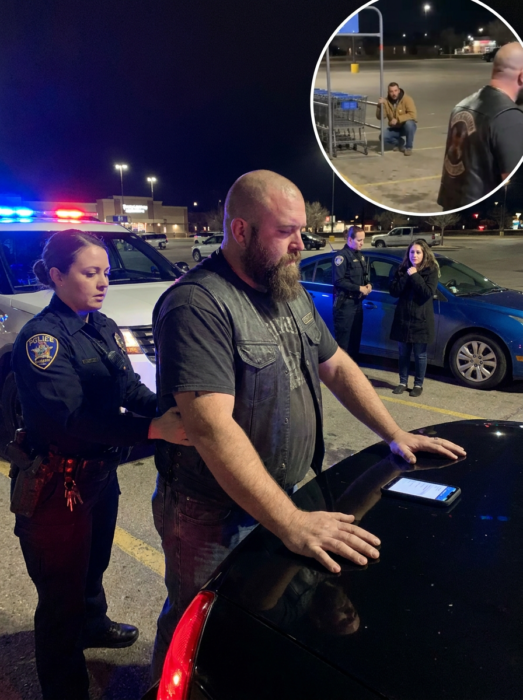
Officer Ortiz saw what I saw: a giant tattooed man in leather, on foot, behind a woman who had reported being followed.
She did what I had asked the police to do.
She stopped him.
Hammer raised his hands. He turned. He placed them against the hood.
Gray Cap began walking away.
“Black sedan,” Hammer said.
Officer Ortiz ordered him to look forward.
“He’s moving.”
Her partner followed the indicated direction.
For a few seconds, the wrong man was restrained while the right question ran across the lot.
I stood behind my car, unable to decide whether I should run toward the store or remain near the officers. The groceries slipped from one arm. A jar of pasta sauce struck the pavement but did not break.
Officer Ortiz searched Hammer.
His chain wallet clicked against the cruiser. Leather creaked. His skull ring rested on the hood beside his phone.
No weapon appeared.
No accusation escaped him.
The second officer intercepted Gray Cap near the service road. He did not tackle him. The man had not attacked anyone in front of them. The officer directed him to stop and began asking questions.
Store manager Carl Gaines hurried outside holding a tablet. He looked frightened that something had happened on business property and more frightened that people would say he had ignored a warning.
Hammer stayed against the cruiser.
“You called us?” Ortiz asked after seeing his phone.
“Yes.”
“Why were you walking behind her?”
“Because he wouldn’t close distance while I was visible.”
“You frightened her.”
“I know.”
The acknowledgment reached me through the wind.
Not she misunderstood.
Not she should have known.
I know.
Officer Ortiz asked whether I felt safe approaching the cruiser.
I said no.
She did not make me.
Instead, another officer moved between Hammer and me while Ortiz took my statement near the Honda. She asked what I had seen, what he had said, whether he had threatened me, and whether I knew the second man.
I answered carefully.
Hammer had not threatened me.
He had followed me.
Both things were true.
The assistant manager brought camera footage outside. On the first clip, Gray Cap appeared behind me near frozen foods. Hammer stood farther away.
Second clip: I turned into household supplies. Gray Cap waited, then entered. Hammer shifted to the aisle entrance.
Third clip: Gray Cap pointed his phone.
Fourth: Hammer spoke with the store manager.
Fifth: Hammer called 911.
The timeline did not erase my experience in the parking lot. It changed what his actions meant.
Officer Ortiz released his wrists.
Red marks circled them.
Hammer put on neither his ring nor his vest immediately. He kept both hands where I could see them.
“I’m sorry I scared you,” he said.
The apology made me angry.
“You don’t get to make this sound noble.”
“I’m not.”
“You could have told me.”
“I thought about it.”
“Then why didn’t you?”
He looked toward the other officers, ensuring Gray Cap remained occupied.
“Because you had one man watching you. Walking up would’ve given you two.”
It was not a perfect answer.
It was an honest one.
I asked why he had not stayed inside.
“Security lost him. Dispatch was coming. He moved when you did.”
“You decided for me.”
“Yes.”
That surprised him as soon as he said it.
Hammer corrected himself.
“I decided where I stood. I didn’t decide what you had to do.”
Officer Ortiz glanced at him.
Mara’s training was somewhere inside that correction.
The manager enlarged one frame from the exterior camera. Gray Cap stood behind a cart return, using the slats to watch my car.
Hammer occupied the open lane between us.
His body had been a barrier.
He had made himself easy for both men to see.
The police interviewed Gray Cap. The store issued a trespass notice based on its footage and policy violations. Officers documented my report and preserved the video for any related complaints.
There was no dramatic confession.
No evidence bag containing a map of my life.
No clean ending.
But when Ortiz asked whether other incidents had been reported, the manager admitted two employees had complained about a man lingering near closing time during the previous month.
The description was similar.
The ordinary details became a pattern.
That was when the story moved beyond what happened to me.
Part 4 — The Part the Viral Video Removed
A customer filmed Hammer against the police cruiser.
The clip lasted nineteen seconds.
It showed his leather vest, Officer Ortiz holding his arm, and me behind my car. It did not show Gray Cap. It did not include the earlier 911 call or store footage.
By morning, the video had spread through local social media.
BIKER CAUGHT FOLLOWING WOMAN AT NIGHT, one post claimed.
Another called him a predator.
A third recognized his club and found an old news report about the assault that sent him to prison.
The comments filled the missing facts with certainty.
The High Plains Riders wanted to respond.
Moose proposed bringing the entire club to Miller’s Market. Hector wanted to publish the security footage. Denny knew the customer who recorded the clip and intended to “explain things personally.”
Hammer stopped all three.
“No ride.”
“They’re calling you—”
“I saw.”
“We let that stand?”
Hammer folded the printed statement Officer Ortiz had given him.
“We don’t turn her parking lot into our clubhouse.”
That tested the club more than a broken motorcycle ever had.
Brotherhood liked action. Waiting felt like weakness. Hammer reminded them that sixty engines outside a grocery store would not correct a story about intimidation.
It would create another one.
Mara called him from Tucson after seeing the video.
“You want me to fix this?” she asked.
“No.”
“Good.”
Hammer sat on a stool inside his welding shop. The one-eyed cattle dog ate from a bowl near the door.
“I scared her,” he said.
“You probably did.”
“I kept the other guy back.”
“Both can be true.”
He looked at the purple fabric sewn inside his vest. It came from a scarf Mara wore during the worst months with her ex. She had given it to Ray only after he completed volunteer training.
Not as a medal.
As a reminder.
Notice. Ask. Do not take over.
Mara told him the incident needed to be reviewed, not romanticized. Had he maintained enough distance? Could he have asked a female employee to accompany me? Should he have used the store intercom, stayed inside, or given dispatch clearer information sooner?
Hammer wrote down every question.
Meanwhile, I went to work.
Customers recognized me from the clip even though my face was blurred poorly. One asked whether I planned to press charges against “the biker.” Another told me I should be grateful.
I disliked both reactions.
Gratitude was not the price of safety.
And fear was not proof of guilt.
Officer Ortiz called before noon. She explained the report, told me the preserved evidence would be available through the proper process, and asked whether I wanted a victim-services advocate to contact me.
I said yes.
The advocate did not tell me how to feel about Hammer. She helped me write down the event in order, identify what information I wanted shared, and understand which decisions belonged to me.
That afternoon, I requested a meeting with Hammer at the police station.
Not his clubhouse.
Not the store.
Neutral ground.
Mara joined by video. Officer Ortiz remained in the room. Hammer sat across from me without his leather vest.
He looked smaller.
Not harmless.
Human.
I told him what the parking lot had felt like: the boots behind me, his size, the words that sounded like an order, and the moment I believed the police had reached me seconds before something worse.
He listened.
He did not explain until I finished.
Then he said, “I should’ve told dispatch to get the store to call you back inside. I should’ve stayed farther to your left so you had a clear route to the doors.”
Mara added, “And you should not assume visibility always reads as safety.”
Hammer nodded.
Nobody transformed the meeting into forgiveness.
I asked why he followed rather than waiting for police.
“He moved when you moved,” Hammer said. “I thought if I stopped, he’d close the gap.”
“Would you do it again?”
He considered the question for a long time.
“I’d call sooner. Push harder for an employee escort. If I still had no better option, I’d stay visible. Farther back.”
It was not the polished answer of a hero.
That made me trust it more.
I decided to give a public statement.
My words were simple:
The biker in the video was not arrested for stalking me. He had called police before I did about another man. He frightened me, and he also helped maintain distance between that man and me. Both facts matter.
Local news corrected the story.
Some people apologized.
Others moved to a different argument.
Hammer did not read the comments.
He was at Miller’s Market with Mara and Officer Ortiz, walking the route from frozen foods to my Honda and marking every place where a safer system had failed before an individual tried to fill the gap.
Part 5 — What Protection Looked Like After the Parking Lot
Miller’s Market replaced the broken lamps within a week.
That should not have required a frightening incident.
The store also restored staffing at the customer-service desk until closing, trained supervisors to respond immediately to escort requests, and established a two-person walkout policy for employees leaving after dark.
The High Plains Riders offered money.
The store declined direct control but accepted a donation through a local safety nonprofit to install two additional exterior cameras.
Mara set the conditions.
No club branding.
No staged photographs.
No riders patrolling the lot.
Support the system. Do not become the system.
Several members disliked that phrase.
They wanted to do more.
Mara asked what “more” meant. Sitting in the parking lot watching women? Following strangers they considered suspicious? Deciding who belonged?
The men went quiet.
Good intentions without limits can reproduce the thing they claim to prevent: somebody else monitoring where a woman goes.
The club chose different work.
Members repaired exterior lighting at a women’s transitional-housing property after the organization requested help. They paid licensed contractors when electrical work exceeded their skills. They serviced vehicles belonging to advocates who traveled between rural counties.
Their motorcycles remained transportation.
Not credentials.
Hammer attended another bystander-training course. He sat in the back, removed his vest, and wrote notes with a carpenter’s pencil because regular pens felt too small in his hands.
The instructor presented scenarios.
A person appears followed inside a store.
A stranger waits near a vehicle.
Someone expresses fear of a partner.
Hammer learned five words he had not used enough in his life:
“What would help you right now?”
The question sounded simple.
It returned control.
My own recovery was uneven.
For several weeks, I avoided Miller’s Market. I shopped at noon across town, even when it meant losing sleep before an evening shift. I checked the rearview mirror repeatedly. Boots in a hallway accelerated my pulse.
People wanted the story to end when police arrived.
Bodies keep later schedules.
The advocate helped me develop practical choices without pretending fear could be erased by preparation. I changed what information appeared on my work badge. My employer adjusted how staff names were displayed. I told friends when I left late.
I also returned to the store.
The first time, Officer Ortiz offered to accompany me. I declined. My friend Jasmine came instead.
We bought groceries at 8:30 and requested a store escort to the car.
A nineteen-year-old employee named Luis walked with us. He wore a bright safety vest and talked nervously about a chemistry exam.
Nothing happened.
That ordinary trip mattered.
Near the cart return, I saw Hammer’s Harley.
He was inside buying dog food.
When he noticed me, he stopped at the end of the aisle. He did not approach.
I decided whether to close the distance.
I did.
“The dog yours yet?” I asked.
“No. He’s still negotiating.”
Hammer held up the bag.
We spoke for two minutes. No grand reunion. No public gratitude. Before leaving, I asked about the purple fabric inside his vest.
“My sister’s.”
“She okay?”
“She made a life.”
That answer protected her privacy better than the story he could have told.
At checkout, a cashier asked Hammer whether he wanted assistance carrying the dog food.
He looked at the fifty-pound bag, then at his own arms.
“I’ll risk it.”
I laughed before I could stop myself.
The sound surprised both of us.
Outside, he waited until my escort and I had reached my car before walking toward his motorcycle. This time, I knew why.
He still kept his distance.
Distance can be fear. It can also be respect. Context decides.
The man in the gray cap did not return to Miller’s Market. Police could not turn the incident into charges unsupported by evidence, and nobody pretended a trespass notice was a magical shield.
What existed was documentation.
The footage was preserved. Employees knew the description. My statement had a report number. Similar complaints from two workers were added for investigators to assess.
A pattern no longer lived only inside women’s unease.
It had entered the record.
That was quieter than revenge.
It was also more likely to matter later.
Part 6 — The Night Hammer Was Followed
Three months after the incident, Hammer left a diner at 10:15 p.m. and noticed headlights behind his Harley.
The vehicle stayed through three turns.
He changed lanes.
It changed too.
For a man of his size and history, the instinct to confront arrived quickly. His right hand tightened around the throttle. He imagined pulling into a gas station and walking straight toward the driver.
Then he heard Mara’s voice in memory.
Make options larger.
Hammer turned into a well-lit fire-station lot and called police.
The car continued past.
Maybe coincidence.
Maybe not.
He remained beneath the lights until an officer arrived.
When he told our safety group about it later, no one laughed. The experience had not made him understand women perfectly. One uncomfortable drive could not teach a lifetime.
It did teach him how quickly uncertainty occupied the body.
Mara visited Amarillo that spring and met me at a coffee shop. She was fifty-three, wore red glasses, and corrected anyone who introduced her only as Hammer’s sister.
“I have my own résumé,” she said.
We talked about Ray.
“He wants rules,” Mara said. “Rules make him feel he can prevent every bad thing.”
“Can he?”
“No.”
She stirred her coffee.
“But he can become less dangerous while trying to help.”
That sentence captured what social media could not.
Hammer was not secretly flawless beneath the leather. He had committed violence. He had mistaken control for protection. He carried shame without allowing shame to perform the work of repair.
His good choice in the parking lot did not erase his past.
His past did not make that choice meaningless.
Miller’s Market began quarterly safety walks with employees, police liaisons, advocates, and property management. I attended the first.
Hammer did not.
He had offered his observations, then stepped back when Mara said the people using the lot every night should lead the discussion.
Workers identified blind spots no outsider had noticed. Delivery drivers explained how parked trailers blocked views. A cashier requested a second break-area exit. The store changed closing procedures.
The solution did not have a beard or a motorcycle.
It had schedules, lights, training, accountability, and people listening to those most affected.
Hammer approved.
He said systems were harder to photograph but easier to trust.
Part 7 — The Space Between the Store and the Car
One year after the night police stopped Hammer, I finished another late pharmacy shift.
Rain glazed Route 66. The market windows reflected headlights across the dark. Every exterior lamp worked.
Inside, an older woman stood near customer service with two grocery bags and a folded umbrella. She asked whether someone could walk with her.
The employee did not act inconvenienced.
He called another worker, told the woman his name, and asked whether she preferred him to carry the bags or simply walk beside her.
She chose beside.
They crossed the lot together.
No biker followed them.
Nobody needed one.
I found Hammer near the coffee aisle holding two brands of dog treats.
“He moved into the shop,” he said before I asked.
“The dog?”
“Owns my office chair.”
“So negotiations ended.”
“I lost.”
The one-eyed cattle dog was now named Clutch. Hammer kept a bed for him beside the welding table and another beneath his desk because Clutch refused to recognize boundaries Hammer had paid money to establish.
We reached checkout.
Hammer set the treats on the belt. I placed cereal behind them.
The cashier recognized us but said nothing about the parking lot. After a year, that felt like a gift.
Outside, the rain had weakened.
Hammer’s black Harley waited beneath a light. My Honda sat three rows away. The distance between them resembled the original night, but my body no longer read every shadow the same way.
Not because danger had vanished.
Because I had choices.
“I’m good from here,” I said.
Hammer nodded.
He did not insist.
At my car, I looked back. He stood beside his motorcycle fastening his helmet. The leather vest carried no public symbol of what happened, only the hidden strip of purple fabric Mara had given him.
He started the engine.
The low V-twin rumble crossed the wet pavement. Hammer waited until I had entered my car, not because I needed permission to leave, but because traffic moved through the access lane behind me.
When the lane cleared, he raised one gloved hand.
I backed out.
He rode the other way.
Months later, someone asked whether Hammer had saved me.
I said the question was too clean.
He noticed a pattern, called for help, and used his visibility to interrupt it. He also frightened me. When I told him that, he listened without demanding that gratitude erase fear.
That was the part I remembered.
Not the handcuffs.
Not the viral video.
A huge man learning that protection was not standing closest, speaking loudest, or deciding everything himself.
Sometimes it was noticing.
Sometimes it was calling.
Sometimes it was becoming a barrier.
And sometimes it was knowing when to leave the space open.
Follow our page for more biker stories about frightening appearances, quiet choices, and the truths hidden beyond a single moment of judgment.