An Old Man Sold Photos of His Younger Self for Three Dollars Each — I Bought One and Found the Men Who Founded My Motorcycle Club
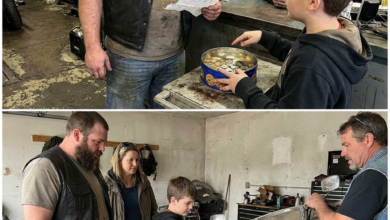
Frank arrived with two other brothers, Malik and Boone. Their engines rolled through the parking area and fell quiet by the market gate. I met them before they reached Walter’s stall and told them to take it slowly. Walter had stayed because he chose to. I didn’t want him surrounded by men demanding answers about a past he had spent thirty years avoiding.
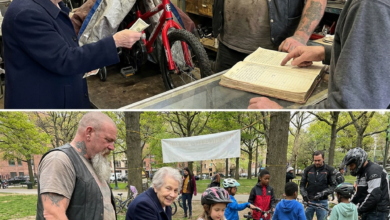
Frank is a big man too, though he speaks gently when he’s unsure of his ground. He greeted Walter, introduced himself, and asked permission to look at the photographs. Walter said yes. For several minutes we crouched beside the tarp and passed prints from one pair of hands to another, holding them by the edges. Frank recognized the brickwork of our garage. Malik found the window that had been covered over long before he joined. Boone stared at the men in the photographs and asked if any were still alive.
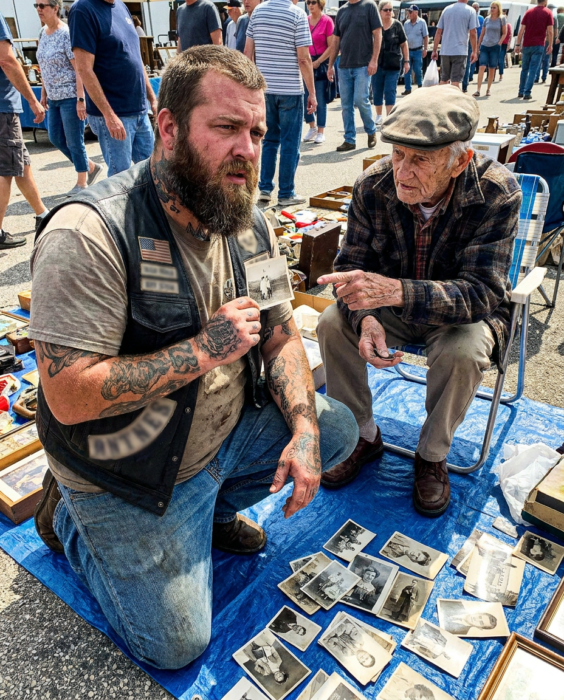
Walter said he didn’t think so. He gave us their first names, one by one, touching each face as he went. Charlie was the one who hated cameras. Luis had painted the white lines on the motorcycle tank. Pete had a sister who sometimes drove over with a pot of stew when the men had spent their grocery money on parts. Walter knew these things without pausing to search his memory. When he came to himself in the picture, he moved to the next man.
Our club kept records, but the earliest pages were thin. The seven men who started it had been young mechanics and riders with more time than money. Over the decades, members left, records moved between garages, and stories lost their names. We had two group photographs from those first days, pinned behind glass near the pool table. One had been copied from a damaged original. In the other, the faces were turned from the camera. I had looked at them hundreds of times and could not have named anyone.
Walter had laid out forty more for three dollars each.
I asked whether he minded if we bought the lot. He looked at the rows, then asked why. Frank told him we wanted to learn who was in them and show them to the club. Walter’s mouth tightened. He said people might have wanted to do that years ago. None of us could answer him. We hadn’t known he was out there, but ignorance did little to soften the years he was talking about.
“Pick the ones you like,” he said. “I haven’t decided on the rest.”
So we picked carefully. Frank bought a photograph of the seven men pushing a bike with a flat tire. Malik chose a close view of the garage door. Boone took one of Charlie making a face at the camera despite supposedly hating it. I asked Walter if he would tell us the story of the half-painted emblem. He said there was a wall at our clubhouse we should inspect. He would tell us more after he knew what was still there.
The market began to close. Walter stacked his unsold prints inside a cardboard portfolio, with sheets of thin paper between some of them. I noticed that he wrapped the pictures more carefully than he had displayed them. They mattered to him. Selling them had required something I could not yet measure.
I offered to carry the portfolio to his car. He had come by bus. We walked with him to the stop and stood off to one side while he waited. Before he boarded, Frank gave him a card with the clubhouse number and his own phone number. Walter turned it over, then tucked it into a pocket.
That evening we hung the photographs we had bought beside the two old copies. The brothers gathered around. A few called out guesses about the bikes. Nobody recognized the faces until I told them Walter had named each man. Frank wrote those names on separate cards and placed the cards beneath the pictures so no one would confuse a guess with what Walter had told us.
I went home with the print I’d bought tucked inside my jacket. My wife, Claire, found me looking at it on the kitchen table. She noticed Walter first. “That one has your expression when you’re trying to fix something with the wrong tool,” she said. I laughed, then told her what he had said at the bus stop.
Claire asked whether I thought he would come to the clubhouse. I said I didn’t know. I had seen him look at Frank’s card like it weighed more than paper. Before we turned in, I enlarged the photograph on my phone and studied the garage wall once more. Beneath the unfinished emblem was a short dark stroke. It might have been a mark on the print. It might have been the beginning of a number.
Walter called Frank three days later. He asked if the pictures were safe. Frank told him they were, and invited him to come see where we had put them. Walter said he would think about it. A week passed. Then he called again and asked what time the clubhouse was usually quiet.
Frank chose a Tuesday afternoon. Only he, Malik, and I would be there. We swept the floor, made coffee, and cleared a chair by the old photographs. I caught myself arranging the room as if Walter were an inspector coming to approve our work. Frank told me to leave the chair alone. Walter would sit where he liked.
He arrived by bus carrying the cardboard portfolio. From the gate he looked at the garage for a long time. A newer section had been added on the right, and the roofline was different. The old brickwork was still exposed along the back. Walter walked toward it with his hand trailing near, though he didn’t quite touch the wall.
Inside, he found the photographs by the pool table. He stood close enough to read every card Frank had made. He corrected the spelling of Luis’s last name and told us Pete’s full name. He didn’t complain that we’d had so little to work with. He asked who had framed the two older pictures and when they had first appeared. Frank could answer only the second question approximately.
For almost an hour, Walter talked about the early club. They met after their shifts at the garage, drank weak coffee, worked on bikes, and argued over whether they needed a name. Charlie wanted something grand. Luis suggested the valley where most of them lived. In the end, Iron Vale Riders was painted on the wall before anyone had ordered a patch. Walter said they had painted the emblem in stages because each man took a turn after work. That explained the photographs: a friend had come by with a camera on several evenings.
I asked if Walter had painted the first part. He smiled. “No. I held the ladder for Luis.”
Then he looked toward the back wall.
We followed him past shelves of tools and a stack of tires. Three layers of paint covered the brick there: the current pale gray, an older cream, and a dark green that showed where a shelf bracket had pulled loose. Walter counted steps from the rear door. He pointed above the workbench we had repaired.
“It’s underneath,” he said. “Unless somebody took the bricks out.”
He described the old emblem’s position so precisely that Malik fetched a tape measure. Walter was right about the distance from the door. Even so, we agreed to inspect the paint properly before removing anything. The wall belonged to the clubhouse, and the history beneath it deserved care.
After coffee, Frank asked Walter whether he had kept a patch. He meant an old photograph of one, I think. Walter reached into his wallet and drew out a small piece of worn cloth protected in a clear sleeve. On its reverse was a stitched number: 03. He held it flat in his palm so we could see the original colors. The shape matched the unfinished emblem in the photographs and the patch on our vests, though the later version had been redrawn.
Frank sat down. Malik stopped turning the tape measure in his hands. I stared at the number, then at Walter. He told us the patches had been numbered when the seven men ordered their first set. Charlie had 01. Luis had 02. Walter had 03.
He was one of the seven founders.
I asked why none of our records named him. Walter slid the patch back into its sleeve. Thirty years earlier, after the first generation had begun handing leadership to younger members, he and the club president argued about a decision at the garage. A friend needed space to work while he recovered from an injury. Walter wanted the club to keep a workbench available for him; the president wanted to rent that part of the building to cover bills. The argument grew. Other grievances came out. Walter accused the president of forgetting why they had formed the club. The president told Walter he no longer had the right to decide for everyone.
Walter left that night. He said things in anger that he regretted, and he had never come back to take them back. Later members knew a founder had gone, but heard little about him. As the years passed, even that much faded. Walter said he had let it happen. It was easier to say he was finished with the place than admit he missed it.
Frank listened without trying to settle the old argument. The people who had stood in that room thirty years before were gone. He could not tell Walter which version they would have given. He could tell him that the photographs belonged to the club’s history and that Walter belonged in them.
Walter looked down at his wallet. “I belonged once,” he said.
“You’re standing here now,” Frank replied.
Walter didn’t answer. He asked if the bus still stopped at the corner after four, and I drove him home instead.
Walter lived in a small apartment above a former tailor’s shop. I carried the portfolio up while he took the stairs one at a time. There were books beside his chair, a kettle on the stove, and a neat stack of unopened mail on the table. He set his keys down next to a pill organizer and thanked me for the ride. When he reached for the portfolio, his hand shook enough that I held it a moment longer.
He saw me notice. “Some days are better,” he said.
Over the next month I came by a few times with his permission. Sometimes we talked about bikes. Sometimes we said little and watched the traffic below his window. Walter had worked as a mechanic for most of his life. After he retired, his savings had grown thin. He was selling belongings to cover living costs and medication. The photographs were among the few things people at the market had asked about, though most shoppers offered less than three dollars.
When I told Frank, he wanted the club to help at once. Walter would not take a collection simply because we had discovered who he was. He said he had lived through leaner years. Frank asked what Walter would accept. Walter said he would accept an honest price for the photographs if the club truly wanted them.
We looked at each print, talked through its condition, and agreed on an amount for the collection that Walter considered fair. He kept the originals of two pictures showing friends outside the garage on a summer evening. The others went to the clubhouse, where Malik made protective sleeves for them before anyone tried to enlarge or display them. Walter signed and dated a short note identifying the people he remembered. When he was uncertain, he said so. We wrote that down too.
The money helped, but it did not solve the larger problem of living alone while his health worsened. Frank brought up the small room behind the clubhouse. Years earlier it had been used for visiting riders; by then it mostly held spare furniture. It had its own entrance and a bathroom, but it needed repairs before anyone could live there. We asked Walter whether he would consider it after seeing a plan. He said he might, provided he could shut his door whenever he wished and nobody treated him as a display piece.
That was fair. Boone repaired the plumbing. Malik arranged for the electrical work to be checked and completed. We cleared the furniture, painted the room, and made space for Walter’s books. A social worker helped him consider whether the room suited his needs and what care he might require later. Walter visited twice before he made a decision. On the second visit, he stood by the window facing the alley and said he would be able to hear when we opened the garage in the morning.
“I used to know who was here by the sound of the door,” he told me.
Meanwhile, we worked on the wall. A local conservator came to inspect the painted brick and advise us on exposing the older design without scraping it away. The first test area showed cream paint, then dark green. Beneath those layers came a sliver of black line and a patch of red. Walter stood beside the workbench while the conservator uncovered a little more.
He recognized Luis’s brushwork before the shape was complete. Luis had painted the curved edge too thick and corrected it with brick-colored paint. Walter pointed out the correction. When more of the emblem emerged, there it was: a slightly uneven band where Luis had made his change. Walter laughed quietly and put a hand against the clean brick below it.
We preserved the exposed painting in place. The rest of the wall stayed as it was, with the newer layers showing its years. Walter liked that. He said the club had changed around the old emblem and would keep changing. He wanted people to know which part was original, and he wanted them to see the work that had protected it by accident.
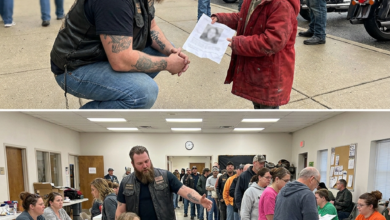
Frank called a meeting to discuss Walter’s place in the club. He did it while Walter was present, at Walter’s request. Some members had questions about the argument thirty years earlier. Walter answered what he could. He said he had been proud and had made leaving easier for others by refusing to return. Frank explained what we knew from the records, which was less than Walter remembered. Nobody had to pretend the disagreement had never happened.
Then the members voted to restore Walter as an honorary member. Frank offered him a current club patch; Walter asked to see it first. He turned it over, felt the stitching, and said it was good work. He chose to wear it on a plain dark vest. His original 03 patch remained in its sleeve. He told us it should eventually stay with the photographs, where people could understand what it was.
That evening he sat outside the garage while we worked. A younger rider named Ben brought him coffee and asked about the motorcycle with the white line painted on its tank. Walter began with Luis and the paintbrush he had used, then told Ben where the tank had come from. By the time I finished changing a tire, two more members had pulled up chairs.
Walter moved into the room behind the clubhouse in October. He arrived with three boxes of books, his kettle, a framed picture of his parents, and the two photographs he had kept. The club carried the boxes in, then left him to put things where he wanted. The first thing he hung was a small picture of the seven founders, taken on the day the emblem was finished. He placed it where he could see it from his chair.
We called the gallery we made from his photographs Room Zero. Walter supplied the name. He said a club’s story began before anybody thought to number its meetings or write down its rules. The room was a former storage space off the main garage. We cleaned it, repaired the lighting, and hung enlarged copies of the prints along the walls. The originals stayed protected. Each display carried the names Walter could verify, along with his recollections of when and where it had been taken. There were gaps. We left them visible.
I spent several evenings there with Walter as he dictated captions. He would pause over an image, looking for a name, then tell me a detail that brought the person near: Charlie’s habit of borrowing a rag and never returning it, Pete’s sister arriving with stew, Luis wiping paint from his hands onto the back of his work shirt. Walter did not remember every date. He remembered the sound of the garage when all seven motorcycles arrived close together.
Visitors came after the room opened. Former members brought their children. One woman recognized her grandfather in a print and returned the next week with a photograph from her own family album. Walter studied it at the table and found two men we had not been able to identify. We added their names after checking with her. The collection grew in small, careful ways.
Walter sat in Room Zero most afternoons. The younger riders learned to ask before recording his stories, and to let him stop when he was tired. He enjoyed explaining how a machine worked, but he also told them what happened when a part failed because someone had rushed the job. Ben became a regular visitor. He brought a notebook and wrote down instructions Walter insisted he ought to remember without one. Walter teased him, then asked to check the notes for mistakes.
We learned to make room for Walter’s quieter days. His medication schedule changed. Some mornings he stayed behind his door. At first, the brothers knocked because they were worried. Eventually we worked out a simple arrangement: he would let Frank or me know he was all right, and we would leave him to rest. He was a club member again, with people close by, and still entitled to his own hours.
Once, a reporter from a local paper asked to photograph Walter holding the 03 patch beside the restored wall. Walter declined. He agreed to talk about the photographs, but he wanted the patch displayed with the collection, not used as a prop in his hands. “People can come and look,” he said. The reporter wrote down the names of the seven founders and took a picture of the wall instead.
On the anniversary of the club’s first ride, we held an open day. Walter took Ben and June through Room Zero. June, nearly grown by then, asked why the seven men had started riding together. Walter thought about it. They had shared tools and a place to work, he said. When one had a breakdown, the others came out. The rides grew from being there for one another on ordinary days. He looked at me to see whether I thought that was enough of an answer.
It was.
After the visitors left, Walter and I sat by the garage door watching Frank sweep the floor. Walter said he had imagined coming back many times during the thirty years he was away. In his mind, there was always an argument waiting, with the same words ready to be thrown again. When he finally returned, he found a room full of people who didn’t know the old men well enough to repeat their fight.
“I should’ve called sooner,” he said.
I told him we might not have known what to say if he had. He nodded. We stayed until Frank finished sweeping, then helped him put away the chairs.
Walter lived behind the clubhouse for five years. In the first year he took the bus to the market once, mostly to see the vendors he knew. He came home with an old wrench he insisted was better than anything in our current tool cabinet. Frank disagreed. The argument lasted until Walter put the wrench in Frank’s hand and asked him to try it.
In the second year, Walter began teaching Saturday mornings in the garage. He didn’t call them lessons. He set a part on the workbench, asked a young rider what they thought was wrong, and waited. He could be impatient with guessing. He had more patience for someone who admitted they needed to look again.
By the third year, Room Zero had become the first place we took a new member after they received a patch. We showed them the uneven painted line on the back wall and the seven faces outside the garage. Walter often sat nearby. Sometimes he told a story. Sometimes he let us do it and corrected a name from his chair.
His health grew less steady in the fourth year. We arranged more help, following his wishes as far as we could. He spent fewer afternoons on his feet, but he still knew when Ben had brought a motorcycle in with a rough idle. He could hear it through the wall. Ben would come by afterward and tell him what he had found. Walter wanted the full answer, including what Ben had tried first.
In the fifth year, Walter asked Frank to move the original 03 patch from its sleeve into a small display case in Room Zero. He watched while we placed it beneath the photograph where his younger self held a wrench. Frank asked if he was certain. Walter said yes. He had carried it in his wallet for decades. It was time for other people to see it without asking him to take it out.
Walter died that winter. We held his memorial in the garage because that was the place he had chosen to make his home. Room Zero stayed open afterward. Ben came in early on some mornings to look at the captions he had helped Walter check. I found him there once, reading the note beneath a photograph of Luis correcting the emblem with brick-colored paint.
We took care of Walter’s personal things as he had directed. The patch remained in the case. His two favorite photographs went to Ellen, a distant relative he had named, and she gave us permission to keep copies in the room. His kettle stayed in the clubhouse kitchen. Frank made coffee in it once, declared it too small for the club, and put it back where Walter used to leave it.
Last spring I went to the antiques market for a replacement socket set. I passed the place where Walter had spread the blue tarp and stopped without planning to. Another seller had old lamps there. The aisle was busy. A father and daughter walked by carrying a wooden chair between them.
I remembered the first photograph in my hand, the three dollars Walter had asked for it, and how close I had come to bargaining. That print now hangs in Room Zero, enlarged so every rider can be seen. The original is stored safely. Beneath it are seven names, including Walter Reed. People still lean in to examine the unfinished emblem on the wall behind them.
I bought the socket set and rode back to the clubhouse. Ben was at the workbench with a young member who had joined the week before. They had a motorcycle part taken apart between them. Ben asked the new rider what he could see before offering an answer. I heard Walter in the pause that followed.
The young member noticed me by the door. I told him I would give them room, then pointed toward the back of the garage. Room Zero was open, and the light was on. When they finished, I said, Ben could show him the people who had first worked at that bench.
Follow this page for more biker stories about the people behind the patches, the places they built, and the memories worth carrying forward.