Part 2: A 280-Pound Biker Read the Same Bedtime Story to His Dead Daughter’s Empty Room for Eight Years — Until a Little Girl Next Door Asked Him to Read It for Her
PART 2 — EMILY’S ROOM
Walter’s daughter, Emily Harlan, died two weeks after her sixth birthday.
That was the basic fact most neighbors knew.
Facts are poor containers for grief.
They did not tell you that Emily had curly brown hair, a gap between her front teeth, and a habit of placing stickers on her father’s motorcycle helmet because she said black was “too serious for adventures.”
They did not tell you that Walter called her Button because, as a baby, she grabbed the buttons on his denim shirt whenever he tried to set her down.
They did not tell you that the same man people avoided at gas stations once wore a paper crown at a six-year-old’s tea party and allowed a stuffed rabbit to sit on his shoulder for twenty-three minutes.
Emily loved The Velveteen Rabbit.
Walter had read it so many times that the spine cracked and the corners softened. Emily believed the toy rabbit became real not because of magic, but because someone loved it long enough.
“That means love changes things,” she told him once.
Walter answered, “Then you better be careful who you love.”
Emily patted his beard.
“Too late. I love you.”
The cancer came quickly.
At first, the family thought it was fatigue from a virus. Then bruises appeared. Then tests. Then the hospital. Then words Walter and his wife Sarah never wanted to know.
Leukemia.
Treatment.
Counts.
Remission.
Relapse.
Hope became a room they entered and exited so many times they stopped trusting the door.
Emily remained herself through more pain than any child should endure. She named her IV pole Sir Rollington. She asked nurses whether their shoes were comfortable. She made Walter promise that if she fell asleep before the end of the rabbit book, he would finish it anyway because “stories get lonely if you leave them.”
He promised.
On the last night, he tried to read.
His voice failed halfway through.
Emily reached toward him.
“Daddy, you sound broken.”
He pressed her hand against his cheek.
“I’m okay.”
“No, you’re not.”
She closed her eyes.
“You can finish later.”
He did not.
For two years after Emily died, Walter could not enter her bedroom.
Sarah wanted to pack it slowly, carefully, with ceremony. Walter refused. Then he refused to discuss it. Then silence grew between them like furniture neither could move around.
Grief did not make them cruel.
It made them incompatible.
Sarah needed motion.
Walter needed the room to remain exactly as it had been, because part of him believed that if nothing changed, then perhaps the world had not fully taken her.
Their marriage ended in the third year after Emily’s funeral.
Sarah moved to Oregon to live near her sister. She took photographs, medical folders, and a few keepsakes. Walter stayed in the house with the closed bedroom door.
For months after the divorce, he slept on the couch.
Then, on a February night, he stood in the hallway and touched Emily’s doorknob.
He opened the door.
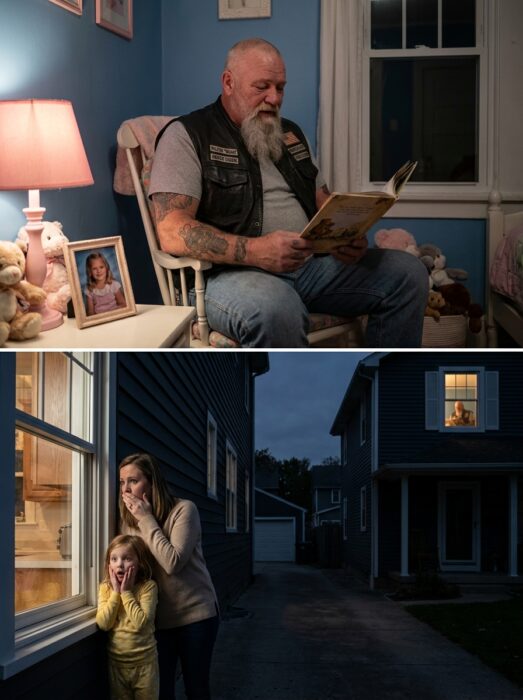
Dust had gathered on the dresser. Stuffed animals sat in careful rows. A pink lamp stood beside the bed. The book lay where Sarah had placed it years before, on the small white nightstand.
Walter sat on the floor because he could not bring himself to sit on the bed.
He opened the book.
The first sentence nearly destroyed him.
He read one page.
Then two.
His voice sounded strange in the room, too large for the walls.
When he finished, he said, “Goodnight, Button.”
The next night, he returned.
Then the next.
It did not begin as a ritual.
It began as an apology.
He had not finished the story when Emily asked him to finish later. So he finished it. Then he finished it again. Then one night became a week, a week became a year, and a year became eight years of bedtime stories spoken into an empty room.
People called Walter lonely.
That was true but incomplete.
Loneliness is not always the absence of people.
Sometimes it is the presence of one voice you can no longer hear answering yours.
PART 3 — THE GIRL NEXT DOOR
The first time Walter read to Grace inside our house, he stood near the living-room doorway as though entering a church.
Grace had arranged her stuffed animals in a semicircle. She wore yellow pajamas, had one missing front tooth, and had drawn a sign in crayon that read, “Story Man Chair.”
Walter stared at the sign.
“Did she make that?”
Grace nodded proudly.
“It’s for you. But if you don’t like chairs, you can read on the floor.”
Walter looked at me, and for the first time I saw fear in a man that large.
Not fear of danger.
Fear of tenderness.
I placed the old rocking chair near Grace’s bed.
“You can stop anytime,” I told him.
He nodded.
He sat.
The chair creaked beneath him.
Grace crawled under her quilt and held her stuffed fox against her chest.
Walter opened the book.
His hands trembled.
Grace noticed.
“Are you scared?”
Walter looked down at the page.
“A little.”
“Of the rabbit?”
“No.”
“Of me?”
He swallowed.
“No, ma’am.”
“Then you can read.”
So he did.
At first, his voice was careful to the point of pain. He read as though one wrong word might summon something too heavy to survive. Then Grace yawned, rolled onto her side, and began listening with the calm trust of a child who had no idea she was holding open a door.
When he finished, she did not clap.
She did not thank him the way adults teach children to thank guests.
She asked the question that changed everything.
“Who do you read to in your house?”
Walter closed the book.
I almost stepped in.
He answered before I could.
“A little girl like you.”
“Where is she?”
His eyes remained on the cover.
“She’s not here anymore.”
Grace thought for thirty full seconds.
Children give silence differently than adults. They do not rush to repair what they do not understand.
Finally, she said, “Then you can read to me now.”
Walter’s face crumpled.
Grace added, “Every night, if you want.”
I expected him to refuse.
He did not.
He only said, “I don’t know if I remember how.”
Grace lifted the stuffed fox.
“You just did.”
That was how Walter became part of our bedtime.
At first, he came once a week.
Then three nights.
Then every night except Sundays, because he said Sundays belonged to laundry and oil changes. Grace argued that rabbits also needed Sundays. Walter compromised by reading earlier.
He never replaced anyone.
That mattered.
He did not become Emily’s father again through Grace. He became something new because Grace allowed him to exist beside his loss instead of inside it.
After a month, Grace stopped calling him Story Man.
She called him Mr. Bear.
After six months, she called him Grandpa Bear by accident.
Walter froze so completely that I thought she had hurt him.
Grace covered her mouth.
“Sorry.”
Walter looked at her for a long moment.
Then he said, “I’ve been called worse.”
She smiled.
He came back the next night.
PART 4 — THE HOUSE THAT LEARNED TO BREATHE AGAIN
Walter changed slowly.
At first, he still returned to Emily’s room after reading to Grace. He read one chapter there, then walked across the yard to read another in our house, as though loyalty required both rooms to receive equal devotion.
One evening, Grace asked whether Emily could share.
Walter looked confused.
“Share what?”
“The story.”
“She already has it.”
“No. I mean, can we hear it together?”
Walter did not answer.
The following Friday, he invited us next door.
I hesitated, worried that entering Emily’s room would be too intimate, too sacred, too dangerous.
Walter opened the front door before I finished deciding.
The house smelled faintly of coffee, leather, and old wood polish. Emily’s bedroom stood at the end of the hall, yellow lamp glowing exactly as it had each night across the driveway.
Grace walked in first.
She did not touch anything.
Some children understand holiness without being taught.
The room was preserved but not frozen. Walter had dusted. The bedspread was clean. Stuffed animals watched from the pillows. Stickers still covered the motorcycle helmet resting on a shelf.
Grace approached the bed.
“Was this hers?”
“Yes.”
“Did she like the rabbit best?”
“Yes.”
Grace placed her stuffed fox beside Emily’s old rabbit.
“Now they can listen together.”
Walter turned away.
I pretended not to see him wipe his eyes.
That night, he read from the chair beside Emily’s bed while Grace sat on the floor with her knees tucked beneath her. I sat in the hallway because the room seemed too full for another adult.
When Walter finished, Grace said, “Goodnight, Emily.”
The name did not break the room.
It softened it.
After that, Walter stopped treating Emily’s bedroom like a sealed museum. He did not pack it away, but he opened the curtains more often. He repaired the loose drawer. He allowed Grace to sit on the rug and draw.
One drawing showed two girls holding hands with a giant rabbit between them.
Walter pinned it to the wall.
Sarah, his ex-wife, visited the following spring after hearing from a neighbor that Walter was reading to a child next door.
I expected tension.
Instead, Sarah stood in Emily’s doorway and cried quietly.
“She would have liked this,” she said.
Walter nodded.
“I didn’t know how to let anyone in.”
Sarah touched the book on the nightstand.
“Neither did I.”
They did not remarry.
Life is not required to undo every separation to prove healing happened.
They shared coffee that afternoon. They spoke about Emily without lowering their voices. Sarah met Grace, who showed her the drawing and explained that Emily’s rabbit and her fox were friends now.
Sarah hugged Walter before leaving.
It was the first time I had seen anyone touch him without him flinching.
PART 5 — SEVEN YEARS OF BEDTIME
Walter read to Grace every night for seven years.
Not always The Velveteen Rabbit.
Children grow, and stories must grow with them. He read fairy tales, adventure books, horse books, mystery novels, and eventually the first chapters of books Grace claimed were “too old for Mom to do voices properly.”
Walter did not do voices.
He read with the steady gravity of a man who believed stories deserved respect.
Grace loved it.
At eight, she insisted he attend her school’s Grandparents Day. Walter wore his leather vest over a clean blue shirt and sat between a retired dentist and a grandmother who knitted through the entire program.
A boy asked Grace why her grandfather had tattoos.
Grace answered, “Because he has a lot of stories and ran out of paper.”
Walter heard.
He laughed so hard the teacher looked over.
At ten, Grace had a nightmare and crossed the yard barefoot before I woke. I panicked until I found her asleep on Walter’s couch beneath an old quilt, while he sat in the recliner reading softly from a book of myths.
He looked embarrassed.
“She knocked.”
“She should not have.”
“She was scared.”
I wanted to argue.
Then I remembered how many nights his voice had crossed into our house before either of us had been brave enough to knock back.
At twelve, Grace announced she was too old for nightly bedtime stories.
Walter nodded as if he had expected the day.
“That so?”
“Yes.”
“Reasonable.”
She looked relieved.
Then disappointed.
He closed the book.
“You still want Thursdays?”
Her face brightened.
“Thursdays and maybe Sundays.”
“Rabbits get Sundays?”
“Exactly.”
So the nightly ritual became weekly dinner.
Walter taught Grace to change a tire, check oil, sand wood, and make pancakes shaped vaguely like animals. She taught him how to use video calls, though he kept answering them like police interrogations.
At fifteen, Grace called him after her first heartbreak.
He listened without telling her the boy was foolish, though later he spent an suspicious amount of time polishing his motorcycle near the sidewalk when the boy passed our house.
At sixteen, she asked about Emily directly.
“Do you ever feel guilty for loving me?”
Walter looked at the kitchen table.
“Yes.”
Grace’s face fell.
He continued, “But guilt is not always telling the truth.”
“What does the truth say?”
“That love is not a chair only one person can sit in.”
Grace repeated that sentence later in college essays, scholarship interviews, and eventually at his funeral.
PART 6 — THE LAST THURSDAY
Walter died at seventy-five.
It was not sudden, exactly, but it still felt like a door closing too fast.
His heart had been weakening for years. He ignored symptoms until ignoring became impossible, which is common among men who can rebuild engines but pretend bodies operate on stubbornness.
In the final months, Grace visited every week.
She was seventeen then, tall, brown-haired, bright-eyed, and almost grown in the way that makes mothers ache. She still called him Grandpa Bear.
One Thursday, Walter asked her to read instead.
She sat in Emily’s old room, now less shrine than sanctuary. The pink lamp still glowed. The old stuffed rabbit sat beside Grace’s fox, both worn in different ways by different kinds of love.
Grace opened The Velveteen Rabbit.
Her voice shook.
Walter lay in the recliner, thinner than he had once been, beard white, leather vest folded across his lap.
“Don’t read sad,” he said.
“I’m not.”
“You are.”
“You read sad for years.”
“Professional privilege.”
She smiled through tears.
That was the last time they read together.
Walter died nine days later in his sleep.
His funeral filled the small chapel beyond capacity. Bikers came from three counties. Former customers from his mechanic days arrived. Sarah flew in from Oregon. Mrs. Whitaker sat in the second row with tissues clutched in both hands.
Grace carried the book.
I thought she would place it beside his casket.
Instead, she walked to the front when the pastor invited memories.
She stood there in a black dress, seventeen years old, holding the same book Walter had carried into our house when she was five.
“My grandfather was not my grandfather by blood,” she began. “He became my grandfather because grief left a window open.”
People shifted softly in the pews.
She continued:
“When I was little, I heard him reading through that window. I did not know he was reading to an empty room. I only knew his voice made the dark feel safe.”
Walter’s biker brothers bowed their heads.
“He read to his daughter Emily first. Then he read to her room after she died. Then he read to me. For seven years, he gave me bedtime stories. For five more, he gave me Thursdays. He taught me that love does not replace anyone. It makes room.”
Grace opened the book.
She did not read the whole thing.
Only a small section near the beginning, enough for everyone to recognize the story without feeling she was performing grief for them. Her voice became steadier as she read.
Then she closed it and placed one hand on the casket.
“Grandpa Bear,” she said, “you read to me for seven years. Tonight, I read back to you.”
The chapel was silent.
“I think you and Emily are together now. And I think you can read to her directly again.”
Sarah covered her face.
A biker in the back began sobbing.
Grace touched the worn cover.
“But I hope sometimes you still leave the window open.”
PART 7 — THE WINDOW
After Walter’s funeral, Sarah asked Grace to keep the book.
Grace refused at first.
“It belongs to Emily.”
Sarah placed it in her hands.
“And to Walter. And to you.”
So Grace kept it.
The house next door was eventually sold, but before that happened, Grace and I helped Sarah pack Emily’s room.
Not empty it.
Pack it.
There is a difference.
Stuffed animals went into labeled boxes. The lamp went to Grace. The sticker-covered helmet went to Sarah. The bedframe was donated to a family rebuilding after a fire.
The room changed because rooms are meant for the living.
But not everything left.
Grace taped one small note to the inside of the closet door before we closed it for the last time.
Thank you for sharing your dad.
Years later, Grace still reads the book on the anniversary of Walter’s death. Not always aloud. Sometimes only a page. Sometimes only the title.
She became a pediatric nurse, which surprised no one who knew her. She says Walter taught her that tenderness can come from unlikely places and that pain does not always make people colder.
Sometimes it makes them careful.
Sometimes it teaches a 280-pound biker how to hold a children’s book like glass.
Sometimes it carries a voice through an open window to a little girl who needs a safe way to fall asleep.
I often think about those first three months when we listened without permission.
I still feel guilty.
But I also think grief is not always locked behind doors as tightly as we imagine. Sometimes it leaks out because part of it wants to be found. Sometimes sorrow becomes a sound traveling across a driveway, waiting for someone brave enough to knock.
Walter spent eight years reading to an empty room.
That sentence sounds tragic until you understand the whole truth.
The room was not empty to him.
It held a promise he had failed to finish on the last night of his daughter’s life. It held a rabbit book, a pink lamp, a stickered helmet, and a love so stubborn that even death could not make it stop showing up at bedtime.
Then Grace entered the story.
Not to replace Emily.
Not to rescue Walter.
A child should never carry an adult’s grief as a responsibility.
Grace simply listened.
Then she asked.
Then she made room.
Walter once told me, near the end, that he had spent years believing love ended in a closed room.
“What changed?” I asked.
He looked through the kitchen window toward our house.
“A little girl asked me to bring the book next door.”
That was all.
But perhaps that is how many lives begin again.
Not with a grand miracle.
With a neighbor hearing a voice.
A child asking a question.
A man opening a door he once thought had nothing left behind it but loss.
And a bedtime story finding one more person who needed to hear that love, when it is real enough, changes everything it touches.
Follow the page for more unforgettable biker stories about rough-looking strangers, hidden grief, and the quiet moments when a broken heart finds a new reason to keep reading.