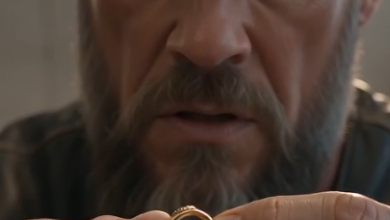
Part 2: A 58-Year-Old Biker Blocked A Hospital Elevator And Refused To Let Doctors Take An Elderly Woman To Surgery — Until One Voice Recording Explained Why He Wouldn’t Move
Part 2
Before that morning, I would have described Raymond Keller the way hospitals often describe men like him when they appear without explanation: visitor, male, late fifties, biker vest, heavily tattooed, uncooperative in hallway.
That description would have been accurate.
It would also have been wrong.
Hospitals are places where everyone is trained to reduce chaos into categories. Stable. Unstable. Consenting. Noncompliant. Alert. Confused. Combative. Family present. Family not present. Those words help us move quickly when seconds matter, but they can also flatten a human being into a problem to be solved.
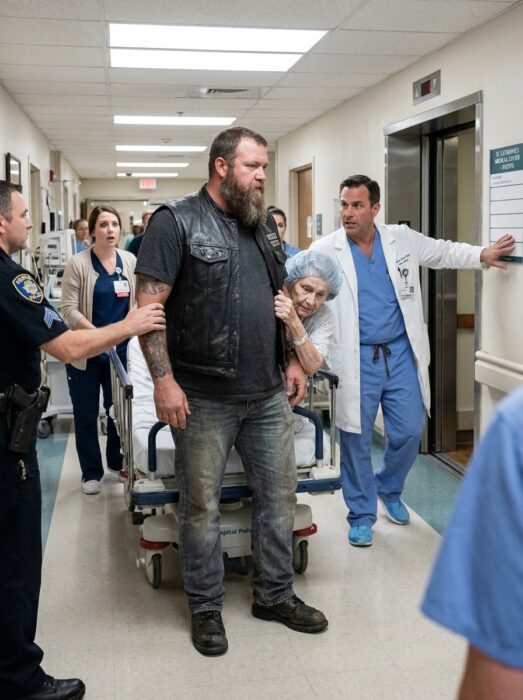
Raymond looked like a problem.
Evelyn Hart looked like a patient delaying surgery.
Neither was that simple.
Mrs. Hart had once been a school librarian in Topeka, Kansas, the kind of woman who remembered every child’s favorite series and quietly paid overdue fees from her own purse so embarrassed students could keep borrowing books. Her daughter, Melissa, told me later that Evelyn had loved crossword puzzles, lemon cookies, blue cardigans, and calling people “honey” before she knew whether they deserved it.
Dementia had stolen pieces, not all of her.
That is what people misunderstand.
There were still mornings when Evelyn could tell stories from 1968 in perfect detail. There were afternoons when she knew Melissa’s face but not her name. There were nights when she packed imaginary lunches for children who had grown up forty years earlier. Under calm conditions, she could be reassured with patience, familiar objects, and her daughter’s voice. Under fear, pain, and fluorescent lights, her mind could run backward into terror.
Raymond understood that because of his mother.
Her name had been June Keller, and she had been sharp enough to run a roadside diner by herself until seventy-four. She raised Raymond alone after his father disappeared somewhere between bills and bad habits. She had known every trucker’s order, every local kid’s trouble, and every hiding place Raymond used when he came home angry from school.
Then dementia came.
At first, Raymond thought she was just forgetful. Burned toast. Lost keys. Repeated stories. Then she began getting frightened by mirrors. Then she forgot Raymond was her son and thought he was a man coming to collect rent. Later, in the hospital after a fall, she screamed when nurses tried to take her for a scan because she believed she was being moved to the place her own mother had died.
Raymond had not known what to do then.
He had tried logic. It failed.
He had tried strength. It made her worse.
Then a hospice nurse taught him something he never forgot.
Don’t argue with the fear. Give it something familiar to hold.
So Raymond recorded his own voice for his mother, then later recorded his sister’s voice, old songs, tiny messages, anything that could reach her when explanations could not. “Mom, it’s Ray. You’re safe. I’m right here.” Sometimes it worked. Sometimes it did not. But when it worked, it worked faster than medicine, because the frightened part of her did not need information.
It needed belonging.
June died three years before Raymond blocked that elevator.
But caregiving had rewired him.
That is why Evelyn’s hand on his vest stopped him so completely. She was not his mother. She was not his responsibility in any legal sense. He did not know her favorite foods, her daughter’s phone number, or the details of her surgical risk. But he knew that grip. He knew the silent crying. He knew the sentence underneath “Don’t let them take me.”
It meant: I am somewhere terrible, and nobody familiar can find me.
In that hallway, Raymond did not see a confused old woman causing delay.
He saw a terrified person being moved faster than her mind could survive.
That was why thirty seconds mattered.
Not to stop the operation.
To help her enter it without believing she was being abandoned.
Part 3
The false climax came when hospital police arrived.
There are moments in a hospital when everybody’s role hardens at once. The surgeon becomes the clock. The nurse becomes the coordinator. Security becomes the boundary. Police become the final warning. The patient, if we are not careful, becomes the object being moved through all of it.
Mrs. Hart was crying silently by then, which frightened me more than shouting would have.
Her hands were locked into Raymond’s vest, fingers twisted in the leather near a faded patch. Her knuckles looked almost translucent. Her eyes did not recognize the hallway anymore. She kept whispering, “Please, please, not where she went,” and every time transport tried to roll the bed an inch, her whole body stiffened under the blanket.
Dr. Patel checked his watch.
He was not a cold man. I need to say that clearly. He was one of the good surgeons, careful with families, patient with questions, known for kneeling beside elderly patients instead of talking over them. But that morning, he was also responsible for a woman whose condition could worsen quickly without surgery. Compassion did not pause the obstruction inside her body.
“Mr. Keller,” he said, using the name Raymond had given security, “I understand you’re trying to help, but we need to move.”
Raymond nodded.
“I know.”
“Then step back.”
“Let her hear her daughter first.”
“Her daughter isn’t here.”
Raymond held up his phone. “She is if someone recorded her.”
That was when I realized he had already asked one of the aides to call Melissa while the hallway was escalating. In the two or three minutes when the rest of us saw resistance, Raymond had been trying to create familiarity.
The hospital officer, a Black American man in his forties named Officer Grant, kept one hand on Raymond’s arm.
“Sir, I’m asking you one last time.”
Raymond looked at him.
“You ever take care of someone with dementia?”
Officer Grant’s expression shifted.
“My grandmother.”
“Then you know.”
That landed.
Not enough to end the standoff, but enough to slow the force gathering around him. Officer Grant did not remove his hand, but he stopped tightening it. Dr. Patel looked at me, and I looked at the bed. Mrs. Hart was still clinging to Raymond, still lost somewhere none of our clinical explanations could reach.
Then Raymond spoke to her.
Not loudly.
Not sweetly.
Just steadily.
“Evelyn, I’m not going to pull you. I’m not going to leave until your daughter talks to you.”
She looked at him like she wanted to believe the sentence but did not know where to put it.
My phone rang at the nurses’ station.
It was Melissa.
I grabbed it, put it on speaker, and explained too quickly. Her mother was frightened. Transport was delayed. Did she have anything she could say? A familiar phrase? A message?
Melissa began crying.
Then she said, “Put me on.”
The line crackled.
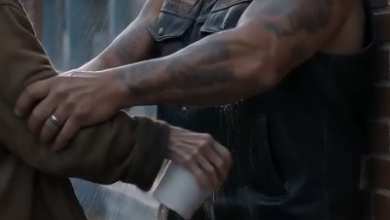
Raymond moved his phone closer because the hospital speaker was too far and the hallway too full of noise. He turned the volume all the way up and held it beside Mrs. Hart’s ear, his tattooed hand gentle under the plastic rail.
Melissa’s voice came through.
“Mom? Mama, it’s me.”
Mrs. Hart stopped whispering.
The whole hallway stopped with her.
Melissa sobbed once, then steadied herself.
“Mama, I’m here. You’re at St. Catherine’s. Dr. Patel is helping your belly stop hurting. I’ll be there when you wake up. You’re not going where Aunt Ruth went. You’re coming back to me.”
Mrs. Hart blinked.
Her fingers loosened slightly.
Melissa kept talking, voice shaking but familiar.
“Remember what you always told me? Brave girls can be scared and still go.”
Tears ran down Mrs. Hart’s temples into her hair.
After thirty seconds, she released Raymond’s vest.
Not completely at first.
One finger.
Then another.
Then her whole hand.
She looked at him, still afraid but no longer lost.
“My daughter is coming?”
Raymond nodded.
“She said she’ll be there when you wake up.”
Mrs. Hart breathed out.
“Okay,” she whispered.
Dr. Patel looked down.
Officer Grant let go of Raymond’s arm.
And the elevator doors opened.
Part 4
The surgery took three hours and sixteen minutes.
I know because I watched the clock more than I needed to.
Melissa arrived twelve minutes after the elevator closed, hair half pinned, parking ticket still in her hand, face pale with panic. She had moved her car because the hospital entrance was blocked, thinking she had time to get upstairs before transport. She did not know her mother would become frightened so quickly. She did not know a stranger in leather would become the temporary bridge between terror and trust.
When I told her what happened, she started crying before I finished.
“Who was he?”
I looked down the hall.
Raymond had not left.
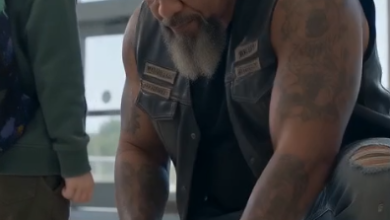
He was sitting on a bench near the surgical waiting room, elbows on knees, hands folded, leather vest hanging open. Without the standoff around him, he looked older. Not weaker, exactly. Just more tired. Like the hallway had borrowed something from him and not returned it.
Melissa walked over to him.
For a second, he seemed unsure whether to stand.
She hugged him before he could decide.
He froze, then slowly patted her back with one hand, awkward as a man accepting thanks he did not feel entitled to.
“I’m sorry,” she said.
Raymond looked confused.
“For what?”
“For not being there.”
His face tightened.
“No, ma’am. Don’t do that to yourself.”
She pulled back.
“I should have known she’d panic.”
“You can’t predict every door her mind opens.”
That sentence stopped her.
Caregivers recognize other caregivers by the shape of their mercy. Raymond did not offer the useless kind of comfort that says everything is fine. He offered the earned kind, the kind that knows guilt will try to sit in every empty chair unless someone tells it no.
Melissa sat beside him.
He told her, briefly, about his mother.
Not the whole story. Men like Raymond often offer grief in pieces small enough to survive being spoken. He told her about recordings. Familiar phrases. How his mother once stopped screaming during a hospital scan because Raymond played an old voicemail from his sister telling her that supper was on the stove. He told her that dementia does not always understand safety, but it often understands love before it understands words.
Melissa listened like a drowning person being handed instructions for breathing.
When Dr. Patel came out after surgery, his mask hanging around his neck, both of them stood.
The procedure had gone as well as possible. Mrs. Hart was stable. Recovery would take time. They would bring Melissa back when her mother was awake enough.
Dr. Patel then turned to Raymond.
He was quiet for a moment.
“I owe you an apology.”
Raymond shook his head immediately.
“No, you don’t.”
“Yes,” Dr. Patel said. “I do. I saw obstruction. I saw delay. I did not see fear clearly enough.”
Raymond looked uncomfortable.
“Doctor, you were trying to save her life.”
“And you were trying to preserve the part of her that knew why it was worth saving.”
That was the line that stayed with all of us.
After that day, St. Catherine’s changed a small thing.
Not a policy overhaul. Not a press release. Just a practical change born from a hallway we almost handled wrong. For patients with dementia or known cognitive impairment, pre-op checklists began including a “comfort voice” plan whenever possible: a family recording, a familiar phrase, a favorite song, or a short reassurance message ready before transport.
Thirty seconds.
Sometimes that is all dignity needs.
Part 5
Mrs. Hart woke up asking for Melissa.
That mattered.
She did not remember the hallway clearly, not in the way the rest of us did. She remembered fear, an elevator, a man with a beard, and her daughter’s voice telling her she was coming back. In recovery, when Melissa held her hand, Mrs. Hart whispered, “The motorcycle man helped me.”
Melissa laughed through tears.
“Yes, Mama. He did.”
Raymond visited once before leaving the hospital, though he stood at the doorway until Melissa waved him in. Mrs. Hart was pale, groggy, and tucked under warmed blankets. She looked at his leather vest and frowned slightly.
“Do I know you?”
Raymond smiled.
“Only a little.”
“You have kind eyes.”
That embarrassed him more than any insult would have.
He looked down at his boots.
“My mother would’ve liked you.”
Mrs. Hart nodded as if that made perfect sense.
“Was she bossy?”
“Very.”
“Good women are.”
Melissa laughed, and the room loosened.
Raymond did not stay long. He never did, according to people who knew him. He helped, then left before gratitude could become too bright. But before he walked out, Mrs. Hart reached toward him with one thin hand. This time, she did not grip his vest in fear. She touched his tattooed knuckles lightly.
“Thank you for waiting,” she said.
Raymond’s jaw moved once.
“Yes, ma’am.”
Then he left.
For weeks after, nurses told the story in break rooms, always starting with the wrong version. Remember the biker who blocked the elevator? Then someone would correct the ending. No, remember the biker who knew what we forgot? Dr. Patel began asking families for short recordings before high-stress procedures. Officer Grant used the phrase “comfort voice” with his own grandmother during a hospital admission two months later.
And me?
I changed how I saw hands.
A confused patient grabbing someone’s sleeve was no longer only a safety issue to manage. Sometimes it was a person searching for an anchor. A rough-looking stranger was not automatically a threat. Sometimes he was the only one in the hallway who had already lived the lesson everyone else was about to learn.
Three months later, Melissa returned to the hospital with a small envelope for Raymond. She did not know how to find him, but she remembered he had been visiting a veteran friend, and our volunteer coordinator eventually tracked him through the cardiac floor guest log.
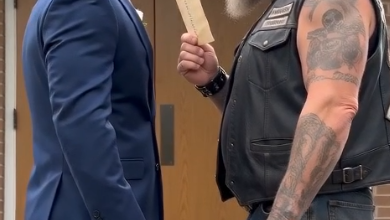
Inside the envelope was a photo of Mrs. Hart at home, sitting in a recliner with a blanket over her knees and a small smile on her face. On the back, Melissa had written:
Thirty seconds gave my mother back her courage. Thank you for knowing.
Raymond carried that photo in the inside pocket of his leather vest.
Right beside the last voicemail from his mother.
Part 6
Raymond came back to St. Catherine’s many times after that, but not as a visitor only.
At first, it was informal. A nurse would call him if she saw him in the building and ask if he could talk to a family struggling with a dementia patient. Then Dr. Patel asked whether Raymond would speak at a staff training, which made him look physically ill. He hated microphones. He hated being introduced. He hated when people clapped before they had heard anything worth clapping for.
But he came.
He stood in a conference room wearing his black leather vest while nurses, residents, aides, and transport staff sat with notepads and paper coffee cups. On the screen behind him was a slide titled Dementia-Aware Patient Movement, which he refused to read because he said it sounded like a dishwasher manual.
He held up his phone instead.
“This was my mother,” he said.
The room quieted.
He did not play the voicemail. That was his. But he told them what it said. June Keller’s voice, thinner near the end but still bossy, telling him not to forget milk and asking why he never wore a coat. He told them that after she forgot his name, she still knew the tone. After she stopped recognizing her house, she still relaxed when she heard an old hymn. After the world became strange, familiar sound sometimes made one safe step possible.
“I’m not here to tell doctors how to doctor,” he said. “I’m telling you that fear can make a person fight you when all they need is proof they aren’t alone.”
Nobody looked at their phones.
Raymond became, accidentally, part of the hospital’s quiet culture. Not a program. Not an employee. Just a man people remembered when they were tempted to rush. His story moved through departments. Emergency. Radiology. Pre-op. Transport. Long-term care discharge planning. The phrase “Give her thirty seconds” became shorthand among some of us when a patient with dementia panicked and the schedule tried to swallow the person.
Mrs. Hart recovered slowly.
Not perfectly, because elderly bodies do not owe us neat endings. But she went home with Melissa, returned to crossword puzzles some mornings, forgot the surgery most afternoons, and occasionally asked if the motorcycle man had eaten. Melissa kept a recording on her own phone after that, updating it every few months.
“Mom, it’s Melissa. You are safe. I’m near. Listen to the nurses. I’ll be there soon.”
She used it during dental visits. Scans. One frightening night in the ER.
It helped.
Not every time.
Enough times.
Raymond visited Mrs. Hart once more the following spring, bringing lemon cookies because Melissa told him her mother used to love them. Mrs. Hart did not remember his name. She called him “the coat man” because of his leather vest. He accepted that as if it were a title.
Before he left, she said, “You wait nicely.”
Raymond smiled.
“I learned late.”
Part 7
Years later, when people ask me about the strangest thing I have ever seen in a hospital hallway, I do not tell them about emergencies, codes, miracles, or the moments medicine won against odds it had no right to beat.
I tell them about a biker blocking an elevator.
Not because he was defiant.
Because he was listening.
I tell them about Mrs. Evelyn Hart gripping a leather vest with both hands, terrified by a hallway her mind had turned into a threat. I tell them about Dr. Patel watching the clock, Officer Grant ready to remove a man who looked dangerous, and me standing there with all my training while missing the simplest truth in front of me.
She was not refusing care.
She was asking not to be abandoned inside it.
Raymond Keller is sixty-four now. His beard is whiter. His knees complain more. His motorcycle has more miles than some ambulances. He still visits St. Catherine’s sometimes, though less often, usually to see old veterans, bring coffee to tired nurses, or sit with a family who has just discovered that dementia turns love into translation work.
He still carries two things inside his leather vest.
One photo of Mrs. Hart in her recliner.
One voicemail from his mother.
I asked him once why he keeps both.
He looked down the hallway toward the elevators.
“One reminds me what I lost,” he said. “The other reminds me what it taught me.”
Then he walked away before I could answer, boots echoing softly against the tile.
Every time I prepare an elderly patient with dementia for surgery now, I ask the family one more question than I used to.
“Is there a voice they trust?”
Sometimes there is.
Sometimes a daughter records thirty seconds in the parking lot. Sometimes a son sings badly into a phone. Sometimes a wife says the same sentence she has said for fifty years. Sometimes the patient still cries, still trembles, still forgets where they are.
But sometimes, after hearing that familiar voice, the hand gripping the blanket loosens.
The fear lowers.
The elevator opens.
And somewhere in that quiet moment, I think of a tattooed biker who taught a hospital that thirty seconds can be the difference between moving a body and guiding a person.
Follow the page for more stories about the people we almost judge too quickly.