They Called Her Difficult” — Until the Bride Took the Microphone
The label spread before the vows ever began.
“She’s so difficult.”
“Always correcting everything.”
“Why does she keep interfering?”
“That poor bride…”
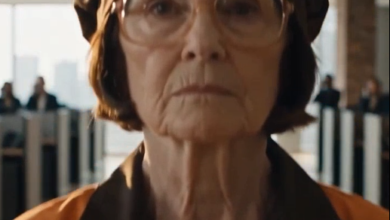
In the front row, the groom’s mother sat stiffly, back straight, hands folded with almost military precision. Her eyes followed every movement at the altar—not with warmth, but with something that looked dangerously close to disapproval.
When the florist adjusted the flowers, she frowned.
When the music started a second late, she glanced at her watch.
When the bride stepped forward, radiant and trembling, the older woman didn’t smile.
A whisper brushed past the pews like a draft.
“Typical mother-in-law.”
Someone rolled their eyes. Someone else sighed. The judgment was swift, collective, and merciless. In a room filled with lace, candles, and soft light, she was the only hard edge.
The bride noticed. Of course she did.
For just a moment—barely a second—her smile faltered as her gaze caught the older woman’s expressionless face. The photographer captured it: a bride glowing in white, and behind her, a woman who looked unimpressed, unmoved, almost cold.
No one asked why.
They didn’t need to. They already had a story.
And in that story, the mother-in-law was the villain—controlling, critical, unable to let her son go even on his wedding day.
The ceremony moved on. Applause rose. The couple kissed.
But the looks toward the front row stayed sharp.

At the reception, the mother-in-law kept to the edges.
She didn’t hover. She didn’t interrupt. She didn’t join the laughter spilling from the tables. Instead, she stood near the window, hands clasped around a small purse she never set down, watching the room as if she were guarding something invisible.
When the DJ announced the speeches, she stiffened.
Her fingers tightened around the purse strap. Her knuckles went pale.
The bride rose first.
She took the microphone with both hands. Her voice was steady at first—thank-yous, gratitude, a joke that earned polite laughter. She glanced at her new husband, smiled, then paused.
The pause stretched.
Her eyes drifted—not to her parents, not to her friends—but to the woman by the window.
The room shifted.
“I want to talk about someone people don’t usually applaud at weddings,” the bride said softly.
A few heads turned. A few brows lifted.
“My mother-in-law.”
A murmur rippled through the guests. Some leaned forward. Some exchanged looks that said, Here it comes.
The older woman’s shoulders tensed. She looked down, not angry—bracing.
“When I first met her,” the bride continued, “I thought she was… strict.”
A polite laugh. The familiar narrative. Safe ground.
“She corrected me. She worried about everything. She asked questions that felt… intrusive.”
The mother-in-law closed her eyes for a brief moment. Just long enough to breathe.
“But,” the bride said, her voice lowering, “I didn’t understand then what she was really doing.”
She reached into her bouquet and pulled out something folded.
A note.
Old. Yellowed. Creased soft with time.
“She never wanted me to read this,” the bride said. “I found it by accident.”
The room went quiet.
“This is a list,” she continued, “written years ago. Before I ever existed in their lives.”
She unfolded the paper carefully, like it might fall apart.
“It’s titled: Things My Son Should Never Have to Worry About.”
The mother-in-law’s breath caught.
The bride read slowly.
“Medical bills.”
“Loneliness.”
“Feeling like he failed.”
“Choosing between love and duty.”
“Standing alone when things fall apart.”
Each line landed like a weight.
“This list,” the bride said, her voice trembling now, “was written after my father-in-law died. Suddenly. Without warning.”
She looked at her husband, eyes shining.
“She became everything overnight. Parent. Provider. Protector.”
The room felt smaller. Closer.
“She worked two jobs so he wouldn’t have debt. She corrected him so the world wouldn’t have to. She interfered so he wouldn’t fall.”
The bride turned fully toward the woman by the window.
“And today,” she said, “when she frowned at the flowers, it wasn’t because she hated them.”
A pause.
“It was because she remembered how my husband’s father never got to see his own wedding.”
The mother-in-law’s hands shook now. Unhidden. Unrestrained.
“She didn’t smile during the ceremony,” the bride continued, “not because she disapproved of me—”
Her voice cracked.
“—but because she was busy making sure nothing else was taken from him.”
Tears fell openly now. Around the room, people dabbed eyes, stared at the floor, swallowed hard.
“She taught me something,” the bride said. “That love doesn’t always look soft. Sometimes it looks like control, silence, endurance. Sometimes it looks like being misunderstood on purpose.”
She stepped down from the stage.
Walked across the floor.
And stopped in front of her mother-in-law.
“Thank you,” she said, simply. “For raising the man I married. And for carrying things I never saw.”
The older woman stood, slowly, as if afraid her legs might fail her.
She didn’t speak.
She opened her arms.
The bride stepped into them.
The room broke.
Later, long after the speeches ended and the music softened, the mother-in-law sat at a small table near the dance floor.
She wasn’t watching the crowd now.
She was watching the bride—laughing, spinning, alive with joy.
The older woman reached into her purse and took out the folded list.
She looked at it once more.
Then she tore it in half.
Not angrily. Gently. Like letting something go.
Across the room, the bride caught her eye and smiled.
This time, the mother-in-law smiled back.
Not wide. Not loud.
But real.
Sometimes the people we judge most harshly are the ones holding the heaviest weight.
Sometimes love hides behind stiffness, behind rules, behind restraint.
And sometimes, it takes one brave voice to tell the truth out loud.
💬 What do you think—have you ever misunderstood someone who was actually protecting others in their own way? Share your thoughts in the comments.