The Woman in the Headscarf Suspected at the Supermarket — She Was the Doctor Who Saved the Manager’s Son
“Call the police. She’s stealing.”
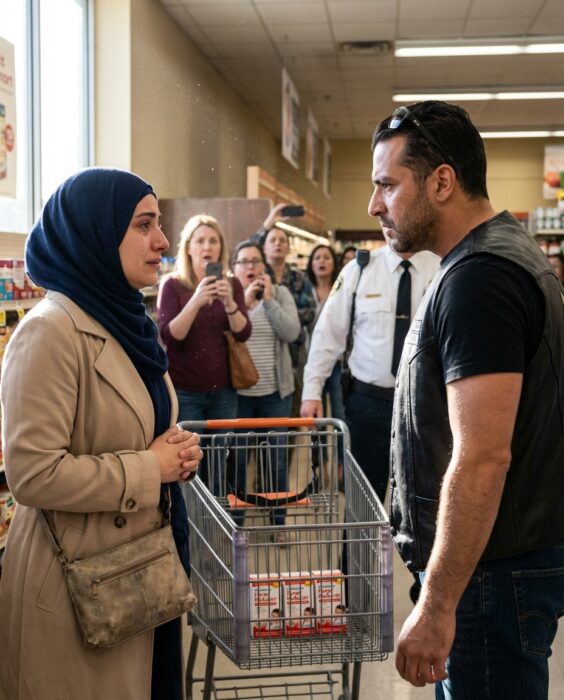
The manager’s voice cracked across the frozen-food aisle like a whip. Heads turned. Carts stopped mid-roll. A jar of pasta sauce slipped from someone’s hand and shattered, but no one bent to clean it up.
All eyes fixed on the woman in the dark navy headscarf, standing alone near the register.
She didn’t run.
She didn’t argue.
She stood there with her hands still on the handle of her cart, her back straight, her chin lifted just enough to appear defiant. To the crowd, she looked exactly like what they were ready to believe.
Suspicious.
Out of place.
Dangerous.
The security guard, a tall man with a tight jaw and a badge too new for comfort, stepped forward. “Ma’am, open your bag.”
The woman’s fingers tightened around the strap of her worn leather purse. A flicker of something passed through her eyes—fear, maybe. Or pride. Or something deeper that no one bothered to recognize.
“Open it,” the manager repeated, louder this time.
He was a broad-shouldered man in his late forties, red-faced, veins standing out at his temples. A name tag read “Mark — Store Manager.” His hand shook as he pointed. “I saw you put something inside.”
Murmurs rose like smoke.
“She was lingering near the medicine aisle.”
“Why would she need so much cold medicine?”
“They always act calm.”
The word “always” hung in the air like poison.
The woman slowly unzipped her purse.
The store felt smaller suddenly. Fluorescent lights buzzed overhead. A baby began to cry somewhere near the bakery section. Someone started recording on their phone.
Inside the purse were three small boxes of children’s fever reducers.
Nothing else.
The manager stepped closer. “You didn’t scan those.”
“I did,” she said softly.
Her voice was steady. Low. Not the voice of someone begging.
The receipt lay folded in her palm, but the manager snatched it before she could unfold it herself.
He scanned it. His lips tightened.
“It’s not on here.”
A sharp inhale rippled through the crowd.
For a moment, the woman closed her eyes.
Just for a second.
Then she opened them again and met his gaze—not with anger, not with shame—but with something that unsettled him more than either.
Calm.
“You’re going to have to come with me,” the security guard said, reaching for her elbow.
That’s when she pulled away.
Not violently. Not wildly.
But firmly.
“Don’t touch me.”
The words were quiet, but the effect was electric.
Gasps. A man near the dairy section muttered, “See? Defensive.”
Mark’s face darkened. “We don’t tolerate theft here.”
The woman’s lips parted as if she wanted to say something. Then she looked down at the boxes of medicine in her cart. Her fingers brushed them gently, almost tenderly.
There was something about that gesture that didn’t match the narrative forming around her.
But no one paused long enough to question it.
Instead, the manager lifted his phone. “I’m calling the police.”
The woman didn’t beg.
She didn’t cry.
She simply stood there in the center of the store—surrounded by strangers who had already decided who she was.
A thief.
A problem.
A threat.
And as the sirens began to wail faintly in the distance, she closed her eyes again—this time longer.
As if she had been here before.
As if she knew exactly how this story usually ends.
The sirens never made it inside.
Because before the police car even pulled into the parking lot, something shifted.
It was small at first.
A flicker.
The cashier—barely twenty, pale and nervous—looked down at the screen again.
“Wait,” she whispered.
No one heard her.
Mark was too busy lecturing. “People think they can just walk in and take whatever they want. Not in my store.”
“Wait,” she said again, louder this time.
The woman in the headscarf looked at her.
Not pleading.
Not accusing.
Just… watching.
The cashier swallowed. Her hands trembled slightly as she scrolled through the transaction history.
“There was a system glitch earlier,” she murmured. “The scanner froze.”
Mark snapped, “That has nothing to do with this.”
But the cashier turned the screen toward him.
Three items—children’s acetaminophen, grape flavor—were listed under “pending transaction.”
Not voided.
Not canceled.
Pending.
Silence dropped like a curtain.
Mark stared at the screen. His jaw worked.
The security guard stepped back half a pace.
The crowd shifted uneasily.
The woman did not move.
She only exhaled.
Slowly.
“I told you,” she said.
But there was no triumph in her voice.
Only exhaustion.
Mark cleared his throat. “Well… you should have said something.”
“I tried.”
“You pulled away when my guard touched you.”
Her eyes flickered briefly toward the guard’s hand.
Then back to Mark.
“I don’t like being grabbed.”
Something in her tone suggested history.
A story.
But she didn’t offer it.
Instead, she began placing the boxes carefully back into her purse.
Mark crossed his arms, still defensive. “You understand how this looks.”
“Yes,” she replied.
And that was it.
No anger.
No demand for apology.
Just that one word.
A few customers began to disperse, embarrassed by their own eagerness.
But before the tension could dissolve completely, a boy’s voice echoed from the front entrance.
“Dad?”
Mark turned sharply.
A teenage boy stood near the automatic doors, pale and thin, a baseball cap pulled low over his head. There was a faint scar along his neck—barely visible unless you were looking for it.
He stared at the woman.
Not with suspicion.
With recognition.
The woman’s hand froze mid-motion.
The air thickened.
“Dad,” the boy said again, stepping forward slowly. “That’s her.”
Mark frowned. “What?”
The boy swallowed. His voice shook—not with fear, but with emotion.
“That’s the doctor.”
A ripple moved through the room.
The woman lowered her gaze.
Mark blinked. “What doctor?”
“The one from St. Mary’s,” the boy said, his words coming faster now. “When I—when I couldn’t breathe. When they said I might not make it.”
Mark’s face drained of color.
The store seemed to tilt.
The woman did not look up.
She simply stood there, clutching her purse, as if bracing for another kind of impact.
Mark stared at her headscarf.
At her hands.
At the quiet dignity he had mistaken for defiance.
“You…?” he began, but the words wouldn’t form.
The boy stepped closer to her.
“You stayed all night,” he whispered. “You held my hand when Mom couldn’t stop crying.”
The fluorescent lights hummed louder somehow.
Customers who had been ready to film now lowered their phones.
Mark’s breathing turned uneven.
But the woman lifted her head finally and met the boy’s eyes.
And for the first time, the crowd saw something they hadn’t before.
Not guilt.
Not fear.
But a depth of compassion so steady it felt almost unbearable.
And still—she said nothing.
No one spoke.
The humming of the fluorescent lights felt suddenly too loud, too cruel in its normalcy.
Mark stared at his son as if he were seeing him for the first time. “What are you talking about?” His voice had lost its authority. It sounded thinner now. Older.
The boy stepped forward again. His hand trembled slightly as he pointed—not accusingly, but reverently. “When I collapsed at school. When my lungs shut down. They said it was an allergic reaction that turned into something worse. They said I might not survive the night.”
The woman’s fingers tightened around her purse strap.
“I remember her voice,” the boy continued. “She kept saying, ‘Stay with me.’ Over and over. I couldn’t open my eyes, but I heard her.”
The store was utterly still.
Mark’s face drained of its red heat, replaced by something raw. “That was two years ago,” he said, almost to himself.
The woman finally spoke, softly. “You had a severe anaphylactic shock. Your airway was collapsing.”
Her tone was clinical. Calm. As if she were reciting a case study instead of recalling a night that had nearly broken a family.
“You performed the emergency procedure,” the boy whispered. “The one the other doctors hesitated about.”
She nodded once. “There wasn’t time.”
Mark’s knees seemed to buckle slightly. He grabbed the edge of a display stand to steady himself.
“You saved him,” he said.
The words hung there.
Heavy.
Unavoidable.
The woman did not correct him. She did not accept praise. She only looked at the boy—and in her gaze was something almost maternal. A quiet guardianship.
“I was part of a team,” she said.
But the boy shook his head. “You didn’t leave my bedside. Not even when your shift ended.”
A faint crease appeared between her brows. “You needed monitoring.”
“You missed your own son’s recital,” the boy added suddenly.
The entire store inhaled at once.
Mark turned sharply toward her. “You have a son?”
She hesitated.
Then nodded.
“He was seven at the time.”
“And you stayed with mine?”
There it was.
The real question.
Not about medicine.
Not about professionalism.
But about choice.
She answered without drama. “Your son was critical.”
No bitterness. No accusation.
Just fact.
Mark’s hands began to shake.
“I—I didn’t recognize you,” he stammered. “You weren’t wearing…”
“My scarf?” she finished gently.
He couldn’t meet her eyes.
The boy stepped closer to her now. Close enough that the scar at his neck was clearly visible. A thin reminder of how close he had come to disappearing.
“I remember waking up,” he said. “You were still there. You told me I was going to be okay.”
Her lips curved slightly. “You were brave.”
The words were simple.
But they landed like a confession.
Mark felt it then—the weight of what he had done. The public accusation. The raised voice. The assumption.
He looked around at the customers. At the phones slowly lowering. At the cashier whose face was flushed with shame.
“I’m so sorry,” he said finally.
It wasn’t loud.
But it was the loudest thing in the room.
The woman held his gaze. Not triumphantly. Not coldly.
Just steadily.
“I understand,” she said.
And somehow, that made it worse.
Because she wasn’t angry.
She wasn’t demanding restitution.
She was offering him grace he hadn’t earned.
Mark swallowed. “Why didn’t you say something sooner?”
Her eyes flickered toward the boxes of fever medicine in her purse.
“My daughter has a high fever,” she said quietly. “I needed to get home.”
There was the twist no one expected.
Not a thief.
Not a provocateur.
Just a mother trying to hurry back to a sick child.
“And I don’t usually bring up the past,” she added. “People deserve dignity without conditions.”
The sentence landed like a verdict.
She had chosen silence not because she was weak—but because she refused to trade her humanity for vindication.
Mark stepped forward, then stopped, unsure if he had the right.
“Please,” he said. “Let me at least—”
“You’ve already done enough,” she interrupted gently.
Not cruel.
Not sharp.
Just honest.
The security guard removed his hat.
The cashier wiped at her eyes.
And the woman in the headscarf—the woman they had nearly humiliated into handcuffs—adjusted her purse on her shoulder and prepared to leave.
The boy spoke once more before she turned away.
“Thank you,” he said.
And this time, her composure cracked just slightly.
“You don’t owe me thanks,” she replied.
But her voice was softer now.
Warmer.
And undeniably human.
She walked toward the automatic doors.
Slowly.
Not rushed. Not dramatic.
The crowd parted without being asked.
It was a different kind of silence now.
Not accusatory.
Reflective.
Mark stood frozen near the register, watching the woman who had once stood between his son and death walk away from him in a grocery store aisle.
The boy suddenly moved.
He jogged after her.
“Wait!”
The doors slid open with a soft mechanical sigh, letting in a rush of late afternoon sunlight.
She turned.
For the first time, the light caught her face fully. The faint lines near her eyes. The tiredness she had carried all along. The strength.
“My mom never got to thank you properly,” the boy said. “She still talks about you.”
The woman smiled gently. “Tell her I remember her.”
He hesitated. Then did something no one expected.
He hugged her.
Right there in the doorway.
In front of everyone.
For a second, she stiffened—surprised.
Then she placed one hand lightly on his back.
It was not a long embrace.
But it was enough.
Mark approached more slowly this time. No authority in his stride. No accusation in his posture.
“Dr…?” he began.
“Rahmani,” she supplied quietly.
“Dr. Rahmani,” he repeated. The name felt different on his tongue now. “If there is anything I can do—”
She shook her head. “Just… be careful who you decide someone is.”
It wasn’t a lecture.
It wasn’t bitter.
It was almost tender.
And it cut deeper than anger ever could.
She turned again and stepped into the sunlight.
The doors closed behind her with a soft click.
Inside the store, life began to resume—but not quite the same.
The cashier cleared her throat and quietly corrected the transaction record.
The security guard stepped away from the entrance and leaned against the wall, staring at the floor.
Mark stood there for a long moment, staring at the scar on his son’s neck.
At the place where breath had almost stopped.
At the place someone else had fought to protect.
“Dad,” his son said gently.
Mark nodded.
“I know.”
But what he knew now wasn’t just that she had saved his son.
He knew how easily he had been willing to condemn her.
Over three small boxes of medicine.
Over a headscarf.
Over an assumption.
Outside, Dr. Rahmani loaded the medicine into her car. She paused for a moment, looking through the windshield at the store.
Not angrily.
Just thoughtfully.
Then she started the engine and drove home—to a child waiting with a fever and a mother who would never mention what had happened in aisle seven.
Because sometimes, dignity is quiet.
Sometimes, the strongest people are the ones who walk away without demanding applause.
And sometimes, the people we are quickest to judge are the very ones who once stood between us and unimaginable loss.
If you had been in that store—what would you have done?
Share your thoughts below.