The Golden Retriever Waited at the End of the Pier for a Boat Lost Six Years Ago — The Fisherman Feeding Him Knew Why It Never Returned
For six years, an old Golden Retriever walked to the end of a Maine pier at sunset, refused every piece of fish until the final boat returned, and kept watching after one empty berth went dark.
His name was Finn.
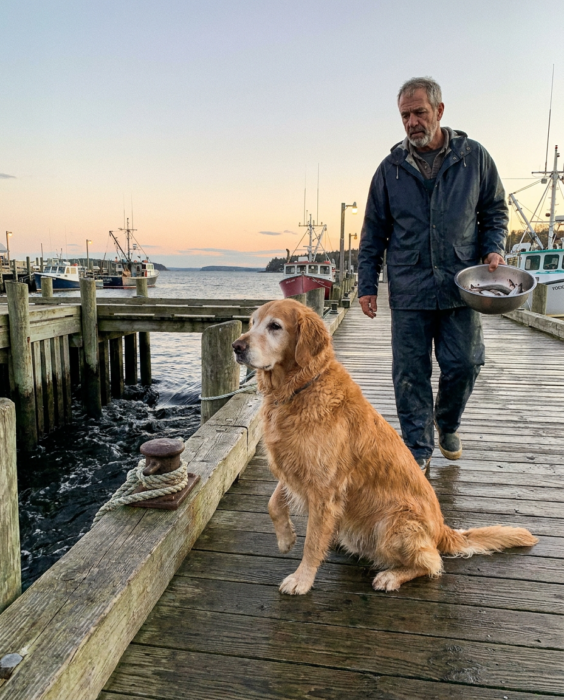
At 6:42 each evening during summer, and earlier when winter shortened the day, he left the bait shed near Camden Harbor and followed the same path across the weathered boards. He limped slightly on his right hind leg, carried his tail low and paused at every gap where black water moved beneath the pier.
Nobody led him.
Nobody needed to.
Finn stopped beside Berth 12, where an old wooden trawler called the Mercy Bell had once been tied. The boat had disappeared during a November storm six years earlier. Only pieces of its wheelhouse and one broken life ring had ever been recovered.
Finn still waited for it.
Tourists photographed him from a distance. Children offered crackers. Restaurant workers brought strips of cod. The dog accepted nothing until the harbor’s last working boat passed the breakwater.
Only then would he turn around.
I was the fisherman who fed him.
My name is Elias Ward, and every evening I carried a dented metal bowl to the end of the pier. Finn knew my footsteps, but he never greeted me the way he had once greeted my older brother.
He would smell the food, look past my shoulder and return his gaze to the sea.
“Not tonight,” I always told him.
He never believed me.
Finn belonged to my brother Jonah, captain of the Mercy Bell. Jonah had raised him from an eight-week-old puppy, taught him to ride in the wheelhouse and trained him to carry dock lines between boat and shore.
When the boat vanished, people called me fortunate.
I was the only man who came back.
They said the storm had separated us. They said the hull had failed. They said no one could have saved Jonah once the second wave rolled the boat.
I let them say it.
I never told them that I had climbed into the emergency raft while my brother remained aboard.
I never told them that I had heard him call my name from the black water.
And I never told Finn why the man he loved had not returned.
The dog was not on the boat that night. An old cut on his paw had opened before we left, so Jonah ordered me to keep him ashore. Finn had fought the leash until our stern light disappeared beyond the harbor.
He had been waiting ever since.
Every sunset, I fed the dog whose owner I believed I had abandoned. Every sunset, Finn watched the same strip of water as though loyalty could change the ending.
Then, on a stormy October afternoon, I stepped onto the pier carrying his bowl. Rain had turned the boards dark and slick. Finn stood at Berth 12, facing waves that struck the pilings hard enough to shake the dock.
My right boot slid.
The bowl hit the boards.
I went over the edge before I could catch the rail.
Cold water closed above my head. My heavy jacket pulled at my shoulders, and the tide carried me beneath the outer beam where the ladder stood just beyond reach.
I surfaced once.
Finn was looking down at me.
“No,” I shouted. “Stay.”
He jumped anyway.
The old dog hit the water beside me, disappeared beneath a wave and came up holding the end of a floating dock line in his mouth.
Then he turned toward shore.
For the first time in six years, I saw my brother’s last act exactly as it had happened—not as the betrayal I had carried, but as a choice someone else had made so I could live.
My full name is Elias Ward, though most people around Camden Harbor have called me Eli since I was old enough to coil a rope. I was sixty-two when Finn pulled me from the water and fifty-six when my brother’s boat disappeared. Jonah was four years older, which meant he had spent nearly our entire childhood walking ahead of me and turning around to see whether I was still following.
We grew up in a weathered house overlooking Penobscot Bay. Our father fished for lobster, our mother kept the books for three boats, and Jonah learned the harbor before he learned long division. By sixteen, he could identify most local engines without looking up from his work. By eighteen, he could bring a thirty-foot boat alongside a moving dock so gently that the fenders barely touched.
I was different.
I liked boats once they were tied down. I liked mending traps, replacing worn hinges and repairing the wooden handles of gaffs. Open water made me cautious in ways Jonah found useful rather than shameful.
“You hear trouble before the rest of us,” he used to say.
Jonah bought the Mercy Bell at thirty-nine. She was a thirty-four-foot wooden trawler with a green hull, a cream wheelhouse and an engine that coughed twice before settling into a deep, steady rhythm. The vessel was old but maintained with the kind of care that makes age look deliberate.
Finn arrived two years later.
A deckhand’s Golden Retriever had produced a litter, and Jonah chose the smallest male because the puppy kept carrying bits of rope away from the others. Finn’s coat was the color of dry wheat. One ear folded backward when he ran, and his front paws looked too large for his body.
Jonah trained him with dock lines.
He began on shore, placing a soft rope between the puppy’s teeth and walking backward six feet. “Bring it home,” he would say.
Finn learned to carry the line without chewing. Next, Jonah stood on the Mercy Bell while I waited on the dock. The puppy crossed a short gangplank, delivered the rope to my hand and returned for praise.
By his first birthday, Finn could carry a light messenger line from the stern to someone standing onshore. He never pulled the full weight of a boat. He only delivered the first line so a person could secure the heavier one.
That distinction would later save my life.
Finn loved the Mercy Bell. He slept beneath the wheelhouse bench, woke when the engine changed pitch and stood beside Jonah whenever we approached the breakwater. On calm afternoons, he placed his nose into the wind and watched gulls cross the bow.
Jonah spoke to him more than he spoke to most people.
“Port line.”
Finn turned left.
“Home.”
Finn searched for the dock.
“Find Eli.”
The dog came to me.
That command began as a joke. Jonah used it whenever I disappeared into the bait shed or worked beneath an engine cover. Finn would search until he found me, then press his damp nose against my hand.
Find Eli became part of his work.
That was the first seed I failed to understand.
The second appeared whenever Jonah practiced emergency drills. He kept an inflatable raft and throw lines aboard, replacing expired equipment before regulations required it. Once each season, he made me rehearse the steps.
“Boat can be replaced,” he said. “Men can’t.”
During one drill, he shoved the inflated raft against my knees and ordered me inside.
“You first,” he said.
“You’re captain.”
“That’s why I decide.”
I laughed and refused. Jonah did not.
He gripped my jacket, pushed me backward into the raft and said, “If one of us can be made safe, we make him safe.”
At the time, I thought he was proving a point.
Six years later, I realized he had been showing me his answer long before the storm asked the question.
Finn’s life moved with ours. When our mother died, he lay beneath Jonah’s chair during the meal after her funeral. When my marriage ended, Finn slept outside the door of the small harbor apartment I rented because I could not bear the quiet inside it. When Jonah injured his shoulder, the dog stopped jumping onto the boat until the sling came off.
We did not call those things devotion.
They were simply ordinary days.
The Mercy Bell returned every evening. Jonah tied the stern line. Finn crossed the gangplank. I cleaned the deck or carried boxes to the truck.
Nothing announced that the routine was temporary.
Nothing ever does.
November 9 began with clear water and a northwest wind that was supposed to remain below fifteen knots. Jonah and I planned a short run to check gear before winter storage. We expected to return by 2:00 in the afternoon.
Finn had torn the pad of his right front paw two days earlier on a jagged shell. The cut was small but reopened whenever he climbed the gangplank.
Jonah left him with Rosa Alvarez, who managed the fuel shed.
Finn resisted the leash. He planted all four paws and watched Jonah step aboard.
“You’re staying dry today,” Jonah told him.
The dog whined.
Jonah crouched, touched two fingers to Finn’s forehead and pointed toward me. “Find Eli when he comes home.”
Those were the last words Finn heard from him.
We cleared the breakwater at 7:18 a.m. The bay looked calm enough to reflect pale strips of sky. Jonah drank coffee from a stainless-steel cup, and I complained that he had forgotten sugar.
By noon, the wind shifted east.
A fast-moving coastal system strengthened beyond the original forecast. The marine radio carried warnings, and we began hauling our remaining gear. Waves built from three feet to six within less than an hour.
Jonah turned the boat toward Camden.
The Mercy Bell handled heavy water well when she met it at the correct angle. But the starboard bilge alarm sounded at 1:47. Water entered faster than the pump could clear it.
I opened the access panel and found seawater spraying near a cracked fitting. We reduced speed, attempted a temporary patch and radioed our position. Static swallowed part of the transmission.
The engine coughed.
It recovered once.
Then it lost power.
By 2:12, waves pushed us broadside. One struck hard enough to throw me against the cabin wall. Jonah pulled me upright and ordered me into a survival suit.
I argued.
He shouted my name.
Jonah rarely shouted. The sound stopped me.
We deployed the raft, but the painter line snagged beneath loose deck hardware. Jonah crawled across the tilted stern while I held the rail. A wave broke over him and filled the cockpit to our knees.
The raft opened beside the boat.
One person could enter safely from where we stood. The second would need to cross the deck while the vessel rolled.
“Get in,” Jonah said.
“Together.”
“Eli, get in.”
“I’m not leaving you.”
The next wave lifted the Mercy Bell and slammed her down. The wheelhouse window broke. Water and glass moved through the cabin.
Jonah seized the front of my suit.
He did not ask again.
He drove his shoulder into my chest and pushed me over the low rail into the inflated raft. I landed on my back. The raft spun away, then jerked tight at the end of its line.
Jonah remained aboard.
I crawled toward him. “Jump!”
He tried.
The boat rolled between us.
I saw his left hand reach above the stern rail. I grabbed the painter line and pulled, trying to bring the raft back. The line had wrapped around broken hardware. Each wave snapped it tighter.
Jonah’s head appeared beside the boat.
He shouted something.
For years, I remembered only two words:
Hold on.
Another wave covered him.
I tried to leave the raft. I got one leg over the side, but the survival suit trapped air around my shoulders. The raft overturned halfway, then righted itself. Freezing water filled the bottom.
The Mercy Bell rolled farther.
The line between us tightened until the raft’s attachment point began tearing.
Jonah reached the stern.
I extended both arms.
We were no more than twelve feet apart.
Then his hand moved toward the snagged line.
He pulled a knife from his vest.
I thought he was trying to free himself.
The line went slack.
The raft drifted backward.
“Jonah!”
He shouted again, but wind took most of the sentence.
I saw his palm strike his own chest, then point toward me.
The boat disappeared behind a wave.
When the water lowered, the stern was gone.
I never saw my brother again.
A Coast Guard crew found the raft at 5:36 p.m., nearly four miles from our last reported position. I was hypothermic, confused and unable to stand. I kept telling rescuers that Jonah was behind me.
They searched through the night and for two more days.
They found wreckage.
They found the broken life ring.
They found one of Jonah’s gloves.
They did not find him.
The official report stated that the Mercy Bell was presumed lost after flooding and loss of propulsion during severe weather. It said I had entered the raft and survived.
It did not describe Jonah’s hand against my chest.
It did not record who cut the line.
Those details lived only inside me.
By the time I returned to Camden, I had turned the memory into a verdict.
I had entered the raft.
Jonah had remained behind.
Therefore, I had abandoned him.
Finn waited at the pier when Rosa brought me back from the hospital. My left hand was bandaged, and bruises covered my ribs. The dog ran past me toward the harbor road.
He searched behind the truck.
Then he returned to the pier and looked toward the breakwater.
I said his name.
Finn ignored me.
For the next eleven nights, he slept beside Berth 12.
Rosa and I tried to lead him away. He slipped collars, refused vehicles and returned whenever nobody watched. Finally, the harbor master placed a bed inside the heated bait shed and left the lower door unlatched.
Finn used the bed after midnight.
At sunset, he always returned to the berth.
I began feeding him because Jonah could not.
That was how I explained it.
The truth was harder.
Feeding Finn became the punishment I knew how to survive.
The town wanted to make Finn into a symbol.
A local newspaper photographed him at the end of the pier. Visitors compared him to old stories about dogs waiting at train stations or graves. People left toys, scarves and bags of food beside Berth 12.
Finn ignored most of them.
He was not waiting for attention.
He was waiting for an engine he knew.
The Mercy Bell had a rough idle below nine hundred revolutions. When Jonah approached the harbor slowly, the engine produced a deep pulse followed by a brief metallic rattle. Finn could identify it before the boat crossed the breakwater.
For months after the wreck, any similar sound brought him running.
He would stand at the pier’s edge, tail raised, chest forward. When the wrong vessel appeared, his body lowered one part at a time.
By the second year, he stopped running.
He only watched.
I brought food every evening in the same dented bowl. In winter, I mixed warm water into his meal. During summer, I carried a second bottle because tourists sometimes filled his dish with seawater by mistake.
Finn never ate before the harbor’s last boat returned.
If fog delayed a crew, he waited.
If a mechanical failure kept a boat out past dark, he waited.
If no boats had left that day, he still watched the empty channel until harbor lights came on.
I tried taking him home once.
My apartment stood less than half a mile away. I placed Jonah’s old blanket near the radiator and left the door open so Finn would not feel trapped.
He remained until 5:30.
Then he stood, scratched once at the door and returned to Berth 12 before sunset.
After that, I stopped asking.
I told myself Finn preferred the harbor. In truth, I was relieved he refused my home. Living with my brother’s dog would have required me to see Jonah’s absence every morning rather than once each evening.
Rosa accused me of keeping both of us stuck.
“He doesn’t need a bowl,” she said. “He needs a person.”
“He has everybody here.”
“That is not the same.”
“He chooses the pier.”
“So do you.”
I did not answer.
My fishing life became smaller. I sold my share in another boat and took repair work near shore. I fixed winches, rebuilt trap doors and sharpened tools. I no longer went beyond the breakwater during bad weather.
People called that wisdom.
It was fear.
During the third year, Finn developed stiffness in his right hip. A local veterinarian examined him through an arrangement with the harbor association. Imaging later confirmed arthritis. He began medication during painful periods, lost six unnecessary pounds and used a rubber mat across the slickest section of the pier.
His right eye also grew cloudy with age. The veterinarian said he still had useful vision, but depth and contrast might become harder in low light.
Finn adjusted.
He walked more slowly, keeping close to the center of the boards. At the last fifteen feet, he lifted his head and moved directly toward Berth 12.
He never forgot.
I wished he would.
Each sunset repeated the question I refused to answer: if Jonah had ordered me into the raft, why had I accepted? Why had I not climbed back? Why had survival taken over when loyalty should have held me beside him?
Friends gave simple answers.
“You would both be dead.”
“Jonah knew what he was doing.”
“You didn’t leave. The storm separated you.”
Those words changed nothing. They came from people who had not seen my brother disappear behind a wall of water.
Finn had been ashore.
He did not know either.
That belief allowed me to keep feeding him.
Then, in the fifth year, Rosa found a canvas tool roll behind an old cabinet in the fuel shed. It belonged to Jonah. Inside were two knives, spare electrical connectors, a notebook and a faded photograph of Finn as a puppy carrying his first dock line.
The notebook contained maintenance records and fuel calculations. On the final page, Jonah had written a list before our last trip:
Check Finn’s paw.
Replace raft painter after winter.
Make Eli run drill again. He still argues.
I sat on an overturned bucket and read the third line until the words blurred.
Rosa said, “He knew you.”
“He knew I was afraid.”
“No. He knew you would waste time trying to save him.”
I closed the notebook.
“That doesn’t mean he planned to die.”
“Of course not.”
“Then stop making it sound noble.”
Rosa’s face tightened. “I am saying he planned to get both of you home. And when he couldn’t, he made the decision a captain makes.”
I returned the notebook to the tool roll.
For another year, I refused to open it.
The sixth anniversary approached with a week of rough weather. Finn moved more slowly, and the veterinarian warned that cold rain could worsen his stiffness. I built a small covered platform near the end of the pier so he could wait without lying on wet boards.
Rosa watched me install it.
“You built him a better place to stay stuck.”
“I built him shelter.”
“Those are not always different.”
On October 21, the harbor forecast called for evening thunderstorms. Most boats returned early. I planned to feed Finn at 4:30 and bring him into the bait shed before conditions worsened.
The storm arrived at 4:07.
By 4:15, Finn was already at Berth 12.
And I was carrying his bowl across the wet pier.
Rain made the boards shine like black glass. Wind drove spray over the outer rail, and mooring lines struck masts with a hard, irregular rhythm.
Finn stood beneath the small shelter I had built, but his head extended beyond it. He watched the channel where the last lobster boat approached through gray water.
“Inside,” I called.
He looked at me and remained where he was.
I carried the bowl in my right hand and a coiled floating line over my left shoulder. We kept throw lines at marked points along the pier, but one had come loose during the rising wind. I had picked it up to secure it near the ladder.
The approaching boat sounded its horn.
Finn stepped forward.
My boot landed on a patch of algae-darkened wood near the outer edge. The heel slid. I dropped the bowl and reached for a post that stood six inches beyond my fingers.
The pier vanished above me.
Cold water struck hard enough to empty my lungs.
I surfaced beside the pilings, but a wave pushed me beneath a crossbeam. My jacket absorbed water. My right boot caught briefly between two submerged braces, and panic arrived before thought.
I kicked free.
The tide carried me toward the outer end of the pier.
“Rope!” someone shouted.
I saw Rosa running from the fuel shed. Another fisherman followed, but both remained more than sixty yards away.
Finn stood above me.
His front paws reached the edge. His cloudy eye turned slightly away, forcing him to angle his head.
“Stay!” I shouted.
The command had always worked.
Not that day.
Finn turned, seized the floating line I had dropped and pulled the loose end from the boards. The far end remained looped through a dock ring but had not been tied securely.
He looked toward me.
Then he jumped.
The water closed over his gray muzzle. He surfaced three feet from the pier, rope between his teeth, and began swimming.
His right hind leg kicked shorter than the left.
“Go back!” I yelled.
Finn kept coming.
A wave rolled between us. He vanished behind it, then appeared closer. The rope floated along the surface in a yellow curve.
I reached once and missed.
Finn turned.
For one second, he faced the dock. Then he circled back and pushed the rope against my shoulder.
My left hand had already grown numb. I tried to close my fingers but caught only water.
Finn released the line, took it again closer to the end and pressed it higher against my chest.
The action was careful.
Deliberate.
Exactly as Jonah had trained him to deliver a messenger line.
I hooked my forearm through the floating loop.
Finn turned toward the pier.
The rope tightened.
Rosa had reached the shore end. She wrapped it twice around a cleat while the other fisherman clipped a rescue ring onto the line.
“Hold it under your arms!” she shouted.
I dragged the loop higher.
Finn swam beside me rather than ahead. Each time a wave turned my body, he shifted toward my shoulder and pushed his chest against my arm.
He was not strong enough to tow my full weight through storm water by himself. No dog his age should have been asked to do that.
He did something more useful.
He delivered the connection.
Rosa and the fisherman pulled from shore. The line guided me toward the ladder, while Finn’s body kept me oriented when waves turned my face toward the pilings.
My knee struck the bottom rung.
I tried to stand.
My legs failed.
The fisherman descended two rungs wearing a flotation vest and clipped a second line to my jacket. Rosa continued hauling from above.
Finn reached the ladder first.
He did not climb.
He remained beside me, paddling in place.
“Get the dog!” I shouted.
They pulled my shoulders onto the lowest platform. Only when my chest cleared the water did Finn place his front paws on the rung.
Rosa grabbed the handle of the flotation harness I had required him to wear during storm evenings. She and another deckhand lifted him onto the platform.
Finn collapsed.
His sides moved fast, but his eyes remained open. Water ran from his coat in dark streams. He crawled toward me and placed one paw across my sleeve.
Someone covered us with insulated blankets. Another person called emergency services. I remember voices, the pressure of the cold pier against my hip and Finn’s nails hooked gently into my jacket.
I touched his wet head.
“Why didn’t you stay?”
Finn looked toward Berth 12.
The question returned to me in my brother’s voice.
Why didn’t Jonah get into the raft?
Because he had been holding the boat long enough for me to enter it.
Why did he cut the line?
Because the sinking hull was pulling the raft back.
Why had his hand struck his chest before pointing toward me?
I had remembered it as accusation.
It was instruction.
Me. Then you. Live.
Finn had just done the same thing in the only language he knew. He entered danger not because he wanted to die beside me, but because he could still deliver a line.
He had not chosen death.
He had chosen a way for both of us to reach shore.
Jonah had not been asking me to stay.
He had been giving me the only chance he had left to send home.
The ambulance transported me for evaluation. My core temperature had fallen, but I remained conscious. Finn went to the veterinary clinic in Rosa’s truck.
The veterinarian found no aspiration injury or new fracture. Finn was exhausted, chilled and sore through his arthritic hip. Staff warmed him gradually, monitored his breathing and kept him overnight.
I refused discharge until someone confirmed he was stable.
Rosa stood beside my hospital bed with rain still drying on her boots.
“You understand now?” she asked.
I looked at the yellow dock line coiled inside a plastic evidence bag near my clothes.
“I think I do.”
“Say it.”
I could not.
Not yet.
Finn came home from the clinic the next afternoon. “Home” meant the harbor, though that word was about to change.
Rosa drove him to my apartment instead of the bait shed.
I had prepared the old blanket beside the radiator, just as I had years earlier. This time I closed the door after Finn entered.
He inspected the kitchen, drank half a bowl of water and stood beside the window facing the harbor.
At 5:39, he looked toward the door.
Sunset approached.
My first instinct was to let him go.
Then I clipped on his leash.
“We’ll go together.”
Finn walked slowly after the rescue. His right hind leg stiffened during the first block, so I shortened the route and allowed him to choose the pace. We reached the pier with six minutes of daylight remaining.
He went to Berth 12.
I carried Jonah’s notebook.
The harbor was calm. The storm had passed east, leaving broken clouds and a thin orange line above the water. No boats remained beyond the breakwater.
Finn sat.
I sat beside him.
For six years, I had spoken to the dog as if he knew less than I did. That evening, I told him everything.
“I got into the raft,” I said. “I thought that was the worst thing I ever did.”
Finn watched the channel.
“Jonah put me there.”
The dog’s ear moved.
“He cut the line because the boat was pulling me back.”
I opened the notebook to the final page.
Make Eli run drill again. He still argues.
The handwriting looked ordinary. Jonah had not known the date would become his last. He had not written a farewell or prepared a speech.
He had simply known his brother.
I remembered the emergency drill years earlier. Jonah had pushed the raft against my knees. He had said, If one of us can be made safe, we make him safe.
I had treated those words as practical instruction.
In the storm, they became his final decision.
The guilt I carried did not disappear. Understanding is not a switch. My brother was still gone. I had still survived when he had not.
But survival no longer looked like theft.
Jonah had given it to me.
Finn stood and smelled the notebook. His nose paused on the oil-stained cover. He licked the edge once, then returned his gaze to the water.
I placed the yellow rescue line beside us.
“You brought me the same answer.”
Finn leaned against my shoulder.
The next morning, I visited the Coast Guard station and requested another copy of the investigation materials I had avoided for years. The records contained no hidden miracle, only times, coordinates, weather readings and statements.
One sentence mattered.
A crew member who had reviewed the damage pattern believed the raft’s painter line had been intentionally cut, preventing the sinking vessel from pulling the raft beneath the surface.
I had known about the cut.
I had refused to accept its meaning.
Jonah had not lost his grip.
He had released mine.
Rosa joined me at the harbor office when I read the sentence. She waited until I closed the folder.
“What do you call what he did now?” she asked.
I looked through the window at Finn asleep beneath the bench.
“Saving me.”
The words came out quietly.
They changed the room.
I returned to fishing the following spring, but not as before. I did not buy another trawler or pretend fear had vanished. I joined a friend’s crew for short inshore runs during calm weather. I completed updated marine safety training and practiced boarding a raft until my hands stopped shaking.
Finn came only on days when conditions were mild. He wore a fitted flotation vest with a strong lifting handle. A rubber mat covered the deck, and we shortened trips for his hip.
The first time we approached the breakwater, Finn trembled.
I almost turned back.
Then he moved to the bow and lifted his nose into the wind.
He did not look for the Mercy Bell.
He looked at the water in front of us.
We stayed out thirty-two minutes.
When we returned, Finn carried a light messenger line to Rosa on the dock. His gait was slower than in his youth, but he delivered it without chewing.
Rosa secured the heavier line and touched two fingers to his forehead.
“Home,” she said.
Finn crossed onto the pier.
That word had changed too.
Home was no longer one boat.
It was the people who took the line.
I stopped leaving Finn at the harbor overnight. He slept in my apartment beside the radiator during winter and near the balcony door in summer. At first, he still asked to visit the pier before every sunset.
I took him.
We sat at Berth 12 until the last working boat returned. I fed him there, but I no longer waited for him to turn away from the water before placing the bowl down.
Some evenings, he ate while boats were still out.
The first time that happened, I watched him take three bites, lift his head and continue eating.
A small change.
A complete one.
I moved Jonah’s photograph from a drawer to the wall above my kitchen table. In it, he stood beside the Mercy Bell with Finn as a puppy in his arms. Jonah looked impatient with the camera, as if the person taking the photograph had delayed useful work.
For years, I could not look at his face without hearing the storm.
Now I sometimes heard him laugh.
The sound was not forgiveness from the dead. I do not claim to know what Jonah would say about the life I built after him.
But I know what he did.
He pushed me toward the raft.
He cut the line.
He sent me home.
Finn spent six years waiting for Jonah’s boat because that was the place where his person had always returned. I spent six years feeding Finn because I thought punishment was the only honest way to remember my brother.
The dog showed me something different.
Remembering someone does not require repeating their loss.
Sometimes it means accepting what they tried to save.
Finn continued going to the pier at sunset, but he no longer went alone.
Every evening at 6:15 during summer, I clipped on his flotation harness and carried the dented metal bowl beneath one arm. In winter, we left earlier, following the light rather than the clock.
Finn walked beside me.
At Berth 12, I placed the bowl beneath the covered platform. He sat facing the channel until the last boat crossed the breakwater.
Then I took out a short yellow messenger line.
“Find Eli,” I said.
Finn picked up the rope, turned in a slow circle and placed it in my hand.
That became our ritual.
It was not a performance for tourists. Most evenings, nobody watched. Finn carried the line because Jonah had taught him, and I accepted it because refusing had cost us enough years.
Afterward, I said, “Home.”
Finn ate.
The harbor association installed new throw lines along the pier and added reflective markers near every ladder. Rosa organized cold-water rescue training for fishermen, restaurant workers and seasonal staff.
I attended every session.
During the first training day, I demonstrated how to secure a floating line around a cleat. My hands shook when I entered the water in a survival suit, but I completed the drill.
Finn waited onshore.
When I climbed out, he brought me the practice line.
Rosa said, “He thinks you still need instruction.”
“He’s right.”
By Finn’s twelfth birthday, arthritis shortened our walks. I built a ramp over the steepest section of the pier, and the veterinarian adjusted his medication. His right eye grew cloudier, so I remained on that side to guide him past gaps.
He still knew Berth 12.
He still recognized the sound of old diesel engines.
But he stopped searching every returning boat.
Sometimes he watched gulls. Sometimes he slept with his chin on my boot. Sometimes he turned away from the harbor before the last vessel arrived and led me home himself.
The town’s stories about him faded. New visitors did not know why an old Golden Retriever sat at the end of the pier. They saw only a gray-faced dog and a fisherman sharing food at sunset.
That suited us.
On the seventh anniversary of the wreck, I carried Jonah’s notebook to Berth 12. Rosa joined us, along with three fishermen who had known my brother.
We did not place flowers in the water. Jonah would have called that littering.
Instead, we replaced the worn rope on the harbor’s oldest life ring. I tied the final knot. Finn smelled it and rested one paw across the coil.
I read the last line from Jonah’s notebook aloud:
“Make Eli run drill again. He still argues.”
Rosa laughed first.
Then I did.
It was the first time laughter and Jonah’s final day had occupied the same minute.
Finn lifted his head at the sound.
I scratched behind his ear. “He knew me.”
Rosa answered, “He still does.”
I did not ask what she meant. The water moved beneath the pier, and the sky turned copper beyond the islands.
The following spring, I helped restore a twenty-eight-foot workboat. I painted the hull dark green, repaired the wheelhouse and installed more safety equipment than regulations required.
I named her The Line Home.
The name appeared only on the stern, small and plain.
Finn joined me for the first launch. I fitted his flotation vest, spread the rubber deck mat and kept the engine at idle inside the harbor.
We passed Berth 12.
Finn looked toward the empty space.
Then he faced forward.
I tapped my chest twice, the way Jonah once had during the storm.
Finn came to me.
We traveled no farther than the breakwater. That was enough.
On our return, Rosa waited on the dock. I handed Finn a messenger line.
“Bring it home.”
He carried it across the short gap and placed it in her hands.
Rosa secured the boat.
I shut down the engine.
For a moment, Finn stood between water and shore, looking at neither. Then he turned toward me and climbed aboard again.
He had chosen where to wait.
During his final years, Finn divided his time between my apartment, the repair shop and the pier. He never became a young dog again. His legs remained stiff, his eye remained cloudy and storms still made him listen more carefully.
We did not try to cure memory.
We gave it safer places to rest.
When rain struck my windows at night, Finn sometimes raised his head. I reached from the bed and touched the floor beside him.
“I’m here.”
His tail moved once.
On calm evenings, I opened Jonah’s notebook and read one maintenance entry aloud. Fuel filters. Pump belts. Engine hours. Ordinary details from a life not yet turned into tragedy.
Finn usually fell asleep before I finished.
The last entry remained the same:
Make Eli run drill again. He still argues.
I no longer argued.
Every sunset, Finn brought me the line.
Every sunset, I took it.
And every sunset, we walked home together.
The boat never returned.
What Jonah sent home did.
Follow this page for more powerful dog stories about loyalty, sacrifice, and the quiet animals who guide people back from grief when words cannot.