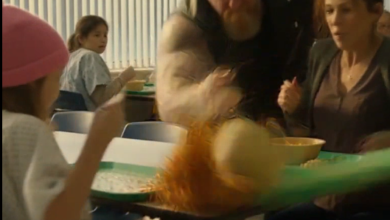
THE BAKERY OWNER ACCUSED A BIKER OF HANDING A LITTLE GIRL A BRICK—THEN SHE POINTED THROUGH THE SHATTERED GLASS AND SAID, “HE STOLE MY GRANDMA’S MONEY.”
Part 2
For a few seconds, nobody on Kinnickinnic Avenue moved.
Then the man in the navy blazer laughed. It was a short, easy laugh, the kind you’d use at a parent-teacher conference.
“Sweetheart, you’re confused,” he said through the broken window. “I’ve never seen you before in my life.”
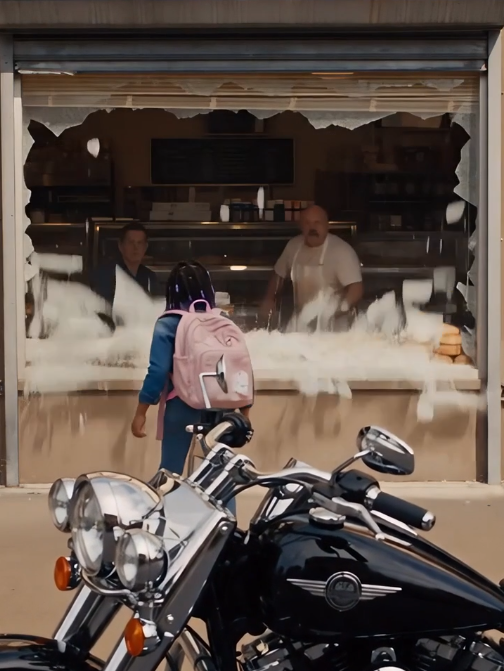
He set the cinnamon roll down on his plate, picked up his coffee, and turned toward the back hallway, where the restrooms were. Where the back door was.
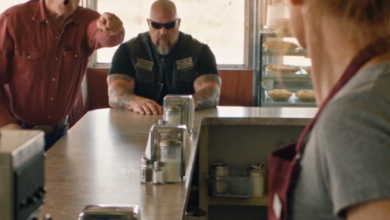
The biker stood up. He didn’t hurry. He walked through the bakery’s front door, glass crunching under his boots, and stopped in the mouth of the back hallway. He didn’t touch anyone. He just stood there, all 288 pounds of him, filling the doorway like a parked truck.
“Sit down, friend,” he said. “Police are on the way. Somebody called it in.”
The man in the blazer looked up at him. Then he sat down.
Frank stood on the sidewalk with his phone still in his hand, and a cold, sick feeling started crawling up from his stomach.
Because he remembered now.
Ten minutes earlier, during the worst of the morning rush, a little girl with purple beads in her braids had squeezed between two customers and tugged on his apron.
“Mister, a man took—”
“Not now, honey,” Frank had said, sliding a tray of cinnamon rolls into the case. “No kids in here without a grown-up. Wait outside for your mom.”
He had pointed at the door. She had gone.
Now she was standing in the glass in front of his shop, and her hands had started to shake.
“I told the bus lady,” the girl said. Her voice was small but steady. “I told a man with a dog. I told you. Nobody stopped. Everybody kept walking.”
She looked at the brick lying in the ruined pastries.
“So I made everybody stop.”
The biker had come back out to the sidewalk. He crouched down beside her again.
“What’s your name?”
“Ruby. Ruby Hayes.”
“Where’s your grandma, Ruby?”
Ruby pointed down the block. A tiny elderly woman was coming toward them on the sidewalk with a cane, moving as fast as her body would let her, a cloth tote bag swinging from her arm.
“Ruby? Ruby Jean Hayes! What on earth did you do?”
Odessa Hayes was eighty-four years old. On the third of every month, she put on her good blue coat and took the Number 15 bus to Lakeview Check Cashing, where she cashed her Social Security check. Then she sat on the bench in front of Kowalczyk’s Bakery to wait for the bus home. In the summers, when school was out and Ruby’s mother was working night shifts at St. Luke’s, Ruby came with her.
That morning, a nice man in a blazer had sat down on the bench beside them. He’d asked about Odessa’s grandchildren. He’d offered to hold her tote bag while she adjusted her cane.
And Ruby had watched his hand slip inside it.
“Grandma,” Ruby said, “check your bag.”
Odessa frowned. She opened the tote bag and dug through it. Her tissues. Her pill organizer. Her reading glasses.
Her hands stopped.
“My envelope,” she whispered. “My rent is in that envelope.”
A police cruiser turned the corner.
Officer Kim Larson stepped out, took one look at the glass, the girl, the biker, and the old woman, and went straight to the man in the blazer.
“Sir, I’m going to need you to empty your pockets.”
He stood up slowly and gave her a tired smile, like a man being patient with a silly mistake.
“Officer, I can explain—”
He reached into his blazer and pulled out not one white envelope.
But a stack of them.
Part 3
Officer Larson laid them out on the bakery counter one by one, between the coffee pot and the tip jar.
Seven envelopes.
The first one said O. Hayes — July in careful, old-fashioned cursive. Odessa pressed her hand to her mouth when she saw it.
The other six had other names. All of them were written in the same kind of shaky handwriting. One said Rent — Mama. One said Lou’s pills. One just said DON’T SPEND.
Larson’s face went hard.
“Let me guess,” she said. “These aren’t yours either.”
“Actually, Officer, they’re not,” the man said smoothly. “They belong to my clients. My name is Greg Lyle. I volunteer with Bay View Senior Ride. I drive these folks to doctors’ appointments, to the bank. Some of them ask me to hold their cash on check day so they don’t get robbed on the bus.” He shook his head sadly. “That’s what I was doing for this lady. Holding her money. She must have forgotten.”
It sounded reasonable. Frank hated how reasonable it sounded.
Odessa drew herself up to her full four foot eleven. “I have never seen this man before in my life.”
“Ma’am, with respect,” Greg said gently, “at your age, it’s easy to forget.”
Ruby made a furious little sound in her throat.
Behind the counter, Frank’s nephew Tommy cleared his throat. He was seventeen, worked the register in the summers, and spent most of his breaks fiddling with his phone. Frank had always assumed he was playing games.
“Uncle Frank,” Tommy said. “The camera.”
“What camera?”
“The one over the register. You put it in after the break-in two years ago. It points right out the front window.” Tommy swallowed. “At the bench.”
Five minutes later, they were all crowded around the little monitor in Frank’s back office. Officer Larson. Frank. Ruby and her grandmother. The biker, standing in the doorway with his arms folded.
Tommy scrolled back to 10:29.
There was the bench. There was Odessa in her blue coat, Ruby beside her. There was Greg Lyle sitting down, smiling, saying something. Odessa laughing. Greg holding the tote bag while she fixed her cane.
His hand went in. It came out with a white envelope. It went into his blazer.
It took less than two seconds.
On screen, Ruby’s head snapped toward him. She tugged on her grandmother’s sleeve. Odessa patted her hand absently, watching for the bus.
Tommy scrolled forward. At 10:41, the brick. At 10:42, the black motorcycle pulled into frame and stopped at the curb.
A full minute after the brick.
“So,” Larson said, looking out at Greg, “the biker handed her the brick from a moving motorcycle half a block away?”
Greg Lyle didn’t answer.
Larson put him in handcuffs.
Frank turned around. The biker was still standing in the office doorway. Up close, Frank could see the gray in his beard, the cracked leather of his gloves, the patch on his back: a bear’s paw, nothing else.
“I’m sorry,” Frank said. “I saw the jacket and I just assumed—”
“You saw leather,” the man said. “Happens.”
“What’s your name?”
“Russell Boone. Most people call me Grizzly.”
When he reached up to take the coffee Frank offered him, his sleeve rode up. On his right forearm was a tattoo Frank hadn’t noticed. A woman’s name, MAE, in old-fashioned script. Under it, a small white envelope. And under that, three characters: 3RD.
Before Frank could ask, Officer Larson came back in from the cruiser, frowning at her notepad.
“The other six envelopes,” she said. “I called the first two names. Both of them cashed their checks this morning at the same place. Lakeview Check Cashing, two blocks down.”
Grizzly went very still.
“Lakeview,” he said quietly. “Same place my mother cashed hers.”
Part 4
They sat on the bus bench outside while the glass company measured the window. Grizzly lowered himself onto the far end. Ruby sat in the middle, swinging her pink sneakers. Odessa clutched her recovered envelope in her lap with both hands.
Frank stood, because there wasn’t room for four.
“Mae Boone,” Grizzly said, looking at the street. “My mother. Raised me alone on a seamstress’s pay, right here in Bay View. When she got old, she lived on her Social Security check. Cashed it at Lakeview every month on the third.”
He turned his forearm over and looked at the tattoo like he was reading it for the first time.
“July 3rd, 1999. Somebody took her envelope on the bus. Whole month. Rent, groceries, her heart pills.” He was quiet for a long time. “I was deployed. She didn’t tell me. Didn’t want me to worry. She skipped her pills to make the rent.”
Ruby had stopped swinging her feet.
“She died in August,” Grizzly said. “Heart gave out. I found out about the money from her landlord, after the funeral.”
Odessa reached over Ruby’s head and put her thin hand on his huge arm.
“That’s why the envelope,” Frank said quietly. “And the third.”
Grizzly nodded. “Third of every month, I ride the check-day route. Lakeview to the bus lines, all morning. My club started doing it with me twenty years ago. Most months, nothing happens. Old folks get home with their money, and nobody even knows we were there.”
“Is that why you were here?” Ruby asked.
“I was a block behind your bus,” he said. “I saw the window go. Figured somebody needed help.”
Ruby studied him with narrowed eyes, the way kids do when they’re deciding whether to believe a grown-up.
“You knew I was telling the truth,” she said. “Before you even saw the camera. How?”
Grizzly looked at her for a long moment.
“Because nobody listened to my mother either,” he said. “And because a kid doesn’t break a window and then stand there and wait. A kid who’s stealing runs. You didn’t run.”
Ruby nodded slowly, like that made perfect sense.
The glass guy hollered something from the shop. Frank went back inside to sign the estimate. $2,800 for the window. Another few hundred for the display case.
Tommy was still in the back office, hunched over the monitor.
“Uncle Frank,” he said. “Come look at this.”
“What?”
“I went back further. Before he sat down.” Tommy pointed at the screen. “Look at what he’s doing at 10:24.”
Frank leaned in. On the grainy footage, Greg Lyle was standing at the corner, phone in his hand. He read something on the screen. Then he looked up and down the bench, slowly, the way you’d scan a grocery shelf. His eyes stopped on a tiny old woman in a blue coat.
Then he looked at his phone again.
And walked straight to her.
“Somebody texted him,” Tommy said. “Uncle Frank, somebody told him who to pick.”
Part 5
Greg Lyle was out on bail by eight o’clock the next morning.
His brother-in-law was a lawyer. By noon, Greg had posted a long, sad message on the Bay View neighborhood app, the one everybody on Kinnickinnic Avenue read with their morning coffee.
Yesterday I was humiliated and wrongfully arrested while doing what I’ve done for six years: caring for our community’s seniors. As a Senior Ride volunteer, I sometimes hold cash for clients who ask me to. A confused child smashed a local business’s window, a biker gang member intimidated me, and the police rushed to judgment. I forgive them. But I will clear my name.
It had four hundred likes by lunchtime.
Underneath, people Frank knew wrote things like Greg drove my dad to dialysis for two years, he’s a saint and Whose kid smashes a window and gets rewarded??
One of the six seniors, an eighty-eight-year-old named Lou Petrakis, even posted: Greg is a nice boy. He takes me to my eye doctor.
Then came the letter.
It arrived at the bakery by courier at two o’clock, on heavy cream-colored paper. Greg’s brother-in-law informed Mr. Kowalczyk that his client considered the statements Frank had made to a local reporter to be defamatory. He suggested Mr. Kowalczyk focus on “the actual crime committed at your establishment,” namely the destruction of property by Ruby Hayes, and advised that Mr. Lyle would “reconsider legal action” if Frank pressed vandalism charges against the child.
Frank read it three times.
Then his insurance adjuster called. To process the claim for the window, she needed a police report naming the responsible party.
“The responsible party is ten,” Frank said.
“I understand, sir. But she did throw the brick.”
That evening, a juvenile officer called too. Polite. Tired. If Frank filed the report, Ruby Hayes could be facing a vandalism petition in family court. Probably just community service. Probably.
Frank sat at his kitchen table with the insurance form in front of him and a pen in his hand.
His wife Helen put a cup of tea next to his elbow.
“It’s business, Frank,” she said gently. “Thirty-one years. You can’t eat three thousand dollars. And that man’s lawyer isn’t going away.”
“She tried to tell me, Helen. She tugged on my apron and I sent her outside.”
“I know.”
“If I’d just listened for ten seconds—”
“I know, honey.”
He stared at the blank line on the form that said Name of Responsible Party.
He didn’t sleep much.
The next morning, the new glass wasn’t in yet. Frank had nailed plywood over the hole, and the bakery felt dark inside, like a house with the curtains drawn. He was rolling out dough when the bell over the door jingled.
Grizzly came in first, ducking his head under the doorframe. Behind him came Odessa, in her blue coat. And behind her, holding something heavy with both hands, came Ruby.
It was a big glass pickle jar, full of coins and crumpled dollar bills.
Ruby marched up to the counter and set it down with a thunk.
“I came,” she said, her chin up, “to pay for your window.”
Part 6
Frank looked at the jar. Quarters, dimes, a lot of pennies. A few folded dollar bills. A strip of masking tape on the lid said RUBY’S SCOOTER FUND in marker, with SCOOTER crossed out.
“It’s fourteen dollars and thirty-seven cents,” Ruby said. “I know it’s not enough. Grandma says I can pay the rest by helping you. I can sweep. I’m really good at sweeping.”
Behind her, Odessa held out her envelope. The one with her rent in it.
“Mrs. Hayes, put that away,” Frank said, and his voice cracked so badly he had to stop.
He came around the counter and knelt down in front of Ruby, flour on his knees.
“Ruby. You tried to tell me first. Didn’t you?”
She nodded.
“And I sent you outside.”
She nodded again.
“Then this window’s on me,” Frank said. “Not you. Never you. I’m not filing anything. You hear me? Put your scooter money back.”
Ruby’s lip trembled. She hugged the jar.
Grizzly stood by the door with his hands in his jacket pockets. He didn’t smile, exactly, but something in his face loosened.
Odessa sat down heavily at the corner table. “I’ve been thinking about something all night,” she said. “That man. He knew. He walked right to me.”
“Somebody texted him,” Frank said. “Tommy found it on the tape.”
Odessa nodded slowly. “There’s a girl at Lakeview. At the window. Every month she counts out my money, and every month she asks the same thing. ‘Big plans today, hon? Taking the Number 15 home?’ Then she steps away and looks at her phone.” Odessa tapped the table. “I thought she was just friendly.”
Grizzly pulled out his phone and called someone. He spoke for about thirty seconds.
That afternoon, Officer Larson came by the bakery.
“Bay View Senior Ride confirmed Greg Lyle is a volunteer,” she said. “They also confirmed that not one of the six people whose envelopes he had ever asked him to hold their money. Two of them aren’t even his clients.”
“So he lied,” Frank said.
“He lied.” Larson set a printout on the counter. “And we got a warrant for his phone this morning. Every third of the month, for two years, he got texts from the same number.”
Frank read the top one.
Blue coat. Cane. Little girl with her. 15 bus. $1,140.
The number belonged to Darlene Kopp. A teller at Lakeview Check Cashing.
Greg Lyle’s sister-in-law.
“There’s more,” Larson said. “Greg Lyle lost his insurance job two years ago. Never told his wife. They’ve got a lake house in Delafield and two kids in private school. He’s been leaving the house in a suit every morning and coming home every night like nothing happened.” She shook her head. “We think there are at least forty victims. Most never reported it. They thought they’d just lost the money. Or they were too ashamed to say.”
Frank thought about Mae Boone, skipping her heart pills to make rent.
“So what happens now?” he asked.
“He’s charged. But he’s out on bail, and his lawyer is very good.” Larson sighed. “And the Senior Center won’t suspend him. The director says he’s innocent until proven guilty, and he’s their most popular volunteer.”
She slid a flyer across the counter. Bright yellow paper.
BAY VIEW SENIOR CENTER VOLUNTEER APPRECIATION LUNCHEON. Thursday, noon. Honoring our Volunteer of the Year: GREG LYLE.
Grizzly picked it up and read it twice.
“Then we’re going to lunch,” he said.
Part 7
The Bay View Senior Center’s community room was decorated with paper tablecloths and blue balloons. A hundred people sat at round tables eating chicken salad. At the front, beside a little podium, sat a wooden plaque with a brass plate.
Greg Lyle sat at the head table in a pressed gray suit. His wife was beside him, and two teenage kids. Three seats down sat a woman with frosted blonde hair and a Lakeview Check Cashing lanyard still around her neck.
Darlene Kopp.
The director tapped the microphone and talked about Greg for five minutes. Six years of service. Hundreds of rides. “And despite the recent misunderstanding,” she said, “we stand by him.”
Applause. Greg stood up, wiped his eyes, and stepped to the podium.
“I just want to say,” he began, “that I forgive the people who—”
The windows started to hum.
Engines. A lot of them, rolling slowly into the parking lot. Then they shut off one by one, and the silence was louder than the noise had been.
The double doors opened.
The Northbound Riders came in single file. Thirty of them. Leather jackets, bear-paw patches, gray beards, worn boots. They didn’t say a word. They lined up along the back wall and folded their hands.
And with them, walking slowly on their arms, came six senior citizens.
Lou Petrakis, eighty-eight, holding Grizzly’s elbow. A tiny woman named Marjorie with an oxygen tank. A retired mailman. Two sisters in matching cardigans. And Odessa Hayes, in her blue coat, holding Ruby’s hand.
Greg’s face went gray.
“This is a private event,” the director said, flustered.
“These folks are members here,” Grizzly said calmly. “Paid their dues.”
Frank stood up from the table nearest the door. Tommy stood beside him with a laptop.
“Excuse me,” Frank said. “I think everybody here should see something before they give out that plaque.”
The director hesitated. But a hundred faces had turned toward Frank, and she nodded.
Tommy plugged into the projector.
The room watched Greg Lyle sit down beside Odessa Hayes on a bus bench. Watched him smile. Watched his hand slip into her tote bag and come out with a white envelope.
Less than two seconds.
Somebody gasped. A woman at the front table put her fork down.
Then Officer Larson walked in, with a detective in plain clothes behind her. Larson didn’t go to Greg. She went straight to Darlene Kopp.
“Ms. Kopp,” she said, loud enough for the room, “can you tell me what ‘Blue coat, cane, little girl with her, 15 bus, eleven-forty’ means?”
Darlene’s coffee cup tipped over. She didn’t pick it up.
At the back of the room, Lou Petrakis pushed himself to his feet.
“Greg,” the old man said, his voice shaking. “You told the police you held my money for me. You never held a dime of mine. Last October, I had to borrow my rent from my daughter. I thought I was losing my mind.”
Greg’s wife turned in her chair and stared at her husband.
“You told me you got a promotion,” she said. “Two years ago. You said you got a promotion.”
Greg opened his mouth. Nothing came out.
The detective put him in handcuffs at the podium, right next to the Volunteer of the Year plaque. Larson cuffed Darlene at the head table.
The room was dead silent as they were walked out past thirty bikers standing perfectly still against the back wall.
Odessa Hayes didn’t watch them go.
She was staring at Grizzly. Specifically, at his right forearm, where his sleeve had ridden up when he reached to steady Lou.
She crossed the room, slow on her cane, and took his wrist in both of her small hands. She turned his arm toward the light.
“Where,” she whispered, “did you get this name?”
Part 8
“My mother,” Grizzly said. “Mae Boone.”
Odessa’s hands tightened on his wrist.
“Red church hat,” she said slowly. “Always the red hat, even in July. Sat in the third seat on the Number 15 so she could see the lake.”
Grizzly didn’t move. He didn’t seem to breathe.
“We rode that bus together for six years,” Odessa said. “Every third of the month. She showed me pictures of her boy in his uniform. Her Russell. Overseas.”
Frank watched the big biker’s face crumple.
“I was on the bench that day,” Odessa said, her voice breaking. “July of ’99. When she found her envelope gone. I held her hand while she cried. And she made me promise. She said, ‘Odessa, don’t you dare tell my boy. He’s got enough to carry.'”
She looked up at him with wet eyes.
“I kept that promise twenty-five years, son. I’m sorry. I’m so sorry. I should have told somebody.”
Grizzly, who was six-foot-three and close to three hundred pounds, sank down slowly into a folding chair so he could be eye level with her. Then he put his arms around that tiny old woman and held on while thirty silent bikers looked anywhere else in the room.
Ruby climbed into the chair next to him and leaned against his side like she’d known him her whole life.
Greg Lyle pleaded guilty in October to multiple counts of theft from vulnerable adults. Police eventually identified forty-three victims over two years. He was sentenced to prison and ordered to pay full restitution. His lake house was sold to pay it. Darlene Kopp was fired, charged, and pleaded guilty as well. Lakeview Check Cashing installed new privacy rules for its tellers and a security guard on the third of every month.
The six envelopes Officer Larson recovered were returned to their owners the same week. Lou Petrakis paid his daughter back first thing.
The Senior Center gave its Volunteer of the Year plaque to someone else. Ruby nominated Officer Larson.
The new glass went into Kowalczyk’s Bakery on a Tuesday. Frank didn’t send anyone a bill. Not the Hayes family. Not the insurance company. He paid for it himself.
And down in the bottom right corner of the window, in small, neat gold letters, he had the glass company paint a single line:
Thank you to the little girl who broke this window.
The Northbound Riders took up a collection that same month and paid for security cameras on every storefront along that stretch of Kinnickinnic Avenue. The hardware store. The barber. The laundromat. The dentist. All of them, pointed at the sidewalks and the bus benches.
On the third of every month now, a black bagger pulls up outside Odessa Hayes’s apartment at 9 a.m. sharp. Grizzly rides behind the Number 15 all the way to Lakeview and all the way home. Odessa says she’s never felt so safe in her life, and also that the motorcycle is much too loud.
Every Sunday morning, Ruby walks into Kowalczyk’s Bakery and orders whatever she wants. It’s free. There’s a handwritten card taped to the register that says so: RUBY HAYES — ON THE HOUSE EVERY SUNDAY UNTIL SHE’S 18. NO EXCEPTIONS. — F.K.
She always orders two cinnamon rolls.
One for herself. One wrapped in wax paper to bring to the man waiting outside on his motorcycle.
And on the shelf behind the register, between the cash drawer and a framed photo of Frank’s late father, sits an ordinary red brick with a little brass plate glued to the front.
Frank had it engraved himself. It says: SOMEBODY HAS TO MAKE THEM LOOK.
A whole street saw a big biker in a leather jacket and decided he was the reason a little girl was holding a brick. They trusted the man in the blazer with the nice smile and the volunteer badge.
The biker was the only one who knelt down and asked her what was wrong. Next time someone small tries to tell you something, don’t look at their size, and don’t look at the leather on the person standing next to them. Just stop. And listen.
If this story stayed with you, follow our page for more stories about the people who stop when everyone else keeps walking.