Part 2: A Daughter Was Ashamed to Introduce Her Garbage Collector Father — Until She Saw What He Did Every Morning
Part 2
Thomas Miller came home at 5:26 that evening carrying the smell of cold air, diesel exhaust, wet cardboard, and the industrial soap used at the sanitation yard.
Sophie heard his key turn while she sat at the kitchen table pretending to study chemistry.
Usually, Thomas announced himself with the same tired joke.
“Your favorite sanitation professional has returned.”
Sometimes Sophie smiled. Sometimes she rolled her eyes. When she was younger, she ran to him before he removed his work jacket, wrapping both arms around his waist even when he warned that he smelled terrible.
That evening, he said nothing.
He removed his boots on the mat, hung the orange jacket near the back door, and walked to the sink. He scrubbed his hands longer than usual, cleaning beneath the nails with a small brush while the water turned gray around his fingers.
Sophie stared at the open textbook.
The words blurred.
Thomas prepared tomato soup from a can, made two grilled cheese sandwiches, and placed one plate in front of her.
“You have rehearsal tomorrow?” he asked.
She nodded.
“What time should I pick you up?”
“I can take the bus.”
“After dark?”
“Madison’s mom can drive me.”
Thomas paused.
“Did she offer?”
“She will.”
He looked at Sophie for a moment, then returned to the stove.
That was how Thomas handled pain. He moved it somewhere practical.
A lunch bag became dinner.
An insult became a ride home.
A daughter’s lie became a question about rehearsal.
Sophie almost apologized three times.
The first time, Thomas asked whether she needed more soup.
The second time, his phone rang.
The third time, she looked at his rough hands around the coffee mug and remembered Madison asking, “Is that your dad?”
The answer had been yes.
She had still said no.
Thomas’s phone call came from someone named Mrs. Reed.
Sophie knew most of the people in her father’s life: sanitation workers, neighbors, the mechanic who kept their old sedan alive, and members of the small church Thomas attended twice a month. She did not know Mrs. Reed.
“Yes, ma’am,” Thomas said quietly. “I found two good ones today.”
He listened.
“No, you don’t owe me anything.”
Another pause.
“I’ll leave them near the side door before six.”
Sophie glanced up.
Thomas turned slightly away.
“And tell Kevin the red one still has all its pieces.”
When the call ended, Sophie asked, “What did you find?”
Thomas opened the refrigerator.
“Nothing important.”
The answer did not sound secretive.
It sounded protective.
That was the first small detail Sophie could not explain.
The second came after midnight.
She woke thirsty and found the kitchen light on. Thomas sat at the table with a cardboard box in front of him. Inside were small plastic trucks, building blocks, two children’s books, a stuffed bear, and a red remote-control car with one missing wheel.
He had spread old newspaper beneath the toys.
Beside him were disinfectant wipes, a screwdriver, batteries, glue, and a sewing kit.
Sophie stayed in the dark hallway.
Thomas cleaned every object carefully.
He stitched a tear beneath the stuffed bear’s arm. He replaced the missing wheel on the toy car using a small black wheel from another broken toy. He tested the battery compartment, smiled when the car’s headlights came on, then removed the batteries and taped them in a plastic bag so they would not leak.
Next, he opened one of the children’s books.
A birthday message had been written inside the cover.
To Henry, our little explorer. Love, Grandma.
Thomas stared at it for a long time.
Then he closed the book and placed it in a separate bag rather than the donation box.
Sophie stepped into the kitchen.
Thomas looked up.
“You okay?”
“What are you doing?”
“Couldn’t sleep.”
“With garbage?”
His expression tightened almost invisibly.
“Things people set out.”
“That’s garbage.”
“Sometimes.”
He picked up the red car.
“Sometimes people throw something away because one piece is broken.”
He did not look at Sophie when he said it.
She wondered whether he was still talking about toys.
Thomas packed the repaired items into two clean cardboard boxes. One was marked with a simple blue dot. The other had a green dot.
“What do the colors mean?” Sophie asked.
“Different stops.”
“On your route?”
“Something like that.”
He stood and carried the boxes toward the mudroom.
Sophie watched him hide them beneath a clean tarp in the back of their old station wagon.
Her father’s garbage route began at 4:45 every morning.
By 4:20, he was usually gone.
The following morning, Sophie woke at 4:07.
Guilt had kept her sleeping badly since the school steps. She heard the quiet scrape of Thomas’s boots against the floor and the click of the back door. She looked through her bedroom window expecting to see him drive toward the municipal yard.
Instead, the station wagon left first.
Thomas returned twenty minutes later on foot, climbed into the garbage truck his partner had parked at the corner, and turned north toward streets outside his assigned neighborhood.
Sophie dressed quickly.
She put on jeans, a winter jacket, and a knit cap. Then she wheeled her bicycle through the back gate so Thomas would not hear.
The air was painfully cold.
Her breath clouded in front of her. The streets were empty except for porch lights, newspaper delivery cars, and the orange blink of the garbage truck several blocks ahead.
Thomas turned onto Linden Street.
Sophie stopped beneath a dark maple tree.
He parked beside a small rental house with peeling paint and a plastic sheet covering one downstairs window. No garbage bins waited at the curb.
Thomas climbed down holding the green-dot box.
He walked quietly to the side door and placed it beneath the porch light.
Before he could turn away, the door opened.
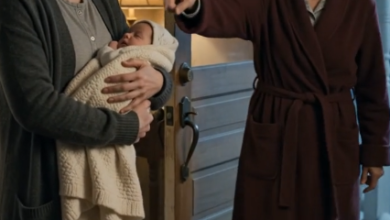
A woman in a nursing uniform stood there, holding a little boy wrapped in a blanket.
Mrs. Reed.
The boy saw the red car through the open box and gasped.
“Is that for Kevin?”
Thomas nodded.
“Someone didn’t need it anymore.”
The woman’s eyes filled.
“You fixed it.”
“Just the wheel.”
“You always say ‘just.’”
Thomas glanced toward the truck.
“I have to go.”
The little boy wriggled from his mother’s arms and ran onto the porch in socks. He hugged Thomas around the knees.
Thomas froze, then rested one gloved hand gently on the child’s head.
Sophie gripped her bicycle handlebars.
Her father had not found garbage.
He had found a birthday present.
That was the first reveal.
The work everyone mocked gave Thomas access to objects families discarded, but he saw value where other people saw inconvenience.
He did not simply collect trash.
He rescued what could still become joy.
Thomas drove to another house.
Sophie followed.
At the second stop, he left the blue-dot box beside the door of a small apartment building. Inside were books, a clean winter coat, and the repaired stuffed bear.
An older Black American woman opened the door before he reached the truck.
“You’re early,” she whispered.
“Roads are clear.”
She handed him a thermos.
“Coffee.”
“You don’t need to do that, Miss Gloria.”
“You don’t need to repair half the neighborhood before sunrise.”
Thomas smiled.
Then Miss Gloria noticed Sophie across the street.
The girl lowered her head, but it was too late.
The older woman looked from Sophie to Thomas.
“Someone following you?”
Thomas turned.
His face changed when he saw his daughter.
Not anger.
Not embarrassment.
Fear.
“Sophie?”
She stood beside the bicycle, shivering.
“What are you doing out here?”
She looked at the box, the apartment door, and the stuffed bear now held by a little girl in pink pajamas.
“I wanted to know where you went.”
Thomas’s shoulders lowered.
“You shouldn’t be riding alone before daylight.”
“I’m sixteen.”
“That doesn’t make the road brighter.”
Even then, after she had denied him in front of her friends, his first instinct was still to keep her safe.
That was the second reveal.
Sophie waited for him to mention the school.
He did not.
Instead, Thomas lifted her bicycle into the empty rack behind the truck and told her to sit inside the cab.
His partner, Eddie Collins, a fifty-five-year-old Black American man with a salt-and-pepper beard, watched her climb in.
“So,” Eddie said, handing her a spare safety vest, “the secret inspector finally joins us.”
Sophie looked at him.
“What secret?”
Eddie glanced at Thomas.
Thomas stared through the windshield.
“Your father doesn’t like people making a fuss.”
The truck pulled away.
On the dashboard sat a handwritten list of addresses, clothing sizes, birthdays, food allergies, and small notes.
Reed—Kevin turns seven. Cars, dinosaurs.
Gloria—girl age five, coat size six.
Mendez—baby blankets, no wool.
Harper—check porch light.
Sophie read the list twice.
“These are families on your garbage route?”
“Some.”
“How long have you been doing this?”
Thomas adjusted the mirror.
“Long enough.”
Eddie laughed softly.
“Since before you lost your baby teeth.”
Thomas gave him a warning look.
But the third reveal had already arrived.
This was not a recent act of guilt or charity.
For years, Thomas had quietly built a network from the things his job allowed him to notice: which homes had eviction notices, which families moved suddenly, which elderly residents stopped putting out food containers, which children watched discarded bicycles from apartment windows.
He collected more than waste.
He collected signs that someone needed help.
Part 3
The garbage truck moved through the sleeping city with its yellow hazard lights blinking against dark windows.
Sophie had ridden in the truck once when she was six, during a family open house at the sanitation department. She remembered feeling proud of how high the cab sat and how her father could operate the mechanical arm with steady precision.
At sixteen, she noticed different things.
The cracks in the vinyl seat.
The heater that blew warm air only after being struck twice.
The black coffee stain near the radio.
The compression bandage wrapped beneath Thomas’s right glove.
“You hurt your wrist?” she asked.
Thomas glanced at it.
“Just sore.”
Eddie snorted.
“Since October.”
Thomas looked at him.
“Drive.”
“I am driving.”
“Then concentrate.”
Sophie watched her father flex his hand when he thought she had turned away.
She remembered asking for money for a school winter formal in October. The dress, shoes, ticket, and dinner had cost more than she originally admitted. Thomas had taken extra Saturday routes and told her the overtime was no trouble.
Now she wondered what those Saturdays had cost him.
The truck stopped near a row of townhouses.
Thomas climbed down and checked a garbage bin beside the curb. He lifted one bag, tied the loose top securely, then rolled the bin toward the mechanical arm.
An elderly man watched through the front window.
Thomas waved.
Before leaving, he carried the man’s newspaper from the sidewalk to the porch and placed it against the door where it would stay dry.
“Does he pay you to do that?” Sophie asked when Thomas returned.
“No.”
“Then why?”
“He walks with a cane.”
The answer contained no heroism.
Only observation.
At another house, Thomas noticed that three garbage bags contained unopened canned food.
He did not take them.
Instead, he knocked on the door.
A tired-looking man answered wearing a warehouse uniform.
“Everything okay, Mr. Mendez?”
The man rubbed his face.
“Moving today. Landlord wants the place cleared.”
Thomas glanced toward two young children sitting among boxes inside.
“Those cans expired?”
“No. No room in the car.”
Thomas looked at Eddie.
Eddie already knew.
They loaded the food into a clean container rather than the compactor. Thomas wrote something on his list.
“I’ll take it to the church pantry,” he told Mr. Mendez. “They can hold some boxes too, if you need.”
The man’s eyes filled.
“I didn’t ask—”
“I know.”
That was the fourth reveal.
Thomas did not help only by returning discarded things. He prevented useful things from disappearing when people were too overwhelmed to protect them.
At 6:02, the truck turned onto Windsor Avenue, a wealthy neighborhood with brick homes, three-car garages, and trash bins aligned like soldiers.
Sophie recognized the street.
Madison Clark lived there.
Her stomach tightened.
“Can I wait in the truck?” she asked.
Thomas looked at her.
“You can.”
He did not ask why.
Sophie sank lower in the seat as Thomas and Eddie worked along the curb. She saw exercise equipment, furniture, electronics, and bags of clothing set beside oversized bins. Objects that could have changed another family’s month had been placed outside because they no longer matched someone’s room.
Thomas separated what was legally reusable under city policy and tagged the items for the municipal recovery center. Some residents had already attached donation labels, but many had not.
At Madison’s house, the garage door opened.
Madison stepped outside carrying a large white trash bag. She wore expensive pajamas beneath a puffer coat and looked annoyed by the cold. Behind her, Madison’s mother dragged out a nearly new desk chair.
Sophie slid farther down.
Thomas lifted the chair.
“This still works?” he asked.
Mrs. Clark nodded.
“We redecorated.”
“Would you mind if it goes to the reuse center instead of disposal?”
“Whatever gets it off the driveway.”
Madison glanced toward the truck cab.
Her eyes met Sophie’s.
For one terrible second, neither moved.
Then Madison smiled.
Not kindly.
“You’re riding with the garbage crew now?”
Sophie’s old instinct returned.
Deny.
Hide.
Become smaller before someone else could make her small.
Then she saw her father standing in the cold, one sore wrist beneath his glove, holding a chair that would become someone else’s study desk because he had cared enough to ask.
Sophie opened the truck door.
“My dad’s teaching me his route.”
Madison’s smile faltered.
Thomas looked over.
Sophie stepped down wearing the spare safety vest.
Madison’s mother glanced between them.
“You’re Tom’s daughter?”
Sophie felt the old heat in her cheeks.
This time, she did not run from it.
“Yes.”
Thomas did not smile immediately.
The school-step wound still existed between them.
But something softened in his eyes.
Madison looked at the truck.
“You said he wasn’t your dad.”
Sophie swallowed.
“I lied.”
The word hurt.
It also freed something.
Madison looked uncomfortable now that cruelty had been answered with honesty instead of defense.
Sophie walked toward the white bag.
“What’s in there?”
“Old clothes.”
“Are they clean?”
Madison shrugged.
“My mom said throw them out.”
Thomas stepped closer.
“Sophie, you don’t need to—”
“Yes,” she said. “I do.”
She opened the bag with Mrs. Clark’s permission. Inside were sweaters, jeans, two winter coats, and a dark blue dress with the original store tag still attached.
Sophie touched the dress.
It looked similar to the one she had worn to the winter formal.
“How much of this gets thrown away every week?” she asked.
Thomas looked down the street.
“Enough.”
Madison crossed her arms.
“Why do you care?”
Sophie looked at her.
“Because my dad knows children who need coats more than we need to protect ourselves from being seen near garbage.”
The sentence was sharper than she intended.
Madison’s face reddened.
Thomas did not praise Sophie.
He only said, “Fold what can be reused. Torn things go separately.”
That was Thomas.
Even emotional moments became a task that could help someone.
They folded the clothes together.
Madison did not join at first. Then her mother handed her a coat and told her to check the pockets.
The dark blue dress contained twenty dollars in an envelope from a birthday card.
Mrs. Clark stared at it.
“I forgot that was there.”
Thomas handed it back.
Sophie watched.
He could have kept it for one of his families.
He did not.
Kindness, she realized, was not taking whatever could be justified.
It was protecting dignity even when no one would know.
The route ended near Westbrook Elementary School.
Thomas parked beside a small service entrance. Sophie assumed they were emptying school dumpsters.
Instead, three cafeteria workers came outside.
One carried a box of sealed breakfast cereal cups. Another had packaged apples and unopened milk cartons that were still safe under district food recovery rules.
Thomas loaded the items into insulated containers.
“What’s this for?” Sophie asked.
“A breakfast shelf at the community center.”
“Who uses it?”
“Anyone who needs breakfast.”
“Students from my school?”
“Maybe.”
“Do you know who?”
“No.”
“Why not?”
Thomas looked at her.
“Because hungry people shouldn’t have to introduce themselves.”
That was the main reversal.
Sophie had been ashamed to introduce her father because she believed his job made him smaller.
Thomas had spent years helping people without forcing them to introduce themselves at all.
He understood the weight of being seen at the wrong moment.
He understood shame.
And he refused to use it as the price of kindness.
Sophie turned away, crying before she could stop herself.
Thomas noticed.
“Hey.”
She shook her head.
“I’m sorry.”
“For what?”
“You know what.”
He removed one glove.
His hand was red, scarred, and swollen at the wrist.
Sophie looked at it, then at his face.
“At school,” she said. “I said you weren’t my dad.”
Thomas lowered his eyes.
“I heard.”
“Why didn’t you say anything?”
“You were trying to survive a moment.”
“That doesn’t make it okay.”
“No.”
His honesty hurt more than easy forgiveness would have.
Sophie wiped her face.
“You should be angry.”
“I was.”
“Are you still?”
Thomas looked toward the elementary school windows beginning to glow as teachers arrived.
“Some.”
She nodded, accepting it.
Then Thomas said, “But being hurt by your child and stopping loving her are two different things.”
Sophie covered her mouth.
Eddie looked away and busied himself checking the truck, giving them privacy inside an open parking lot.
Thomas continued.
“I know my job embarrasses you.”
“It shouldn’t.”
“That isn’t the same as saying it doesn’t.”
Sophie looked at the garbage truck, the recovered food, the coats, the repaired toys, and the handwritten list of families.
“I didn’t know.”
Thomas nodded.
“You didn’t ask.”
Those words stayed with her.
She had spent years noticing the smell of his uniform, the noise of the truck, and the reactions of other children.
She had never asked what he saw each morning.
Part 4
The following Monday, Thomas returned to Westbrook High School.
Not because Sophie forgot her lunch.
The school’s environmental science teacher, Mrs. Bennett, had invited a representative from the municipal sanitation department to speak about waste, recycling, and the city’s material recovery program. Thomas had been scheduled for the presentation months earlier, though Sophie knew nothing about it.
When she saw his name on the classroom agenda, panic tightened her stomach.
A week earlier, she would have begged him to cancel.
Instead, she walked to the auditorium before the first bell and found him standing near the stage in a clean navy work uniform. He had combed his hair carefully. His orange jacket rested over one chair. In his hands was a clear plastic container filled with objects rescued from disposal: a toy wheel, a repaired book, a metal hinge, a child’s mitten, and a cracked wooden picture frame.
“You nervous?” Sophie asked.
Thomas looked at the empty seats.
“I talk to garbage cans most mornings. They interrupt less.”
She laughed.
Then she adjusted his collar.
For a second, he looked surprised.
Sophie almost said, “I’m proud of you.”
The words felt too large and too late.
So she said, “Your collar was folded.”
Thomas nodded.
“I appreciate the rescue.”
Students filled the auditorium.
Madison arrived with two friends and sat several rows behind Sophie. She did not make a joke. In fact, she avoided looking at Thomas until he began speaking.
Thomas did not tell the students about Mrs. Reed, Kevin’s birthday, Miss Gloria, the Mendez family, or the breakfast shelf. Those stories did not belong to him alone.
He explained how much waste the city collected, how contamination ruined recyclable materials, and how objects in good condition could be redirected to approved recovery programs. He showed them a nearly new winter coat someone had discarded because of a broken zipper.
He held up the repaired zipper.
“Some items are trash,” he said. “Some are materials. Some are mistakes made by people who didn’t look twice.”
Sophie felt the sentence move through her.
Thomas displayed a photograph of the city recovery center, where furniture, bicycles, tools, and household goods were cleaned, repaired, and distributed through local nonprofits.
A student raised his hand.
“Do you ever find money?”
“Yes.”
“Do you keep it?”
“No.”
“Why not?”
Thomas seemed confused by the question.
“Because it isn’t mine.”
Several students shifted.
Another asked about the worst thing he had found.
Thomas looked toward Sophie briefly.
“The worst things aren’t always dirty,” he said. “Sometimes they’re letters, photographs, toys with a child’s name written underneath. Things thrown away during hard days.”
The auditorium grew quieter.
“Do you save them?” Mrs. Bennett asked.
“When policy allows, we try to return personal items. Otherwise, we make sure useful materials go somewhere safe.”
He did not call himself kind.
He described a system.
That made Sophie understand him even more.
Thomas did not want to be admired for rescuing people from suffering. He wanted fewer things—and fewer people—to be treated as disposable.
At the end, Mrs. Bennett thanked him.
Students applauded politely at first.
Then a boy from Sophie’s history class stood.
He was someone whose family had received a refurbished bicycle from the recovery center the previous Christmas. Sophie did not know that until he spoke.
“My little brother got one of those bikes,” he said. “He rides it every day.”
The applause changed.
Not louder because of spectacle.
Warmer because the work had acquired a face.
Another student said her grandmother received a repaired heater through the community center.
A cafeteria worker near the side wall wiped her eyes.
Thomas looked uncomfortable.
He preferred machines, routes, and lists to gratitude.
Then Madison raised her hand.
Sophie held her breath.
Madison stood.
“Mr. Miller,” she said, “I laughed at your truck last week.”
A murmur moved through the room.
Thomas did not look at Sophie.
Madison continued.
“I also laughed when Sophie said—”
Sophie stood.
“I’ll say it.”
The room turned toward her.
Her heartbeat pounded painfully against her ribs.
She looked at her father.
“Last Monday, my dad brought my lunch to school. When my friends asked who he was, I said I didn’t know him.”
Thomas’s face remained still.
Sophie forced herself to continue.
“I was embarrassed by his uniform, his truck, and the smell of his work clothes. Then I followed him one morning and saw him repairing toys, saving food, returning personal things, and helping families before most of us were awake.”
The auditorium was silent.
Sophie’s voice shook.
“I thought his job was about taking away what people didn’t want. But he spends every morning noticing what people still need.”
Thomas lowered his head.
Sophie looked at the students.
“I denied my father because I was afraid his work made me look small. It turns out the smallest thing in that moment was me.”
She did not ask for applause.
She did not dramatize forgiveness.
She sat down.
For several seconds, nobody moved.
Then Thomas stepped away from the microphone.
He walked down from the stage and stopped beside her row.
Sophie stood again.
He opened his arms.
She crossed the small distance and hugged him, pressing her face against the clean navy uniform she had once feared would make her smell like garbage.
Thomas held her tightly.
“I’m sorry,” she whispered.
“I know.”
“Are you still angry?”
“A little.”
She laughed through tears.
“Okay.”
“But I’m here.”
That answer was enough.
After the presentation, Westbrook High School started a student-led recovery drive. Mrs. Bennett insisted it would not become an excuse to dump broken junk on people with fewer resources. Every donated item had to be clean, functional, complete, or repairable by a volunteer who committed to doing the work.
Thomas helped design the rules.
Madison joined the clothing team.
At first, Sophie suspected she was performing guilt. Then Madison began arriving early, sorting quietly and checking every zipper. She convinced her mother’s neighborhood association to create a monthly reuse collection rather than sending usable items directly to landfill.
One afternoon, Madison held up a pair of expensive boots with cracked soles.
“Donate or trash?” she asked.
Sophie examined them.
“Would you wear them?”
“Not like this.”
“Then repair first.”
Madison nodded and placed them in the cobbler bin.
Thomas’s standard had traveled.
Would you give this to someone you loved?
Months passed.
Sophie began waking early every second Saturday to join her father’s approved recovery route. She wore gloves, reflective gear, and boots Thomas bought used from another city worker. She learned to separate safe materials, recognize personal items, document recovered valuables, and never assume a family wanted help simply because she believed they needed it.
Thomas taught her to knock gently.
To stand away from doors.
To offer choices instead of instructions.
To leave without demanding thanks.
Mrs. Reed’s son Kevin eventually outgrew the repaired red car and donated it back with a handwritten note taped underneath.
For the next kid.
Thomas found the note while cleaning the toy.
He handed it to Sophie without speaking.
She folded it and placed it inside the truck’s glove compartment beside the route list.
The sunflower lunch bag remained there too.
Thomas had picked it up from the school wall after Sophie walked away that terrible afternoon. He had washed it, dried it, and kept it rather than returning it immediately.
When Sophie found it, the faded drawing from her mother was still visible.
Her mother, Laura, had died when Sophie was nine after a long illness. Before she became sick, Laura drew sunflowers on lunch bags, grocery notes, birthday cards, and sometimes directly onto Sophie’s hand when they waited in doctors’ offices.
“You kept this?” Sophie asked.
Thomas nodded.
“I didn’t want it thrown away.”
The words carried more than the bag.
Sophie pressed it against her chest.
She finally understood where her father’s habit had begun.
During Laura’s illness, medical supplies, food containers, flowers, cards, and household items passed through their home in waves. After the funeral, relatives offered to clear everything quickly so Thomas and Sophie would not have to face it.
Thomas refused.
He sorted each object himself.
He saved Laura’s handwritten recipes, donated unopened supplies, returned borrowed equipment, and repaired a small wooden music box Sophie had broken during a tantrum.
Loss had taught him that people sometimes throw things away because grief makes decisions faster than love.
After that, he started looking twice.
That was the final private reveal.
Thomas’s morning kindness was not born from a need to be heroic.
It was born from knowing how easily pain can make someone discard what they later need.
Years later, Sophie would leave Westbrook for college to study social work and environmental policy. She would write application essays about material recovery, dignity, and the hidden social map sanitation workers see before most city officials arrive at their desks.
But on the morning she left home, none of that mattered.
Her suitcase sat by the door.
Thomas stood beside the station wagon checking the tires, though he had checked them twice already.
Sophie wore the faded burgundy hoodie from high school and carried the sunflower lunch bag in one hand.
“You’re taking that?” Thomas asked.
“For the drive.”
“It barely closes.”
“So does your toolbox.”
He smiled.
Then the municipal garbage truck turned onto their street.
Eddie leaned on the horn.
Thomas waved.
Sophie looked at the truck that had once filled her with shame. Its paint was scratched. Its side panels were stained. The mechanical arm rattled. Inside the cab were lists, gloves, thermoses, and a thousand mornings nobody applauded.
She walked to the curb as Eddie slowed down.
Thomas looked at her.
“What are you doing?”
Sophie raised her phone.
“I want a picture.”
“With the truck?”
“With my dad.”
Thomas hesitated.
He still wore his work uniform because he planned to take an afternoon route after driving her to campus.
Sophie stepped beside him and handed Eddie the phone.
“Get the whole truck,” she said.
Thomas looked at his daughter.
“You sure?”
She heard the school steps inside that question.
The lunch bag.
“My mistake.”
The lie that had sat between them until she finally named it.
Sophie slipped one arm through his.
“I should have done this years ago.”
Eddie took the photograph.
Thomas did not smile widely. He never did. But his tired blue eyes softened, and his scarred hand rested over Sophie’s on his arm.
Behind them, the garbage truck waited in the morning light.
Not glamorous.
Not clean.
Necessary.
Sophie posted the photograph only once, with a caption containing six words:
My father notices what others discard.
Then she put the phone away before comments arrived.
The photograph was not an apology performed for strangers.
It was an introduction finally given correctly.
On the drive to college, Thomas stopped at a community center to leave two repaired lamps, a box of children’s books, and the red car Kevin had returned for the next child.
Sophie carried the books inside.
When she came back, Thomas was waiting beside the station wagon, the passenger door open.
“You ready?” he asked.
She looked at him, his uniform, and the road ahead.
“Yes, Dad.”
This time, she said it loudly enough for everyone nearby to hear.
Follow this page for more heartfelt stories about family, dignity, and the quiet people who see value where the world sees something disposable. 🌷