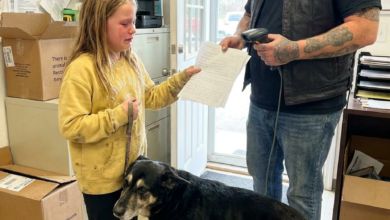
Part 2: A Tattooed Biker Sat Outside a Donut Shop All Night With a Forgotten Seven-Year-Old — When Her Father Finally Arrived, He Didn’t Get the Anger He Expected
Part 2 — The Gloves in My Saddlebag
The ride I canceled was for my older brother, Tommy. He had died the previous winter, and our club had promised his wife we’d ride his favorite stretch of road together at sunrise, then have breakfast at the place where he always ordered too much bacon.
I was supposed to lead it. His old gloves were in my saddlebag.
Deke, our president, had watched me spend three months finding reasons to stay busy whenever somebody mentioned Tommy. Missing the ride looked bad from where he stood. I understood that. I also understood how much easier it would have been to start my motorcycle than remain beside a child whose excuses sounded familiar.
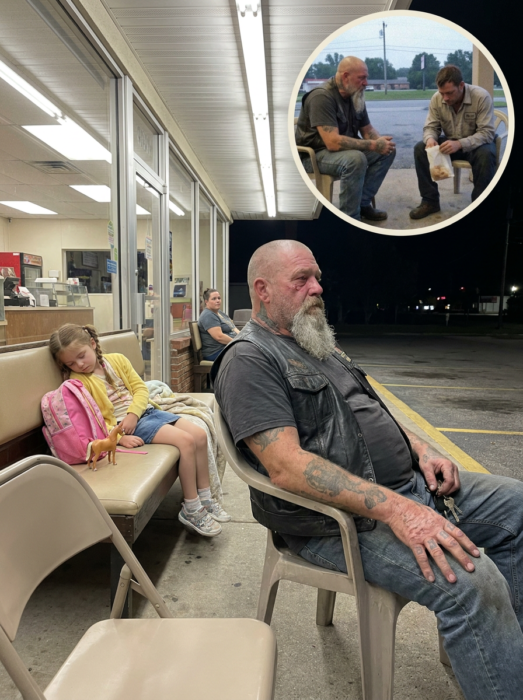
Years before, my daughter Beth used to explain me to other people.
Dad’s working. Dad’s tired. Dad forgot his phone.
Sometimes I was working. Sometimes I was asleep on a friend’s couch with a bottle on the floor. By the time I finally got help and stopped drinking, Beth had learned to make plans that didn’t include me.
She was thirty-one now. We exchanged a few messages a year. She had never told me I was unforgivable. What she had said, the last time I tried to make a visit happen too quickly, was that my getting better didn’t require her to get comfortable on my schedule.
I carried that sentence more carefully than my sobriety token.
Lena came outside around eleven with a cheese sandwich cut into four squares. She set it beside Maddie without asking whether she deserved a treat for being patient.
“Mom says she’s on the highway,” she told her.
Maddie nodded, then glanced toward the driveway. “Does Daddy know she’s coming?”
“We’ve left him messages.”
“He might feel bad if everybody comes.”
Lena sat down. She was younger than her brother, with his same straight eyebrows and the exhausted movements of somebody who had been solving his small emergencies for years. She placed her hand beside Maddie’s, not over it.
“You didn’t make any of these phone calls,” she said. “You haven’t done anything wrong.”
Maddie pulled the crust off one sandwich square. Then she asked whether she could have a napkin. The big things were too big, so she handled a small one.
When Lena returned to the counter, she told me the ordinary facts. Aaron was thirty-five. He and Maddie’s mother had separated the previous year. There was a parenting arrangement, and this was supposed to be his overnight after Maddie spent the afternoon with her aunt.
Her mother had gone to help her own father after an operation. When Lena called, she immediately packed and headed back.
“Aaron said he was finishing a job,” Lena said. “He’s a mechanic. He said eight.”
She didn’t offer me a childhood explanation or a tragic excuse. She watched her niece peel a piece of lettuce off the bread.
“I should’ve made him answer before I told her he was coming.”
“You believed your brother,” I said.
“I knew better.”
I didn’t tell her she should have stopped loving him sooner. People like Aaron, people like I used to be, leave other people arguing with themselves long after the room goes quiet.
The officer who stopped by was named Ruiz. He spoke with Lena inside first, then crouched near Maddie’s chair and introduced himself. He didn’t ask her to give a speech about her father in front of me.
He asked whether she felt okay, and whether she wanted to sit with her aunt.
She said she could see her aunt through the door.
He checked the arrangements with her mother by phone. Maddie would stay with Lena until her mother arrived; no one was going to put her into a car simply because the missing adult eventually appeared. Before Ruiz left, he asked for my name, too.
I gave it to him. Being willing to help didn’t make me exempt from being checked.
After midnight, June handed me fresh coffee and said, “You can go home, Ray. We’ve got her.”
I’d been buying coffee there for years. June knew my usual order, knew Tommy, knew that the quieter I became, the more likely I was to be arguing with someone who wasn’t in the room.
“I know,” I said.
She looked at the little girl, then back at me. “Good. Stay because you want to. Don’t start imagining nobody else can.”
That landed where it needed to.
Maddie wanted to know whether the faded scar on my hand came from fighting. I told her it came from being careless with a garage door spring.
“Did somebody tell you not to?”
“Yes.”
She considered that for a moment. “Then it was probably extra embarrassing.”
I laughed hard enough that Lena turned around inside.
Later we counted delivery trucks, naming the colors instead of the companies. Maddie corrected me when I called one purple that was apparently burgundy. She told me her second-grade teacher had a lizard, but the lizard belonged to the whole classroom emotionally.
I asked her what “emotionally” meant.
“It means you can’t take him home.”
That was the child her father was missing. Not a sad little figure in a parking lot. A whole person with opinions about lizards and truck paint and whether chocolate frosting counted as a vegetable because chocolate started as a plant.
Around one, she tucked the paper bag under her chair again.
“If he gets here and I’m sleeping,” she said, “can you tell him I waited?”
I promised I would tell him exactly that.
Part 3 — The Man Who Arrived After Daylight
Deke arrived at half past two. I heard his Harley before I saw it, the low uneven rumble slipping under the highway noise. He parked beside mine and took his gloves off one finger at a time.
He had brought Tommy’s widow, Ruth, in on the change of plans. Someone else would lead. They would still go. He said it without making me thank him.
Then he looked through the shop window at Maddie, who had gone inside with Lena to wash her hands.
“June’s here. The aunt’s here. Her mother’s coming.”
“I know who’s here.”
“And you told that kid you’d sit until morning.”
“Yes.”
He rubbed his forehead. Deke had driven me to my first treatment appointment twelve years earlier. He had also driven me to appointments before that, when I did more lying than listening. He knew what it cost to keep returning to a man who made you feel foolish for believing him.
“You trying to fix something?” he asked.
“Not with her.”
He didn’t answer immediately.
I took Tommy’s gloves out of my saddlebag and held them toward him. They were soft at the fingertips from years of use. A seam had opened beside the left thumb; Tommy always said he’d mend it next weekend.
“Take these to Ruth.”
Deke looked at them for a long time before putting them inside his vest. Then he went into the shop, bought coffee, and asked Lena whether she needed anything from the grocery store before he left.
There was no grand reconciliation between us. He was still upset. He helped anyway.
At three, Maddie fell asleep properly. Lena and I made a flat place on the padded patio bench, and her aunt sat at the end while I moved to the chair nearest the parking lot. June brought another clean towel for a pillow.
The door stayed open. We were three tired adults watching a seven-year-old breathe.
That was when Lena’s phone rang again.
The police had located Aaron through a friend. He was at that friend’s apartment, not injured, not stranded beneath a broken car, not in any of the terrible situations his daughter had invented ways to forgive.
Lena stepped inside to take the rest of the call. When she came back, she had the same expression I remembered on my former wife’s face: relief trying to find room beside fury.
“He’s alive,” she said.
I nodded.
“He’s been drinking.”
I nodded again, though she hadn’t needed agreement. She needed somewhere to put the words.
Maddie’s mother, Claire, was less than two hours away. Lena told her what she’d learned. The adults agreed that Maddie would go home with her mother, and that any conversation with Aaron could wait until she was safely out of the middle of it.
I kept my eyes on the sleeping child. One sock had slipped down around her heel. She had carried the paper bag onto the bench and placed it beside her backpack before lying down.
Lena asked whether I thought Aaron would remember this.
“I don’t know,” I said.
It was the only honest answer I had.
Claire arrived a little after five, gray-faced from the drive. She left her bag in the car and came through the patio gate so fast that I stood without thinking. Then I stepped aside.
Maddie woke when her mother touched her shoulder.
There wasn’t a dramatic cry. She blinked, looked past Claire toward the parking spaces, and asked, “Did Daddy call you to get me?”
Claire sat beside her. “Aunt Lena called. I came because you needed picking up.”
“Is he mad?”
“No, honey.”
“Because I didn’t wait awake?”
“No.”
The second answer came sharper. Claire caught herself, took a breath, and tucked Maddie’s fallen sock back over her heel.
They went inside to gather her things and get water for the trip home. I stayed by the bench. My knees had stiffened so badly that standing up felt like lifting somebody else’s legs.
I thought that was the end of it.
Then a gray sedan turned into the lot. Aaron got out of the passenger side wearing a work shirt with one sleeve folded inside itself. A friend remained behind the wheel. Aaron stood beside the open door, looking from my motorcycle to the small paper bag still on the bench.
He had heard where everyone was. His friend had brought him.
I cannot tell you how much alcohol was still in his body. I can tell you that nobody offered him car keys or handed over his daughter. Claire saw him through the window and stayed inside with Maddie.
Aaron approached me with the careful shoulders of a man hoping the right tone might reduce the size of what he’d done.
“You the guy who’s been with her?”
“Her aunt’s been here. June, too.”
“Right. Yeah. I just—my phone died, and I was over at—”
He stopped. Perhaps he heard himself. Perhaps he noticed I wasn’t helping him finish.
From inside, Maddie lifted one hand against the glass. She wasn’t waving him away. She was showing him where she was, as if he might still need help finding her.
Aaron put his palm against his mouth.
I didn’t stand over him. I was already sitting again. I didn’t call him worthless, or make him listen to a speech about all the things he should have done.
I said one sentence.
“I’m a stranger, and tonight I’ve sat with your little girl longer than you have.”
His eyes moved to the empty chair. The one she had saved.
For several seconds the only sound was the sedan idling at the curb. Then Aaron lowered himself onto that chair and asked, so quietly I nearly missed it, “Why’d you stay?”
Part 4 — The Girl I Once Left Waiting
Because there had once been a woman in a bowling-alley snack bar who stayed with my daughter.
I had never met her properly. By the time I arrived that night, Beth’s mother was there, the woman was mopping beneath a table, and my daughter had stopped looking at the door.
Beth was ten. I was twenty-six, old enough to know better and still perfectly capable of believing the next apology would work.
There had been a school bowling party. I was supposed to pick her up afterward. Instead, I went for a drink with a man from work and discovered, again, how easily an hour could disappear if nobody beside you had reason to watch the clock.
I was three hours late.
For years I told that story with the word “only” attached to the number, especially when comparing it with worse things other fathers had done. I fed her. I worked. I never put my hands on her. I had a whole inventory of injuries I hadn’t inflicted, as though any of them could fill the chair where I wasn’t.
That morning outside the donut shop, Aaron waited for me to answer.
“Somebody did it for my girl,” I said.
He looked surprised. Then he looked at my vest again, perhaps seeing something different in the creases.
I took the worn token from my pocket and placed it on my knee.
“Twelve years,” I said. “Didn’t get them all at once.”
He leaned forward, elbows on his legs. “You think I’m a drunk.”
“I think your daughter’s inside.”
It wasn’t my job to pin a label on him before breakfast. The missing night was real enough. Whatever name he eventually used for his drinking, he was going to have to look at what it had done.
Through the window, Maddie was showing her mother the plastic horse on her backpack. Claire listened with both hands around a cup of water she hadn’t drunk. Lena stood nearby, still wearing her flour-dusted apron.
Aaron asked, “Did she cry?”
I could have chosen an answer that hurt him most. I knew exactly where to put it. There was a part of me that wanted to punish him for the child outside, and another part that wanted to punish him for the father I had been.
“She kept saving your seat,” I said.
He covered his face.
I let him.
After a while, Claire came outside alone. I got up and moved toward my motorcycle, far enough to give them room without pretending I couldn’t hear raised voices if they came.
There weren’t any.
Claire told him Maddie was leaving with her. She told him she would not argue about future arrangements in the parking lot, and that there would be follow-up with the people already involved. She would not accept another promise as a substitute for a plan.
Aaron nodded at the pavement.
Then he asked whether he could apologize to Maddie before they went.
Claire went back inside and asked their daughter what she wanted. Maddie said yes, but she wanted her mother to stay beside her.
So he went in without me.
I saw them through the glass. Aaron crouched. Maddie held Pancake by one plastic leg. Claire stood close enough for the child to lean against her knee.
Later, Claire told me the words he used.
“I forgot to come. That was my fault. You didn’t do anything wrong.”
Maddie asked whether his phone had been broken.
“No.”
“Were you asleep?”
“Some of the time.”
“Could you put an alarm?”
That was the part Claire remembered most. Her daughter was offering him a tool, trying to solve an adult’s failure with something she had seen work for getting up before school.
Aaron said an alarm wasn’t the whole problem. He said he needed help with the problem.
He didn’t ask her to tell him he was a good daddy. He didn’t promise that nothing bad would ever happen again. When she hugged him briefly, he let go when she did.
They came back outside together.
Maddie retrieved the donut from the bench and held it toward him. The bag had a dark grease mark along the bottom. One corner had gone soft from being folded and unfolded through the night.
“It’s probably not good anymore,” she said.
Aaron accepted it with both hands. “Thank you for saving it.”
She nodded, already turning toward her mother. Then she looked back at me.
“Did you sleep at all?”
“A little with my eyes open.”
She frowned. “That’s not real sleeping.”
“No, ma’am.”
She said goodbye to June and her aunt, then climbed into her mother’s car. I didn’t ask for a hug. As they backed out, she lifted the plastic horse above the window edge and made it nod at me.
Aaron remained by the bench.
“Can I have your number?” he asked.
“For what?”
He swallowed. “I don’t know where to start.”
I wrote it on the back of a shop receipt. Then I told him I could help him make a call, but I couldn’t promise him his family back.
He stared at the receipt for a moment.
“Okay,” he said.
The word wasn’t a transformation. I had said it myself while already planning how to avoid what came next. But he stayed while I called a local treatment service, and he spoke to the person who answered instead of handing the phone back.
That was the first thing he did.
Not the last drink, not a new life, not forgiveness. A conversation he could have walked away from, held beside a donut he could no longer pretend had been waiting only a few minutes.
Part 5 — The Calls After the Apology
Aaron didn’t ride away on the back of my Harley, and I didn’t take him to a cabin somewhere to sweat it out. His friend drove him for a professional assessment that morning. I went home, showered, and slept until my phone woke me near suppertime.
It was Deke.
The memorial ride had gone fine. Ruth cried at breakfast. Tommy’s gloves were on the seat beside her for a while, then in her purse, which apparently made more sense to her than anything ceremonial we might have arranged.
“You coming over?” Deke asked.
I nearly said I was too tired. Then I heard myself.
Ruth didn’t need a grand gesture, either. She needed people to keep coming after the funeral casseroles had stopped.
So I went.
There were four of us at her kitchen table. We ate cold chicken and looked for an envelope Tommy had supposedly left with the title to an old utility trailer. We never found the envelope. We found six flashlights that didn’t work and a photograph of Deke with a mustache nobody remembered.
Ruth laughed until she had to take her glasses off.
I told her I was sorry about the ride.
“You sent the gloves,” she said. “I’ve been looking for those.”
It wasn’t permission to disappear whenever I found a new emergency. I made sure I didn’t use it that way.
Aaron called three days later. He was following the treatment plan arranged with his care team, and he sounded scraped out. He asked about Maddie before he asked about himself.
I told him he needed to get updates through the arrangements Claire and Lena had agreed to. I wasn’t going to become a back door into his daughter’s life.
“I just wondered if you’d tell Claire I wasn’t a bad guy,” he said.
There it was. The shortcut I would have asked for myself.
“I don’t know you yet.”
The silence went on long enough that I thought he’d hung up.
Then he said, “Yeah. Fair.”
A week later, he asked whether I could drive him to an appointment. That was different. I could take a man to a door without telling anybody what ought to happen once he came out.
I picked him up in my truck.
He talked most of the way there. Work had slowed down. Rent had gone up. His marriage had fallen apart. Then he stopped halfway through a sentence about how Claire never understood the pressure he was under.
“No,” he said, staring at the windshield. “I was doing it before that.”
I kept driving.
When we arrived, he went inside. I didn’t accompany him to make sure he said the right things. I bought a sandwich across the street and came back when we had agreed.
Over the next month, he did more of those small, unphotogenic things. Appointments. Calls. Meetings. Work. Some days he was angry that the effort hadn’t restored everything he’d lost. Other days he could name exactly why it hadn’t.
I wasn’t his counselor. I wasn’t available every hour. He built connections with people equipped to help him, including people who knew recovery from the inside. My number was one number, not his entire plan.
That mattered to Deke.
When I asked whether the club could help cover a few rides while Aaron’s car was being repaired, the room went sour. Several brothers knew somebody they had spent years bailing out. A few were that somebody.
One man offered to give Aaron a used bike so he could join us.
Deke shut that down.
“He needs transportation,” he said. “He doesn’t need a costume.”
Then he looked at me. “And who’s handling next week when you’ve gone back to work?”
It wasn’t hostility toward helping. It was the question we’d failed to ask in other situations, when a loud promise felt better than a workable schedule.
We drew up a small list. Two brothers could drive on certain days. Aaron needed to call ahead, be ready, and keep using the other resources available to him. Nobody was paying off every consequence or promising indefinite rides.
One brother declined altogether. We let him. He had spent years trying to keep his own son alive and didn’t owe us that story in exchange for saying no.
Deke took the first Wednesday.
When he returned, he didn’t say Aaron seemed changed. He said Aaron had been outside at the agreed time.
For once, that was enough information.
I stopped at Millie’s a few days later. June was wiping the pastry case. The patio chairs were stacked against the wall because somebody was pressure-washing the sidewalk.
Without them, the place looked like any other shop along the frontage road.
June asked how Aaron was doing.
“Showing up.”
“And you?”
“Trying not to show up in places I haven’t been invited.”
She smiled at that. “Keep practicing.”
I had written Beth a message twice that week and deleted it both times. The first version described the whole night with Maddie. The second made it sound like an accident that I happened to be telling her about another child I’d stayed with.
Both versions wanted something.
Finally, I sent her the ordinary photograph Ruth had found of Tommy and Deke, because Beth had loved her uncle and deserved the picture without having to sift through my recovery for it.
She replied the next day.
“Oh wow. Uncle Tommy’s jacket.”
That was all. I didn’t turn those five words into an invitation.
Outside, a father was fastening a bicycle helmet under his son’s chin. The boy kept talking while the man worked at the buckle. I stood there long enough to watch him get it right on the second try, then went back to my motorcycle.
Part 6 — Fifteen Minutes Early
The first time I saw Maddie again, she didn’t ask whether I remembered her.
She pointed at my hand and said, “That’s the garage-door mistake.”
It was a Saturday, nearly two months after the night at the shop. Lena had told me she and Maddie would be at Millie’s for an early snack before an arranged visit with Aaron. She said Maddie had asked whether the motorcycle man still bought coffee there.
I said yes, but left the invitation where it belonged.
The girl had lost a front tooth. Pancake was still clipped to her backpack, now missing most of the paint on one ear. She ordered a plain glazed donut because she had changed her mind about sprinkles.
“Too much crunch,” she said.
Her father arrived fifteen minutes early. He stayed near the counter until Lena let him know Maddie was ready. Then he joined them in a booth, asking about school without reaching for her hands or expecting an embrace.
I sat at the other end of the shop.
That was an important distance. I wasn’t there to supervise the visit, interpret her expressions, or make sure the morning ended in a photograph everybody could feel good about.
At one point Maddie said something I couldn’t hear. Aaron looked down. Lena stayed still. Then Maddie went on eating, and her father listened.
Later, Lena told me she’d said, “I’m still mad about the dark.”
He had answered, “I understand.”
He didn’t add “but.” He didn’t point to his appointments or remind her how hard he’d been trying. He let a seven-year-old have the feeling she’d earned.
After that, I saw them occasionally. Sometimes together, sometimes Maddie with her mother, sometimes Aaron alone before work. There were arrangements and reviews I wasn’t part of, and I didn’t ask for details that belonged to their family.
Aaron kept getting help. By winter, he could talk about a bad day without making it sound like somebody had delivered it specifically to injure him.
Once he called because he’d missed a work opportunity and wanted to drink.
I was on my way to Ruth’s house.
I pulled over, spoke with him, and made sure he was connecting with the support people in his plan. Then I continued to Ruth’s. She needed help moving a bookcase, and I had told her six.
I didn’t stay on the phone all evening to prove I cared.
The next day Aaron told me he’d gotten through the night without drinking. He had made several calls, gone where he could get support, and stayed away from the place he’d been thinking about going.
He sounded proud and embarrassed by being proud.
“Good work,” I said.
In January, Maddie came into the shop wearing a paper crown from a friend’s birthday party. She set it on the table, announced she was done being royalty, and asked June for water.
Aaron hung her coat on the back of his chair.
It was such an ordinary movement that I nearly missed it. He noticed she was carrying too much. He took something from her hands without needing to be told.
On another afternoon, he arrived late because traffic had stopped near the highway. This time Lena’s phone rang before the agreed pickup time. He gave a realistic update. Lena stayed with Maddie, and he called again when the situation changed.
Maddie still watched the door.
When he arrived, she didn’t pretend she hadn’t worried. He apologized for the delay without expecting the phone calls to erase the feeling.
They left together when the handoff was complete.
I watched that door close and thought about how little applause there is for becoming dependable. No crowd. No engine procession. Just a coat taken off a chair, a grown man checking that a child had her backpack.
The next Thursday, Beth texted that she’d be in Wichita for work.
“Coffee?” she asked.
I said yes, told her when I was available, and waited for her to choose.
At Millie’s, I arrived early enough to be embarrassed about it. June saw me check the door and brought my coffee without making a joke.
When Beth came in, I stood. She hugged me briefly, then sat across from me.
We talked about her job. I listened.
Part 7 — While the Donut Was Still Warm
A year after that night, Aaron brought a small coin into Millie’s.
He didn’t hold it over his head. He didn’t announce anything to the room. He put it beside my coffee while Maddie and Claire were at the counter choosing donuts.
One year without a drink.
I looked at him. He had gained a little weight, and the permanent tightness around his mouth had eased. He was still the same man. Recovery hadn’t given him a new face or returned the time he had spent pretending other people could wait.
“Congratulations,” I said.
“Thanks for that morning.”
“You made the calls after it.”
“I know.” He picked up the coin, turned it once, and put it away. “Still. Thanks.”
He and Claire hadn’t gotten back together. I mention that because people seem to want every repaired life to return to its original shape. They were learning to handle their daughter’s days without making her carry messages between them.
That morning, Claire had brought Maddie to meet him before they visited a children’s science exhibit. She stayed long enough to have coffee and check the time he planned to bring their daughter back.
Maddie was eight now. She still had the plastic horse, although she told me she was thinking of renaming it something less babyish.
“Like what?”
“Pancake the Second.”
“A substantial improvement.”
She nodded gravely.
We took our coffee outside. August again. Same frontage road, same delivery entrance, same uneven chair June kept meaning to replace. In daylight it was just a chair with a short leg.
Maddie tried it, felt the wobble, and moved to another one.
Aaron noticed. He slid a folded piece of cardboard beneath the bad leg, tested it with his hand, and sat down.
I thought about telling him that was the chair she had saved. Then I saw his face and knew I didn’t need to.
Claire and I talked about the road construction while Maddie explained the science exhibit to her father. There would be a room where you could make a cloud, she said. He asked how. She said they would find out when they got there, which was the whole point of going.
He smiled and put his phone in his pocket.
A man arriving on a touring bike recognized my club patch and stopped to ask about a ride later that month. While we talked, Aaron began gathering the empty cups.
Maddie slipped off her chair.
“Daddy, we’re going to be late for the cloud.”
He looked at his watch. “We have time.”
“But not if we keep sitting.”
“Fair enough.”
She went inside with her mother to use the bathroom before the drive. Aaron carried the trash to the bin, then stood beside me for a moment.
“I still hear what you said,” he told me.
I looked at the parking lot. “You don’t have to repeat it.”
“I wasn’t going to.”
There were other words in his life now. Appointment times. School pickup details. Grocery lists. The ordinary language of a man making room for somebody besides himself.
Maddie came back carrying a fresh paper bag. She hadn’t bought an extra donut to save for an absent person. She was taking the rest of her own to eat later.
Aaron held out his hand. She took it without looking up from the plastic horse she was adjusting on her backpack.
At the car, he opened her door and waited while she climbed in. Before getting behind the wheel, he checked that her bag was clear of the door.
She waved at me through the window.
They left while the donut was warm.
Follow our page for more biker stories about second chances, quiet loyalty, and the people who learn to show up before morning.