A Biker Tore Up My Brother’s Eulogy at Our Mother’s Funeral—Then Her Last Letter Revealed What He Made My Nine-Year-Old Daughter Hide That Night
Andrew’s hand closed around the microphone.
“Stop.”
The speakers carried that one word into every corner of the church.
Lily pressed against my side. I could feel her teeth knocking together, though the room was warm enough that people had taken off their coats.
Ray lowered the letter.
My brother looked at our pastor.
“My mother was confused near the end. This is not the place.”
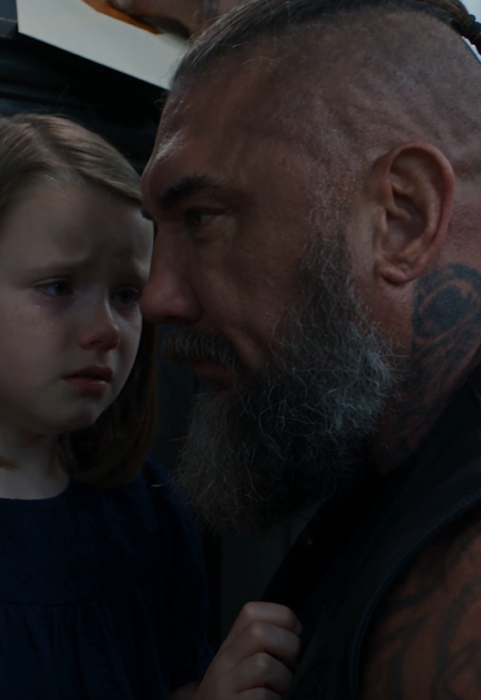
Mom had forgotten an appointment the week before she died. She had called me twice to ask whether Thursday was the dentist or the hairdresser.
I remembered that now.
I wished I hadn’t.
Because suddenly I could hear how easily a frightened daughter might turn an ordinary mistake into a reason to doubt her mother’s last words.
Pastor Dean stepped between the men.
“We’re going to pause.”
Andrew nodded immediately, grateful and wounded in a way that made three people behind me start whispering about Ray.
My uncle put both pieces of the speech on the lectern.
“I shouldn’t have torn that.”
Andrew let out a short breath.
“But I’m not putting hers away.”
The pastor asked everyone to wait in the fellowship hall. Some obeyed. Others lingered near the doors, pretending to gather coats they were already wearing.
I stayed with Lily.
“Tell me about the envelope,” I said.
She shook her head.
Andrew moved toward us.
“Em, don’t question her like that. She’s had a terrible week.”
“So have I.”
“She needs somebody calm.”
He held out his hand.
Lily pulled her knees up on the pew.
That tiny movement frightened me more than anything Ray had read.
My daughter adored Andrew. He bought the cereal I wouldn’t buy and remembered which soccer cleats she wanted. When my car needed a transmission, he had paid the shop before telling me.
Now she was trying to make herself smaller.
Ray crouched at the end of the pew.
His boots creaked.
“Kid, nobody’s asking you to pick a side.”
Andrew looked at him.
“You’ve done enough.”
Ray stood slowly.
He was sixty-six, broad through the shoulders, with hands made rough by forty years repairing diesel engines. He could make people step back without meaning to.
He stepped back himself.
“Then let her mother listen.”
Lily’s fingers found the sleeve of my coat.
“He said it was Grandma’s surprise.”
“What surprise?”
“For you.”
I looked at my brother.
He didn’t answer.
Outside, a car door slammed. The sound made Lily flinch.
I had been working the closing shift at a grocery store when Mom became ill. Andrew had called after the ambulance left. He said everything had happened quickly.
I had thanked him for being there.
Now Ray held out the letter.
On the last sheet, below Mom’s familiar handwriting, was a darker paragraph squeezed into the margin.
The ink was purple.
Lily stared at it.
“That’s my pen,” she whispered.
What else had happened in my mother’s kitchen while I was ringing up somebody else’s groceries?
Three weeks earlier, Mom had made pancakes shaped like things none of us could identify.
“That’s a rabbit,” she told Lily.
“It has six ears.”
“Very good hearing.”
Ray sat beside the stove in his leather vest, turning a broken cabinet handle between two fingers. Andrew arrived with orange juice and kissed Mom’s cheek before taking a work call outside.
It had been a good morning.
I need that part to stay true.
Mom kept her household papers in a blue biscuit tin with roses around the lid. Under the loose green felt at the bottom, she tucked carbon copies from an old receipt book.
“Banks lose things,” she said. “Paper ought to have a twin.”
She wrote every seven with a little line through it.
Lily copied her.
At the table, Mom borrowed Lily’s purple pen to label an envelope. Then she rested her teaspoon against the flap, leaving a tea stain, and complained that nobody made decent paper anymore.
Those were ordinary details.
A tin.
A crossed seven.
A child’s pen.
After she died, they became the things adults argued over.
In the church office, I read her letter while Lily sat with our cousin Ruth in the hallway.
Most of it had been written days earlier.
Mom explained that she had asked Ray to read it if she could not speak for herself. She was tired of Andrew answering questions addressed to her. She wanted me to know she had begun reviewing the accounts he managed.
The final paragraph was different.
Written that night.
He has called the ambulance now. Before that, he sent Lily outside with the envelope. She believes she is helping me. Please don’t let him make her carry this too.
I read it twice.
Then I looked at Ray.
“Why didn’t you tell me?”
“I called the next morning.”
“You said there was paperwork.”
“I didn’t know what all of it meant yet.”
“You could’ve said her name. You could’ve said Lily.”
He rubbed the scar across his thumb.
“You were arranging a funeral.”
That answer hurt because I understood it.
It also wasn’t enough.
Ray had arrived at Mom’s house that evening to repair a loose porch railing. She had asked him to come after supper. While he worked outside, Lily carried a thick envelope to his motorcycle.
He saw her put it in the saddlebag.
She said Grandma wanted him to keep it safe.
Later, inside, Mom gave him her letter.
He thought the two things belonged together.
After she died, his lawyer opened the thick envelope with him.
It contained financial records, several pieces of jewelry, and cash.
By then, Andrew had already reported some of those items missing.
Ray’s lawyer contacted the police and preserved everything.
My uncle had not come to the funeral with a family rumor.
He had come knowing my brother was accusing him of theft.
Why had Mom trusted Ray with her last words while someone else filled his saddlebag with reasons not to believe him?
The first detective I spoke with was named Dana Brooks.
She met us two days after the funeral in a room with a round table, a box of tissues, and a clock that made more noise than it should have.
I arrived carrying Mom’s letter in a plastic document sleeve.
I thought we were there to talk about the night she died.
Brooks began with something else.
“Your brother called emergency services promptly after your mother reported feeling unwell.”
I stared at her.
She turned a page.
The call had been recorded. Paramedics’ notes matched the timing. Ray’s account matched too.
Mom had been sitting upright when help arrived.
She had asked for her cardigan.
Andrew had fetched it.
Nothing investigators had found suggested he caused her medical crisis or prevented treatment.
The hospital records explained her death without needing a villain in the room.
I felt relief so sudden it made me ashamed.
Then I felt angry at the relief.
“What about the letter?”
“We’re separating what happened to her health from what may have happened to her property.”
Andrew had been saying exactly that.
For half a day, I wondered whether he had been right about everything.
He sent me a photograph of himself holding Mom’s hand in the emergency department.
I was there, Emma.
He had been.
Just not until the end.
A nurse later told me he left before Mom died. That made his eulogy dishonest. It did not make him a criminal.
Brooks was careful about the difference.
Then she asked whether Ray had financial problems.
He did.
His repair shop had lost a contract. His truck needed work. Years earlier, he had served time for handling stolen equipment through a business he said he should have questioned sooner.
He had pleaded guilty.
Andrew’s attorney supplied copies of that case.
Alongside photographs of Mom’s jewelry.
And the cash.
Together, the pages told a clean story: a recently bereaved family, an uncle with money problems, valuables in his motorcycle, and a letter accusing the one person who might notice.
I hated how reasonable it sounded.
At home, I opened Mom’s old text messages.
Ray asking whether she needed groceries.
Mom reminding him about a blood-pressure appointment.
A photograph of the porch railing.
Nothing proved innocence.
Nothing proved theft.
Then my brother called.
“I’m not asking you to abandon him,” he said. “I’m asking you to stop letting him use Lily.”
His voice was gentle.
That made it worse.
“What was in the envelope when you gave it to her?”
“Records for safekeeping.”
“And jewelry?”
A pause.
“Mom changed her mind about things.”
He said her memory had been unreliable.
He offered to send me the note from an appointment where she had mentioned being forgetful.
I almost said yes.
Then I remembered Mom’s tin.
The carbon copies.
The little lines through every seven.
If her memory had truly become so unreliable, why had she begun making more copies instead of fewer?
Mom’s bank statement arrived in the mail three days later.
Andrew had handled her online access, but she still insisted on paper statements sent to her own house.
I opened the envelope at her kitchen table.
There were withdrawals I expected.
Utilities.
Groceries.
A pharmacy.
Then a transfer large enough that I read it as a mistake.
Eighty-six thousand dollars.
That was almost everything in the account Mom had called Lily’s school money.
It was not a formal education trust. It was savings Mom had put aside from an insurance payment after my father died, with smaller amounts added whenever she could.
She had told Lily it was for college.
She had told me it was one thing we would not have to worry about.
The transfer description meant nothing to me.
Brooks asked me not to call the receiving company myself.
She took a copy.
Then Mom’s attorney called.
Her name was Miriam Cole. Mom had visited her without telling either of her children.
“I’d like you to bring the blue tin,” she said.
It wasn’t in the pantry.
I checked every cabinet.
Then the coat closet.
Then the little back bedroom where Mom kept Christmas paper flattened beneath the mattress.
Gone.
Miriam did not sound surprised.
Fortunately, Mom had already brought her copies.
The documents showed money passing through a business Andrew controlled, then moving into accounts associated with several of his clients.
Miriam explained only what she could establish.
The records did not yet tell us everything.
They did show that Andrew’s description of a simple family loan was incomplete.
There was also a draft agreement involving Mom’s house.
She had not signed it.
He had brought it that last evening.
According to Mom’s notes, he wanted the property used to secure additional borrowing.
I remembered the transmission repair he had paid for.
The groceries he occasionally dropped at my door.
I had mistaken spending for security.
Miriam opened a folder.
“Your mother asked him for an accounting.”
“When?”
“Ten days before she died.”
“What did he say?”
“That it would take time.”
Mom had given him a deadline.
The night she died was the deadline.
Lily’s envelope contained the original receipt book, some account papers, jewelry, and eight thousand dollars from Mom’s lockbox.
The valuables made the packet look like theft.
The records made it something else.
Brooks later told us Andrew had photographed the contents before Lily carried them outside.
Then he photographed her beside Ray’s motorcycle.
He said the pictures documented property his mother wanted stored safely.
But the next morning, he described the same property as missing.
That contradiction was the first thing I could hold without wondering whether grief had bent it.
At Miriam’s office, I watched a printer produce copies of my mother’s handwriting.
One page after another.
She had been preparing to confront her son.
He had been preparing a different explanation.
How long had both of them known that their family was living on borrowed time?
My brother did not threaten me.
He called the principal.
He called Lily’s father, who lived in another state and usually needed three reminders to sign a school form.
He called Ruth and said I was overwhelmed.
By Friday, everyone seemed to have received a calm version of my life in which grief had made me unstable and a convicted biker had become my closest adviser.
At school pickup, the office asked me to confirm who was authorized to collect Lily.
A reasonable question.
I answered it while my face burned.
That evening, Lily’s father called.
“What’s going on with your uncle?”
I stood in the laundry room so she wouldn’t hear.
“What did Andrew tell you?”
“That Lily saw something traumatic at the funeral.”
“She did.”
“And you keep taking her around him.”
I leaned against the dryer.
He said he was worried.
Maybe he was.
Andrew had given him enough truth to make the rest travel easily.
Then my work schedule changed.
I had requested two mornings off for appointments. My manager could not keep rearranging shifts around a family investigation.
There was no conspiracy in that.
Just a small life with no room for anything else to break.
Ray offered money.
I said no too sharply.
He nodded and put his wallet away.
The next day, Andrew’s attorney sent a demand for the return of estate property. It included the letter, the records already held by Ray’s lawyer, and items I had removed from Mom’s house.
My own childhood photographs were on the list.
So was Lily’s purple pen.
I sat at my kitchen table and laughed until I cried.
Then Lily stopped speaking at dinner.
Not completely.
She answered questions about school.
She asked for water.
But whenever Andrew or Grandma came up, she looked toward the window as if somebody might be standing outside it.
I asked whether her uncle had called.
She shook her head.
“Texted?”
Nothing.
I held out my hand for her tablet.
There was a message from a number she had saved under his name.
Adults are handling this. Remember what we agreed about upsetting your mom.
Below that:
You did a good thing for Grandma. Don’t let anyone turn it into something bad.
I photographed the messages and called Brooks.
She told me to preserve the device.
I asked whether that meant somebody would finally tell him to stop.
“It means I can document what he’s doing.”
I wanted a stronger answer.
But a documented answer was what we had.
Through attorneys, boundaries were put in writing. School contacts were corrected. Lily’s father received information directly from me and agreed to stop discussing the investigation with her.
The pressure didn’t vanish.
It became harder to disguise as help.
That night, Ray came over with a bag of groceries and left them on the counter without mentioning money.
Lily watched him from the hallway.
Then she said, “I’m sorry I stole from Grandma.”
What had Andrew taught my child to call the thing he made her do?
I sat on the floor so Lily would not have to look up at me.
“You didn’t steal from anybody.”
“He said Grandma asked.”
“I know.”
“She did ask him for the blue folder.”
Lily twisted the hem of her shirt.
“But he put other things inside.”
Ray stayed near the kitchen doorway.
Still.
Listening.
Andrew had packed the envelope at the table. Jewelry first. Then money. Then a thick book and loose papers.
He told Lily not to look.
He said Ray would make a fuss if he thought Grandma needed help, so she should put the envelope in the saddlebag quietly.
A surprise.
For me.
“If I told, you’d have to give the money back,” she said.
“Who told you that?”
Her eyes filled.
“He said you needed it.”
I wanted to break something.
Instead, I asked whether she would tell Detective Brooks with a person trained to talk with children present.
She asked whether Ray would get arrested.
“No one can promise what investigators will do,” I said. “But telling the truth helps them understand.”
It was the hardest honest answer I had ever given.
Afterward, Miriam asked to see me alone.
She put an older receipt on her desk.
Eighteen thousand dollars.
Mom had authorized that payment months before the larger transfer.
Not for Lily.
For Andrew.
“He told her he had a temporary shortfall,” Miriam said.
“A business loan?”
“That was how he described it.”
Mom had known there was trouble.
She had helped him cover it.
Then she had hidden that help from me.
In her earlier notes, she admitted believing that if he could correct one problem quietly, nobody would be hurt.
Some of the money had gone toward shortages involving people who trusted him with their savings.
Mom had not understood every detail.
She understood enough to be afraid of asking.
I stared at the receipt.
“She let him take Lily’s money?”
“Not the later transfer. She specifically denied authorizing that.”
“But she helped him before.”
“Yes.”
There it was.
The part nobody would put beside her smiling photograph at the funeral.
My mother had loved us.
She had also protected Andrew from consequences until consequences had nowhere else to go.
I was angry with her.
Then ashamed.
Then angry again.
Miriam let me sit.
She did not turn Mom into either a saint or an accomplice to everything Andrew had done.
She showed me when Mom began asking for statements.
When she contacted counsel.
When she started documenting.
Late was not the same as never.
But late had cost us.
In a note she never finished, Mom wrote that she had confused protecting her son with protecting the man she hoped he would become.
I carried that sentence home.
Ray read it at my table.
“She did that with me once,” he said.
“What stopped it?”
“She finally let me lose something.”
Outside, Lily practiced soccer against the fence. Each kick made the loose boards knock.
Mom had tried to correct what she had helped conceal.
Would any of us have listened before she put the truth in writing?
The hearing was about the estate.
By then, other investigators were reviewing Andrew’s handling of client money. That work had its own pace, its own records, and people whose losses had nothing to do with our family.
Miriam’s immediate concern was narrower.
She wanted estate assets preserved and an independent administrator appointed while Andrew’s conduct was examined.
He had been named executor in an older will.
He arrived in a charcoal suit.
Ray came in a clean shirt, his leather vest folded over one arm.
I sat beside him.
Lily stayed with Ruth.
There would be no child standing up at the perfect moment to save the adults.
She had already done enough.
Andrew’s attorney said the letter reflected family tension and an elderly woman’s uncertainty. He emphasized Ray’s conviction and the valuables found in his possession.
Ray answered questions about both.
He did not make himself sound better.
“Yes, I knew the equipment was stolen.”
“Yes, I pleaded guilty.”
“Yes, I had financial problems.”
“Did you take your sister’s money?”
“No.”
Then Miriam introduced the records his lawyer had preserved, the messages, the original envelope, and the chain of events surrounding its delivery.
Andrew said Mom directed the transfer.
He said the documents in the envelope could be misunderstood.
He said the old receipt book was unreliable.
“Why?” Miriam asked.
“She copied things wrong.”
“Frequently?”
“She was getting confused.”
Miriam placed an enlarged image on the screen.
A carbon receipt.
Eighteen thousand dollars.
The sevens had little lines through them.
Andrew identified it as the loan his mother had authorized.
Then came a second document: his explanation of the later transfer, submitted after her death.
It relied on a supposed authorization bearing Mom’s name.
The original was missing.
A photograph existed.
Miriam asked whether he had seen Mom sign it.
“Yes.”
“With what?”
He frowned.
“A pen.”
“Which pen?”
“I don’t remember.”
Miriam showed the final page of Mom’s letter, written in purple.
Andrew looked away.
He said the letter could have been changed.
Miriam asked what part.
“The last paragraph.”
“How do you know?”
“Because that wasn’t—”
He stopped.
Nobody moved.
Miriam waited.
Andrew’s face tightened.
“She hadn’t written that part when I left the kitchen.”
His attorney stood.
The judge told him to wait.
Miriam spoke quietly.
“You said you never saw this letter before your uncle read it at the funeral.”
Andrew looked toward me.
For a moment, his expression was not polished at all.
He looked furious that a conversation he remembered could be placed beside one he had invented.
Then Miriam returned to the receipt book.
The carbon page corresponding to the disputed authorization was still there.
Mom had recorded something else on it.
A refusal.
With the amount written twice.
Her crossed sevens.
Her note to ask Andrew for the money back.
The missing top sheet had not erased its twin.
The judge’s ruling did not end the criminal investigation. It did remove Andrew’s control over the estate and preserve the remaining assets.
Outside the courtroom, Ray opened his hand.
The white scar across his thumb looked almost silver beneath the hall lights.
For once, he wasn’t rubbing it.
What would my brother call confusion now that our mother’s copies were speaking clearly?
Nothing was repaired all at once.
The investigation expanded.
Clients came forward with statements they had been told were mistakes. Transfers were traced. The photographs Andrew had taken became part of a chronology he could no longer rearrange simply by explaining it better.
He eventually pleaded guilty to financial crimes involving family money and client funds.
His sentence belonged to a judge.
The loss belonged to more people than I knew.
Some money was recovered.
Not all of it.
Restitution was ordered, but Miriam warned me not to build Lily’s future around payments that might arrive slowly or incompletely.
So I didn’t.
I opened a small account of my own.
The first deposit was twenty-five dollars.
It felt insulting.
Then I made the second one.
Ray’s name was cleared in the theft complaint. That did not travel as far as the original accusation.
A few people apologized.
Some said they had always known he was a good man.
He usually answered, “You didn’t have to know. You could’ve waited.”
At church, Pastor Dean asked whether he wanted to say anything publicly.
Ray shook his head.
“Already talked enough at the funeral.”
He had sent Andrew a written apology for tearing the speech.
One sentence.
No apology for reading the letter.
I asked why he bothered.
“Because both things can be true.”
I kept that.
It helped when I thought about Mom.
I could miss her without pretending she had handled everything well. I could be grateful for her letter and angry that she had needed so long to write it.
Some days I talked to her photograph.
Other days I turned it toward the wall while I cleaned.
Neither felt permanent.
Lily began seeing a counselor.
At first, she thought the appointments were where she would learn the correct version of the night.
Instead, she learned she could remember something in pieces.
A sleeve.
An envelope.
The sound of a saddlebag buckle.
She was allowed to be uncertain without being dishonest.
Months later, she asked whether Grandma had been disappointed in her.
I showed her the line I had copied from the letter.
She believes she is helping me.
We read it together.
“That’s what Grandma knew,” I said.
Lily touched the words.
Then she asked if we could make pancakes.
We did.
They looked like nothing.
Ray came over carrying Mom’s blue biscuit tin.
The independent administrator had returned it after the documents were cataloged. Someone had cleaned the lid, but a scratch still crossed one of the painted roses.
Inside were buttons, two safety pins, and the old receipt book.
The loose green felt lay beneath it.
Lily lifted the felt carefully.
“Paper ought to have a twin,” she said.
Ray pulled out a chair.
“That sounds like your grandma.”
I gave Lily her purple pen.
She wrote the date on a fresh page.
Then she recorded our first new deposit.
Twenty-five dollars.
She crossed the seven in the account number.
At the bottom, beneath her careful figures, she wrote another line.
Pancakes with Mom and Uncle Ray.
No amount beside it.
Just proof.
That evening, I put Mom’s letter back in its stained envelope.
Lily watched me close the tin.
“Can I ask you something?”
“Always.”
“Next time somebody says it’s a surprise, can I ask you anyway?”
I pulled out the chair beside me.
“Especially then.”
What else might she finally feel safe enough to ask?