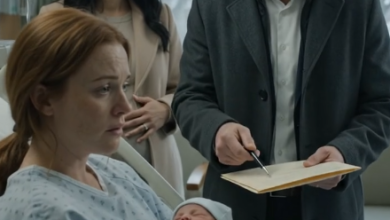
The Whitmore Family Laughed at the Hotel Housekeeper Fighting for Her Daughter—Then the Judge Recognized the Hands That Once Pulled Him from a Burning Car
A housekeeper is mocked in family court, but her daughter’s drawings uncover the truth no wealthy witness can explain away.
The laughter began before Elena Ruiz reached the table.
It was not loud enough for the bailiff to call for order. It came in the polished, socially acceptable form of a covered smile, a breath through the nose, and a whisper intended to travel exactly as far as its target.
“She came dressed like the help,” Judith Whitmore murmured.
Elena heard her.
So did Daniel, who sat beside his attorney without turning toward his mother.
At thirty-eight, Elena had learned that humiliation was rarely accidental when wealthy people delivered it softly. She kept walking across Courtroom 4B of the Richmond Juvenile and Domestic Relations courthouse, carrying a grocery-store folder against her chest. Beneath her navy coat, she still wore the pale gray uniform of the Riverstone Hotel. A faint bleach mark crossed one pocket. Her dark hair had been pulled into a low bun at five that morning, and several strands had come loose during the bus ride downtown.
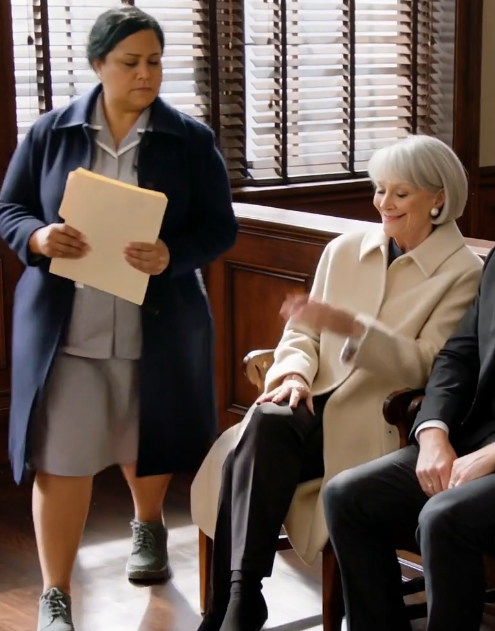
She had cleaned fourteen rooms before appearing to ask a court not to take away her daughter.
Across the aisle, Daniel looked prepared for a magazine photograph about responsible fatherhood. His charcoal suit fit perfectly. His burgundy tie had been a Christmas gift from Elena six years earlier. Beside him, Judith wore pearls and a cream wool coat that probably cost more than Elena’s monthly rent.
Lucy was not in the courtroom. At seven, she was waiting in a child-friendly interview room with Dr. Aisha Monroe, the therapist appointed after both parents accused the other household of causing her sudden anxiety.
Elena sat beside Priya Shah, the legal-aid attorney who had taken her case three weeks earlier. Priya was thirty-four, Indian American, brisk without being cold, and wore her case notes in three color-coded binders.
“Do not look at them,” Priya whispered.
“I wasn’t.”
“You were looking with your shoulders.”
Elena lowered them.
The custody dispute had begun six months after Elena left Daniel. Their marriage had not ended with violence, an affair, or one explosive betrayal. It had thinned through years of decisions Daniel made alone and apologies Elena accepted before discovering that nothing had changed.
Daniel controlled the accounts because he understood investments. Judith chose Lucy’s school because she knew the right families. Elena’s housekeeping schedule was described as temporary even after it paid the mortgage during Daniel’s worst year in real estate. When Elena objected, Daniel called her tired. When she insisted, he called her angry. When she left, he told everyone she had become unstable.
The original arrangement gave both parents equal time. Then Lucy began crying before visits to Daniel’s house. She chewed the cuffs of her sweaters until they frayed and asked Elena to leave the hallway light on.
Daniel responded by filing for primary custody.
His petition argued that Elena’s job required overnight shifts, that her apartment was too small, and that a recent eviction showed financial instability. He offered Lucy a private bedroom in his large West End home, access to an excellent school, and the support of an extended family.
The eviction notice had Elena’s name on it. What Daniel’s petition omitted was that it came from the house they had shared after he stopped paying the mortgage without telling her.
Judge Samuel Bennett entered at nine fifteen.
He was sixty-one, Black, close-cropped gray hair visible above rectangular glasses. He moved with a slight stiffness in his left leg and carried no theatrical sternness. The room became quiet because he expected it to, not because he demanded a performance.
Daniel’s attorney, Charles Voss, began with photographs of Elena pushing a housekeeping cart through a hotel corridor at 11:48 p.m.
“Ms. Ruiz has represented that she works only daytime shifts,” he said.
“I do now,” Elena answered when permitted. “Those photographs are eight months old.”
Voss produced an unsigned schedule supposedly issued two weeks earlier. It showed her working three overnight shifts.
Elena had never seen it.
Before Priya could object, Judith whispered, “She probably cannot keep track.”
The judge looked up.
“Mrs. Whitmore, another comment from the gallery and you will wait outside.”
Judith’s mouth tightened.
During a recess, Elena opened Lucy’s folder. Twelve drawings lay inside, each protected by an inexpensive plastic sleeve. Dr. Monroe had advised her not to interpret them alone, but Elena had studied them until their crayon lines followed her into sleep.
Most showed a small girl beside a red chair. Sometimes there was a window. Sometimes a black rectangle floated near the door. In three pictures, Lucy had drawn Elena with impossibly long arms reaching from a hotel building across the city.
The drawings made Elena feel accused even when she did not understand the accusation.
As court resumed, one sleeve slipped from the folder. Elena bent to retrieve it, exposing the inside of her right hand.
A curved scar ran from the base of her thumb toward her wrist.
Judge Bennett stopped speaking.
His gaze remained on Elena’s hand for so long that Priya glanced between them.
“Ms. Ruiz,” he said, “how did you get that scar?”
Voss stood. “Your Honor, I’m not sure how this is relevant.”
“Neither am I yet. Please sit down.”
Elena closed her fingers. “A broken car window.”
“When?”
“Nine years ago.”
“On Interstate 64, near the Shockoe Valley exit?”
Her breath caught.
Daniel finally turned toward her.
Judge Bennett removed his glasses. “The vehicle was upside down against the barrier. There was smoke beneath the hood. The driver’s door would not open.”
The courtroom seemed to lose air.
Elena remembered rain hissing on hot metal, the smell of electrical smoke, and a man hanging sideways from a locked seat belt. She had been returning from a double shift. Other drivers had stopped, but she was the first to cross the road.
She had wrapped her cleaning apron around her fist, struck the rear window, crawled through broken glass, and cut the seat belt with a box opener. When the man was too disoriented to move, she dragged him through the window while someone else called for help.
Elena had left in an ambulance before learning his name.
Judge Bennett stepped down from the bench.
“That was you,” he said.
Elena did not answer.
He looked at the scar, then at her face. “You saved my life.”
No one laughed now.
Judith’s hand rose to her pearls. Daniel stared at Elena as though a room had opened inside their marriage that he had never known existed.
Judge Bennett stopped several feet away. He did not embrace her or touch her. His expression held gratitude, but also immediate concern.
“Why did you never respond to the notices?” he asked.
“I didn’t know about them.”
“The police tried to locate you.”
“My address changed. And I didn’t do it to be found.”
Voss rose again. This time his voice was cautious. “Your Honor, given this personal connection—”
“I agree.”
Judge Bennett returned to the bench. He placed his glasses beside the file and addressed both attorneys.
“I have only now recognized Ms. Ruiz. I cannot continue without creating a reasonable question about impartiality. I will disclose the circumstances in full and recuse myself immediately.”
Judith’s shoulders loosened.
Elena saw it and understood. The Whitmores believed the miracle had just been removed from the case.
Before leaving, Judge Bennett looked at Elena once more.
“What you did nine years ago will not determine custody,” he said. “Nor should it. Your daughter’s welfare must be decided by evidence concerning her life, not by a debt anyone owes you.”
Elena nodded. “That is what I want.”
Bennett hesitated, perhaps surprised.
Then Elena added, “She deserves a judge who owes neither of us anything.”
By early afternoon, Judge Caroline Price had been assigned. She was fifty-four, white, with auburn-gray hair and a reputation for reading every page lawyers hoped she would skim.
Daniel’s family began smiling again.
Judge Price reviewed the morning record, then turned to Dr. Monroe.
“You indicated that the child’s drawings contain a recurring detail that may require immediate investigation.”
Dr. Monroe placed the first picture on the evidence display.
A purple moon hung over a crooked building. Lucy had drawn herself beside a red chair. At the far edge of the page stood a door with a heavy black line across it.
“That is a lock,” Daniel said. “Children draw locks.”
Dr. Monroe placed a second picture beside it. Then a third.
Twelve drawings.
Twelve red chairs.
Twelve doors locked from the outside.
And in the corner of the final picture, behind Lucy’s small yellow figure, stood a blue triangular window that Elena had never seen in Daniel’s house.
Judge Price leaned forward.
“Mr. Whitmore,” she asked, “do you recognize that window?”
Daniel said no.
But Judith’s hand tightened around her pearls before he finished speaking.
Part 2, The House That Wasn’t a Home
Dr. Monroe did not call the drawings proof.
She explained that children’s artwork could reflect memory, imagination, fear, wishes, or borrowed images. No ethical therapist should announce that a crayon picture alone established neglect.
“What concerns me,” she said, “is not one image. It is the repetition of the same environment across twelve sessions, combined with Lucy’s physical responses whenever I asked who was outside the door.”
Judge Price studied the drawings. “What responses?”
“She hid my phone beneath a cushion. Then she asked whether the red light meant someone was watching.”
Daniel’s attorney objected to the statement as hearsay. Judge Price allowed it only for the limited purpose of explaining the therapist’s recommendation, not as proof that an event occurred.
That distinction mattered to Priya. It also frightened Elena.
A moving story could make people stare. It could not safely decide where a child lived.
Dr. Monroe described the details that remained consistent: a red chair with one short leg, a blue triangular window, a black latch outside a glass-paneled door, and a rectangular object mounted high on the wall. In seven drawings, Lucy placed a small crescent moon at different positions outside the window. In five, she drew a clock using blocks instead of numbers.
“I believe she is trying to show the passage of time,” Dr. Monroe said.
Voss asked whether Elena could have coached her.
“It is possible for any parent to influence a child,” Dr. Monroe replied. “That is why I did not show either parent the complete set until today.”
Elena looked at Priya. She had received photocopies of only four pictures.
Daniel had received the same four.
Dr. Monroe then removed a thirteenth drawing, one neither parent had seen. It showed an adult in a cream coat outside the locked door, holding two phones. The face was a pale oval with pearls around its neck.
Judith rose.
“This is absurd.”
The bailiff moved toward her, and she sat again.
Daniel whispered something to his attorney.
Judge Price noticed. “Mr. Whitmore, if you know where this room is, now would be an excellent time to tell the court.”
“I don’t.”
“Does your mother?”
“No.”
Judith’s face hardened. “Our family owns many properties. A child could have seen any window.”
The answer arrived too quickly.
Priya requested a temporary order preventing Lucy from being taken to any property other than Daniel’s registered residence, school, or approved childcare. Voss called the request excessive.
Judge Price granted it for seventy-two hours and appointed guardian ad litem Margaret Cole to investigate. Margaret was a fifty-eight-year-old white attorney with cropped blond-gray hair, comfortable shoes, and a habit of asking questions while looking at the person least prepared to answer.
Court adjourned until Monday.
Outside, reporters waited because news of Judge Bennett’s recusal had already reached the courthouse hallway. Elena refused interviews. Daniel stopped beside her near the elevators.
“You never told me,” he said.
“About the accident?”
“You let me sit there looking like a fool.”
Elena stared at him. “A man almost died. It wasn’t a story I kept for parties.”
“I’m talking about the judge.”
“I didn’t know who he was.”
Daniel glanced toward Judith, who was speaking sharply into her phone. “My mother thinks you arranged this.”
“Your mother thinks hotel towels are part of an international plot.”
He almost smiled. That brief movement made Elena remember the man who once danced with Lucy in the kitchen while pancakes burned.
Then the elevator opened, and his expression closed again.
“Where is the blue window?” Elena asked.
“I told the judge I don’t know.”
“That is not what I asked.”
Daniel looked at the drawings in her folder. “Children make things up when adults keep questioning them.”
“Lucy stopped sleeping before anyone questioned her.”
“She started after you moved her into that apartment.”
The accusation found its mark. Elena’s apartment had one bedroom. Lucy slept there while Elena used a foldout couch. Pipes knocked inside the walls, and buses groaned along Broad Street before dawn. It was not the home Elena wanted for her.
But Lucy slept with the door open now.
At Daniel’s house, she had begun asking whether bedroom doors could lock from the outside.
Margaret Cole spent Friday interviewing both parents. She inspected Elena’s apartment, opened the refrigerator, tested the smoke detector, and looked beneath the bathroom sink. She saw the foldout couch, Lucy’s neatly labeled school shelf, and a calendar showing Elena’s shifts.
At the Riverstone Hotel, Margaret met Elena’s supervisor, Marlene Brooks, a sixty-two-year-old Black woman with silver braids and reading glasses on a beaded cord.
Marlene produced payroll records.
Elena had not worked an overnight shift in seven months.
The schedule filed by Daniel’s attorney was genuine, but it was old. Someone had removed the year before copying it.
Marlene also revealed something Elena had not told Priya. Three months earlier, the hotel had offered Elena a supervisory promotion with higher pay. She declined because it required rotating nights during Lucy’s school week.
“She still fills in when another employee has an emergency,” Marlene said. “But only when her daughter is with Mr. Whitmore.”
Margaret asked why Elena had kept working in uniform on court days.
“Because hearings do not pay her rent,” Marlene replied.
The eviction record produced another reversal. Daniel had stopped making mortgage payments four months before the separation, after borrowing against the house for a failed property investment. The final notice remained under both names because Elena was still legally an owner.
Daniel’s attorney had presented the notice without the loan history.
It was misleading, but not enough to decide custody.
The blue window remained.
On Saturday, Margaret visited Daniel’s West End house. Lucy’s bedroom was spacious, newly painted, and almost untouched. The closet contained expensive clothes with tags still attached. A row of stuffed animals sat in perfect alignment.
Margaret opened a bedside drawer and found granola bars, crackers, and two small bottles of water hidden beneath pajamas.
Daniel said Lucy enjoyed snacks.
Margaret asked why she hid water.
He had no answer.
Judith arrived during the inspection carrying a bag of groceries. Margaret showed her the drawing with the pearls.
“A cream coat is not an identity,” Judith said. “And half the women in Richmond own pearls.”
“Do you know a room with a blue triangular window?”
“No.”
“Do you own a red chair with one shortened leg?”
“No.”
“Has Lucy ever been left alone while in your care?”
“Certainly not.”
Margaret watched Daniel as his mother answered. He did not look at either woman.
Before leaving, Margaret noticed a framed advertisement in Daniel’s office. It showed one of the Whitmore Group’s new housing developments, Cedar Ridge.
At the center of the photograph stood a luxury model home.
Above its sunroom was a blue triangular window.
Daniel said the model was closed for renovation and Lucy had never been there.
Margaret called Judge Price that evening.
Within two hours, the court authorized a child-welfare inspection.
When investigators entered the Cedar Ridge model home, they found a red chair in the sunroom, its front leg shortened by a broken caster. A folded child’s blanket lay behind it. Granola-bar wrappers filled a wastebasket.
The glass door had a black latch.
It could be opened easily from the hallway.
From inside the sunroom, a seven-year-old child could not reach it.
Part 3, The Hours Between the Moons
Daniel did not attend the Cedar Ridge inspection, but Judith arrived before it ended.
She parked crookedly beside the curb, left her car running, and demanded to know who had authorized strangers to enter company property. Her indignation lasted until an investigator showed her the blanket.
Then she became silent.
It was yellow with small white rabbits.
Elena had packed it in Lucy’s overnight bag months earlier.
Judith said she had never seen it.
The smart-home system told a different story.
Cedar Ridge’s model home was designed to demonstrate automated lighting, climate control, door sensors, and remote security. Most of the system had remained active during renovation. The data did not show what happened in every room, but it recorded when doors opened, which access codes were used, and when the alarm was armed.
Judith’s code had entered the property on eleven of the dates appearing in Lucy’s therapy drawings.
The sunroom sensor showed the door closing shortly afterward. On six occasions, it remained closed for more than three hours.
Once, it remained closed for five hours and forty-two minutes.
“That doesn’t prove the child was inside,” Voss argued at Monday’s hearing.
“No,” Judge Price said. “The blanket, food wrappers, drawings, and access records may do that collectively.”
Daniel sat pale and rigid beside his attorney. Judith had retained separate counsel.
Dr. Monroe explained the moons. Lucy had drawn them at different heights because she had watched daylight fade through the triangular window. The block-shaped clocks were copied from a digital thermostat mounted above the sunroom door.
“She could not read all the numbers,” Dr. Monroe said. “So she reproduced their shapes.”
The court allowed a recorded forensic interview conducted by a trained specialist with neither parent present. Lucy’s voice was small and uneven.
“Grandma called it the quiet room.”
“Why did you go there?”
“When Dad had house people.”
“What are house people?”
“People who buy houses. They drank shiny drinks.”
“What did you do in the quiet room?”
“I waited.”
“Was the door locked?”
“Grandma said it wasn’t locked. She said it was helping me stay.”
“Could you leave?”
Lucy paused for seventeen seconds.
“My arms were too little.”
Elena covered her mouth.
Across the aisle, Daniel closed his eyes.
Lucy explained that Judith took her tablet because the screen light could be seen from outside. She was given snacks, a blanket, colored pencils, and an old phone without service. Judith told her the room was safe and that adults would be nearby.
“Was your father there?”
“Sometimes.”
“Did he know you were in the room?”
Another long pause.
“He said, ‘Just until the buyers go.’”
Daniel’s attorney asked for a recess.
In the consultation room, Daniel admitted that Cedar Ridge had become essential to saving his company. His real-estate business had nearly collapsed after interest rates changed and two partners withdrew. Weekend sales events attracted prospective buyers, but Daniel believed seeing his daughter during scheduled custody time would strengthen his claim.
His mother offered a solution.
She would supervise Lucy at the model property while Daniel worked.
The first time, Judith kept Lucy in an upstairs office with the door open. A buyer complained that children made the property feel “already used.” Judith moved her to the sunroom during the next event.
“I thought my mother stayed with her,” Daniel said.
“Did you check?” Priya asked.
“I saw her moving through the house.”
“That was not my question.”
Daniel rubbed both hands over his face. “My mother said Lucy wanted to draw alone.”
The sunroom had heating and air conditioning. Lucy had food, water, a blanket, and access to a restroom whenever Judith opened the door. Daniel insisted he never believed she was in danger.
Elena listened until he finished.
“You knew she could not open that door.”
“I learned that later.”
“When?”
Daniel did not answer.
“Before or after she started crying when she saw your mother’s cream coat?”
“Elena—”
“When?”
“After the third weekend.”
“And you kept taking her there.”
“I told my mother not to latch it.”
“But you didn’t stop using the room.”
Daniel struck the table with his palm, not violently, but hard enough to make the water cups shake.
“You think I wanted this? I was trying to keep the business alive. I was trying to hold on to the house she knew. You left, and suddenly I was the only person expected to preserve everything.”
Elena stared at him.
“I left with two suitcases because you emptied our joint account to cover Cedar Ridge.”
“I was going to replace it.”
“You always planned to replace what you took after the next sale.”
Daniel looked toward the darkened window.
His failure was not that he did not love Lucy. He loved her fiercely in photographs, in plans, and in the future he imagined providing. His failure was that whenever her immediate needs conflicted with that future, he asked her to wait quietly.
Judith’s explanation was harsher.
She insisted the latch prevented Lucy from wandering among construction materials and strangers. She called the room a practical childcare arrangement. When asked why she took Lucy’s phone, Judith said screen time caused behavioral problems.
The old phone found in the room appeared useless.
Then an investigator charged it.
There was no active service, but the device contained forty-three audio recordings.
Lucy had discovered the voice-memo function.
Most clips held the sounds of colored pencils, distant adult conversations, and the hum of the climate system. In one, Judith opened the door and told Lucy to stop crying before Daniel saw her.
In another, Daniel entered.
His voice was exhausted.
“I know you don’t like it, bug, but Grandma is helping me. I need you to be brave.”
“I want Mommy.”
“We are not calling Mommy every time you don’t get your way.”
“Door stuck.”
“I’ll tell Grandma.”
“Stay?”
“I can’t. People are waiting.”
The door closed.
A small hand tested the latch after he left.
Judge Price listened without expression. Daniel bent forward until his forehead nearly touched his folded hands.
The recordings supported the drawings. They also revealed that Lucy had not remained completely silent.
She had told him.
He had believed there would be time to fix it later.
Near the end of the hearing, Voss introduced photographs of Elena’s apartment, her housekeeping cart, and the couch where she slept. He argued that Daniel’s mistakes should not erase the financial advantages he could offer.
Judge Price looked at the images.
“Money is relevant when it affects a child’s needs,” she said. “It is not a substitute for responding when that child says she cannot open a door.”
Then Dr. Monroe produced one final drawing.
Unlike the others, it contained two adults outside the sunroom. Judith wore pearls. Daniel wore a burgundy tie.
Between them, Lucy had drawn a speech bubble containing four careful words:
Don’t tell the cleaning lady.
Elena recognized the phrase Daniel had once used jokingly when she found cookie crumbs in their bed.
Lucy had believed “the cleaning lady” meant her mother.
Part 4, The Life the Whitmores Never Asked About
The story of the burning car spread across Richmond before the custody hearing ended.
A local reporter found the old accident report. Someone located grainy traffic footage showing a woman in a wet uniform running toward an overturned sedan while other drivers stood behind the barrier. By Tuesday morning, Elena’s face appeared beside headlines calling her a forgotten hero.
The Riverstone Hotel offered her paid leave.
Elena refused.
“I need hours, not a ceremony,” she told Marlene.
The hotel compromised by moving her to lighter assignments until the hearing concluded.
Daniel’s family treated the publicity as a legal strategy. Judith’s sister posted online that Elena had “conveniently discovered” a connection to the first judge. Voss privately warned Daniel that the attacks were damaging his credibility.
Daniel asked his mother to remove the post.
Judith refused.
“For eight years,” she said, “that woman let us believe she was ordinary.”
Daniel stared at her. “She is ordinary.”
Judith heard an insult where he had intended a correction.
The person most unsettled by the attention was Judge Bennett. He released a brief statement confirming his recusal and refusing further discussion. Then he asked the court administrator to deliver a sealed letter to Elena.
Priya reviewed it first.
Bennett wrote that gratitude could become another form of pressure when made public. He apologized if his recognition had complicated Elena’s case. He also included the name of the paramedic who had treated them both after the crash.
The name was Thomas Ruiz.
Elena’s older brother.
Thomas had been thirty-two, broad-shouldered, impatient, and famous in the family for repairing objects with the wrong tools. He died four years after the accident from an undiagnosed heart condition during a charity softball game.
Elena had not known he treated Bennett at the scene. She remembered only waking inside an ambulance with Thomas gripping her uninjured hand.
“You could have died,” he told her.
“So could he.”
“That is not an answer.”
“It’s the one I have.”
Thomas later paid for the surgery that restored movement to Elena’s hand. He used money he had saved for paramedic certification courses and told the family the hospital waived the bill.
Elena did not learn the truth until after his death, when she found the payment receipt inside his toolbox.
That receipt became the object she carried whenever fear tempted her to walk away from something difficult. It was now folded behind Lucy’s drawings.
Judge Bennett’s letter revealed another connection. Thomas had visited him twice during rehabilitation. He never disclosed Elena’s name because she had asked her family not to turn the rescue into a public event. Instead, he encouraged Bennett to support first-responder mental-health programs after hearing him describe waking from nightmares about the trapped car.
Bennett later helped establish a diversion program for paramedics and firefighters struggling with trauma-related substance offenses.
Thomas never knew that.
Elena sat alone in the courthouse cafeteria after reading the letter. She had spent years thinking her brother sacrificed his certification savings only for her hand. Now she understood that he had also carried the memory of a stranger from the highway into rooms Elena never entered.
Daniel found her there.
He placed a cup of tea on the table and sat without asking.
“I didn’t know about your brother,” he said.
“You never asked how the surgery was paid for.”
“You said insurance covered it.”
“I said it was handled.”
He looked down. “I heard what I needed to hear.”
That sentence described much of their marriage.
Daniel had not been cruel when they met. He was a nervous twenty-eight-year-old sales associate who practiced property descriptions in the mirror. Elena cleaned rooms at the hotel where his first regional conference took place. When his presentation laptop failed, she found an extension cord, called maintenance, and kept two executives waiting by claiming their conference room was still being inspected.
He remembered her saving his presentation.
He did not remember that she missed the bus home.
For years, Elena protected him in ways too small to become family stories. She learned which creditors required early calls. She stretched groceries during commission droughts. She ironed shirts after midnight. When Cedar Ridge began failing, she quietly took weekend shifts so Lucy’s preschool tuition would clear.
Daniel interpreted the absence of complaint as the absence of cost.
“Why didn’t you tell me what my mother was doing?” he asked.
“I didn’t know.”
“Lucy told you she hated visits.”
“She said Grandma made her practice being still. I thought Judith was taking her to church.”
Daniel’s face tightened. “You should have asked more.”
“So should you.”
Neither could reject the accusation.
That was one of the most painful truths of the case. Elena had noticed Lucy’s sleeve-chewing and nightmares, but she initially blamed the separation. She delayed requesting therapy because she feared Daniel would describe it as evidence of instability. In trying not to give him a weapon, she left Lucy without words for what was happening.
Elena did not excuse herself.
At the next hearing, she testified to that mistake before Voss could expose it.
“I saw changes,” she said. “I kept hoping routine would settle her. I should have asked for help sooner.”
Judge Price asked why she had not sought emergency custody immediately after Lucy mentioned the locked door.
“I did not know there was a real door. I thought she meant she felt trapped between us.”
“What will you do differently?”
“Believe the feeling first, even before I understand the facts.”
Daniel watched her from across the room.
When his turn came, he admitted knowing the latch existed. He admitted hearing Lucy ask for Elena. He also admitted asking a marketing employee to remove references to after-hours model-home access from the company calendar after the investigation began.
Voss looked as though he had been struck.
“You told me those records were automatically deleted,” he said.
“I lied.”
Daniel had recovered the deleted calendar entries the previous night and turned them over. They showed twelve sales events corresponding to Lucy’s drawings.
His admission damaged his case.
It also broke something between him and Judith.
During recess, she cornered him in the hallway.
“You are handing your daughter to that woman.”
“That woman is her mother.”
“I kept your company alive.”
“You locked my child in a room.”
“I protected her while you worked.”
“You taught me that providing for someone meant deciding what they were allowed to endure.”
Judith’s face changed. For a moment, she looked less offended than frightened.
After Daniel’s father abandoned the family, Judith had worked two jobs and sometimes left twelve-year-old Daniel alone in the stockroom of a department store. She called it making him strong. She had survived through control and converted survival into a family rule.
Daniel had spent his life mistaking that rule for love.
He returned to the courtroom and asked Priya whether Elena would consider a temporary agreement.
Elena expected money.
Instead, Daniel offered to surrender primary physical custody while he entered parenting counseling and completed a court-approved reunification plan.
Elena did not accept immediately.
“What does Lucy need?” she asked Dr. Monroe.
The answer was smaller than victory.
“She needs to know that when she says a door will not open, an adult will come.”
Part 5, What the Drawings Proved
Judge Price issued temporary orders on Thursday.
Elena received primary physical custody. Daniel’s visits would be supervised until a therapist determined that Lucy felt safe and Daniel demonstrated that he could respond without minimizing her fear. Judith was prohibited from unsupervised contact.
The ruling was not based on Elena rescuing Judge Bennett.
Judge Price stated that explicitly.
It was based on the drawings, the forensic interview, access records, voice recordings, witness testimony, and Daniel’s admission that he had known enough to intervene but chose not to disrupt his business events.
“The drawings did not decide this case,” Judge Price said. “They showed responsible adults where to look.”
Daniel’s family heard defeat.
Elena heard a warning.
A child should not have needed twelve pictures before someone looked.
Outside the courtroom, reporters surrounded Elena. They wanted the story of the housekeeper who defeated a wealthy family. They asked whether Judge Bennett had secretly helped her. One reporter shouted that viewers were calling for donations.
Elena stopped.
“I am not homeless,” she said. “My daughter is not a symbol. Please do not raise money using her name.”
She walked away before anyone could turn the sentence into a performance.
Her refusal produced its own problems. Strangers sent toys to the hotel. A local business offered her a house in exchange for appearing in an advertisement. Someone left an envelope containing three thousand dollars beneath her apartment door.
Elena gave it to Priya, who returned it.
She did accept one form of help.
Marlene showed her an internal opening for housekeeping quality coordinator. The position paid more, required no overnight shifts, and involved training new employees. Elena had rejected a similar promotion because she feared losing the flexible hours that allowed her to care for Lucy.
This version had been redesigned by the hotel’s operations manager after learning that several employees—not only Elena—struggled with rotating schedules.
The change did not carry Elena’s name. No camera attended the staff meeting.
She applied.
Meanwhile, Cedar Ridge faced investigation for safety violations and misuse of a model property. Daniel’s partners voted to remove him as managing broker. He sold his interest to cover debts and moved from the West End house into a two-bedroom rental.
Judith called this humiliation.
Daniel called it an address.
His supervised visits with Lucy were difficult. During the first, he arrived carrying expensive art supplies. Lucy ignored them and used the dull crayons in Dr. Monroe’s office.
Daniel tried to apologize.
“I should have known you were scared,” he said.
“You did know.”
The child’s answer left nowhere to hide.
He nodded. “Yes.”
“Why didn’t you open it?”
“I thought my work couldn’t wait.”
Lucy colored a purple moon.
“Did it wait?”
Daniel’s eyes filled, but he did not ask her to comfort him.
“Yes,” he said. “It waited anyway.”
Progress came in measurements too small for court headlines. During the fourth visit, Lucy let him sit beside her. During the sixth, she asked him to sharpen a blue crayon. During the eighth, she allowed him to drive her to a supervised lunch.
He did not regain unsupervised time quickly.
Elena did not accelerate the process because he appeared remorseful. Remorse belonged to the person who caused harm. Safety belonged to the child.
Judith resisted longer. She filed a grandparent visitation petition claiming Elena was exploiting the case to isolate Lucy from her paternal family. Judge Price ordered an independent evaluation.
The evaluator found that Judith spoke sincerely about love while refusing to acknowledge the locked door as punishment. She called Lucy sensitive, Elena vindictive, and Daniel weak.
Then investigators recovered a deleted message Judith had sent Daniel after the third Cedar Ridge event:
She cried for twenty minutes, but she settled when I took the phone. Do not reward this behavior by calling Elena.
The message proved Daniel had known earlier than he first admitted.
Daniel turned it over himself after finding it in an archived account.
His cooperation did not erase the lie. Judge Price extended supervision by three months.
Judith withdrew her petition.
Before leaving the courthouse, she handed Daniel a cardboard box containing his childhood belongings. Inside was a faded photograph of twelve-year-old Daniel sitting on the floor of the department-store stockroom where she used to leave him.
The door behind him had no inside handle.
Daniel stared at it for a long time.
His mother had not invented the quiet room for Lucy. She had repeated a form of survival she once demanded from her son. That history explained her certainty.
It did not make the latch less real.
Daniel brought the photograph to therapy. Later, with Dr. Monroe’s approval, he showed it to Lucy.
“Grandma did this to you?” she asked.
“She left me somewhere I couldn’t get out.”
“Were you bad?”
“No.”
“Was I bad?”
“No.”
“Then why?”
Daniel could have blamed Judith. He could have described debt, buyers, payroll, or fear. Instead, he chose the sentence he had avoided throughout their marriage.
“Because adults can love someone and still make a wrong choice.”
Lucy considered this.
“Did Mommy make wrong choices?”
“Yes.”
Elena, observing behind the one-way glass, felt anger rise.
Then Daniel continued.
“She waited too long to ask why you were scared. I waited after you told me. Both were wrong. Mine kept putting you behind the door.”
It was the first time he distinguished their failures without pretending they were equal.
Lucy pushed the childhood photograph back toward him.
“You can keep it.”
Daniel placed it inside his wallet.
The red chair from Cedar Ridge was scheduled to be discarded when the property was sold. Elena did not want it. Daniel did not either.
Lucy surprised them both.
“Can we fix the little leg?”
Dr. Monroe asked why.
“So it doesn’t wobble if another kid sits there.”
The chair was delivered to a community family center that used art therapy with children navigating divorce and custody cases. A carpenter replaced the broken caster. Staff removed the black latch from the glass door and mounted it inside a clear evidence box used during training for child advocates.
They did not attach Lucy’s name.
Judge Bennett visited the center privately after his ethical restrictions concerning the case had ended. He saw the repaired chair but did not meet Lucy. Instead, he donated to a program providing independent advocates for children whose parents could not afford them.
Elena learned about the donation only because the center’s director mistakenly included the receipt in a packet she received.
The amount was modest.
One hundred and seventeen dollars—the highway exit number where Elena had pulled him from the car.
She sent it back with a note.
Please give this without my story attached.
Bennett honored the request.
The program changed its intake process that year. Every child was offered blank paper before being asked direct questions. Staff members received training on recurring visual details, while being warned never to treat drawings as automatic proof.
The change was careful, imperfect, and quiet.
Exactly the kind that might last.
Part 6, The Door Daniel Learned to Open
Six months after the hearing, Elena received the housekeeping coordinator position.
Her office was a converted linen closet with no window, one metal desk, and a chair that leaned slightly to the left. Marlene presented it as though unveiling a private suite.
“It has a door,” Marlene said.
“Does it open from the inside?”
Marlene gave her a look.
Elena laughed harder than the joke deserved.
The new position brought predictable hours, but it also forced Elena to confront a flaw she had mistaken for strength. She disliked delegating. She redid other employees’ work instead of explaining corrections. She accepted extra responsibilities and then resented people for not noticing.
Marlene called her into the office one afternoon.
“You know what you do?” she asked. “You rescue everyone before they can ask, then get angry because they never learn how much it cost.”
Elena touched the scar on her hand.
“That sounds familiar.”
“Hero habits are still habits.”
Elena began practicing requests. She asked a coworker to cover an afternoon when Lucy had therapy. She asked the apartment manager to repair the hallway light instead of buying a bulb herself. She asked Priya to explain a court document twice when fatigue made the wording blur.
None of those actions felt brave.
That was why they mattered.
Lucy’s nightmares decreased, though they did not vanish. She stopped hiding water beside her bed. For several months, she refused to close any interior door. Elena removed the latch from the bathroom cabinet after Lucy mistook its clicking sound for the Cedar Ridge lock.
Dr. Monroe helped her create a new bedtime routine. Lucy checked the apartment door with Elena, placed her own phone on the kitchen charger, and chose whether her bedroom door stayed open, partly closed, or shut.
Choice returned in inches.
Daniel completed parenting classes and individual therapy. He sold his silver watch to pay legal fees, then took a salaried position with another brokerage. The job carried less status and fewer promises of sudden wealth.
For the first time in years, he knew the exact amount of his next paycheck.
Supervised visits became monitored community visits. Then came a three-hour unsupervised period at a public library and park.
Before approving it, Dr. Monroe asked Lucy what she would do if she became frightened.
“Tell Dad.”
“And if he says you are fine?”
“Tell him I didn’t ask if I was fine.”
Daniel wrote the sentence on a card and kept it in his wallet beside the stockroom photograph.
During their first unsupervised visit, Lucy disappeared from his view for eleven seconds in the library’s children’s section. Daniel’s chest tightened. He found her behind a shelf choosing a book.
His first impulse was to scold her for wandering.
Instead, he knelt.
“I got scared when I couldn’t see you.”
Lucy examined him. “Do you need the door open?”
“Maybe I do.”
She took his hand.
Daniel did not tell Elena this story as evidence that he deserved more time. He told Dr. Monroe because he had realized how easily fear turned into control when disguised as protection.
Judith attended therapy only after Daniel said he would end contact if she refused. For weeks, she focused on everything Elena had done wrong. Then Dr. Monroe placed Daniel’s stockroom photograph beside Lucy’s drawing of the sunroom.
The rooms were different.
The waiting child was not.
Judith removed her pearls and held them in one fist.
“My manager would not allow him on the sales floor,” she said. “I checked every hour.”
Daniel answered, “Sometimes two.”
“I had no one.”
“You had me.”
The sentence broke through what accusations had not.
Judith cried without elegance. She did not become gentle overnight. She still called Elena’s apartment inadequate and complained that the court had embarrassed the family. But during her next supervised meeting with Lucy, she did not defend the quiet room.
“I told myself you were safe because I was close,” Judith said.
Lucy arranged crayons by color. “You couldn’t hear me.”
“I heard you.”
“Then why didn’t you come?”
Judith looked toward Dr. Monroe, perhaps hoping an adult would soften the question.
No one did.
“I thought crying would make you stronger,” she said.
“Did it?”
“No.”
Lucy gave her a brown crayon. It was not forgiveness, but Judith accepted it with both hands.
A year after the first hearing, Judge Price reviewed the custody order. Daniel had complied with every requirement. Lucy’s therapist supported expanding his time to alternating weekends, provided Judith was not used as unsupervised childcare.
Elena agreed.
Priya asked whether she was certain.
“No,” Elena said. “But certainty isn’t the standard. Safety is.”
Daniel’s first weekend took place in his apartment. He had installed no smart-home devices. Lucy’s room contained mismatched furniture, a desk bought secondhand, and the repaired blue lamp Elena had once used beside her foldout couch.
At bedtime, Daniel asked how far she wanted the door open.
Lucy held up two fingers.
“Two inches?”
“Two Dad hands.”
He measured the opening with his palms.
At midnight, he woke and nearly closed it to block the hallway light. Then he remembered the card in his wallet.
He left it exactly where she had chosen.
Part 7, The Picture with Three Open Doors
Three years later, Lucy drew the courtroom again.
She was ten now, taller, quieter around strangers, and impatient when adults described her as resilient. She preferred science to art and insisted that the old pictures looked “babyish.”
The new drawing was part of a school assignment about a place where something changed.
Lucy drew Judge Bennett’s original courtroom from memory, though she had never been inside it during the hearing. Elena had described the wooden benches, Daniel had remembered the evidence screen, and Lucy had invented a ceiling so high that purple clouds floated beneath it.
At the front stood two judges.
One stepped down.
The other remained seated.
Elena appeared in her gray uniform. Daniel wore no tie. Judith stood without pearls. Dr. Monroe held the grocery-store folder.
There were three doors in the picture.
All were open.
Elena kept the drawing on the refrigerator, not because it proved recovery, but because Lucy had drawn herself in the center without placing either parent beside her.
The custody arrangement continued to change as Lucy grew. Daniel received additional time. Elena moved into a two-bedroom apartment after saving enough for the deposit. Neither development became evidence that one parent had defeated the other.
Daniel never returned to Cedar Ridge.
The model home was sold to a retired couple who converted the sunroom into a place for orchids. They removed the triangular blue glass because it leaked during storms.
Judith’s progress came slowly. She learned to ask before buying Lucy expensive clothes. She stopped referring to Elena’s work as temporary. Once, when another relative described Elena as “the hotel maid,” Judith corrected her.
“She manages an entire housekeeping team.”
Elena heard about it from Daniel and felt no triumph. Accuracy arriving late was still accuracy.
Judge Bennett retired the following spring. At his private retirement reception, he invited Elena and Thomas’s widow, Rebecca. No reporters were present.
Bennett showed Elena a small object he had kept in his desk for nine years: a piece of green fabric cut from the apron she wrapped around her fist before breaking his car window.
“I was told it belonged to the woman who pulled me out,” he said.
Elena touched the faded edge.
“That uniform was terrible.”
“It seemed impressive at the time.”
He offered it to her, but she shook her head.
“You keep it.”
“Why?”
“Because I already remember what happened.”
Bennett nodded. “So do I.”
They did not call the accident destiny. Elena’s rescue had not made her a better mother than Daniel, just as Bennett’s gratitude had not entitled her to custody. The connection mattered because it exposed how little the Whitmores had known about the woman they judged by her uniform.
The case was decided elsewhere—inside a red chair, a blue window, a child’s recorded voice, and twelve drawings that adults finally placed in the correct order.
Dr. Monroe later asked Lucy whether she wanted the original pictures returned.
Lucy selected one.
It was the first drawing of the quiet room. The purple moon tilted above the triangular window, and the black latch was drawn twice as large as the child inside.
“Why that one?” Elena asked.
“So nobody says I made it up later.”
Elena wanted to tell her she would never need to prove it again. She stopped herself. Promises about the future could become another way adults replaced a child’s knowledge with their own.
Instead, she said, “Where should we keep it?”
Lucy chose a flat archival box beneath her bed. Not the refrigerator. Not a courtroom. Not a public display.
Her own room.
Daniel gave her the old phone from Cedar Ridge after the court released it from evidence. He had erased nothing, but Lucy asked Dr. Monroe to transfer the recordings to a protected file.
Then she placed the phone in the box beside the drawing.
At fourteen, Lucy began volunteering twice a month at the community family center. She did not tell younger children what their pictures meant. She sharpened crayons, fixed torn folders, and listened when they explained why a cloud needed to be purple.
The repaired red chair remained in the art room. Its replacement caster was a slightly different color, and one leg still looked newer than the others.
One rainy afternoon, Elena arrived to collect Lucy and found Daniel tightening a loose screw beneath it. He had come for a parent-volunteer orientation.
“You’re using the wrong tool,” Elena said.
Daniel looked up from the floor. “Thomas would approve.”
“You never met Thomas.”
“You’ve told me enough.”
Lucy crossed the room carrying a stack of blank paper. She tested the chair, decided it no longer wobbled, and placed the paper on the seat for the next child.
Near the entrance, the old black latch from Cedar Ridge remained sealed inside its clear box. Beneath it was a short line written by the center’s director:
A locked door is not made safe by calling the room safe.
Lucy paused beside it.
Then she walked past.
Outside, rain tapped against the windows. Elena held the front door while Daniel carried the repaired chair to another room and Lucy followed with the crayons.
No one needed to drag anyone through smoke.
No judge needed to step down.
A child simply reached the doorway, pressed the handle, and found that it opened from her side.
Follow this page for more heartfelt stories about family, quiet courage, misunderstood people, and the small truths that can change an entire life.
#FamilyDrama #QuietCourage #MothersStrength #ChildrensVoices #SecondChances