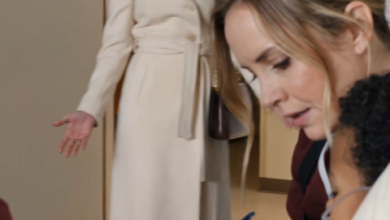
Part 2: The Girl Wrote an Apology Letter to the Entire School — But Her Confession Left the Auditorium Completely Silent
Part 2
Emily’s voice did not sound like a confession.
That was the first thing Mrs. Lawson noticed.
It sounded practiced, yes.
Careful.
But not guilty in the way adults expect guilt to sound. There was no dramatic sobbing, no collapse, no desperate apology to make punishment smaller.
Emily read like someone carrying something fragile across a crowded room.
Mrs. Lawson had taught seventh-grade English for nineteen years. She had heard many apologies. Most came written in borrowed language from parents, counselors, or panic.
I take full responsibility.
I made a poor choice.
It will never happen again.
Emily’s letter began that way, too.
But the second paragraph had changed everything.
“I did not steal it for myself.”
The auditorium shifted.
Principal Davis stepped closer to the podium, his hand hovering near the microphone stand. He looked as if he might stop her, but stopping a child mid-confession in front of six hundred students would only make the room hungrier.
Emily continued.
“I know people saw me near the charity jar after school. That part is true. I stayed behind because I was counting the coat money.”
Mrs. Lawson frowned.
Counting?
Emily had not told anyone that.
The charity jar sat on a folding table near the front office. Each homeroom had taken turns decorating it with paper snowflakes and cardboard mittens.
Students dropped in coins, wrinkled dollar bills, and the occasional five from parents who remembered at the last second.
The fundraiser had been Ava Bennett’s idea.
Ava was bright, confident, and impossible to ignore. She wore perfect braids, spoke in student council sentences, and always volunteered before anyone else could.
Mrs. Lawson liked Ava.
Everyone did.
Emily was different.
She sat in the back of Room 204 and read library books with broken spines. She wrote beautiful essays but never shared them aloud. She kept her lunch account card in her shoe after a boy once grabbed it as a joke.
When the money disappeared, Ava cried in the office.
Emily stayed silent.
That silence had looked like guilt.
Now, onstage, Emily’s eyes moved once toward Ava.
Ava sat in the second row, frozen.
“I counted the money because Ava asked me to,” Emily read. “She said she was bad at math when nervous, and she did not want to mess up the total.”
A few heads turned.
Ava’s face flushed.
Principal Davis looked toward the student council adviser.
Emily kept reading.
“There was one hundred and twelve dollars in the jar when I counted it. I wrote the total on the yellow sticky note and placed it under the jar.”
Mrs. Lawson remembered the sticky note.
It had been gone the next morning.
Only the jar remained, holding thirty-nine dollars and loose change.
Seventy-three missing.
Emily paused and touched the edge of the paper.
Her fingers shook harder now.
“I left the office hallway at 4:18 because my brother was waiting outside. I know the time because the late bus had already left.”
A boy near the back whispered, “Why didn’t she just say that?”
Mrs. Lawson wondered the same thing.
Then Emily answered without knowing he had asked.
“I did not say anything because somebody told me if I did, the whole school would learn about my brother.”
The sixth-grade boy in the front row covered his face.
His name was Noah Harper.
Emily’s brother.
He was smaller than most sixth graders, with round glasses and sleeves that always slipped past his wrists. He had transferred to Brookside after winter break and avoided the cafeteria whenever possible.
Mrs. Lawson had assumed he was shy.
Emily glanced at him again.
Her voice softened.
“My brother has been eating in the nurse’s office since February because boys at his old school made videos of him when he had panic attacks.”
The auditorium went so still that even the heating vent seemed loud.
Mrs. Lawson felt her stomach sink.
Emily turned the page.
“The first week at Brookside, someone found out. They made a group chat. They said if I told anyone, they would post the old videos.”
Ava looked down.
Not shocked.
Ashamed.
That was the second crack.
This was not only about missing money.
Emily continued, and every word seemed to pull another thread loose.
“I thought they were joking until they sent me one clip.”
Noah made a small sound.
Mrs. Lawson moved instinctively toward him, but the counselor reached him first and crouched beside his seat.
Emily looked at her brother, then forced herself to continue.
“I was scared. I did not want him to start over again with everyone laughing.”
Principal Davis’s face had gone pale.
Students who had whispered earlier now stared at the floor.
Emily lifted the letter closer to her face.
“I am sorry I said I took the money. I am sorry I let teachers believe I did something wrong. But I was more scared of what would happen to Noah than what would happen to me.”
Mrs. Lawson’s folded arms dropped to her sides.
She remembered Emily in the office on Wednesday afternoon.
Principal Davis had asked, “Were you near the jar?”
Emily said yes.
“Did you take the money?”
Emily looked at Ava, then at the hallway behind the glass door.
“I can write an apology,” she whispered.
At the time, Mrs. Lawson thought that was admission.
Now she heard the missing piece.
Emily had not confessed.
She had negotiated.
Ava began crying silently in the second row.
Emily’s letter was not finished.
Not even close.
Part 3
Principal Davis stepped toward the microphone.
“Emily,” he said gently, “you do not have to continue.”
Emily looked at him.
For the first time all morning, her voice changed.
“Yes, I do.”
It was not defiant.
It was tired.
The kind of tired children should not have to earn.
She looked back at the paper.
“I wrote this letter because I was told to apologize to the school. So I am.”
A few students shifted.
“I am sorry to everyone who donated money for coats. The money mattered.”
She swallowed.
“I know it mattered because my brother and I got coats from that same program two years ago.”
Mrs. Lawson closed her eyes.
She had not known that.
Emily never mentioned old help. Some children carry assistance like a secret scar, grateful and embarrassed at the same time.
Emily continued.
“I am sorry to the kids who need those coats this year. I am sorry adults thought the wrong person took from you.”
Then she looked directly at Ava.
“And I am sorry, Ava, that you were so scared of losing your student council speech that you let me take the blame.”
The auditorium erupted in whispers.
Ava covered her face with both hands.
The student council adviser stood halfway, then sat back down.
Mrs. Lawson looked at Principal Davis.
His jaw tightened, not with anger at Emily, but with the sudden horror of realizing the school had built a punishment on a child’s silence.
Emily reached into the pocket of her sweater.
Teachers moved slightly, unsure what she was doing.
She pulled out a yellow sticky note.
The sticky note.
Flattened.
Folded.
Saved.
“I found this in the trash after school,” she said. “I kept it because I thought someone might need to believe me later.”
On it was her small handwriting.
$112.43.
Counted by Emily.
Ava confirmed.
Ava’s initials were beside it.
The room turned toward Ava.
Ava shook her head, crying harder.
“I did not take it,” she whispered.
Her voice was tiny, but in the silence, people heard.
Emily nodded.
“I know.”
That twist confused everyone.
If Ava had not taken it, then why had Emily accused her?
Emily looked down at the letter again.
“Ava did not steal the money,” she said. “She saw who did.”
A teacher near the aisle inhaled sharply.
Emily’s voice thinned but held.
“The person who took it was her cousin, Mason. He is in eighth grade. He said it was a prank and he would put it back before anyone noticed.”
Mason Wells sat near the back with the basketball team.
His face changed before his name reached the room.
“He did not put it back,” Emily read. “Ava panicked because Mason’s dad is on the school board, and she did not want her family blamed.”
Mason stood suddenly.
“That is not true.”
The whole auditorium turned.
Principal Davis said, “Sit down, Mason.”
Mason did not.
His face was red, his hands curled.
“It was just seventy bucks.”
That sentence did more than any accusation could.
The room heard the confession inside the excuse.
Ava began sobbing.
“I told him to put it back,” she said. “I did.”
Mason looked at her with disbelief.
“You said not to say anything.”
“Because you said you would ruin Noah,” Ava cried.
The counselor beside Noah looked up sharply.
Emily’s letter shook.
But she did not stop.
“Mason sent me the video of Noah. He said if I told, he would post it and say Noah was crazy.”
Noah folded into himself.
Mrs. Lawson walked to the front row and sat beside him without asking. She did not touch him. She only placed herself between him and the rows of staring students.
For once, the school seemed to understand that looking can hurt too.
Emily continued.
“I said I took the money because I thought I could survive people thinking I was a thief.”
She looked at her brother.
“I did not know if Noah could survive people laughing again.”
That was the moral center of the story.
Not theft.
Protection.
A twelve-year-old girl had chosen disgrace because disgrace felt safer than her brother’s humiliation.
Principal Davis signaled to the assistant principal, who moved toward Mason’s row.
Mason finally sat.
A police matter was not announced. No dramatic removal happened. This was a school, not a courtroom. But everyone understood the morning had changed from assembly to reckoning.
Emily turned to the final page.
“I am also sorry to Mrs. Lawson,” she read.
Mrs. Lawson looked up.
“I heard you say yesterday that I was bright enough to know better. You were right.”
Mrs. Lawson’s eyes filled.
“But I wish you had asked what I was afraid of before you decided what I had done.”
That sentence landed softly.
It hurt anyway.
Mrs. Lawson remembered saying it in the teacher workroom, tired and disappointed. She had not meant for Emily to hear. But children often hear the words adults think are safely behind doors.
Emily lowered the paper.
“I am sorry I lied,” she said. “But I am not sorry I tried to protect my brother.”
No one clapped.
It would have been wrong.
The silence held too much.
Then Noah stood.
He was shaking.
Mrs. Lawson whispered, “You do not have to.”
He nodded.
“I know.”
He walked to the stage steps, but did not climb them. Emily turned toward him. For a moment, she looked like the older sister again, not the girl on trial.
Noah looked out at the auditorium.
“My sister did not steal,” he said.
His voice cracked.
“She brings me lunch when I cannot go to the cafeteria.”
A few students looked down.
“She waits outside the nurse’s office even when she misses recess.”
Emily covered her mouth.
“She told me starting over would be okay,” Noah said. “Then people made her carry my old school too.”
That was the fifth twist.
Emily had not only protected Noah once.
She had been protecting him every day, quietly moving through the school like a shield no one thanked.
Noah looked at Mason.
“Do not post the video,” he said.
It was not a plea.
It was a small boy reclaiming the right to be seen as more than his worst moment.
Mason stared at the floor.
Principal Davis stepped forward then.
His voice was unsteady.
“Students, we are ending the assembly now. Teachers, please remain with your classes.”
Emily folded the letter.
She looked suddenly younger.
As students filed out, no one laughed.
No one whispered loudly.
Some looked at Emily with shame.
Some looked at Noah with a gentleness that had arrived late but not uselessly.
Ava stayed seated, crying into her sleeves.
When the auditorium emptied, she walked to Emily.
“I am sorry,” Ava said.
Emily’s face hardened for a second.
Then softened.
“You should have told.”
“I know.”
“You let them think I was a thief.”
“I know.”
Emily looked at her brother.
Then back at Ava.
“You still can help fix it.”
Ava nodded.
That was Emily.
Even hurt, she left people a door if they were brave enough to walk through it.
Part 4
Brookside Middle School did not heal in one assembly.
Schools rarely do.
By Monday, adults were in meetings. Parents were called. Mason’s family arrived angry, then left quieter after seeing screenshots and hearing Ava’s statement.
The missing money was returned with an additional donation from Mason’s parents, though Principal Davis made clear that money returning did not undo harm done.
Ava stepped down from the student council race.
Not because anyone forced her.
Because she said leadership should not begin with letting someone else bleed for her fear.
That sentence traveled through the seventh grade faster than gossip.
Emily did not become popular.
That would have been too easy, and maybe unfair.
Some students apologized. Some avoided her because guilt made them awkward. A few tried to act like they had never believed the rumors in the first place.
Emily noticed.
She said nothing.
Noah returned to the cafeteria slowly.
The first day, he sat with Mrs. Lawson for ten minutes near the door. The second day, he sat with a boy from science class who liked drawing dragons. By Friday, he stayed through lunch without going to the nurse’s office.
Nobody mentioned the old video.
Not because the school pretended it never existed.
Because Principal Davis made a rule that private humiliation, even shared online, would be treated as harm, not entertainment.
He also apologized to Emily.
Not in a hallway.
Not with a quick “sorry about that.”
He invited her, her mother, Mrs. Lawson, and the counselor into his office. He sat across from Emily, not behind his desk.
“I believed the simplest version,” he said.
Emily looked at him carefully.
“I helped make it simple.”
“No,” he said. “You were a child under pressure. I was the adult who should have asked better questions.”
Emily did not forgive him immediately.
She nodded.
That was enough for one afternoon.
Mrs. Lawson changed too.
She stopped calling quiet students “fine” just because they completed work. She began asking different questions in private conferences.
What are you carrying that school cannot see?
Who are you worried about when you leave here?
Is there something you are afraid will happen if adults know the truth?
Sometimes students shrugged.
Sometimes they stared at her like she had opened a window in a room without air.
Once, a boy admitted he stayed late because home was loud after dinner.
Once, a girl said she lost homework because she slept in two houses and forgot which backpack had which folder.
Once, a student wrote nothing on a check-in card except: I am tired of being the easy kid.
Mrs. Lawson kept that card in her desk for years.
As for the apology letter, Emily asked for it back.
Principal Davis gave her the original and kept a photocopy only with her mother’s permission. Emily folded it into a small square and placed it inside a library book she loved, one about a girl who survived by telling the truth at the right moment.
A month later, the school held a new fundraiser for winter coats.
This time, every jar had two students and one adult count the money together. Totals were written, signed, photographed, and locked away.
Emily volunteered to help.
When Mrs. Lawson asked if she was sure, Emily said, “I still care about coats.”
That nearly broke her teacher.
Ava volunteered too.
At first, Emily did not speak to her except about numbers.
By the third week, Ava quietly brought Noah a graphic novel about dragons and placed it on the edge of his lunch table.
“I thought you might like this,” she said.
Noah looked at Emily.
Emily shrugged.
Noah took it.
Trust returned like that.
Not as a grand forgiveness.
As one book placed carefully where an apology could sit without demanding applause.
Near the end of the year, Brookside held its spring showcase. Students displayed art, science projects, essays, and service work.
Emily submitted a piece of writing.
The title was:
The Difference Between Sorry and Safe.
Mrs. Lawson read it after school when the hallway was empty.
Emily did not describe the assembly in dramatic terms. She wrote about the feeling of a folded paper in her hand, the sound of a whole school breathing, and the strange moment when truth stops being a secret and becomes everyone’s responsibility.
One line stayed with Mrs. Lawson.
I learned that people can make you say sorry for the wrong thing when they do not ask why you were silent.
Mrs. Lawson sat in Room 204 until the evening custodian flicked the hall lights.
At the showcase, Emily stood beside her essay while parents drifted past. Some read quickly. Some paused. One mother wiped her eyes.
Noah stood beside her for part of the night, pretending he was only there because the dragon drawings were nearby.
Mrs. Lawson watched them from across the room.
Their mother arrived late from work, still wearing a grocery store vest. Emily handed her the program without explanation.
Her mother read the essay slowly.
Then she pulled both children close, right there between a volcano project and a table of watercolor landscapes.
Emily stiffened at first.
Then leaned in.
Noah did too.
That was the image Mrs. Lawson remembered most.
Not the auditorium.
Not the accusation.
A mother holding two children who had carried too much while adults looked in the wrong direction.
Years later, Emily would become the kind of teenager people trusted with difficult truths. She did not gossip. She did not rush to judgment. She asked quiet questions and waited for real answers.
Noah grew taller. He still disliked crowded rooms, but he no longer vanished from them. He learned to say, “I need a minute,” instead of disappearing into shame.
Ava and Emily never became best friends.
That was all right.
Not every repair becomes closeness.
Sometimes repair is being able to pass someone in the hallway without the past grabbing your throat.
On the last day of eighth grade, Mrs. Lawson handed Emily a sealed envelope.
Inside was a copy of the essay and a note.
Dear Emily,
You once said I should have asked what you were afraid of before deciding what you had done. I have carried that sentence into every conference since.
Thank you for teaching me with more courage than any child should have needed.
Emily read it twice.
Then she looked up and said, “You asked later.”
Mrs. Lawson smiled through tears.
“I am trying to ask sooner now.”
Emily nodded.
That was forgiveness in the language she trusted.
Small.
Precise.
Earned.
When she left Room 204, the hallway was loud with end-of-year voices. Lockers slammed. Shoes squeaked. Someone shouted about summer.
Emily walked beside Noah, who carried the dragon book Ava had given him months earlier.
At the front doors, he nudged her.
“Do you still have the letter?”
Emily touched the edge of her backpack.
“Yeah.”
“Why keep it?”
She looked through the glass doors at the bright afternoon outside.
“Because it reminds me that truth can be late and still arrive.”
Noah thought about that.
Then he held the door open for her.
Follow this page for more heartfelt stories about the quiet courage people carry long before anyone hears the truth.