Part 2: I Welded a Sidecar to My Harley So My Daughter With Cerebral Palsy Could Feel the Wind — She’s 5 Now. I’ll Build Her a New One Every Year Until I Can’t Hold a Torch
I want to tell you about the welding.
I am a structural welder by trade. I weld I-beams and column splices and plate steel for buildings. I have a TIG cert. I have a stick cert. I have a structural cert. I have done this for sixteen years and I am good at it.
A motorcycle sidecar is not a structural beam.
A motorcycle sidecar that has to safely carry a child with cerebral palsy who cannot brace herself, cannot hold her head up, cannot signal pain or discomfort, and weighs thirty-one pounds at age two and a half — is not a structural beam.
It is, by every measurement I have ever applied to a piece of metal, the most important weld I will ever do in my life.
I bought a used Velorex sidecar shell on Craigslist in March of 2022 for $700. It was rusted. It was missing a windshield. It was missing the original mounting hardware. It had a hole in the floor. I do not recommend Velorex sidecars to most people. I bought it because the basic frame was sound and because I knew I was going to throw away most of it and rebuild from the chassis up.
I worked on the sidecar for six months.
I did the work in my garage on Friday nights and Saturday mornings, because those were the times Camila could be with Sofia in the house and I could put on a respirator and a welding helmet and do the work without interrupting our family’s life.
I welded a new floor pan.
I welded a custom child-seat frame to the floor pan that would hold a pediatric travel chair Sofia’s physical therapist had helped me select, with five-point harness mounting points reinforced with backing plates so the harness loads transferred into the frame, not into the upholstery.
I welded a custom headrest support that would hold Sofia’s head in a neutral position even if she could not hold it up herself, padded with two inches of high-density foam I bought from a medical supply store.
I welded a custom roll bar above the child seat that would protect Sofia’s head and neck if the bike ever went down, with a padded crash pad so she could rest her head against it on long rides.
I welded mounting points for a small clear acrylic windshield that would deflect the worst of the wind off her face but still let her feel it on her cheeks.
I welded a small reinforced compartment in the rear of the sidecar for her medical bag — her suction machine, her emergency seizure medication, her epi-pen, two bottles of formula, her communication tablet, and a small soft blanket.
I sewed the upholstery myself.
Yes. I learned to sew.
I bought a $300 Sailrite leather sewing machine off eBay. I watched eighteen YouTube tutorials. I bought twelve yards of marine vinyl from an upholstery supply place in Phoenix. I drove down on a Saturday to pick it up because the shipping cost more than the gas. I sewed the seat cushion, the headrest cover, the side bolsters, and the harness pads myself in my garage over the course of three weekends.
The first three sets of upholstery I sewed were terrible. I scrapped them.
The fourth set was acceptable.
The fifth set is what is on the sidecar today.
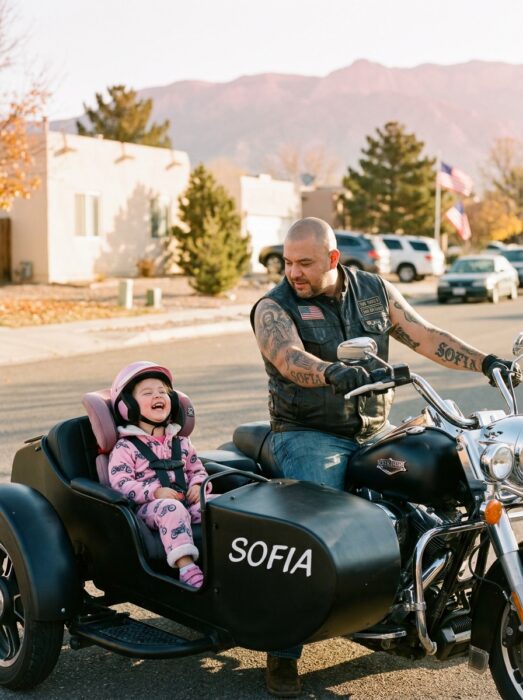
I painted the sidecar to match the Road King — flat black, with a small hand-painted detail on the right rear quarter panel that says, in white script, “SOFIA.”
I let Camila pick the lettering style.
She cried when I showed her.
The whole project took me 384 hours.
I tracked it on a small notepad in my workshop. I am a measurer. I measure everything.
When the sidecar was done — September 24th, 2022 — I took the entire rig to a motorcycle inspection shop in Rio Rancho run by a man named Ezekiel “Zeke” Marquez who is a third-generation Harley mechanic and a brother in a different club. I told him what I had built and what I had built it for.
Zeke spent six hours going over the rig.
When he was done, he came out to the parking lot, and he sat down on a bench, and he said to me, very quietly, “Brother. I do not know who taught you to weld. But this rig is the safest sidecar I have ever inspected in twenty-eight years.”
He charged me nothing for the inspection.
He said, “You bring that little girl by sometime. I want to meet her.”
I did. He has now met her. Sofia signs his name as “Z.”
The first ride was on October 1st, 2022.
Sofia was two years and ten months old.
I told Camila, “Honey. I want to take her around the block. Once. Slow. Just to see how she does.”
Camila said yes, but she came outside and stood in the driveway with her arms crossed and her face holding back what every mother of a medically complex child holds back when their child does something for the first time.
I lifted Sofia into the sidecar.
I buckled the five-point harness.
I positioned her head in the headrest.
I checked her airway. I checked her breathing. I checked her color.
She was looking at me with her dark eyes and her small mouth slightly open, the way she does when she is deciding whether something is good or bad.
I put a small pair of pediatric shooting earmuffs over her ears for sound protection.
I climbed onto the Road King.
I started the engine.
The V-twin kicked awake with a long low rumble that I felt in my chest and that Sofia felt through the bones of the sidecar.
She startled.
Then her face changed.
It changed in a way I have only seen on her face one other time in five years — at her baptism in 2020, when the priest poured water on her forehead and she opened her mouth in absolute surprise and then laughed.
She laughed.
Camila put her hand over her mouth.
I rolled the rig out of the driveway. Slow. First gear. Maybe eight miles per hour.
I went to the end of our street. I made a careful right turn. I went around the block. I came back to our driveway.
The whole loop took five minutes.
Sofia laughed for four and a half of those five minutes.
When I killed the engine, she signed something with her small hand against the side of the sidecar. The sign was not in any standard sign system. It was one of her own.
It was a gesture she had developed at fourteen months that meant more.
Camila walked over.
She was crying.
She said, “Marco. She said more.”
I said, “I know.”
I started the engine.
I took her around the block again.
We have been doing the school run on the sidecar every weekday morning for the last twenty-six months.
Sofia attends an inclusive preschool program at a small school called Mesa Verde Early Learning Center on the west side of Albuquerque. It is 4.7 miles from our house. The drive on the sidecar takes 11 minutes. The drive in the minivan takes 14 minutes.
The minivan is faster on the freeway. The sidecar takes side streets.
The sidecar is, every morning, our daughter’s choice.
She tells us with her hand. More. Sidecar.
Some mornings, when it is raining or when it is below 35 degrees or when she has had a hard medical night, we take the minivan. She accepts this. She does not protest. She knows the rules.
But every morning we can ride, we ride.
I lift her out of her crib at 6:42 a.m.
Camila feeds her her morning bottle and her morning meds.
I dress Sofia in a small fleece-lined riding suit that Camila and I designed together — pink with small motorcycles printed on it, a custom job from an Etsy seller named Julie in Indiana who is a special needs mom herself.
I lift Sofia into the sidecar at 7:43 a.m.
I buckle her into the five-point harness.
I position her head in the headrest.
I put her small pediatric earmuffs over her ears.
I put on her small pink helmet — a custom-fitted helmet from a manufacturer in Italy that took six weeks and $640 to ship.
I start the engine.
She laughs.
I pull out of the driveway.
For 11 minutes, my five-year-old daughter — who cannot walk, who cannot sit up unsupported, who cannot hold her head up by herself, who cannot speak in full sentences — flies through the streets of Albuquerque with the wind on her cheeks and the sun on her helmet.
I watch her in the small fish-eye mirror I welded to the inside of the sidecar fairing.
She watches the world go by.
She does not look like a child with cerebral palsy in those 11 minutes.
She looks like a child who is moving.
That is the entire reason I built the sidecar.
That is the entire reason I will keep building sidecars for the rest of my working life.
I want to tell you about a conversation I had with my road captain — a forty-six-year-old man named Hector “Bandit” Salazar — at the clubhouse in November of last year.
Hector and I had ridden out to a brother’s house for a barbecue. We were standing on the back patio with beers — well, I had a Dr. Pepper because I do not drink anymore — and we were talking about Sofia.
Hector said, “Marco. She’s growing. The sidecar’s gonna get tight on her in another year or two.”
I said, “I know.”
He said, “What are you gonna do.”
I said, “I’m gonna build her a new one, Bandit. Bigger. Same flat-black paint. Same SOFIA on the side. New harness sized for an eight-year-old. New headrest. New crash bar. Reinforced floor for the heavier wheelchair we’ll need by then.”
He said, “That’s another six months of welding.”
I said, “Yeah.”
He said, “And then in another two or three years she’ll outgrow that one.”
I said, “Yeah.”
He said, “And then another.”
I said, “Yeah.”
He looked at me for a long moment.
He said, “How many times you gonna build her a sidecar, brother?”
I said, “Until I can’t hold a torch anymore, Bandit. That’s how many.”
He did not say anything for a long time.
Then he reached out and put his hand on my shoulder.
He said, “Brother. When you start the next one, I’m gonna be in your garage on Saturdays. I can’t weld but I can hand you tools.”
I said, “Bandit. I’d appreciate that.”
He said, “And the brothers will be there too.”
I did not say anything.
I drank my Dr. Pepper.
He was right. The brothers have been there.
Sofia is going to outgrow her current sidecar in approximately fourteen months.
I have already started designing the next one.
The next one will be larger. It will hold a slightly more upright child seat to accommodate her growing torso. It will have new harness mounting points for an eight-year-old’s body proportions. It will have a slightly larger crash bar with adjustable padding. It will have a larger medical compartment because her medical bag has grown. It will have new upholstery that I will sew myself, again, because I have learned to sew now and because that is part of the deal.
I have estimated, based on the work I did on the first sidecar, that the second one will take me about 320 hours. I am faster now.
I have estimated that the third sidecar — for when she is around ten or eleven — will take me 280 hours. I will be faster still.
I have estimated that the fourth sidecar — when she is around fourteen — will be the most complex one, because Sofia will be approaching adult size and the engineering tolerances will tighten.
I have estimated that the fifth sidecar — when she is around eighteen, if I am still alive and healthy and able to weld — will be the last one I build for her.
I am estimating five sidecars total over the next thirteen years.
I am fifty-two years old now in the calendar I have laid out in my head. I will be sixty-five when I weld the last one.
I have a small notepad in my workshop that I have written this calendar on. The notepad is on a shelf above the welding bench. Camila found it last summer when she was looking for a tape measure.
She did not say anything about it for two days.
On the second day, she came out to the workshop while I was finishing a sample weld for a stress test. She sat down on the wooden stool I keep next to the bench.
She said, “Marco.”
I lifted my welding helmet.
She said, “You’re going to build her five sidecars.”
I said, “That’s the plan, honey.”
She said, “Five sidecars.”
I said, “Yeah.”
She said, “Marco. I want to tell you something. And I want you to listen to me.”
I put down the torch.
I said, “I’m listening.”
She said, “You think you are building her a sidecar. You are not building her a sidecar. You are building her the proof that her father is going to keep showing up. Every two or three years, for the rest of her childhood, our daughter is going to watch her father weld a new vehicle for her body.”
She paused.
She said, “That is the most important gift she will ever receive. From anyone. In her whole life. Including from me.”
I did not say anything.
She said, “I love you. Don’t stop. I will help you sew the upholstery on the next one. I want to be part of it.”
I did not have words.
I just nodded.
She kissed me on the cheek. She walked back to the house.
I went back to welding.
That night, after Sofia was in bed, I added one line to the bottom of the calendar in the notepad.
It said, in my handwriting:
Camila will sew the upholstery starting with #2.
That note is still on the page.
There is one detail about the current sidecar that I have not mentioned yet.
Stitched into the inside of the headrest cover — on the side that touches Sofia’s head, hidden beneath the padding — is a small rectangle of soft pink cotton.
It is a piece of the swaddle blanket Sofia was wrapped in on the day she came home from the NICU on April 12th, 2020.
I stitched it into the headrest before I closed up the upholstery in September of 2022.
I did not tell Camila I had done it until last year.
I did not tell Sofia at all. I will tell her when she is older.
I wanted, when I was building the sidecar, to put something physical between my daughter’s head and the world she was about to fly through. Something soft. Something that had once held her body when her body was the most fragile it would ever be.
Every single ride for the last twenty-six months, my daughter has been resting the back of her small head against the swaddle blanket she came home in.
Every single morning. Every single school run.
I will build the next sidecar with a piece of that same blanket stitched into the next headrest.
I have enough of the blanket left for at least three more sidecars.
I have already cut the squares.
They are in a small ziplock bag in my workshop drawer.
Labeled, in my handwriting:
FOR HEADRESTS — DO NOT LOSE.
Sofia is five.
She is in pre-K at Mesa Verde Early Learning Center.
She loves Bluey.
She loves her aide Mrs. Yolanda Reyes (Yo-yo).
She loves her mother.
She loves her father.
She loves the sidecar.
She has, in the last eleven months, learned to sign the word “helmet” on her own. She signs it every morning when I lift her out of her crib. She signs it with her small right hand against the side of her head.
I sign back, “Yes. Helmet. Sidecar. School.”
She laughs.
We go.
I am not the man I was before her.
I am better.
I am going to keep welding.
If this story moved you — follow the page. There are more bikers out there building things in their garages for kids the world has decided about. More fathers learning to sew at thirty-eight. More custom rigs no one will ever see at a bike show. More children flying for eleven minutes a day because somebody who loved them spent six months in a respirator. There are more stories the world doesn’t see — and I will keep telling them as long as someone keeps reading.