Part 2: A Biker Father Showed His Burn Scar to a Classroom That Mocked His Daughter’s Face, but the Truth About His Arm Made Her Mother Cry Years Later
PART 2 — THE GIRL WHO FACED THE WALL
Sophie did not hate school at first.
She loved kindergarten. She loved stickers, library day, animal crackers, and the feeling of writing her name neatly enough for her teacher to draw a star beside it. Children noticed her scar even then, but younger children usually asked questions the way they ask about rainbows, missing teeth, wheelchairs, freckles, or why teachers live at school.
“What happened to your face?”
Sophie would look at Claire.
Claire would answer gently, “She was hurt when she was very little, but she is safe now.”
Most children accepted that because little children are better than adults at moving on when the answer is honest and calm.
But as Sophie grew, questions changed.
Curiosity became comparison.
Comparison became whispering.
Whispering became jokes.
By fourth grade, Sophie knew every name children used when adults were not close enough to hear. She knew which bathroom mirror made the scar look darker. She knew which hallway window reflected her left side. She knew which classmates would sit beside her only when assigned. She knew that birthday party invitations sometimes skipped the girl whose face made group photos “weird,” though no parent ever admitted saying that.
The worst thing was not one cruel moment.
It was accumulation.
A note that said monster girl.
A lunch table going silent.
A boy pretending to spill hot soup and laughing when she flinched.
A girl telling her she could be pretty “from the other side.”
Each piece was small enough for adults to handle separately, and that was exactly the problem. Adults like separate pieces. Children live the whole pile.
Claire watched her daughter fade in slow motion.
Sophie stopped wearing bright hair clips. Stopped asking for picture day outfits. Stopped looking at herself when brushing her teeth. She began eating breakfast with her hair pulled forward over her cheek. She asked if makeup could “erase things.” She asked whether skin could be replaced. Then one morning, she sat on the bathroom floor with her purple backpack in her lap and said, “I can’t go where my face gets laughed at.”
Claire called the school.
Then she called Mason.
Mason was at Holt Road & Cycle Repair, the small garage he owned outside Nashville. He had married Claire three years earlier, after knowing exactly what had happened to Sophie and exactly how careful love would need to be. He never asked Sophie to call him Dad. She did one night by accident while half-asleep on the couch, and he went into the garage afterward so she would not see him cry.
When Claire told him Sophie did not want to go back to school, Mason became very quiet.
That kind of quiet frightened Claire more than anger.
“What did they say to her?” he asked.
Claire told him what she knew.
Not all of it.
No parent ever knows all of it.
Mason looked down at his right arm.
At the mark he had added months earlier.
Not because he wanted attention.
Not because he wanted to pretend he understood everything.
Because Sophie had once asked him, in the smallest voice, “Why am I the only one with a face like this?”
He had not known how to answer.
So he had gone to a tattoo artist who specialized in medical-style realism and asked for something strange.
A scar.
Not a dragon.
Not flames.
Not a skull.
A realistic burn-scar tattoo across his forearm, placed where he could show it or hide it. He told almost no one. Claire knew. His closest friend knew. Sophie did not.
Not yet.
Mason had been waiting for the right moment.
That morning, the moment arrived wearing a purple backpack and refusing to leave the bathroom floor.
PART 3 — WHAT MASON KNEW
Mason knew he was not Sophie’s first father.
He also knew biology is sometimes given too much credit.
Sophie’s biological father had been removed from her life years earlier after harming her when she was only two. The legal records used careful language. Family members used even softer language because some truths make people uncomfortable. Claire never softened it inside herself. She had lived the hospital nights, the investigation, the protective orders, the therapy appointments, the questions from strangers, and the terrible work of helping a toddler become a child without letting the past become her whole name.
Mason met Claire when Sophie was six.
He met Sophie three weeks later at a diner, after Claire decided he was kind enough to be introduced and patient enough to leave if Sophie felt uncomfortable. Sophie wore a yellow sweater and sat beside Claire instead of across from him. She stared at Mason’s boots, then his beard, then his hands.
“Do you fix motorcycles?” she asked.
“Yes, ma’am.”
“Are motorcycles mean?”
“Only if you don’t maintain them.”
Sophie considered that.
“People are mean even if you maintain them.”
Mason did not laugh.
He should have, maybe, because children say strange things.
But he heard the truth under it.
“Some are,” he said. “Not all.”
That answer mattered to Sophie.
Mason never pushed affection. He offered presence. He fixed the loose chain on her bike. He learned which cartoons she liked. He sat through school plays. He let her paint his fingernails once and kept the purple polish under his gloves for three days at the garage. He read about trauma in children, though he would have rather rebuilt a carburetor blindfolded than admit he was reading parenting articles at midnight.
He made mistakes.
Plenty.
Once, he told Sophie she was brave and she screamed, “I don’t want to be brave, I want to be normal.”
Mason apologized.
That became his strongest parenting skill.
Not knowing everything.
Apologizing fast and meaning it.
He joined Iron Order before marrying Claire, but he kept club life separate from Sophie until she asked to see the bikes. The members treated her gently. They did not stare at her scar. Or if they did, they learned quickly not to. The club president, Frank “Bear” Hollis, a sixty-two-year-old white American biker with silver hair, gray beard, tattooed hands, and a voice like gravel in a warm coat, once knelt in front of Sophie and said, “Around here, scars are just stories skin remembers.”
Sophie liked that.
But school was harder.
Children her own age had the power to make her feel outside her body.
Mason could not punch that problem.
He could not roar it away with motorcycles.
He could not threaten nine-year-olds, and he would not. That would only teach Sophie that her safety required fear.
So he thought of maps.
Sophie loved maps because maps made difficult places understandable. A map could show where rivers curved, where roads ended, where mountains stood, where to go next. A map did not erase hard ground. It made it survivable.
That was what Mason wanted for her scar.
Not denial.
Not forced positivity.
A new language.
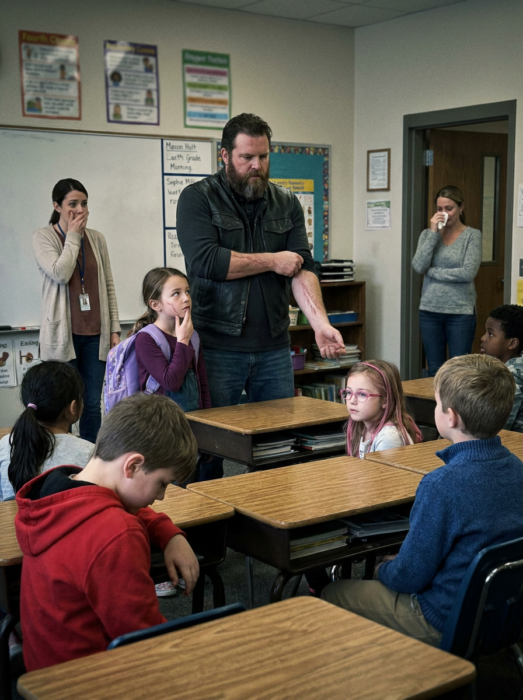
So in front of her class, he gave her one.
This is a map.
And for the first time in months, Sophie heard her face described as something other than a problem.
PART 4 — THE CLASSROOM AFTER
The class did not transform into saints overnight.
Stories lie when they pretend one speech fixes every child forever.
What happened was quieter and more realistic.
The room became accountable.
Tyler apologized first, badly. He mumbled into his hoodie sleeve, eyes still down, saying he was sorry “if” he made her feel bad. Mason did not accept it for Sophie. He did not correct it either. He only looked at Rebecca Lane, and she understood that the work belonged to the adults now.
So she did the work.
The school counselor came in. Principal Denise Carter, a fifty-three-year-old Black American woman with deep brown skin, short natural curls, glasses, and a navy blazer, met with parents. The bullying was documented clearly, not softened into “peer conflict.” Seats changed. Hallway supervision changed. Bathroom line procedures changed. Students learned about visible differences, trauma, empathy, and the difference between questions and cruelty.
Some parents became defensive.
That always happens.
“My child would never.”
“He was just curious.”
“She did not mean it like that.”
“They’re only nine.”
Principal Carter answered each version with calm steel.
“Nine is old enough to learn repair.”
That became the school’s approach.
Not humiliation.
Repair.
Students wrote apology letters only after discussions, not as punishment scripts. The letters had to include what they did, why it hurt, and what they would do differently. Sophie was not forced to read them. She chose two. She ignored the rest for weeks.
That was her right.
Mason walked her to school the next morning.
Not into class.
Only to the front door.
Sophie wore her hair clipped back.
Claire cried in the car where Sophie could not see.
At the door, Sophie hesitated.
Mason crouched.
“You don’t have to say anything today.”
Sophie touched her cheek.
“Is it really a map?”
Mason nodded.
“Every road on it means you made it here.”
She looked at his covered arm.
“Yours too?”
He paused.
“Mine too.”
That was not exactly a lie.
It was not exactly truth either.
Sophie looked toward the classroom hall.
“What if they stare?”
Mason thought carefully.
“Then let them learn geography.”
She laughed.
Small.
Real.
Every morning after that, Claire placed a mirror on the kitchen table. Not because Sophie had to love what she saw. Love can be too big a demand for a child still healing. The goal was not sudden confidence. The goal was not looking away.
Sophie would stand in front of the mirror, touch her cheek, and whisper, “This is my map.”
At first, she cried every time.
Then only sometimes.
Then one morning, she added:
“And I know the way through.”
Mason heard from the hallway and had to grip the wall.
Because sometimes a child’s healing is so brave it makes adults feel unworthy of witnessing it.
PART 5 — THE ARM THAT WAS NOT BURNED
Claire told Rebecca the truth years later.
Not to expose Mason.
To explain him.
Sophie was thirteen by then, taller, sharper, still scarred, still beautiful, and no longer willing to make herself smaller for other people’s comfort. She wore her hair however she wanted. Sometimes over her scar. Sometimes away from it. Both choices belonged to her. That was part of healing too.
The truth came out after a middle school art exhibit where Sophie displayed a large painted map of a girl’s face made of rivers, roads, forests, and storm lines. At the bottom, she titled it:
Places I Survived.
Rebecca, who had since moved to another grade, came to the exhibit and cried in front of the painting.
Claire stood beside her.
“You remember that day Mason came to class?”
“I’ll never forget it,” Rebecca said.
Claire smiled through tears.
“There’s something you never knew.”
Rebecca looked at her.
“His scar?”
Claire nodded.
“It wasn’t from a motorcycle accident.”
Rebecca was silent.
Claire looked across the room at Mason, who stood awkwardly near the punch table while Sophie explained her painting to two classmates. His right forearm was visible below his rolled sleeve. The mark still looked raised, raw in color, healed in texture, unmistakably scar-like.
“It’s a tattoo,” Claire said.
Rebecca turned sharply.
Claire’s eyes filled.
“He had it done six months before that classroom speech.”
“Why?”
Claire watched Mason watching Sophie.
“Because one night she asked why she was the only one.”
The room seemed to fall away.
Claire explained it softly. Mason had gone to a tattoo artist with photos of healed burn scars, medical references, and a request so unusual the artist made him repeat it twice. He did not want flames. He did not want toughness. He wanted a mark that looked like survival. Something believable enough that Sophie would not feel alone if she ever needed to see it.
“He told me,” Claire said, “if the world keeps pointing at her scar, I want her to be able to point at mine.”
Rebecca covered her mouth.
“He let the class think—”
“He let everyone think what Sophie needed them to think.”
“Does she know?”
Claire nodded.
“She found out last year.”
“How did she take it?”
Claire laughed softly through tears.
“She was furious for ten minutes.”
That sounded like Sophie.
“Then she asked if it hurt.”
“What did he say?”
“He said, ‘Not like yours.’”
Rebecca looked at Mason differently after that.
Not because the scar was fake.
Because the love behind it was not.
Some men tattoo names.
Some tattoo flags.
Some tattoo memories.
Mason tattooed companionship into his skin so a little girl would not have to stand alone in hers.
PART 6 — SOPHIE FINDS OUT
Sophie found out on a summer afternoon in the garage.
She was twelve, nearly thirteen, sitting on an overturned bucket while Mason changed brake pads on a customer’s motorcycle. The bay door was open. Country music played low. Claire was inside making iced tea. Sophie was sketching a dragon with one wing scarred and one wing made of clouds.
Mason reached for a rag, and sunlight hit his forearm just right.
Sophie saw something she had not noticed before.
The “scar” did not pull the skin the way hers did.
Not quite.
Its edges looked too intentional.
Too shaded.
Too designed.
She stared.
Mason noticed.
“What?”
She stood.
“Is your scar real?”
The wrench stopped moving.
Mason could have lied.
He almost did.
Not because he wanted to deceive her, but because he feared losing the language that had helped her survive school. But Sophie was old enough now to deserve the full truth, and Mason had promised himself never to build her healing on a lie once she was ready to ask directly.
He set the wrench down.
“No,” he said.
Sophie’s face changed.
“It’s not?”
“It’s a tattoo.”
She stepped back as if the garage floor had shifted.
“You lied to me.”
Mason nodded once.
“Yes.”
Her eyes filled with anger before tears.
“You said it was your map.”
“It is.”
“No, it isn’t. You chose it.”
His voice stayed quiet.
“I did.”
“I didn’t choose mine.”
“I know.”
The words landed heavy.
Sophie wrapped both arms around herself.
“Why would you do that?”
Mason looked at his forearm.
Then at her.
“Because you asked why you were the only one.”
She looked away.
“I was little.”
“You were hurting.”
“You pretended.”
“I joined you.”
That made her angry all over again because it was almost beautiful, and she did not want it to be beautiful yet.
“You can wash yours off if you want.”
“No,” he said. “I can’t.”
“It’s still not the same.”
“No. It will never be the same.”
That answer stopped her.
Mason stood, keeping distance.
“I did not do it to say I knew your pain. I don’t. I did it so when the world made you feel marked, you could see someone standing beside you with a mark too.”
Sophie cried then.
Not softly.
Not prettily.
She cried like a child old enough to understand love and young enough to still hate what happened.
Mason did not touch her until she moved first.
Finally, she stepped into him and pressed her face against his shirt.
“You’re stupid,” she sobbed.
He closed his eyes.
“Yes.”
“And nice.”
“Trying.”
“And still not my real dad.”
That one hurt, but he accepted it.
“No.”
She gripped his shirt harder.
“You’re my dad though.”
Mason’s breath broke.
Claire watched from the kitchen doorway, one hand over her mouth, iced tea forgotten on the counter.
Sophie pulled back and touched his tattooed scar.
“Did it hurt?”
“Some.”
“Good.”
Mason almost laughed through tears.
Then Sophie touched her own cheek.
“Mine hurt more.”
His face softened.
“I know, baby.”
She looked at him for a long time.
Then she said, “Okay. It can still be your map. But mine has better roads.”
Mason nodded.
“Always did.”
PART 7 — THE MAP SHE KEPT
By high school, Sophie no longer said the mirror sentence every morning.
She did not need it the same way.
Some days she still did, especially before hard things: first day of school, class presentations, school photos, dates, job interviews, the morning a stranger at a coffee shop stared too long and she felt nine years old again. Healing is not a staircase. It is a road with loops, weather, potholes, and places where you swear you have already been.
But the map remained.
In her art.
In her language.
In the way she corrected people who called her scar a tragedy before knowing her.
“It’s not the tragedy,” she once told a college interviewer. “It’s the evidence.”
Mason nearly fell apart in the hallway when Claire repeated that.
Sophie eventually became interested in art therapy, trauma care, and helping children draw what they could not yet say. She volunteered at a burn support camp one summer and came home quiet, not sad exactly, but full. She told Mason about little kids asking whether scars made them scary, ugly, broken, different, bad.
“What did you tell them?” he asked.
She smiled.
“I told them they were maps.”
Mason turned toward the sink and pretended to rinse a cup.
Claire whispered, “Coward.”
He said, “Absolutely.”
Years after the classroom speech, Cedar Hill Elementary invited Sophie back for a small assembly about kindness and visible differences. She was eighteen then, white American, fair-skinned, with brown hair cut to her shoulders, hazel eyes steady, scar fully visible, wearing a green dress and boots that Mason said looked impractical but cool.
Mason came too.
He sat near the back in a plain leather vest with no readable patches, hands folded, tattooed scar visible beneath his sleeve. Rebecca Lane sat beside Claire. Principal Carter, older now and still powerful in quiet ways, introduced Sophie not as a victim, not as an inspiration, but as an artist.
Sophie stood at the front of the gym.
Children looked at her face.
She let them.
Then she held up a painting.
It showed two arms and one face, all marked like landscapes, roads crossing through fire-colored valleys and blue rivers, mountains rising where pain had tried to settle. In the corner was a tiny motorcycle, almost hidden, parked beside a sign with no words.
“My dad once told my class scars are maps,” Sophie said.
Mason lowered his head.
“He was right.”
Claire took his hand.
Sophie smiled toward the back row.
“But I learned something else later. Some maps show where you survived. Some maps show where someone chose to walk with you.”
Mason covered his mouth with one hand.
Everyone who knew the truth understood.
Most people in the gym did not.
That was okay.
Not every act of love needs public explanation to be real.
After the assembly, a little girl with a surgical scar near her eyebrow approached Sophie and asked whether her scar could be a map too.
Sophie knelt.
“Absolutely.”
“Even if it’s small?”
“Small maps still help people find their way.”
The girl smiled.
Mason watched from the hallway and touched the tattoo on his arm.
He had once worried that choosing a scar made his love dishonest.
Now he understood it differently.
Sophie’s scar was history.
His was promise.
Both were maps.
One showed where pain had happened.
One showed where love decided to stand.
And somewhere between them, a little girl who once faced the wall learned to walk into rooms with her whole face uncovered.
Not because the world became gentle.
Because she became fluent in herself.
If you asked Mason about it, he would shrug and say, “I just rolled up my sleeve.”
That was not true.
He rolled up the story he had built into his skin.
He rolled up his pride, his fear of being misunderstood, his anger at what had happened before he came, and his promise that Sophie would never again be the only marked person in the room.
He rolled up his sleeve and gave a child a sentence strong enough to grow into.
This is my map.
And she did.
Follow the page for more unforgettable biker stories about quiet love, misunderstood heroes, and the rough-looking fathers who choose to stand beside a child’s pain until she can call it strength.