A Biker Snatched My Five-Year-Old Daughter’s Doll and Threw It Into a Burning Barrel — Six Weeks Later, He Brought Her One He Had Sewn Himself
My brother put out the ordinary yard fire while we kept Ava away from the barrel. He did not reach into it for the doll. By the time the first officers arrived, smoke was drifting across the driveway, and Mrs. Bell was waiting by the gate to tell them what she had seen.
She had seen Mason grab a child’s toy and throw it into a fire. She had seen Ava run after it. She was right about both. I was relieved she spoke first, because I was still trying to comfort Ava and could not put the afternoon into sensible order.
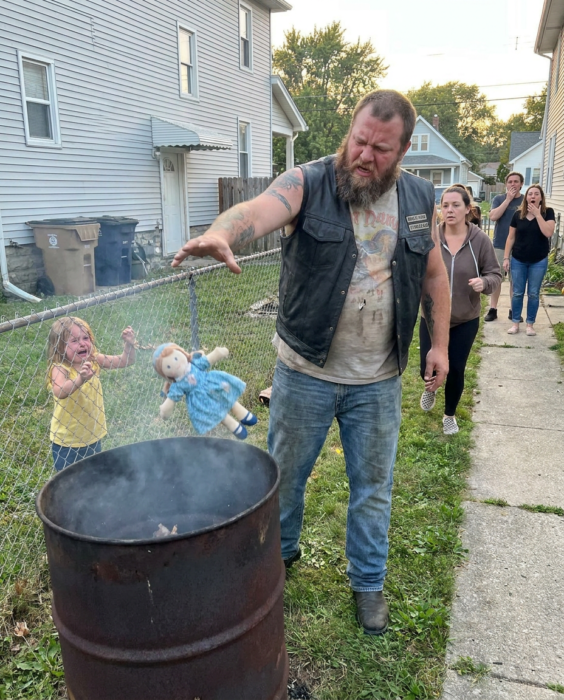
One officer separated Mason from us to hear his account. The other asked me whether Ava was hurt. She was frightened and furious, but she had not reached the flames. My brother led us onto the porch, where Ava could sit without looking directly at the barrel. She kept asking why Rosie was gone.
I told her I did not know enough yet. Mason had said he thought something was wrong with the doll, and people were checking. It was a poor answer for a five-year-old. It was the only honest one I had.
I learned the rest of Mason’s first account that evening. When Ava brought Rosie over to him, she had tucked the doll beside the radio he was examining. A burst of interference came from its speaker. He moved the radio and heard it again when the doll was close. He felt a hard shape through the stuffing, under a patch of fabric that looked as though it had been sewn twice.
Mason repaired small electronics for a living. Those details made him suspicious; they did not tell him exactly what was inside. He asked Ava who had given her the doll. She said a man at the park. Mason asked to hold it and felt her pull it back. Then the radio crackled again.
He made a fast decision. He took the doll, went to the barrel, and threw it in. He later said he feared an active device could transmit whatever we said while we called for help. He also admitted that fear had outrun his judgment. Burning a toy that might contain a battery created another hazard and destroyed evidence the police would have preferred intact. He had not thought clearly through either consequence.
I appreciated hearing him say that. It did not bring Rosie back, but it told me he understood why I was angry.
The officers asked my brother who had started the fire, what was burning before the doll went in, and who had stood near it. They kept the area clear while they documented what remained. Mason gave his name, his shop address, and the details of the radio. My brother unplugged it and set it aside when an officer asked him to leave everything where it could be examined.
A fire crew came to check that the barrel and surrounding area were safe. Ava watched from the window, her hands flat against the glass. I moved her away when she tried to look at what they took from the cooled debris. The officers later collected charred material, including small pieces Mason believed came from something other than a cloth doll. They made no announcement on our porch about what those pieces proved.
Mason had been my brother’s friend for four years. He fixed a temperamental amplifier for him without charging for the hours. At a cookout the previous summer, he had let Ava sit on his parked Harley and warned her that its exhaust stayed hot even after the engine stopped. She knew him as a man who brought extra napkins because she always spilled lemonade. That history was why she had taken Rosie to show him.
It was also why his action hurt her so much.
After the officers left, I found a loose blue thread caught on the rough concrete near the barrel. Ava wanted it. I put it in an envelope and gave it to her, though I wondered whether it would make the loss harder. She placed the envelope beneath her pillow and asked if Mason would come back.
“I don’t know,” I said.
That night I checked the doors twice. The stranger from the park had been close enough to hear Ava’s name. I replayed the handoff while washing the dinner plates: my phone lighting up, Ava running toward me, the doll already in her arms, the man moving toward the parking area. I had not seen enough to describe him well, but I wrote down what I remembered before sleep blurred it further.
A detective called the next morning. She asked for that account and whether we had taken photos at the park. I had two of Ava by the slide. In the corner of one, beyond her shoulder, was a person near the path. His face was turned away. I sent the original image as requested, knowing it might show very little.
The detective also asked me to gather anything I remembered Ava saying about the gift. I started to answer by asking Ava again, then stopped. The detective arranged for a trained interviewer to speak with her. My job was to tell them what she had already said, without turning our kitchen table into another interview.
We stayed with my brother for two nights, then went home after talking through a safety plan with the detective. I changed the routine for picking Ava up from preschool. My brother helped with the mornings I worked early. Mason did not offer to stand watch at our house, and I was grateful. I had begun to trust that he had seen something real, but Ava still cried when his name came up.
The story had already spread through the neighborhood. One person said Mason had found a camera. Another said he had caught a man watching our house. Neither claim had come from us or the police. Mrs. Bell apologized for repeating the camera story after she learned nobody had confirmed it. She had meant to warn another parent and had passed along a guess as a fact.
I asked people to stop using Ava’s name. A five-year-old should be able to go to the library without someone asking about the toy she had watched burn. The request worked with most of our neighbors. It did not work with every person who had seen the short video of Mason carrying Rosie to the barrel.
Someone had posted it online. The clip began when he took the doll and ended before police arrived. It showed Ava crying and me running across the yard. Comments filled in explanations the footage could not provide. Some called Mason cruel. Others claimed he had saved Ava from a device whose details they had invented. I asked the person who posted it to remove it. He did, but copies lingered.
Mason called my brother, not me, to ask whether Ava was all right. He accepted it when my brother said she needed time. Then he sent an apology through him, written on the back of a repair-shop receipt because that was the paper near his phone. He said he should have told me what he had noticed and moved Ava away while we called for help. He was sorry he had frightened her and sorry he had damaged something she loved.
I kept the receipt in a drawer. Ava did not want to hear it yet.
Four days after the fire, the detective came to speak with me again. Investigators had examined what they could recover from the barrel. The fragments were consistent with electronic components, but heat had damaged them badly. A bit of board and wiring was not enough by itself to establish a working microphone or a tracking device. I felt my hope for a clear answer sink.
Then she asked whether Ava had received anything else from the stranger. She had not. The detective said they were following other leads and could not discuss them. She encouraged me to keep our routines private and contact her if I remembered another detail about the park.
I remembered the stranger’s bag. It was a canvas tote with a printed picture I had noticed only because it swung against his knee as he walked away. I could not describe the picture. The detective added the bag to her notes.
The possibility that Mason had burned the only strong physical evidence stayed with me. When I finally called him, I said so.
“I know,” he told me.
He was at his shop. I could hear a small fan in the background and a customer bell near the door. He said the officers had taken a statement about his decision and he would answer anything else they asked. He did not defend the fire as clever. He wished he had left Rosie intact for the people who knew how to examine her.
I told him Ava had lost sleep. He was quiet for a moment, then asked whether there was a way to replace the doll without coming to our house. I said she would know a store-bought Rosie was different. He said, “I figured.”
After we hung up, I stood in the kitchen looking at the empty spot beside Ava’s breakfast plate. She had put Rosie there every morning. Now she placed the envelope with the blue thread beside her cereal bowl. She opened it sometimes, made sure the thread was still inside, and closed it.
A week later, the detective phoned with news she could share: another family had come forward after seeing a police request for information about gifts given to children in local parks. Their child still had the doll she had received. It had not been burned or altered.
That doll would be examined intact.
The next stretch of the investigation happened outside our view. We were told enough to answer questions and keep Ava safe. I learned more months later, after an arrest, when the detective explained what she was allowed to share. I have never known every detail, and I do not need to.
The second doll contained a small electronic assembly hidden inside its stuffing. Investigators also recovered records and other items that led them to additional families. By the time they had traced the pattern across three towns, they had identified at least nine girls who had been given similar dolls. None of those families had known anything was concealed inside.
The evidence from the intact toys supported what Mason had suspected: the devices could be used to collect information about where the dolls were and sound from nearby. Whether each device was functioning every moment a child carried it was something investigators had to determine. The charred fragments from Rosie helped connect our case to the others, but they were not the discovery on which the whole investigation rested.
The man who had given Ava the doll was arrested. Investigators found more than my uncertain park photograph; the later case drew on the intact devices, witness accounts, and records gathered through warrants. I was told he was stopped before investigators found evidence that he had physically approached any of those families after giving the dolls. That mattered to me, though it could not undo the three nights Rosie had been beside Ava’s pillow.
I sat on our couch after the detective called and counted nine children in my head. I could picture only my own. I thought of eight other kitchens where parents had checked seams, washed clothes, packed lunches, and put their children to bed without seeing what had been sewn into a toy.
Mason heard about the arrest from the detective who had taken his statement. He called my brother to ask whether it was all right to send Ava something. My brother passed the question to me. I told him he could write her a short note. I was not ready to have him arrive with a new doll and hope she would accept it.
The note came in an envelope addressed to Ava in careful block letters. Mason apologized for taking Rosie and for scaring her. He wrote that grown-ups should have kept her safe while they figured things out. He did not say the fire had been necessary, and he did not ask her to forgive him.
I read it first, then asked Ava whether she wanted to hear it. She listened while drawing at the table. She wanted to know if Mason still had the radio.
“I think he fixed it,” I said.
“He can fix radios.”
“Yes.”
“Can he fix Rosie?”
I told her Rosie was gone. She looked down at her drawing. I waited for tears, but she only asked if I would put Mason’s note with the blue thread. I did.
Mason began making another doll without telling us. Later he showed me a paper pattern folded into four squares, each marked with corrections. He could solder a loose connection under a magnifying lamp. Cloth was different. The first arm he sewed was too short. He made a second, pulled its stitches out, and tried again.
Rook, his club brother, told me Mason spent six weeks on it. Several men offered to buy Ava an expensive doll instead. One found a shop that could make a close copy of Rosie from a photograph. Mason thanked him and kept sewing.
His sister showed him how to turn the fabric without splitting a seam. He chose plain cotton stuffing and left the doll’s clothes simple. Before he closed it, he asked his sister to look it over. He did not want to give Ava anything she might reasonably worry was hidden inside. His sister laughed at him for how many times he checked, then helped finish the dress.
I learned about the sewing only when Mason called to ask permission to bring the doll over. He said I could inspect it first and that Ava could refuse it. That was the first offer from him that felt fully shaped by what had happened.
I told Ava Mason had made something and asked whether she wanted to see him. She said yes, then asked if he would be wearing his vest. I said I could ask him to leave it at home. She said no; she only wanted to know.
Mason came on a Sunday afternoon, six weeks after he had thrown Rosie into the barrel. His Harley sounded down the street, then went quiet in front of our house. He took off his helmet and waited at the gate until I waved him in.
Ava stood behind me. She had the envelope with the blue thread in one hand. Mason noticed it but did not mention it. He set a clean cardboard box on the porch rail and stepped back so she could decide whether to approach.
Inside was one cloth doll. Not a hundred. Its blue dress had been cut from a fabric close to Rosie’s, though the pattern was different. Its yarn hair sat unevenly around its face, and one button eye was visibly lower than the other. The crookedness was the first thing Ava saw.
“Her eye,” she said.
“I know,” Mason answered. “I tried three times.”
She considered him, then picked up the doll. Its legs were too thick for its body. The stitching along one wrist wandered away from the seam. It looked like something made by a man who knew exactly how to mend a radio and had spent weeks learning that a needle would not obey him the same way.
Ava asked whether it had a name. Mason said that part was hers. She named it Button before he had reached the gate. He did not try to hug her. She held the doll against her chest and called goodbye.
After he rode away, she put Button on the table beside her drawing. She still kept Rosie’s blue thread in the envelope. For months, the new doll and the old thread traveled together between her room and the kitchen. I did not ask her to choose which one mattered more.
The investigation affected our neighbors in ways I had not expected. Mrs. Bell checked every toy her grandchildren brought over, then worried aloud that she was making them afraid of everyone. My brother blamed himself for having a burn barrel lit when Mason panicked. Mason told him he had made the choice to use it. I had my own list of things I wished I had done differently at the park.
A family counselor helped me talk to Ava without making every gift or friendly person seem dangerous. Ava knew she could tell me if an adult gave her something, asked her to keep a secret, or made her uncomfortable. She also knew none of this was her fault. We practiced ordinary sentences she could use and made sure she knew which familiar adults she could approach.
Mason’s club wanted to do something for the other families. Their first idea was to put photographs of the dolls on flyers. I asked them to wait. The detective was still gathering evidence, and none of the families had agreed to have their children’s stories made public. Mason agreed before I had finished speaking.
Months later, after the investigation no longer depended on secrecy around the dolls, the club partnered with a child safety organization to support parent information sessions. Trained staff wrote the material. Schools decided whether to host it. The club paid for printing, carried supplies, and helped spread meeting dates without naming Ava or the other girls.
The sessions were about more than toys. Parents talked with their children about unexpected gifts, personal information, and how to tell a trusted adult about something that felt strange. They learned where to report a concern and were told to leave a suspected device intact for authorities to assess. Mason attended some meetings to answer a narrow question about how he first became suspicious. He also told people plainly that burning the doll had been a mistake.
By the third year, the organization had taken its program to more than forty elementary schools in the region. I attended one session as a parent. It was held in a library with folding chairs and too little coffee. Nothing about it looked like a campaign photograph. A mother asked a question about an ordinary birthday-party favor. A presenter answered without frightening the room. I thought about how much more useful that was than the rumors that had raced down our street.
Ava did not stand on a stage. She went to school, lost a tooth, learned to ride a bicycle, and sometimes left Button in the laundry basket by accident. Mason saw her when he visited my brother. He never asked whether she still had the doll. He could see its lopsided head tucked under her arm.
One afternoon, she brought him a radio with a broken knob. It was the same kitchen radio that had crackled on the porch. My brother had dropped it. Ava wanted Mason to repair it because, she said, “You know this one.”
He fixed the knob. Then he sat with her on the porch and let her choose a station.
Four years have passed. Ava is nine now. Button’s blue dress has faded, and the lower button eye has been resewn twice. The second repair was hers. She wanted to learn, so Mason’s sister showed her how to thread a needle and let her make the stitches herself.
The envelope with Rosie’s thread is still in Ava’s room. Sometimes she takes it out. Most of the time, it stays in a box with school drawings, a library card she outgrew, and a smooth stone she insists came from our old park.
We still go to parks. That took time. At first I chose a different one across town. Ava noticed, of course. She asked if we could return to the playground with the long slide. We went with my brother on a bright Saturday, stayed as long as she wanted, and came home for lunch. Nothing unusual happened. That ordinary afternoon did us good.
Mason has a photograph of Button on the counter at his repair shop. Ava took it herself, with the doll propped beside an unplugged radio. In the picture, its uneven eyes are easy to see. People who ask about it sometimes hear that his sister taught him to sew. He does not tell Ava’s story to customers.
He and I have talked about the fire more than once. He still regrets how he acted. I no longer doubt that he was trying to protect her. Both thoughts fit in the same memory: my daughter running toward the flames, and Mason keeping her back after he had put the thing she loved there.
The families in the investigation have kept their own distance from public attention. I know their number because it was part of what authorities eventually shared, not because we became a group. I have never met most of them. When the child safety organization asks me whether I want to speak at a parent session, I decide each time. I sometimes say yes. I never bring Ava unless she asks to come for an ordinary reason.
Last winter, she sat at Mason’s shop while he repaired my brother’s amplifier. Button was in her backpack, one thick leg sticking out beside her math folder. Mason looked up from the bench and asked whether the doll needed fixing again.
“No,” she said. “She came to watch.”
He nodded as though that explained everything and went back to work. Ava pulled up a stool at a safe distance from his tools. She watched him test the amplifier, asked what made the small light turn on, and wrote the answer in the margin of her homework.
I could hear a Harley pass outside. Mason’s hands stayed on the workbench, steady over the part he was repairing. Ava’s doll sat beside her folder, its crooked eye turned toward him.
On Ava’s tenth birthday, Mason arrived with a small package. I told him he did not need to bring presents. He said it was not from the club, then handed it to Ava and let her open it.
Inside was a sewing kit sized for a beginner. His sister had chosen the needles and put them in a case that closed securely. There was blue thread for Button’s dress and black thread for its wandering mouth. Mason had added a small scrap of cloth so Ava could practice before touching the doll.
Ava thanked him. She asked why he had not brought another doll.
“One was hard enough,” he said.
She laughed. He smiled, then went outside to help my brother carry the birthday chairs from the garage.
That evening, after everyone left, I found Ava on the couch with Button in her lap. She had made three crooked lines of practice stitches on the scrap. She showed me each one. The last was straighter than the first.
She asked again about the day Mason threw Rosie into the fire. Her questions have changed as she has grown. When she was five, she wanted to know why he took her doll. Now she wanted to know why he had not told me first.
“He was frightened and decided too fast,” I said. “He told the police that, too.”
“But he heard something.”
“He heard something that worried him. Other people had to find out what it meant.”
Ava turned Button over and examined the seam at its back. “I wish Rosie hadn’t burned.”
“I do too.”
She put the practice cloth beside her and leaned against my shoulder. We stayed there until my brother called to ask whether we had found the leftover birthday cake in the fridge.
Before bed, Ava placed Button on her pillow. Its blue dress bunched beneath one thick arm. The lower eye had begun to loosen again, and she set the sewing kit beside her backpack so she would remember to fix it the next day.
I turned off her light. In the hall, I passed the drawer where I had kept Mason’s apology on the back of a repair-shop receipt. I left it there and went to wash the birthday plates.
Follow this page for more biker stories about hard choices, imperfect people, and the quiet work of making things right afterward.