Everyone Thought the Biker Was Chaining a Veteran’s Wheelchair to His Harley—Then I Learned Dad Had Been Waiting Twenty-Seven Years for That Ride
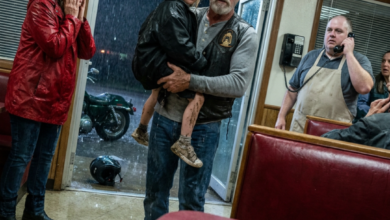
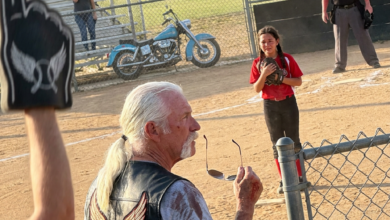
The first time I saw Wade Mercer, he was chaining my dying father’s wheelchair to a black Harley in a hospital parking lot while strangers filmed him and a security guard shouted for him to step away.
I did not know his name then.
I only knew that my father looked small beneath a faded Army blanket, the oxygen tube resting under his nose, while this enormous biker pulled a steel chain through the frame of his wheelchair.
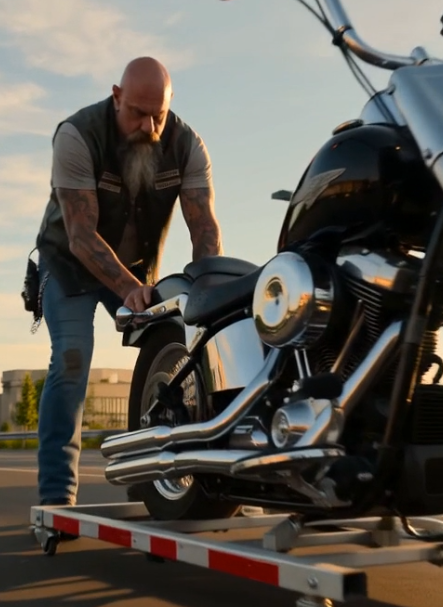
Wade was impossible to ignore. He stood at least six-foot-five, with a shaved head, a gray beard reaching the center of his chest, tattoos climbing both arms and disappearing beneath a worn leather vest. His boots struck the pavement like hammers as he walked around the motorcycle.
A woman near the entrance lifted her phone.
“Is he stealing that man’s chair?”
Someone else said Wade was humiliating a veteran.
The security guard repeated his warning, louder this time, but Wade did not answer. He crouched beside the wheelchair and tugged the chain with both hands, testing it against a strange steel platform mounted beside the Harley.
That made everything look worse.
I had driven four hours from Columbus after receiving a call from Mercy Ridge Hospital in Dayton, Ohio. The doctor had not used the words “last day,” but I heard them inside every careful pause she made.
My father, Thomas Bell, had advanced pulmonary disease, a failing heart and perhaps weeks left if he stayed in bed.
Perhaps days if he did not.
We had barely spoken during the previous three years.
Then I reached the hospital and found a giant stranger fastening Dad’s wheelchair to a motorcycle as if it were scrap metal.
I crossed the parking lot so quickly that I almost dropped my keys.
“Get your hands off him.”
Wade finally looked up.
His face showed no surprise and no anger. He simply rested one tattooed hand on the custom frame and glanced toward my father.
Dad did not ask him to stop.
That frightened me more than anything.
“What are you doing?” I demanded.
“Load test,” Wade answered.
Two words. Nothing else.
I grabbed the wheelchair handle, but Dad placed his thin hand over mine. His fingers were cold, and his wedding ring hung loosely against his knuckle.
“Danny,” he whispered, “let him finish.”
Nobody had called me Danny since my mother died.
Behind Wade’s Harley stood three other bikers, all wearing plain leather cuts with no readable patches. One held a torque wrench. Another watched a small pressure gauge attached to the platform’s suspension. The third carried a folded blue blanket and an old military helmet with a fresh padded lining.
It looked organized.
It still looked wrong.
The security guard stepped closer and told Wade that hospital property was not a workshop. Wade nodded once, removed the chain, and showed him the mechanism beneath it: four locking clamps, a safety rail, a shock-absorbing base and two redundant steel restraints.
“The chain isn’t towing the chair,” he said. “It’s backup.”
Then I noticed the small brass plate welded beside the seat.
T. BELL — ONE MORE MILE.
My father turned his face away before I could ask what it meant.
Wade opened one of the Harley’s saddlebags and removed a weathered photograph. In it, two young soldiers stood beside a battered motorcycle somewhere covered in dust. One was Wade.
The other was my father.
On the back, in Dad’s handwriting, were seven words:
If we get home, we ride together.
Wade had spent eleven weeks building that wheelchair platform. Dad had spent twenty-seven years waiting to explain why the promise had never been kept.
But before either man could tell me the truth, Wade looked at the darkening sky, touched the brass plate and said something that made every person in that parking lot lower their phone.
“We only get one chance tonight.”
Want to know why my father waited twenty-seven years and what happened when Wade finally started that Harley? Drop RIDE in the comments—I’ll share more soon.
I chose the first teaser when I eventually wrote about that afternoon, but the real story began long before Wade brought his Harley into the Mercy Ridge parking lot.
It began in 1999, on a road my father almost never discussed.
Dad had served as an Army vehicle mechanic. Wade had been assigned to the same transport unit, although his primary skill seemed to be keeping broken machines alive long after every manual declared them dead.
The two men were opposites.
Dad measured twice, labeled every tool and believed silence could solve most disagreements. Wade worked by sound, touch and instinct. He could place a palm against an engine housing, close his eyes and identify a failing bearing before anyone else heard it.
They became brothers anyway.
In the photograph Wade carried, both men were twenty-six. Dad still had dark hair. Wade had not yet grown the beard that later made children stare at him in grocery stores.
Between them stood a battered military motorcycle used for short runs around their compound.
It should not have survived.
Wade made certain it did.
Late one evening, after weeks of dust, heat and poor sleep, they promised that when they returned to Ohio, they would buy two Harleys and ride the back roads along the Great Miami River.
No uniforms.
No schedules.
No one waiting for an engine to fail.
“If we get home,” Dad had said, “we ride together.”
They both came home, but not in the way they imagined.
Wade returned with damage nobody could see. He slept in garages because small rooms felt unbearable. He drank too much for several years and vanished whenever anyone asked where he had been.
Dad returned with damaged lungs and a left leg that never regained its full strength. Doctors told him he could still ride if he accepted certain modifications.
He refused.
At first, pride stopped him. Later, fear did.
Dad purchased a used Harley and kept it beneath a cover in our garage for nearly two decades. Every few months, he started it, listened to the engine idle and shut it down before the pipes grew warm.
As a child, I thought he was waiting for better weather.
He was waiting to become the man he had been before the war.
That man never returned.
Mom understood more than I did. She would stand in the doorway with coffee and watch Dad polish a motorcycle he never rode.
“Some promises take longer,” she once told me.
I thought she meant patience.
She meant Wade.
For years, Dad did not know where his old friend was. Wade had drifted through three states, worked in repair shops and eventually joined a veterans’ riding association outside Dayton.
The club was not interested in territory or trouble. Its members repaired vehicles for veterans, escorted funeral processions and delivered groceries to people too proud to request help.
Wade rarely spoke at meetings.
He simply arrived first and left last.
By the time he found Dad again, my father could no longer transfer safely from his wheelchair to a motorcycle seat.
Wade came to our house one Sunday morning. I remember the low V-twin rumble outside and Mom wiping her hands on a dish towel before opening the door.
Dad stood in the hallway using a cane.
For several seconds, neither veteran moved.
Then Wade said, “You still owe me a ride.”
Dad answered, “Build me a road.”
That was all.
Wade began experimenting with wheelchair sidecars soon afterward. He visited adaptive-mobility workshops, spoke with occupational therapists and learned enough fabrication engineering to understand how easily a generous idea could become a dangerous machine.
His first frame was too heavy.
His second vibrated badly at low speed.
The third placed too much lateral strain on the motorcycle.
Dad rejected each one without kindness. Wade accepted every criticism without complaint.
They were not sentimental men.
They loved each other through revisions.
Mom died before the fourth frame was completed.
Cancer took ten months to reduce our family to calendars, medication bottles and conversations whispered in hallways.
After the funeral, Dad stopped answering Wade’s calls.
He covered the Harley again. He rolled the unfinished sidecar frame behind the garage and allowed rain to collect inside it.
I was furious at him for becoming silent when I needed him to be my father.
He was furious at himself for still being alive.
Our final argument began over the motorcycle.
I accused him of caring more about machines and old promises than the woman who had waited beside him for thirty-four years.
Dad listened from his wheelchair.
Then he said, “Your mother was the reason I kept trying.”
I did not believe him.
I told him so.
He removed the old photograph from his wallet and placed it on the kitchen table. I left before turning it over, so I never saw the promise written on the back.
That failure stayed with me.
For three years, Dad and I spoke only on birthdays, Christmas and the rare Sunday when guilt became stronger than pride. Our calls lasted fewer than five minutes.
He always asked whether I still rode.
I always said no.
I did not tell him I had sold my Harley to pay part of Mom’s final hospital bill. I did not want gratitude, and I did not want another conversation about everything we had lost.
Dad’s condition worsened.
His lungs scarred. His heart weakened. Walking became impossible, then transferring from his chair became exhausting.
Wade returned during the worst winter Ohio had seen in years.
He found the abandoned frame behind Dad’s garage, dragged it inside and began again.
This time, Dad helped.
He could no longer lift steel, but he could criticize weld placement with brutal precision. He sat beside the workbench under two blankets while Wade cut tubing and shaped brackets.
The men worked three evenings each week.
Sometimes they talked about the war.
Mostly they argued about measurements.
Wade brought in a physical therapist named Elena Park from Mercy Ridge and a mechanical engineer who had designed adaptive controls for farm equipment. Together, they converted the sidecar concept into a stable wheelchair platform.
The chair would roll up a low ramp and lock into four floor clamps. A padded restraint would secure Dad’s torso without restricting his breathing. Independent suspension would reduce vibration.
The chains were not meant to hold him during the ride.
They were redundant safety restraints used during testing, visible because Wade trusted things he could inspect with his own hands.
Every component had a backup.
Every backup had been tested.
There would be no highway speed and no public traffic. The hospital, local police and veterans’ club approved a closed, low-speed route around the medical campus and through a nearby memorial park.
Two miles.
That was all Dad wanted.
But he wanted me there.
Without my knowledge, Wade spent six months searching for the motorcycle I had sold. He traced it through two owners and found it behind a barn near Richmond, Indiana.
The engine had seized.
The paint had faded.
The scratch across the fuel tank remained.
Wade bought it with money raised quietly by his club. Twelve bikers rebuilt the machine during winter evenings, but they preserved that scratch because Dad remembered when I had made it.
I was seventeen and learning to maneuver through our driveway. I clipped Dad’s metal toolbox and expected him to explode.
Instead, he placed two fingers over the mark and said, “Now it belongs to us.”
Wade understood that the scratch mattered more than new paint.
That was the machine waiting for me in the hospital lot.
And when I finally recognized it, the anger drained from my body so quickly that my knees weakened.
The crowd had gone silent.
Phones slowly lowered.
My father watched me from his wheelchair, searching my face for the son he remembered.
“Why didn’t you call me?” I asked.
“I did.”
“You never told me any of this.”
“You never stayed long enough.”
The words were not cruel.
That made them hurt more.
A nurse came through the hospital doors carrying Dad’s portable oxygen unit. Behind her walked Elena, the physical therapist, and Dr. Hammond, Dad’s cardiologist.
That was when I understood this was not an impulsive stunt.
It was a medically supervised farewell.
Dr. Hammond explained that Dad’s condition was stable enough for a brief low-speed ride but unlikely to remain that way. The weather was mild. The route was secured. Emergency support would remain nearby without turning the moment into a parade of fear.
Dad had signed every document himself.
He knew the risk.
He also knew what waiting would cost.
Wade crouched beside the platform and removed the testing chains. The crowd watched as he rolled Dad’s wheelchair down the ramp, inspected every clamp, then rolled it back into position.
Click.
Click.
Click.
Click.
Four locks.
He attached the padded torso restraint, checked the oxygen line and placed the blue blanket around Dad’s legs. His hands were large enough to cover my father’s shoulder, but every movement was gentle.
Then he installed the two small flags.
One beside Dad.
One on my motorcycle.
I stood there holding my helmet and feeling twenty years old again.
“I haven’t ridden in three years,” I said.
Wade looked at me.
“You remember.”
It was not a question.
The hospital security guard who had first confronted him now helped clear the parking-lot exit. The woman who had been filming put away her phone and apologized to Dad.
Dad nodded, but his eyes remained on me.
I pulled on my helmet.
The restored Harley started on the second turn. The sound entered my chest before I was ready for it: a deep, uneven rumble I remembered from summer evenings, scraped knuckles and my father’s hand covering mine on the throttle.
Wade started his motorcycle.
Dad closed his eyes.
The platform did not jerk or sway. It settled gently into the rhythm of the engine, and the blanket moved around Dad’s boots.
His expression changed.
For the first time since Mom’s funeral, he did not look sick.
He looked ready.
We moved out at walking speed, escorted by two club riders and a hospital vehicle. People stood along the sidewalk, but nobody cheered.
Silence was better.
At the first turn, I rode beside Dad.
He lifted one hand from beneath the blanket and tapped two fingers against his forehead, the same signal he had used when I was a teenager riding behind him.
I returned it.
We followed the closed service road toward Riverbend Veterans Memorial Park. The August air smelled of cut grass, hot pavement and rain gathering somewhere beyond the trees.
Dad watched everything.
A red-tailed hawk above the utility wires.
A boy bouncing a basketball beside an apartment building.
The flag moving beside his wheelchair.
At the memorial park, Wade slowed to a stop beneath an old oak. I parked beside them, removed my helmet and waited for Dad to catch his breath.
His eyes were wet again.
“Your mother picked this route,” he said.
I thought I had misheard him.
Dad reached inside his jacket and removed a sealed envelope with my name written across the front in Mom’s handwriting.
“She helped Wade design the first frame,” he continued. “She made me promise we’d bring you when it worked.”
My mother had known.
Before the cancer. Before the bills. Before our final argument.
She had sat with Wade at our kitchen table, drawing the river route on the back of a grocery receipt because she believed one day Dad and I would need a road back to each other.
The envelope contained that receipt.
It also contained a letter.
Danny,
Your father thinks this ride is about keeping an old promise to Wade. Wade thinks it is about giving your father something the war took away. They are both wrong.
It is about you two having nowhere to hide.
Engines are loud, but they leave room for truth. Ride beside him. Do not waste the quiet afterward.
Love, Mom.
I read it twice.
Then I folded forward over the fuel tank because my body could no longer hold the weight of those words upright.
Dad did not apologize for the lost years.
Neither did I.
Not yet.
Wade stood between us, pretending to check a tire that did not need checking.
Finally, Dad said, “I should’ve come after you.”
I answered, “I should’ve answered.”
That was enough to begin.
We stayed beneath the oak for twelve minutes.
Dad told me he had not kept the Harley because he loved it more than Mom. He kept it because she refused to let the war decide which parts of him were allowed to survive.
Every time he started the engine in our garage, she stood in the doorway to remind him he was home.
When she became ill, Dad stopped working on the adaptive frame because he would not leave her side. After she died, the unfinished machine felt like proof that he had failed both promises.
I had interpreted his grief as indifference.
He had interpreted my anger as a door I wanted closed.
We had both protected ourselves until there was almost no time left to be a family.
Dad looked toward Wade.
“Tell him the other part.”
Wade straightened.
For years, I had assumed my father’s injuries came from an accident nobody wanted to discuss. That was only partly true.
During their deployment, the vehicle carrying Wade had broken down in a dangerous stretch of road. Dad had gone back for him when protocol said to wait for recovery support.
He managed to get Wade and another soldier to safety, but damage to his lungs and leg followed him home.
Wade believed he owed Dad his life.
Dad hated that version.
“I went back because he was my brother,” he said. “A debt means there was another choice.”
Wade looked down at his boots.
“So why build all this?” I asked him.
He touched the frame beside Dad’s chair.
“Because brothers finish what they start.”
That sentence explained eleven weeks of fabrication, six months of searching for my motorcycle and twenty-seven years of one promise refusing to die.
It also explained the brass plate.
T. BELL — ONE MORE MILE.
Dad had asked for that inscription because Wade originally planned a one-mile route. Mom had drawn two miles on the receipt, so Wade doubled it.
The phrase was never a measurement.
It was an answer.
Whenever Dad believed he was finished, Wade asked for one more mile.
When Wade wanted to abandon the third failed frame, Dad said the same thing.
One more mile.
One more attempt.
One more phone call.
One more chance to bring a son home.
We restarted the motorcycles and completed the loop through the park. This time, Dad did not watch the scenery.
He watched me.
At one point, Wade moved slightly ahead, allowing my motorcycle to ride level with Dad’s platform. There was no windshield between us, no hospital room and no telephone line waiting to go silent.
Dad smiled.
Not broadly. That was never his way.
Just enough.
We returned to Mercy Ridge thirty-eight minutes after leaving. Nurses waited beneath the entrance awning. Several visitors from the earlier crowd were still there, but the suspicion had disappeared from their faces.
Wade stopped the Harley and shut off the engine.
The sudden quiet felt enormous.
Dad kept his eyes closed for several seconds. His right hand remained curled as if it still held handlebars.
Then he looked at Wade.
“Debt paid,” Dad said.
Wade shook his head.
“No debt.”
Dad nodded.
“Brother, then.”
Wade rested his forehead briefly against Dad’s.
“Always.”
My father lived another nineteen days.
I spent eighteen of them beside him.
The first night after the ride, we talked until after midnight. Not beautifully. Not smoothly. We stopped often because Dad needed breath and because I needed time to hear things I had spent years refusing to understand.
The next morning, I brought coffee from the terrible vending machine near cardiology. Dad drank two sips and declared it an insult to veterans.
It was the first joke we had shared since Mom died.
Wade visited every afternoon.
He never arrived empty-handed, though his gifts were strange: a cleaned spark plug, a road map from 1999, one of Mom’s old route sketches, a bolt from the first failed frame.
Dad understood each object.
I learned to ask.
The custom platform remained in Wade’s garage after the ride. He could have stored it beneath a tarp as a private memorial, but Dad had another plan.
He signed it over to the veterans’ riding association on one condition: no veteran would be charged to use it.
Wade and Elena refined the design. The mechanical engineer prepared proper plans, inspection procedures and a maintenance schedule.
The chains stayed.
Not as the primary restraint, but as visible redundant backups during every static test.
Months later, when a different veteran’s family saw Wade testing them in another parking lot, someone again assumed the worst.
This time, the hospital security guard explained.
“He isn’t chaining the man to a motorcycle,” he said. “He’s making sure nothing can take the ride away.”
Dad died early on a Thursday morning.
Wade stood on one side of his bed.
I stood on the other.
Dad’s breathing became quieter until the room held only the hum of an air vent and the faint rattle of Wade’s vest when he shifted his weight.
My father opened his eyes once more.
“Good ride?” Wade asked.
Dad looked toward me.
“Best one.”
Those were his final words.
At Dad’s funeral, Wade did not give a speech.
He placed the old photograph beside the urn, turned it over so everyone could read the promise and walked outside.
Thirty-one motorcycles waited along the curb.
My restored Harley stood among them.
We rode the same two-mile route from Mercy Ridge to Riverbend Veterans Memorial Park, then continued another mile for Dad.
The wheelchair platform traveled beside Wade’s Harley, empty except for the Army blanket, two small flags and the brass plate.
No one spoke at the oak tree.
We listened to cooling engines tick beneath us.
A year later, I began volunteering in Wade’s garage. I was not much of a fabricator, but I could clean components, track inspections and listen when families described what their veterans missed most.
The requests were rarely about speed.
They wanted to feel an engine again.
They wanted to sit beside a daughter, brother or son.
They wanted one familiar sound that did not belong to a hospital.
The platform has carried fourteen veterans now. Every ride is different, but Wade performs the same test before each one.
Four clamps.
A padded restraint.
The oxygen line, if needed.
Two redundant chains.
Then he pulls against the frame with everything he has.
People sometimes stare.
Wade never explains unless they ask.
On the anniversary of Dad’s ride, Wade and I return to the hospital parking lot shortly before sunset. We park beside the faded spot where strangers once raised their phones.
He starts his Harley.
I start mine.
For a few seconds, we let the engines speak.
Then we follow Mom’s route past the hospital, around the memorial park and beneath the old oak where Dad finally told me the truth.
Two miles for the promise.
One more for Dad.
If stories about misunderstood bikers, quiet brotherhood and unexpected acts of compassion move you, follow this page for more unforgettable stories from the road.