Everyone Laughed When I Paid $20,000 for a Child’s Messy Drawing—Until the Boy Beside the Easel Tried to Hold His Shaking Hand Still
The room laughed when I offered twenty thousand dollars for a crooked crayon drawing, but the small boy beside the easel stopped smiling—and tried to hide the hand still trembling after treatment.
My name is Dean “Rook” Mercer.
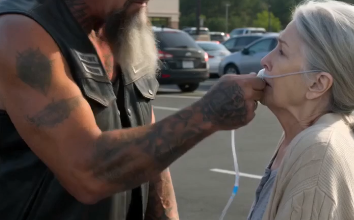
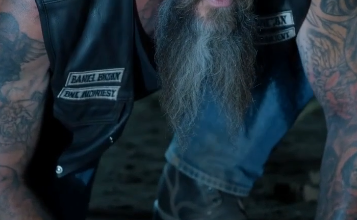
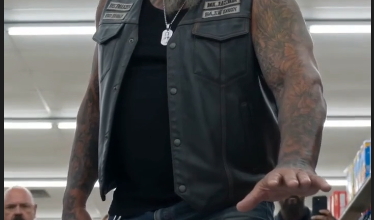
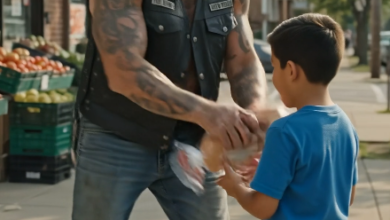
I was fifty-six years old, six-foot-four, and built like a refrigerator somebody had covered in faded tattoos. My beard reached the center of my chest, my head was shaved, and the black leather vest over my shoulders had been softened by twenty-eight years of rain, road dust, diner grease, and hospital waiting rooms.
That Saturday evening, I walked into the ballroom of the Grand Hollow Hotel in Knoxville, Tennessee, carrying a motorcycle helmet beneath one arm.
Three hundred people turned to look.
The auction was raising money for families whose children needed long hospital stays. Most guests wore dark suits, polished shoes, and dresses that moved quietly between white tablecloths.
My boots did not move quietly.
Each step landed heavily against the marble floor. Conversations faded as I passed. A waiter stared at the tattoos across my knuckles and nearly walked into a tray of champagne glasses.
I was accustomed to rooms deciding what I was before I opened my mouth.
A few people probably thought I had taken a wrong turn.
Others knew exactly who I was. I owned Mercer Industrial Repair, a chain of heavy-equipment workshops that had grown from one rented garage into a business employing nearly two hundred people across Tennessee and Kentucky.
Money had changed what banks called me.
It had never changed what strangers saw.
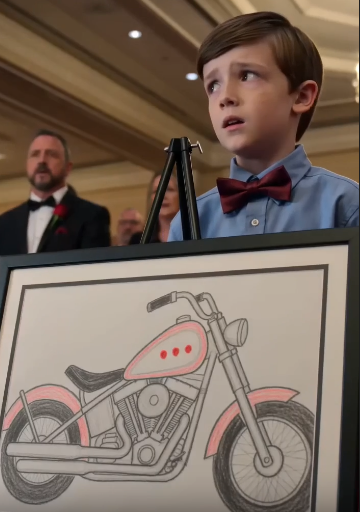
Near the stage, a young volunteer held up a framed drawing labeled Lot Forty-Seven. The paper showed a black motorcycle beneath a yellow sun, two figures with enormous heads, and something that might have been a hospital beneath a sky filled with uneven blue lines.
The auctioneer smiled carefully.
“Our artist is eleven-year-old Noah Bennett.”
A thin white boy stepped from behind the curtain.
He wore gray pants, a pale blue shirt, and a red bow tie that leaned toward one shoulder. His brown hair had recently begun growing back, soft and uneven above a face much too serious for eleven.
He raised one hand.
The fingers trembled.
Some people applauded. Others looked down because sickness makes comfortable adults uncomfortable, especially when it enters a ballroom without hiding.
“Who will begin at one hundred dollars?” the auctioneer asked.
A woman near the front lifted her card.
“One hundred.”
A man answered with two hundred.
The bids crawled upward until they reached eight hundred dollars, then stopped.
The auctioneer tried again.
“This original work was created during Noah’s recovery.”
Silence.
The drawing was not technically good. The wheels were different sizes. One rider’s arms seemed to grow directly from his neck. The yellow crayon had been pressed so hard that it had torn the paper beside the sun.
People had already spent twelve thousand dollars on a vacation package and six thousand on a signed guitar. They were saving their money for the expensive items displayed behind the stage.
Noah stared at his shoes.
That was when I raised my bidder card.
“Twenty thousand.”
The room went still.
The auctioneer blinked. “Sir, did you say two thousand?”
“Twenty.”
A nervous laugh came from the table behind me.
Then another.
A man in a navy tuxedo leaned toward his wife and whispered loudly enough for several tables to hear, “Some people need everyone to know they have money.”
His wife covered a smile with her napkin.
I looked at neither of them.
The auctioneer asked whether anyone wished to bid higher. Nobody did.
His hammer struck.
“Sold for twenty thousand dollars.”
Applause scattered through the ballroom, but it was the thin applause people give when they are unsure whether they have witnessed generosity or a performance.
I walked toward the stage.
Noah watched me approach with widening eyes. Up close, I could see a plastic hospital bracelet beneath his cuff and a crescent-shaped scar near the base of his neck.
The volunteer handed me the framed picture.
I did not take it.
Instead, I looked at Noah’s trembling right hand.
“Did it start again?” I asked.
His face changed.
The auctioneer lowered his microphone.
Noah nodded once.
A woman rushed from the side of the stage. She was his mother, though I did not know that yet.
She put one protective arm around him and looked at me as if I had opened a door nobody else knew existed.
“You know my son?” she asked.
I turned the drawing around.
In the lower corner, beneath the crooked motorcycle, Noah had placed three tiny red dots.
Nobody in the room understood them.
I did.
“Your boy gave my daughter something worth more than every item in this room,” I said.
Then Noah whispered the name I had not heard him speak in nearly two years.
“Is Emma here?”
Before illness entered our house, my daughter Emma could turn any quiet room into noise.
She sang while brushing her teeth. She narrated trips to the grocery store as if we were crossing hostile territory. She laughed whenever my beard caught soup, which happened often enough to become a family tradition.
Emma was thirteen when the bruises appeared.
At first, we blamed volleyball. She played libero for her middle-school team and treated every practice as though a national championship depended on her knees.
Then her gums began bleeding.
She slept through dinner twice in one week. One Saturday, she sat on the garage floor beside my Harley and admitted she did not have the strength to climb the three steps into the house.
My wife, Laura, drove her to the emergency room.
I followed on the bike because I told myself we would need two vehicles when they sent us home.
They did not send us home.
The diagnosis arrived inside a small consultation room where the air conditioner sounded louder than the doctor.
Acute myeloid leukemia.
The words passed through me without finding a place to land. Laura asked questions. I stared at the doctor’s blue pen and wondered why she had chosen one with silver stars.
Emma listened without interrupting.
When the doctor finished, my daughter looked at me.
“Dad, you’re scaring her.”
I glanced at Laura.
Emma shook her head. “The doctor.”
Apparently, my face had become so hard that the woman explaining how to save my child thought I blamed her for the disease.
I softened it.
Or tried.
Chemotherapy began three days later. Emma lost her hair, her appetite, and the strength to pretend she was not frightened.
What she did not lose was the disease.
The doctors told us a bone marrow transplant offered her best chance. Laura and I were tested. Neither of us matched. Family members came next, followed by a search through the donor registry.
Weeks passed.
I stopped sleeping.
The Iron Lantern Riders, the motorcycle club I had belonged to since my twenties, arranged meal deliveries, blood drives, and transportation for our employees. Men who could rebuild transmissions blindfolded stood helplessly outside Emma’s hospital room, holding stuffed animals and avoiding the word cancer.
My closest brother in the club was Ray “Preacher” Collins, a sixty-one-year-old Black Army veteran with a white beard and the patience I lacked.
One night, he found me sitting on a concrete barrier in the hospital parking garage.
“You need rest,” he said.
“I need a donor.”
“You need both.”
“I can sleep when she’s home.”
Preacher lowered himself beside me. His knees cracked.
“What if this breaks you before she gets there?”
“It won’t.”
“You’re already broken, brother.”
I looked at him.
He handed me a cup of coffee and said nothing more.
Eleven days later, the transplant coordinator called.
A potential match had been found.
The donor was not an adult.
He was a nine-year-old boy.
His name was Noah Bennett.
We were not supposed to know Noah’s identity.
Donor rules existed for good reasons. Families could exchange anonymous letters through the registry, but personal information remained protected until the required waiting period ended and both sides consented.
So, at first, Noah was only a number.
The doctors called him an unusually strong match. They explained procedures, risks, collection methods, timelines, and complications. I heard every word, yet all I understood was that somewhere beyond our hospital walls, a child had agreed to hurt so mine might live.
I wrote his family a letter.
Then I threw it away.
The next attempt sounded like a corporate speech. The third sounded desperate. The fourth had grease from my thumb across one corner because I wrote it at the workshop.
Emma finally took the paper from me.
“You’re terrible at this,” she said.
“I know.”
“Just tell him the truth.”
“I’m trying.”
“No. You’re trying to sound strong.”
She wrote the letter herself.
Dear Donor,
My name is not important yet, but I am thirteen. I like volleyball, old motorcycles, terrible music, and making my father uncomfortable in public.
He looks frightening. He isn’t. Please don’t tell him I admitted that.
Thank you for giving me a chance to be annoying for many more years.
Your grateful stranger.
At the bottom, Emma drew three red dots.
They came from an old game between us. When she was little, I squeezed her hand three times whenever speaking felt too difficult.
One squeeze meant I.
Two meant love.
Three meant you.
During chemotherapy, when masks and exhaustion stole conversation, she drew three dots on everything: napkins, medicine cups, the fogged hospital window.
I added one sentence beneath her letter.
Her father will owe you for the rest of his life.
We received a reply three weeks later.
Dear Grateful Stranger,
I am nine. I don’t like needles, but my mom says being brave means doing important things while scared.
I hope your volleyball comes back.
My hand is not good at motorcycles, but I drew one.
Your donor.
The letter included a small picture of a motorcycle with unequal wheels beneath a yellow sun.
Three red dots appeared near the bottom.
Emma taped it above her bed.
When transplant day arrived, I stood beside her while the donated cells entered her body through a clear tube. The bag looked ordinary.
That offended me.
Something capable of carrying another child’s courage into my daughter should have looked like fire or gold. Instead, it resembled every other medical bag hanging from a silver pole.
Emma watched it closely.
“Is that him?” she asked.
“Part of him.”
“So I’m going to have boy bones?”
“Marrow isn’t bones.”
“Will I grow a mustache?”
“Probably.”
She smiled.
It was the last joke she made for twelve days.
The transplant nearly crushed her before it helped her. Fever came first. Then nausea, pain, mouth sores, and long nights when machines sounded alarms for reasons nobody explained quickly enough.
I stopped leaving her room.
Laura slept on the folding couch. I sat in the chair beside the bed with one hand wrapped around Emma’s fingers.
Three squeezes.
Again.
Again.
Again.
On the ninth night, her breathing became uneven. Nurses entered. Then doctors. Laura was asked to step outside.
I remained until someone physically guided me into the hallway.
Preacher found me against the wall.
“My kid is in there fighting with another kid’s blood,” I said.
“Cells,” he corrected gently.
“Don’t.”
He stood beside me while the medical team worked.
Twenty-seven minutes later, the doctor came out and told us Emma had stabilized.
My knees gave way.
Preacher caught my vest before I reached the floor.
The transplant took.
Slowly.
Her blood counts improved. The fever broke. She began eating crushed ice, then soup, then half a grilled cheese sandwich she described as the finest meal ever prepared.
On the day she walked one full lap around the transplant ward, every nurse at the station applauded.
Emma hated the attention.
I loved it enough for both of us.
Before leaving the hospital, she removed Noah’s first drawing from the wall and placed it inside my vest.
“Don’t fold it,” she warned.
“I won’t.”
“You fold everything.”
“I fold maps.”
“You folded my birth certificate.”
“That was tactical.”
She rolled her eyes.
My daughter was coming home.
For several months, we believed that was the ending.
It was not.
Two years after the transplant, the registry contacted us.
The donor family had agreed to exchange identities.
Emma was fifteen by then. Her hair had returned in dark curls, and she had rejoined her volleyball team as an assistant coach while doctors decided whether she was ready to play again.
She opened the email at our kitchen table.
Noah Bennett lived in Oak Ridge, less than thirty miles away.
His mother, Rachel, had enrolled him in the donor registry after his older cousin needed testing. Noah was not a match for his cousin, but his information led doctors to Emma.
There was also a newer message.
Noah wanted to meet her.
We arranged the meeting at a park between Knoxville and Oak Ridge. I arrived early on my Harley, though Laura and Emma came by car.
I needed the ride.
The engine gave my hands something to hold while my mind searched for words large enough to thank a child.
Noah arrived wearing a green sweatshirt and carrying another drawing. He was eleven now, smaller than I expected, with brown hair falling over his eyes.
For ten seconds, nobody moved.
Then Emma walked toward him.
“You gave me boy bones,” she said.
Noah stared.
His mother looked horrified.
Emma smiled. “They work pretty well.”
Noah laughed.
The sound released everyone.
He gave her the new drawing. This one showed two figures beside a motorcycle, their heads still enormous, but the wheels were closer to the same size.
Emma handed him a red volleyball signed by her entire team.
I stood several feet away because every sentence I had prepared felt useless.
Noah eventually approached me.
“You’re the scary father.”
“That’s me.”
“Emma said you cry at dog movies.”
“She has experienced memory problems.”
He looked at my Harley.
“Can I touch it?”
“You saved my daughter. You can touch anything that belongs to me.”
He placed his palm against the fuel tank.
His hand was steady then.
I remember that clearly because of what happened later.
Six months after our meeting, Rachel called Laura.
Noah was sick.
The same child who had given marrow to save Emma had developed a serious autoimmune complication following an infection. It was unrelated to the donation, the doctors assured everyone, but facts did little to soften the cruelty.
His immune system began attacking healthy tissue.
Treatment controlled the worst of it, but weeks of hospitalization followed. Steroids changed his face. Physical weakness stole his balance. A medication reaction left him with tremors in his right hand.
Drawing became difficult.
He tried anyway.
Emma visited whenever his doctors allowed it. They sat at a hospital table sharing colored pencils, trading insults, and arguing about whether motorcycles or volleyball required more intelligence.
I waited outside more often than I entered.
Hospitals had trained my body to expect bad news. The smell of disinfectant tightened my chest. The rolling wheels of a medicine cart could pull me backward two years before I knew it was happening.
One evening, Noah’s occupational therapist met me in the hallway.
“He gets frustrated when his hand shakes,” she said. “He thinks the drawings look childish now.”
“He is a child.”
“Children rarely want to be reminded.”
Through the glass, I watched Noah attempt to draw a circle.
His pencil moved unevenly. He clenched his jaw and started again. Emma placed her hand over his, but he pulled away.
Then he crumpled the paper.
I entered before thinking.
Noah saw me pick it up.
“Throw it away,” he said.
I smoothed the page against the table.
It was another motorcycle beneath a yellow sun.
The wheels were worse than those in his first picture.
I folded the damaged corners inward.
Emma pointed at me. “You promised not to fold his drawings.”
“This one was already crumpled.”
“That’s not the point.”
Noah watched us argue, then began laughing so hard that his tremor worsened.
I kept the drawing.
After that, he mailed me every motorcycle he finished. Some had square wheels. Some had six exhaust pipes. One appeared to have wings.
I framed each of them in my workshop office.
My managers thought I had developed strange taste.
I never explained.
The charity gala was Rachel’s idea.
The hospital foundation needed money for temporary housing, meal vouchers, and travel assistance for families of sick children. Noah wanted to contribute but had no savings to donate.
He offered a drawing instead.
Rachel told him the auction would accept it only if he genuinely wished to let it go.
He spent twelve evenings creating Lot Forty-Seven.
The tremor made every line an argument between his mind and his fingers. When his hand became tired, he taped the pencil between two fingers. When the blue crayon snapped, he continued with the broken half.
He did not show Emma the finished picture.
He wanted it to be a surprise.
I learned about the auction from Laura, but she did not know I planned to bid. Emma had a follow-up appointment that evening, so she and Laura arrived late.
I came directly from a repair call in Kentucky. That explained the boots, vest, and road dust.
It did not explain the amount.
For years, I had kept a separate bank account labeled Project Three Dots. Every month, I deposited money there for something I could never define.
I thought I might fund a scholarship for Noah.
Then I considered buying medical equipment for the transplant floor. Sometimes I imagined giving the entire amount to Rachel and telling her to use it however she wished.
None of those plans felt right because every one of them turned gratitude into a debt that could be settled.
It could not.
When Noah’s drawing reached the stage and the bidding stalled at eight hundred dollars, I understood what the account was for.
Not the paper.
The effort.
The room saw uneven crayon lines. I saw an eleven-year-old boy strapping a pencil against trembling fingers because sickness had taken his control but not his need to give.
So I said twenty thousand.
The people who laughed did not know that.
They saw a wealthy workshop owner in dirty leather buying attention. Perhaps I made it easy for them. I had not registered with a corporate table or arrived in a limousine.
I entered like a man coming to collect a debt.
When Noah asked whether Emma was there, I looked toward the ballroom doors.
They opened.
Emma stepped inside wearing a dark green dress and red sneakers she had smuggled beneath it. Her curls were pinned loosely behind her head.
She saw Noah on the stage.
Then she saw the drawing.
Her hand rose to her mouth.
Noah’s picture showed a large biker on a black motorcycle. Behind him sat a girl with dark curls, one hand resting against his vest. Beside the road stood a smaller boy in a hospital gown, waving beneath the yellow sun.
Above them, the blue sky leaned crookedly toward one corner.
Near the motorcycle were three red dots.
Emma walked to the stage.
The room watched her embrace Noah carefully, one arm around his shoulders and the other protecting his trembling hand between their bodies.
The auctioneer lowered his hammer.
“What does the picture mean?” he asked.
Noah looked at me for permission.
I shook my head.
It was his story.
He faced the room. Public speaking frightened him more than treatment, and his voice barely reached the first tables without the microphone.
“The girl was sick,” he said. “I gave her some marrow.”
The ballroom became still.
Noah pointed at Emma.
“That’s her.”
A chair scraped somewhere behind me.
He pointed at the biker.
“That’s her dad. He sent letters when they didn’t know my name.”
Then he touched the three red dots.
Emma answered for him.
“They mean I love you.”
The man in the navy tuxedo stopped smiling.
Noah tried to continue, but the microphone shook against his fingers. I stepped closer, expecting to hold it.
He pulled it toward his chest.
“I can do it.”
So I stopped.
The boy steadied his wrist with his other hand.
“This picture is about getting home,” he said. “Some people need medicine. Some need somewhere to sleep. The money helps both.”
The applause began softly.
Then the entire ballroom stood.
I remained still.
Noah had spent too much of his young life being treated as either fragile or heroic. In that moment, he needed neither. He needed adults to hear what he had chosen to say.
When the applause faded, the auctioneer offered me the framed drawing again.
This time, Noah held it.
“Twenty thousand is too much,” he whispered.
“No.”
“It’s crayon.”
“I noticed.”
“The wheels aren’t even round.”
“Neither are mine after Tennessee potholes.”
He almost smiled.
I leaned closer.
“You didn’t sell me a drawing, little brother. You reminded this room what giving costs.”
His eyes filled, but he did not cry.
Neither did I.
Not there.
The twenty thousand dollars paid for more than anyone expected.
It provided forty-six nights in temporary apartments for families living too far from the hospital to commute. It covered hundreds of meal vouchers and several emergency fuel cards.
One card went to a single mother whose four-year-old son needed treatment three hours from home.
Another helped a grandfather drive from rural Kentucky to sit beside his granddaughter during surgery.
The foundation placed a photograph of Noah’s drawing in its annual report. The original went home with me, but I did not hang it in my office beside the others.
It belonged somewhere more important.
I mounted it above the main workbench in our Knoxville garage.
Every mechanic could see it.
New employees often asked why the owner had paid twenty thousand dollars for a child’s picture. Older workers told them to wait until Friday.
Every Friday afternoon, our staff passed a red metal container through the workshops. Nobody was required to contribute. Coins, five-dollar bills, and sometimes folded hundreds went inside.
The company matched everything.
We called it the Three Dots Fund.
Noah objected to the name.
“It sounds like a bug,” he said.
“You design something better.”
His hand still trembled, but less than before. He drew a small motorcycle wheel with three red dots at its center.
That became the symbol printed on the collection container. There were no names, no photographs of patients, and no corporate slogan.
Just a crooked wheel.
The Iron Lantern Riders joined the fund that spring. Preacher organized a charity ride through the Smoky Mountains, and four hundred motorcycles arrived at our workshop before sunrise.
Noah stood near the entrance wearing hearing protection.
The first engines started.
Then another row answered.
The deep V-twin rumble traveled through the concrete floor and into our boots. Noah pressed both palms against his chest as though he could hold the sound there.
I gave him a plain leather vest without patches.
Inside, Laura had sewn a tiny piece of blue fabric cut from one of Emma’s old hospital gowns. Beside it were three red stitches.
Noah ran his shaking fingers across them.
“Does this mean I’m in the club?”
“You’ve been in longer than most.”
“I don’t have a motorcycle.”
“Preacher barely has one. His spends more time being repaired than ridden.”
Preacher heard me.
“That machine has character.”
“It has electrical problems.”
Noah laughed.
Emma climbed onto the passenger seat behind me. She was healthy enough to return to school full-time and had begun playing short volleyball rotations again.
Before we left, she reached toward Noah.
Three squeezes.
He returned them.
The riders took the long route around Knoxville, slow and controlled, while Noah and Rachel waited at the finish beside the hospital foundation volunteers.
We raised another sixty-three thousand dollars.
But the moment I remember came after everyone left.
Noah stood alone beneath the framed drawing in the workshop. He looked at the crooked motorcycle and the girl behind the biker.
“Did you really think it was worth twenty thousand?” he asked.
I wiped my hands on a shop rag.
“No.”
His face fell.
I continued.
“It was worth more. Twenty was what I had ready.”
He stared at the drawing again.
“My hand was really bad that week.”
“I know.”
“I almost quit.”
“I know that too.”
“How?”
“The yellow sun.”
He looked at me.
On every picture Noah sent during recovery, the sun was unfinished. His fingers became tired before he could fill the circle.
In the auction drawing, he had colored the entire sun.
The pressure tore the paper in two places.
He finished anyway.
Three years have passed since the auction.
Emma is eighteen now. She graduated high school last spring and plans to study pediatric nursing, although she claims my hospital manners are not the reason.
Noah is fourteen.
His tremor has improved, but it has not disappeared. He draws with thicker pencils now and rests his wrist against a small support designed by an occupational therapist.
His wheels are nearly round.
I prefer the old ones.
Last month, the foundation held another auction at the Grand Hollow Hotel. This time, Noah submitted a painting of an empty road beneath a yellow sky.
There was no motorcycle.
People expected me to bid.
I did not.
A schoolteacher bought it for twelve hundred dollars. Noah smiled when the hammer fell because the room no longer needed a shocking number to understand the value of his work.
Afterward, he found me near the ballroom entrance.
“You didn’t want that one?” he asked.
“I wanted someone else to carry it.”
He nodded as if the answer made sense.
Then he handed me a small package wrapped in brown paper.
Inside was a new drawing.
It showed three people beside a motorcycle: a bearded biker, a young woman with curly hair, and a teenage boy wearing a plain leather vest.
The biker was much too wide.
“Accurate,” Noah said.
The motorcycle’s wheels were perfect circles. The lines were steady, and the yellow sun had no tears in the paper.
I should have admired the improvement.
Instead, I missed the shaking lines.
They recorded a kind of courage this new picture no longer required.
At the bottom, Noah had added three red dots.
“I’m not auctioning this one,” he said.
“Good.”
“It’s for the man who paid too much.”
I carried it to the garage the following morning.
The original twenty-thousand-dollar drawing had hung above the workbench for three years. Its frame carried a thin layer of metal dust, and sunlight had begun fading the blue crayon.
I removed it carefully.
For the first time, the wall was empty.
One of my mechanics asked whether I planned to replace it with Noah’s new picture.
“No.”
I wrapped the original and delivered it to the hospital transplant floor.
Today, it hangs in the family waiting room, where frightened parents sit beneath fluorescent lights and learn how much hope can fit inside an ordinary medical bag.
Below it is a small plaque.
No donor names.
No mention of twenty thousand dollars.
Only three words chosen by Noah:
GIVING LEAVES MARKS.
The new drawing hangs in my home above Emma’s childhood helmet.
Sometimes Noah visits and studies it as if searching for flaws. His right hand still shakes when he becomes tired, but he no longer hides it beneath the table.
On those evenings, Emma cooks. Laura complains about the mess. Preacher arrives without knocking. Noah and I argue over whether his next painting needs a Harley.
It always does.
When he leaves, I walk him to Rachel’s car. He squeezes my hand three times, climbs inside, and waves through the window.
Then I stand beneath the porch light, listening until their engine fades.
The drawing was never worth twenty thousand dollars.
It was priceless.
Follow our page for more unforgettable biker stories about misunderstood riders, courageous children, quiet sacrifices, and the human hearts hidden beneath leather, tattoos, and road-worn faces.