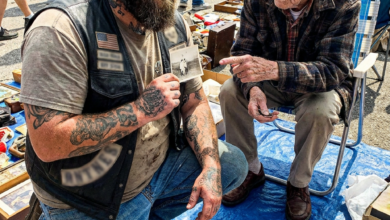
Part 2: Every Friday a Pack of Bikers Walks Into a Rehab Center — They Don’t Preach. They Just Tell the Truth About the Bottom
The club is called the Iron Saints. There are about forty of them. The Friday group started with one man and a promise he made over a coffin.
His name’s Bear. He’s the one who runs it. Sixteen years clean now, but for eleven years before that he was, by his own flat description, “a walking reason for people to lock their doors.” He’ll tell you the whole thing if you ask, without flinching, because he learned a long time ago that the shame only has power as long as you keep it in the dark.
Bear got clean the hard way. No spiritual flash. No rock-bottom movie moment. Just a long ugly grind, relapse after relapse, until one of them finally stuck.
But the reason he started showing up at that rehab center on Fridays wasn’t his own recovery.
It was Petey’s.
Petey was the youngest Iron Saint. Twenty-six. Bear had pulled him into the club personally, the way you do when you see a kid who reminds you of yourself and you think maybe you can get to him before the world does.
Petey had four years clean. Then he didn’t.
It happens like that sometimes — quiet, no warning, a bad week and an old number still in the phone. They lost him on a Tuesday. The whole club rode behind the hearse, forty engines, and Bear stood at that graveside and made himself a promise out loud, in front of everybody, because a promise you say out loud is harder to walk away from.
He said: nobody in that club was ever going to sit alone in the dark again with this thing, thinking they were the only one, thinking the door was closed.
And he figured if it was going to be true for his brothers, it ought to be true for strangers too.
So the next Friday, Bear called the rehab center where Petey had done his first stint years before, and he asked if he could come sit with the people in there. Just sit. Just talk. No agenda.
They said no.
That’s true, by the way — the counselor who wrote the post you’re reading, the one who said no? I asked Bear about it and he laughed. He said the no didn’t bother him. He said in his experience, the people most worth getting through to always say no first. He’d said no to everyone who tried to help him for eleven years. He understood the no better than anyone in that building.
So he waited. And when the director finally said one Friday, Bear brought seven brothers and a single rule.
The rule was: we don’t give advice.
That’s it. That’s the whole method. Bear had sat through a thousand hours of people telling him what he should do, and not one hour of it had ever helped, because advice from a person who’s never been where you are is just noise with good intentions. What had finally reached him, years before, was one old timer in a meeting who didn’t tell him a single thing he should do — who just told him, plain and unbothered, exactly how bad it had been for him, and then said, “and I’m still here.”
That was it. That was the thing. I’m still here. Not as a brag. As a fact. As proof.
So that’s all the Iron Saints do on Fridays. They walk in, they sit in the circle — not in front of it, in it — and each one says: here’s how far down I went, here’s what I lost, here’s what I did that I can’t undo. And I’m still here. They never finish with a lesson. They never say “so you should.” They just leave the truth sitting in the middle of the room where everybody can see it’s survivable.
It turns out that’s the most powerful thing you can show a person who’s convinced they’re past saving. Not advice. Proof.
I want to tell you about the night the counselor wrote about. The day-eleven man. The one in the corner who hadn’t spoken in nine days.
His name — he’s said it’s okay to share it now — is Marcus.
Marcus came in bad. The kind of bad where the staff watch you close. He’d lost about everything a person can lose and still be breathing, and he’d arrived at that center mostly because somebody else made him, not because he believed there was anything on the other side worth the agony of getting clean.
By day nine he’d stopped talking entirely. He’d sit in group with his hood up, eyes on the floor, present in body and gone everywhere else. The counselor said she’d seen it before and it scared her, because that particular silence is sometimes the sound of a person deciding.
Then Friday came, and the Iron Saints came, and it went around the circle the way it always does.
Bear. Then a guy named Tank. Then a wiry old rider named Gospel who’d been clean longer than some of the patients had been alive. Each one, the same: here’s the bottom, here’s what I lost, I’m still here.
And then it got to Diesel.
Diesel is a mountain of a man and he talks the least of any of them, which is why what he says lands so hard when he finally does. He told the room he’d been forty-one when he got clean. He told them he’d burned down every single thing he’d ever loved — the people, the trust, the years. He said he came out the other side of detox with literally nothing and nobody, standing in a parking lot wondering what the point of staying clean even was if there was nothing left to be clean for.
And then he talked about the bike.
He said a man from his recovery meetings sold him a beat-to-hell Harley for almost nothing, mostly out of pity. Diesel said he didn’t even want it at first. But he had it, and it didn’t run right, and one day with nothing else to do he started fixing it.
And the bike, he said, didn’t care about his apologies.
That was the line. The bike didn’t care that he was sorry. It didn’t care about his sad story or his good intentions or his promises. It only responded to one thing: whether he actually showed up and did the work. You change the oil or you don’t. You tighten the bolt or you don’t. The machine only knew the truth of what you actually did, not what you meant to do.
“So I learned to keep one thing,” Diesel said. “Just one. I kept that bike running. Every day, one small thing, done right, for something that only believed me when I showed up. And after a while I thought — if I can be reliable to a motorcycle, maybe I can be reliable to a person. Maybe even to myself.”
He looked around the circle.
“Everything I ever loved, I burned. That Harley was the first thing I ever held onto and didn’t destroy. It wasn’t about the bike. It was about finally being a man who could keep something. You start with one thing you won’t let yourself wreck. The rest comes after.”
The room was dead quiet.
And from the corner, for the first time in nine days, the man in the hood spoke.
Marcus didn’t lift his head all the way. He just said, low, barely a voice at all:
“What if you already burned the one thing.”
It wasn’t a question with a question mark. It was the flattest, heaviest sentence in the world. The counselor said her chest seized up. She’d been trying to reach this man for nine days and here he was, finally talking, and it was the most hopeless thing she’d ever heard.
Nobody in the circle moved.
And Diesel — this enormous quiet man — didn’t rush to fix it. Didn’t say “no you didn’t” or “it’s not too late” or any of the things a counselor in nice shoes would say. He just sat with it a second, the way you sit with something true.
Then he said, “Yeah. I thought I had too. The people I’d burned — some of them never came back. Some never will. That’s real. I’m not gonna lie to you and say you get it all back.”
He leaned forward.
“But the thing I learned fixing that bike wasn’t how to get back what I burned. It was that I was still capable of keeping something new. The bike was new. It wasn’t somebody I’d already hurt. It was a clean thing I got to find out I could hold onto. And once I knew I could hold one new thing —” he tapped his own chest “— turns out I’m a new thing too. I’d burned the old me down. But I was still here. And I got to find out if I could keep this one.”
Marcus put his head down. His shoulders started shaking.
And Bear — across the circle — said the only thing he ever says at a moment like that. Not advice. Not a lesson.
“We’re here next Friday too. And the one after that. You don’t have to keep anything tonight. Just come back Friday.”
Marcus came back the next Friday.
And the one after that. He’s the reason I can tell you this story with his name in it, because he’s the one who asked me to. He’s got a little over a year now. He’s not fixed — nobody in this story is fixed, that’s not how it works, and the Iron Saints would be the first to tell you so. But he’s still here.
He bought a motorcycle eight months in. Beat-up old thing. Doesn’t run great. He’s learning to keep it running, one small thing at a time, for a machine that only believes him when he shows up.
He told me he gets it now. The bike isn’t the point. The bike is just the first thing you find out you can keep.
The Iron Saints still come every Friday.
It’s been six years. Bear’s calculated it out once — they’ve sat in that circle with somewhere north of two thousand people now. They don’t know how many made it. You never know how many made it; that’s the hard math of this thing. Some of the faces come back proud with a chip in their hand. Some you never see again and you don’t let yourself ask. Some, like Petey, you bury, and you ride behind the hearse, and you make the promise over again.
But every Friday at seven, eight of them walk in, drag the folding chairs into the circle, and sit down knee to knee with whoever’s there. And the biggest one says, “My name’s Bear. I’m an addict. And I’m still here.”
No advice. No sermon. No nice shoes.
Just eight men who went all the way down to the bottom, sitting in a circle, holding the door open with the only thing that ever actually works.
Proof.
I’m still here. Come back Friday.
If this one reached you — or somebody you love is in the dark right now — follow the page, and share it. You never know which stranger in which corner is finally going to look up.
(If you or someone you care about is struggling with substance use, please reach out to a doctor, a local treatment center, or a support line — there are people who want to slow down for you, and it’s okay to ask.)