Every Evening, an Old Saint Bernard Wagged Only for the 6:15 Train from Chicago — Then a Young Woman Stepped Down Carrying the Scent of Someone Who Would Never Return
At 6:15 every evening, an old Saint Bernard who ignored every other train would struggle onto his feet, face the Chicago platform, and wag his tail for passengers who never once stopped for him.
I first noticed him on a wet Thursday in November, beside the newspaper kiosk where I worked inside Milwaukee’s downtown station. He was enormous even in old age, with a broad white chest, rust-colored patches, and a leather collar softened by years of use. His left eye had turned cloudy, and his right hind leg moved with the stiff, guarded motion of a dog who had learned how to hide pain.
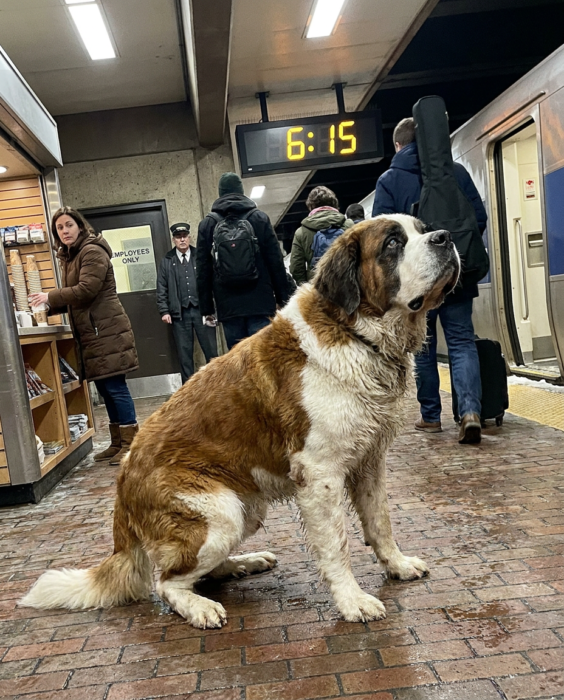
He never begged. He never barked.
He simply waited beneath the departure board as if one minute on that clock belonged to him.
The 4:42 came in from Chicago, and he barely raised his head. At 5:26, passengers spilled through the doors carrying briefcases, grocery bags, and dripping umbrellas. The dog watched them pass without moving. A child offered him half a pretzel. He sniffed it politely, then looked away.
But at 6:14, his body changed.
His ears lifted. His nose began working. He pulled himself upright before the arrival announcement had finished, planting his front paws wide while the weak hind leg trembled beneath him. At exactly 6:15, the train doors opened, and the old dog searched the air with such concentration that the crowded station seemed to disappear around him.
He did not study faces.
He smelled sleeves, leather bags, wet hair, wool coats, and the wake of perfume left behind as people hurried past. His tail moved only when a certain kind of scent reached him. The motion was slow at first—one careful sweep against the floor—then faster, hopeful enough to make strangers turn around.
But whoever he expected never appeared.
At 6:23, after the final passenger had left the platform, the dog lowered himself beside my kiosk again. His chin landed on his paws. The tail stopped.
That was when the station’s hardest ticket inspector came through the gate.
His name was Thomas Bell. He was a narrow-shouldered man in his early sixties who corrected passengers before they finished asking questions and could silence a group of college students with one look. I had never seen him pet the dog. I had never heard him speak kindly to anyone.
Yet every evening, Thomas carried a plain paper bowl beneath his coat.
He placed it near the dog without looking down, waited until the old Saint Bernard took the first bite, and walked away. The bowl always contained the same things: softened kibble, warm water, and a small piece of roasted chicken torn into careful strips.
One night, I asked why he fed a dog he seemed determined not to touch.
Thomas stopped.
His hand tightened around the metal punch clipped to his belt. For several seconds, he stared toward Track 3, where the 6:15 train had already departed.
“He has waited long enough,” he said.
Then he left before I could ask who the dog was waiting for.
Three days later, I saw the dog react to a woman wearing a dark green wool scarf. He pushed through a crowd despite his bad leg, pressed his nose to the trailing edge of the fabric, and wagged so hard that his hips nearly folded beneath him.
The woman turned.
The dog looked up at her face.
Something in him went still.
He stepped backward, lowered his head, and returned to his place beneath the board. The woman watched him go with one hand over her mouth, though she had no idea what she had done.
Thomas had seen it too.
For the first time, the severe inspector knelt beside the dog. He did not stroke him. He only rested two fingers against the worn collar and whispered six words I could not forget:
“Not her, Ben. I know. Not her.”
That was how I learned the dog had a name.
It was also how I understood that he was not waiting for a person’s face.
He was waiting for something the rest of us could not see.
My name is Grace Nolan. I was forty-four that winter, and I had managed the small newspaper and coffee kiosk inside Milwaukee Intermodal Station for eleven years. I knew which commuters wanted black coffee before speaking, which teenagers would miss the last train because they were watching their phones, and which travelers needed directions but were too proud to ask.
Ben appeared on November 7, shortly after 7:00 in the morning.
A maintenance worker named Luis found him lying near the taxi doors with rainwater dripping from his coat. Ben wore a cracked brown collar but no tag. His paws were dirty, and the fur along his chest had formed damp ropes. He was not thin enough to have been wandering for months, but his ribs could be felt beneath the heavy coat, and the muscles around his right hip had wasted with age.
Luis called county animal services. A field officer arrived forty minutes later, scanned Ben for a microchip, and found one that led to a disconnected number and an address belonging to an empty apartment. The officer recorded his condition, offered him a slip lead, and waited rather than forcing him when he flattened himself against the tile.
Ben would walk only toward Track 3.
He planted himself beneath the arrival board and refused to move until 6:23 that evening. After the Chicago train left, he followed the officer outside without resistance.
That should have ended it.
Five days later, Ben returned.
A foster volunteer had been keeping him six miles away. During an early morning bathroom break, a side gate failed to latch. Ben slipped through and walked back to the station in cold rain, crossing several busy streets and arriving with raw paw pads before noon.
The rescue placed him with me temporarily because my apartment allowed large dogs and my kiosk schedule meant I could watch him during the day. I agreed for seventy-two hours.
Ben stayed for nearly two years.
The veterinary examination estimated his age at eleven or twelve. Imaging showed severe arthritis in the right hip but no fresh fracture. The cloudiness in his left eye limited his vision, though he could still detect light and movement. Bloodwork showed nothing dramatic enough to explain why he appeared exhausted after standing for twenty minutes.
The explanation was simpler.
Ben was old. Ben was sore. Ben was waiting.
At my apartment, he slept beside the front door instead of on the padded bed I bought him. He ate slowly, drank with half his muzzle submerged, and woke whenever he heard the distant horn of a freight train. He tolerated my hands on his chest and shoulders, but he pulled away if I reached toward his collar from behind.
Every afternoon at 5:20, he began pacing.
At 5:35, he stood beside the leash hook. If I pretended not to notice, he nudged the cabinet with his nose. If I remained seated, he walked to the window and back until the stiff hip caused him to drag two nails across the floor.
So I brought him to the station.
The ritual never changed. We arrived before 5:50. Ben rested beside the kiosk while Thomas delivered the paper bowl. At 6:12, Ben stopped eating. At 6:14, he stood. At 6:15, he moved toward the platform and began sorting a world none of us could smell.
I assumed he recognized the train.
A veterinary behaviorist later corrected me. Dogs can learn schedules, sounds, routes, and repeated human movement, but Ben’s strongest reaction did not begin with the bell, the announcement, or the brakes. It began when air from the opening doors moved across his nose.
The train was only carrying the thing he wanted.
Thomas refused to answer questions. He fed Ben, checked the platform clock, and left through the employee door. He always tore the chicken into six pieces. He always set the bowl to Ben’s right, where the dog could see it clearly.
That was our first clue.
The second arrived in a black instrument case.
A cellist from Chicago stepped off the 6:15 one Friday wearing a long camel coat. Ben rose so fast that his back paws slipped. He followed the case, sniffed the woman’s cuff, then circled her once as though checking every side.
The cellist crouched.
“Do I know you?” she asked.
Ben pressed his nose to the case. A small white luggage tag swung from the handle. Printed beneath a Chicago address was the name of a repair shop that serviced string instruments.
Thomas appeared behind us.
His face drained of color when he saw the case. He made a sound in his throat, turned away, and walked so quickly toward the staff hall that he left his ticket punch on a bench.
Ben watched him go.
That night, the dog slept with his nose against my coat.
At 2:13 in the morning, he began to dream. His paws moved against the floor, and a small sound came from behind his closed mouth—not a bark, not a whine, but the restrained note of an animal following someone he could no longer reach.
I began asking careful questions about Ben without claiming he belonged to anyone. Station employees remembered seeing him before November. A baggage attendant recalled a woman traveling with him several times during the previous spring. A café worker remembered that she carried a cello and ordered hot water with lemon. Nobody knew her full name.
“She talked to the dog like he was another musician,” the café worker said. “Told him when the train was flat.”
The detail sounded like a joke until I found an old photograph pinned behind a schedule board in the employee break room.
The picture showed six station workers beside a holiday wreath. Thomas stood at the edge in his charcoal uniform, unsmiling as usual. Behind him, partly cut off by the frame, was a dark-haired woman holding a cello case. A younger Ben sat at her feet.
Thomas had folded the photograph so the woman disappeared.
I carried it to the platform the next evening.
Ben smelled the paper, but he showed no reaction. He did not understand photographs. He did not look at the woman’s face. He placed his nose near the folded edge, sneezed once, and returned his attention to the arriving train.
Thomas saw the picture in my hand.
“Where did you get that?”
“Break room.”
“You had no right.”
“It was pinned to a wall.”
He took it without asking. His fingers covered the woman’s face.
“Was her name Mara?”
Thomas stared past me toward the tracks. His jaw moved once, but he said nothing.
“Did Ben belong to her?”
The station announcement cut through the space between us. The 6:15 was approaching. Ben stood and moved forward.
Thomas folded the photograph into quarters.
“Ask the dog,” he said.
Then he left.
Over the next month, Ben taught me the difference between recognition and hope. He hoped when a woman carried a cello. He hoped when someone wore green wool. He hoped when perfume drifted behind an older passenger. But recognition required several pieces at once.
One evening, a woman in a green coat came through carrying a violin case. Ben followed her, tail moving, until she spoke. Her voice broke the pattern. He turned away.
Another night, a passenger wore the same floral perfume I had smelled before. Ben reached her, sniffed the cuff, then checked both hands. When they carried no trace of rosin—the pale dust musicians rub onto a bow—he lost interest.
The scent Ben waited for was not one smell.
It was a whole person assembled from fragments: wool, winter air, hand cream, instrument wood, rosin, coffee, and whatever private chemistry made Mara different from every other human being.
Thomas knew this.
He began arriving earlier. Some nights, he stood beside my kiosk and watched Ben sleep. He still refused to touch him, but his hand opened and closed near his coat pocket as though holding something invisible.
On December 18, a freezing rainstorm delayed trains across southern Wisconsin. The 6:15 did not arrive until 7:41.
Ben waited the entire time.
I spread a blanket over him, but he pushed it off whenever an announcement sounded. Thomas brought another bowl. Ben refused it. His breathing became quick and shallow from the effort of standing, and his right leg began to buckle.
“We should take him home,” I said.
Thomas looked at the empty track.
“He never left before she arrived.”
The words escaped before he could stop them.
“Who was she?”
He rubbed his thumb against the edge of his ticket punch. “Someone who hated being late.”
That was all.
When the train finally arrived, only twenty-three passengers stepped down. Ben inspected every one. A woman carrying a cello paused and let him smell her coat. A man with a bouquet stood still while Ben checked the paper wrapping. A college student offered his gloved hand.
Ben found nothing.
At 7:49, he returned to us and collapsed onto his chest—not unconscious, but emptied. Thomas knelt. His face tightened as he reached toward the dog’s head.
Ben lifted his nose.
Thomas stopped an inch away.
“I don’t know if he blames me,” he said.
“For what?”
Thomas stood before I could see his expression.
The following morning, Ben refused breakfast. The clinic found no obstruction, infection, or sudden organ problem. His pain had increased after the long wait, and he needed rest, anti-inflammatory medication, and shorter walks. The veterinarian told me an older dog could not keep repeating that kind of strain.
I kept Ben home that evening.
At 6:14, he stood at my apartment door.
At 6:15, he pressed his nose to the gap beneath it and began to whine. He had never made that sound before. He paced from the door to the window and back, dragging the nails of his weak foot. When a train horn carried faintly through the city, he struck the door once with his paw.
By 6:22, he was panting.
I drove him to the station.
We arrived at 6:37. The train had gone. Ben pulled me to Track 3, smelled the floor, then followed a fading scent toward the exit. He stopped beside a metal bench where someone had dropped a green wool thread.
Thomas was sitting at the far end.
He had removed his cap. A small leather case rested between his hands, the kind musicians use to store spare rosin.
Ben approached him, smelled the case, and lay down at his feet.
Thomas finally touched him.
His palm settled between the dog’s ears and remained there. Ben closed his eyes. Thomas bent forward until his forehead nearly reached the old dog’s head.
“I’m sorry,” he said. “I couldn’t bring her back either.”
The station clock changed to 6:41.
Neither of them moved.
Thomas told me about Mara three weeks later, after Ben slipped on ice outside the station and needed help getting into my car. Thomas lifted the dog’s back end with both arms, settled him on the blanket, then climbed into the passenger seat without being invited.
“Drive,” he said.
We did not go to the clinic. Thomas directed me toward a narrow brick house on Milwaukee’s south side, where a woman named Evelyn answered the door. She was Mara’s older sister.
Evelyn recognized Ben before I finished introducing myself.
She sat on the front step despite the cold and wrapped both arms around his neck. Ben smelled her hair and coat. His tail moved twice, but not the way it moved for the 6:15. He knew she belonged near the scent he wanted, yet she was not its source.
Evelyn invited us inside.
Mara Bell had been a freelance cellist. She taught at a music school in Chicago two days a week and performed wherever orchestras needed an extra player. On teaching days, she took the afternoon train home and arrived in Milwaukee at 6:15.
Ben waited for her because that was what Ben had always done.
Mara had adopted him at eight weeks old after finding him beneath a picnic table at a county fair. He grew into a Saint Bernard large enough to occupy most of her kitchen floor. He slept beside her cello while she practiced and stood at the front window whenever her schedule brought her home.
After Mara and Thomas separated, she moved into an apartment that permitted Ben. Their daughter, Lucy, was seventeen and furious with both of them. She left for college the following year, stopped answering Thomas’s calls, and spoke to Mara mostly through short messages.
The divorce became final, but Mara and Thomas never fully untangled their lives. They still ate breakfast together twice a month. Thomas repaired cabinet hinges at her apartment. Mara left soup outside his door when he worked double shifts.
Ben moved between them without choosing sides.
Then, on October 28, Mara drove to Madison for an evening rehearsal. Heavy rain began after dark. Her car left the highway on the return trip and struck a barrier. She died before an ambulance could reach the hospital.
Ben was at Evelyn’s house that night.
For nine days, he searched every room each time the front door opened. During the memorial service, he lay beneath Mara’s cello and refused food. Evelyn tried to keep him, but Ben escaped through a screen door on November 7.
He went to the station.
The microchip company had Mara’s old apartment number. Evelyn assumed animal services would contact Thomas. Thomas assumed Evelyn still had Ben. By the time they discovered what happened, I had already become his temporary foster.
“Why didn’t anyone tell me?” I asked.
Evelyn looked at Thomas.
He stared at his hands.
“Because our family had become skilled at believing silence was easier,” she said.
Lucy had not attended the memorial.
That fact sat in the room harder than anything else. She had been touring with a small audio-production company in Canada when the accident happened. Mara’s last message to her had been an apology for missing a call. Lucy listened to the voicemail from Evelyn, booked a flight, then canceled it before departure.
She told her aunt she could not walk into a room where Thomas would be standing beside her mother’s coffin.
“She blamed him for everything,” Evelyn said. “The divorce. The move. The years she lost with Mara. Grief chooses a target when the real target is too large.”
Thomas did not defend himself.
He took a small photograph from his wallet. Lucy was nineteen in it, standing between her parents while Ben’s head appeared at the bottom of the frame. Someone had written a date on the back: June 14, 2018.
“Does she know Ben is alive?” I asked.
“No,” Evelyn said.
Thomas’s shoulders tightened.
Evelyn looked at him. “You never told her?”
“She blocked my number.”
“You have an email address.”
“She would think I was using the dog.”
“Were you?”
Thomas stood so fast that the chair legs scraped the floor. “I fed him. I watched him. I stayed away from everything else.”
Evelyn’s voice lowered. “That has always been your talent.”
Ben woke at the sound of the chair. He raised his head, looked toward Thomas with his good eye, and thumped his tail once.
Thomas sat again.
Evelyn brought Mara’s green wool coat from an upstairs closet. The moment she entered the room, Ben changed. His nose lifted. His front paws pushed against the rug. He tried to stand before his right leg was beneath him.
Evelyn placed the coat on the floor.
Ben lowered his entire chest onto it. He buried his muzzle in the sleeve and released one long breath. His body softened in a way I had never seen at the station.
The coat still carried traces of Mara.
But cloth could not walk through a train door.
Evelyn let me take it home. For the next four nights, Ben slept on it and did not pace at 5:20. I thought the waiting had ended.
On the fifth evening, he stood beside the leash hook.
At 6:15, he returned to Track 3.
Mara would never step off that train again.
Ben waited anyway.
Thomas found me after closing the kiosk on January 26. He placed an envelope on the counter and asked me to read it before judging him.
Inside was a copy of a handwritten note from Mara.
It had been written eleven months before the accident, after Thomas moved into an apartment that prohibited large dogs. Mara’s handwriting leaned sharply to the right.
If anything happens to me, do not let Ben sit by the door hungry. He will wait longer than is good for him. You know how he is. Warm water in the food. Chicken in small pieces. Bowl on his right.
That explained everything I had watched Thomas do.
The six chicken pieces were not a habit he invented. Mara had prepared Ben’s food that way because he swallowed larger pieces too quickly. The bowl sat on the right because of his cloudy left eye. Thomas left before the train arrived because he had once met Mara on that platform after their separation, and Ben’s excitement had pulled both of them into an awkward embrace.
After Mara’s death, Thomas could feed the dog.
He could not stand beside him while he waited for her.
“I was her husband for twenty-six years,” Thomas said. “Then I was not. There wasn’t a word for what I was when she died.”
He had been the emergency contact on Mara’s medical paperwork. He identified her belongings at the hospital. He carried her cello to Evelyn’s house. Then he returned to work the next morning because staying home meant sitting in an apartment where none of Mara’s things had ever lived.
Thomas was not cruel.
Thomas was a man rationing grief into tasks small enough to finish.
He could check the water temperature. He could tear chicken. He could watch a clock. He could not touch Ben because Ben had spent years carrying Mara’s scent home on his coat, and the first time Thomas knelt near him after the accident, the dog smelled Thomas’s uniform and searched behind him for her.
“I had come from the hospital,” he said. “Her scarf was in my bag. Ben thought I had brought her home.”
Thomas’s voice failed on the last word. He looked toward Track 3 until he could continue.
Lucy believed Thomas had abandoned Ben after Mara’s death. Evelyn had assumed Thomas told her otherwise. Thomas had typed seventeen emails but sent none. Each one sounded, to him, like an excuse.
I asked to see the last draft.
It contained four sentences.
Lucy, Ben is alive. He goes to the station every day for your mother’s train. I feed him because she asked me to. I do not know how to make him stop.
“Send it,” I said.
Thomas shook his head.
“Then let me.”
“No.”
“You are protecting yourself, not her.”
His eyes moved to Ben, who was asleep beside the kiosk with Mara’s green coat beneath his chin.
Thomas lowered his voice. “What if she comes only for the dog?”
“Then she comes.”
“What if she takes him?”
“Then you let her decide.”
“What if he thinks she is Mara?”
That question revealed the fear beneath all the others. Thomas had watched Ben chase fragments of scent through crowds. Lucy shared Mara’s blood, some of her features, and perhaps the chemistry Ben remembered. Thomas did not know whether a reunion would comfort the dog or break something that had barely survived.
We sent the email at 8:11 that night.
Lucy replied at 3:42 the next morning.
Her message contained seven words.
Does he still wait for the 6:15?
Thomas read it twice.
Then he sat on the floor behind my kiosk with his back against the cabinet, exactly where Ben usually slept. He placed both hands over his face and remained there until the morning cleaning crew arrived.
Lucy did not say when she would come.
For twelve days, Thomas checked his email during every break. Ben continued his routine. The train arrived; doors opened; passengers passed; hope rose and fell inside the old dog’s body.
On February 8, snow began shortly after noon. By evening, the rails shone beneath the platform lamps, and the wind pushed loose powder through every opening in the station doors.
The 6:15 was listed eleven minutes late.
At 6:14, Ben stood anyway.
Thomas had not retreated to the employee corridor. For the first time since I had known him, he remained beside the dog as the scheduled minute passed.
At 6:19, Ben leaned against his leg. Thomas rested one hand on the broad white patch between his shoulders. Neither looked at the other.
At 6:26, the train entered the station.
The brakes screamed. Warm air, diesel, snow, damp wool, and the layered scent of more than a hundred passengers moved along the platform. Ben stepped forward.
The first passengers were commuters. Then came a family with two sleeping children, a man carrying skis, and a woman dragging a silver suitcase.
Ben watched none of their faces.
A young woman stepped down near the rear of the train.
She was twenty-six, with dark hair cut above her shoulders and a black coat dusted with snow. A green wool scarf circled her neck. One end had been repaired with a line of uneven stitches.
Mara’s scarf.
Lucy had found it inside a sealed garment bag at Evelyn’s house. The fabric still held traces of the orange-blossom perfume Mara wore, the cedar lining of her closet, and rosin dust transferred from years of carrying her cello against the same shoulder.
Ben caught the scent before Lucy saw him.
His head lifted. His nostrils widened. The worn ears rose as far as age allowed. His tail struck Thomas’s leg once, then again.
He moved.
Not quickly. Not cleanly. His right hip resisted, and one back paw slid on the wet platform. Thomas reached for his harness, but Ben steadied himself and continued.
Lucy stopped fifteen feet away.
Her suitcase tipped onto one wheel. She stared at the dog, then at Thomas, and every practiced expression left her face.
“Ben?”
The dog’s body surged at the sound.
He had heard Mara’s voice through years of rehearsals, phone calls, arguments, and laughter. Lucy’s voice was not the same, but it carried familiar shapes—the same low beginning on his name, the same breath at the end.
Ben crossed the distance.
He smelled the scarf first. His nose pressed into the repaired seam. His tail moved so hard that his hindquarters swayed. Then he smelled Lucy’s hands, coat, hair, and face.
Lucy knelt.
Ben raised his nose to her left cheek, the way he had greeted Mara when she returned from Chicago. He inhaled once and froze.
For one second, everyone on that platform seemed to wait with him.
Then Ben did something he had never done with the passengers who carried pieces of Mara’s scent.
He placed one paw on Lucy’s knee.
Lucy folded over him. Her forehead pressed into the thick fur behind his ears. She did not make a speech. She repeated his name against his coat while Ben stood between her knees, tail striking the wet concrete.
Thomas remained several feet away.
Lucy looked up.
“You let him come here every day?”
Thomas removed his cap. Snow landed in his gray hair.
“I couldn’t stop him.”
“You could have told me.”
“I should have.”
“You sent me four sentences.”
“They were the first four I could finish.”
Lucy’s hands stayed in Ben’s fur. “Mom called me the night she died.”
Thomas’s face changed.
“I know,” he said.
“I didn’t answer.”
“She knew you were working.”
“She left a voicemail.”
Thomas nodded. “I heard it at the hospital.”
Lucy stared at him. “You had her phone?”
“They gave me her things.”
“You listened to my message?”
“No. I heard hers. She played it for me two days before the accident because she wanted to know if it sounded desperate.”
Lucy lowered her eyes.
Thomas continued. “She said, ‘Lucy, no pressure. Call when you can. Ben stole my glove again.’ Then she laughed.”
Ben pushed his muzzle deeper beneath Lucy’s arm, as if responding to his name inside a memory none of us could hear.
“I deleted it,” Lucy said. “I was angry. I deleted the last thing she ever said to me.”
Thomas reached into the inner pocket of his coat.
He removed an old phone wrapped in a clear plastic bag.
“The hospital returned this to me,” he said. “I charged it once. I never changed anything.”
Lucy did not take it.
Thomas placed the phone on the bench between them.
“I kept it because I didn’t know what else to keep.”
The platform announcement sounded overhead. Ben startled, then looked toward the train. For the first time, he did not move closer to the opening doors.
He stayed with Lucy.
That small choice broke through what words could not. Lucy sat on the wet platform beside him. Thomas lowered himself onto the bench, leaving the phone in the space between them.
Lucy pressed the power button.
Mara’s voicemail played softly beneath the station noise.
“Lucy, no pressure. Call when you can. Ben stole my glove again.”
A woman laughed from a year that had already ended.
Ben raised his head.
He looked toward the phone, then toward Lucy. His nose touched the green scarf. Thomas’s hand came down over his mouth.
Lucy did not accuse him again. She did not forgive him in one clean sentence. Families rarely repair themselves that way.
She moved from the floor to the bench.
The phone remained between them.
Ben placed his heavy head across both their knees.
Thomas’s right hand rested on one side of his neck. Lucy’s left hand rested on the other. Their fingers were six inches apart, then four, then close enough to touch the same strip of worn collar.
The 6:15 train departed behind them.
Ben did not watch it leave.
Lucy stayed in Milwaukee for nine days. She slept at Evelyn’s house, visited Mara’s apartment, and came to my place every morning to help with Ben’s medication and slow walks. She and Thomas still argued, but their arguments changed. They stopped fighting about who had ruined the past and began discussing what to do the next day.
Ben became their shared schedule.
Thomas handled breakfast because he knew the right water temperature. Lucy brushed the thick coat in short sections because Ben tired when standing. I kept the medication chart on my refrigerator and drove him to follow-up appointments.
The veterinarian found no sudden miracle in him. His arthritis remained. His cloudy eye did not clear. Age continued its patient work. But his appetite improved, and he stopped pacing at 5:20.
On Lucy’s final evening, we brought Ben to the station.
The three of us stood beneath the arrival board at 6:14. Lucy wore Mara’s scarf. Thomas carried the paper bowl. Ben sat between them.
The 6:15 arrived.
Passengers stepped onto the platform, bringing hundreds of passing scents. Ben lifted his nose. His tail moved once against Lucy’s boot.
He did not stand.
Thomas placed the bowl on Ben’s right. Lucy tore the chicken into six pieces. Their hands bumped above the food, and neither pulled away.
When the final passenger left, Ben rose slowly and turned toward the exit.
He had finished waiting alone.
Lucy did not take him away from Milwaukee. Her apartment in Boston had narrow stairs, and Ben’s hip would not manage them. She also understood that he had built a life with me. Instead, she returned every six weeks, always on the Chicago train scheduled for 6:15.
Thomas met her on the platform.
Sometimes they spoke easily. Sometimes they sat with Ben between them because conversation remained too sharp. The dog never asked either of them to explain.
Nine months later, Lucy moved to Chicago for a permanent audio job. She could have flown or driven when she visited, but she chose the train. She wore Mara’s scarf on cold evenings and carried the old phone in her bag.
Ben lived another fourteen months.
During his final week, he stopped eating chicken. Thomas still tore it into six pieces. Lucy came on the 6:15 and slept on my living-room floor beside him. At 6:14 each evening, Ben raised his head, but he no longer searched the door.
He looked toward Lucy.
On his last morning, snow pressed softly against the windows. Lucy held Mara’s scarf near his nose. Thomas rested one hand on the worn collar. Ben breathed in, released the air, and settled his head across both their wrists.
The room became quiet.
Afterward, Thomas kept the collar. Lucy kept the green scarf. I kept the paper bowl behind the kiosk.
Every year on February 8, Lucy takes the 6:15 from Chicago. Thomas waits beneath the arrival board. They buy two coffees, sit on the metal bench, and play Mara’s voicemail once.
Then Lucy tears a small piece of roasted chicken into six parts and leaves it with the station’s community pet-food collection.
At 6:23, they walk out together.
Ben no longer waits beneath the clock.
But the family he gathered still arrives on time.
Follow this page for more powerful dog stories about loyalty, memory, and the quiet ways animals bring broken families back to one another.