I Thought a 140-Kilo Biker Had Struck My Six-Year-Old Daughter in a Crowded Restaurant — Then I Saw What She Couldn’t Do
Maddie drew in a rough breath. Then another. Her crying began a moment later, and I have never been so grateful to hear it.
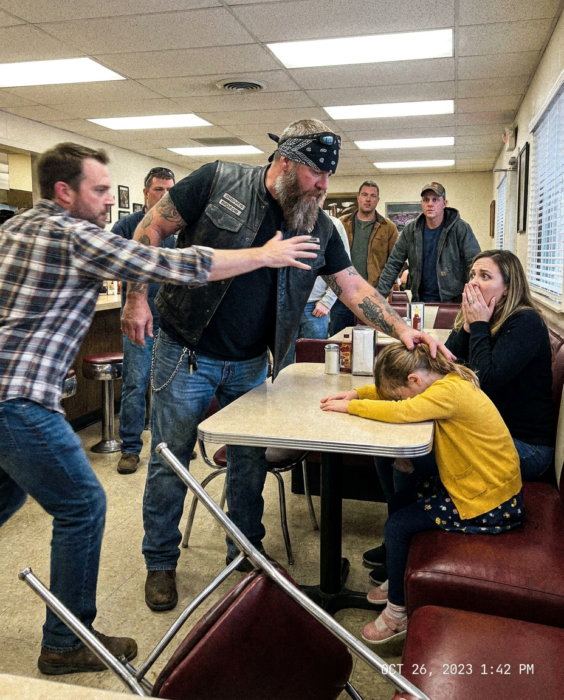
Sarah slid into the booth beside her and held her without pressing her upright. The biker stayed close long enough to see that she was breathing, then asked the waitress whether the emergency call had gone through. It had. He told us help was coming and asked us to give Maddie space. He sounded calm, though his hands were shaking.
The piece of food was on the tablecloth near my water glass. I had watched it land without understanding what I was seeing. Now I looked from it to Maddie, whose face had begun to lose the frightening color around her lips.
“She was choking,” the biker said.
I turned toward him. I wanted to say that I would have noticed. I was her father. I had been sitting beside her, close enough to touch her sleeve. Sarah had been across from her. Surely one of us would have seen.
The biker pointed toward his booth. “I could see her face from there.”
That was all he said. I followed the line from his empty coffee cup to Maddie’s seat and understood how her body had hidden her from us. She had turned toward Sarah at the far end of the booth. Sarah and I had been looking at the back and side of her head. The biker, alone across the aisle, had seen her try to make a sound and fail.
The man by the register was still holding his phone. He had stopped filming when the waitress called 911, but its dark screen was aimed our way. I asked him to put it down. He did, without arguing.
I picked up my chair. One of its legs had caught beneath the neighboring table, and freeing it took longer than it should have. I needed something to do with my hands. The waitress wiped up the spilled drinks nearby while another customer quietly moved a family away from the crowd gathering in the aisle.
Maddie kept crying. Sarah stroked her hair and told her the ambulance was coming. My daughter nodded, though I doubted she understood why people were staring. She put a hand against the front of her cardigan and asked, between uneven breaths, whether she could have some water. The biker looked at the waitress, then back at Maddie, and said the paramedics would be there soon. We waited with her.
His name was Frank Donnelly. I learned it when the waitress asked so she could tell the dispatcher who had helped. He was broad across the chest, with gray in his beard and ink running from his wrists beneath the sleeves of a faded shirt. There was a thin scar across one knuckle. I had mistaken his silence for indifference a few minutes earlier. Up close, I could see he was working hard to steady his breathing.
Frank stepped away when Maddie reached for me. I slid into the booth opposite Sarah and took our daughter’s hand. Her fingers were warm. I counted them with my thumb, one after another, although I had no reason to.
“Dad?” she said.
“I’m here.”
It was the easiest answer I had given her all day, and the one I had nearly lost the chance to give.
The paramedics arrived before our dinner had been cleared. They spoke to Maddie, checked her carefully, and asked us what had happened. Frank described what he had seen from his booth and what he had done. He gave them the sequence without trying to make himself sound brave. I told them I had pulled him back while he was helping her.
One paramedic looked at me and said, “She’s breathing well now. We still need to assess her.”
Maddie went with them to be examined. Sarah rode beside her, and I followed. In the parking lot, I saw Frank’s Harley under the diner’s orange lights, parked beside our minivan. I had barely noticed it when we arrived. Now I recognized the helmet hanging from its handlebar and wondered why its owner was still standing inside instead of leaving.
I went back through the door. Frank was at the counter, holding his cooled coffee without drinking it. The waitress was taking down his number in case anyone needed to ask him more questions.
“I’m sorry,” I said.
He set the cup down. He looked at me for a moment, then toward the ambulance outside.
“Go with your girl,” he said.
I did. I thought he had simply refused to talk to me while Maddie needed us. Later, I learned that the words I’m sorry had reached a place in him I knew nothing about.
The hospital waiting room had a vending machine that hummed louder than the television. I stood beside it while Sarah took Maddie into an examination room, because I could not bear to sit still and could not think of anywhere useful to stand.
A nurse came out twice. The first time, she asked me to repeat what Maddie had been eating. The second, she said our daughter was alert and that the clinician was checking her after the choking episode. I held on to the word alert until Sarah opened the door and waved me inside.
Maddie was sitting up, her cardigan folded in her lap. She had cried enough to make her eyes swollen. She asked whether we had left her school program drawing at the restaurant. Sarah said we would find it. Maddie wanted to know whether the large man had got in trouble.
“No,” I said. “He helped you.”
She touched the spot on her back where his hand had landed. “It hurt.”
“I know.”
Both things were true. I wished I could have made the second one take the first away.
I called the diner after Maddie was cleared to go home. The waitress, Nora, had put the drawing behind the register. She also told me Frank had paid for his coffee and left his food untouched. She had tried to give him our phone number after Sarah agreed, but he had declined it. He had left his own number for the paramedics in case they needed his account.
When we returned the next morning, the breakfast crowd had no idea what had happened. The same bell rang above the door. Someone was carrying pancakes to the far booth. Nora handed Maddie her drawing, slightly bent at one corner, and showed us where Frank had been sitting.
From his seat, I could see ours plainly. I sat down there for a minute while Sarah and Maddie waited by the counter. I imagined watching a child across the aisle lift a hand toward her throat and fail to speak. The route from that booth to ours was short, but he would have had to get around the table and a chair. He had crossed it while I was still hearing Sarah finish her sentence.
Nora came over with a fresh coffee I had not ordered. “He used to be a firefighter,” she said. “That’s what he told the paramedics.”
I looked up.
She had heard him give his work history when they asked about his training. Twenty-two years, he had said. Then, when one of them called him a firefighter again, he had corrected the tense.
“He said he was one,” Nora told me.
That detail bothered me. A man who had spent twenty-two years in that job would know what he had seen from the booth, and he had moved before anyone else did. Yet he had stayed in the diner with that cold cup afterward, looking as though the emergency had followed him out of our aisle.
I asked Nora whether she would pass him a message if he came back. I wrote my name and number on the back of a receipt. I did not ask her to tell him I had apologized; he knew. I wrote that Maddie was home and had asked about him.
Four days passed. We returned to school pickups, work calls, and dinners at our own table. Maddie was quieter than usual when we ate. Sarah cut her food into smaller pieces and watched every bite. I kept remembering that we had been watching her that night, too. Attention had not helped us understand what was happening when it mattered.
On Thursday, a number I didn’t know appeared on my phone while I was unloading groceries. The man who answered my hello said, “Nora gave me your note.”
It was Frank. He asked about Maddie first. I told him she had gone back to school and was doing well. He was quiet for a moment. Then he asked whether Sarah and I were doing all right. I said we were trying.
“I pulled your vest,” I told him. “I was about to hit you.”
“I know.”
“You let me.”
“You were her dad,” he said. “I had my eyes on her.”
I wanted to explain myself. He had seen me explain enough in the restaurant. Instead, I asked whether we could meet for coffee so I could thank him properly. He said he would think about it and ended the call kindly.
The next afternoon, he phoned again. We met at Nora’s diner before the dinner rush. I arrived early and chose a table where I could see the booth he had occupied. Frank came in carrying his helmet. He set it beside his chair and looked toward Maddie’s place before he sat down.
I thanked him. I apologized once more, this time without asking him to make me feel better about it.
Frank ran his thumb along the rim of his mug. “I heard you the first time,” he said.
Then he told me why he could not answer me that night.
Frank’s daughter had been named Ellie. She was four when she died.
He told me that much first and waited while I absorbed it. Outside the window, a delivery truck stopped near his Harley. The driver checked an address and went into the pharmacy next door. I watched him because looking at Frank felt intrusive, though I had asked him to come.
Ellie had been at a birthday party with her mother nine years earlier. Frank was working a firehouse shift across town. There were about thirty adults at the party, he said, counting the parents and relatives who came and went. When Ellie began choking, the people nearest her did not recognize it at once. By the time someone called for help and told Frank where she was, her condition was critical. Responders tried to save her. They could not.
He did not tell the story as an accusation against every adult in that room. Some had acted. Some had thought another person knew what to do. They were frightened, and Ellie died. Those were the facts he had to live with.
“I wasn’t there,” he said.
I had wondered how a firefighter could be at a party where nobody knew how to help. I had been too ashamed to ask. Frank had been at work, doing the job he had trained for, when his own child needed someone beside her.
He took off his silver ring and rolled it once between his fingers. On the inside was a tiny worn engraving. I didn’t ask to read it. He put the ring back on.
For a while after Ellie died, he stayed in the fire service. He completed shifts. He answered calls. People who worked with him tried to help, though he could not always accept it. Eventually he left. His twenty-two years in the department ended with a quiet farewell he barely remembered. That had been nine years before our dinner at Nora’s.
“I know how it sounds,” he said.
I told him I didn’t know how anything sounded yet.
“I’d helped other families,” he said. “I couldn’t even be in the room for mine.”
I wanted to say that being absent from a birthday party did not make him responsible for Ellie’s death. It was true, but it was not a sentence likely to settle nine years of grief over coffee. I let him continue.
When he came into Nora’s that night, he had planned to eat and go home. He sometimes took that route after visiting an old friend at the garage where he kept his Harley. He noticed Maddie because her yellow cardigan reminded him of a sweater Ellie had worn. The resemblance was small, he said. He would not have remembered it if nothing else had happened.
He saw Maddie stop moving her fork. From across the aisle, he could see her open her mouth without making a sound. He stood before he was certain what she had eaten. He remembered my jacket hanging over the end of our booth because he had to move around it.
“Then you grabbed me,” he said.
“I did.”
“You made it hard to reach her.”
I looked at the table. He had every right to say it.
“But you let go,” he added. “When I told them to call.”
He did not let me off the hook. He also did not make the worst second of my life the whole account of who I was. That was more generosity than I had brought to our first meeting.
At the diner, he had seen Sarah and me take Maddie to the ambulance. He wanted to know whether she was safe, so he stayed until Nora received word from the paramedics that we were on our way for an examination. He had held the coffee because his hands would not settle. When I came back to apologize, he heard an old room full of adults apologizing for not knowing what to do.
“Don’t spend your time apologizing to me,” he said. “Learn first aid.”
The words were plain. I could hear how much it had cost him to say them without shouting.
I asked whether he would recommend a class. Frank said the fire department and community centers could point us toward certified training. He did not offer to teach us. He had not taught a class since he left the department, though he once helped train new firefighters. Even telling me that seemed to make him uneasy.
Before we left, I told him Maddie still wanted to thank him. He looked toward the drawing tucked inside my coat pocket. I had brought it in case he asked to see it.
“Maybe later,” he said.
I went home thinking that our family’s next step was simple: enroll in a class. I had no idea that the harder question was whether Frank could bear to walk into one with us.
Sarah registered us for a certified first aid and CPR class the following week. We asked Maddie’s grandmother to stay with her while we went. Maddie wanted to know why both of us were leaving on a Saturday, so we told her the truth: we were learning what to do when someone needed help.
She asked if Frank would be there. We said no.
There were eleven other people in the room, including a restaurant worker, two grandparents, and a teenager preparing for a babysitting job. The instructor used training equipment and stopped us when we rushed. I had expected the class to make me feel ready by lunchtime. Instead, I understood how much I had needed someone to show me the skills, correct me, and make me practice them.
On the way home, Sarah asked what it would cost to offer a class in our neighborhood. She was thinking about the other families at school, the servers at Nora’s, and the thirty adults Frank had described. She also understood that our one Saturday did not make us instructors.
We called the community center. A coordinator, Denise, explained how they arranged classes with qualified instructors and what a free session would still cost: materials, room time, and an instructor’s fee. Sarah asked whether our family could help cover the first one. Denise gave us the figure. We could manage it if we postponed a home repair we had planned for that month.
Frank was the last person we called.
I told him what we had done and that Denise was planning an introductory session followed by proper certification courses. I asked whether he might come to the first one to speak about why training mattered. He said he would call me back. Three days later, he did. He wanted to meet Denise before agreeing to anything.
At their meeting, Frank asked more questions than either of us. Who would teach? What qualifications did they have? Would anyone tell his daughter’s story without his permission? Denise answered each one. She had already contacted an active instructor to run the first course. Frank would be welcome to observe or help only in a role he was ready and qualified to take.
That answer changed the meeting. Frank had thought we were asking him to stand at the front of a room and turn Ellie’s death into a lesson for strangers. I had not intended that, but I had not said clearly what we were asking either. We rewrote the invitation before it went to families. It described a training opportunity. It did not mention Ellie or Maddie.
Nora offered to leave flyers beside the register. I worried that diners would connect them to the emergency and ask Maddie about it. Nora said she would give the details to anyone interested without naming her. She kept that promise.
The first class filled. Frank came in carrying no helmet and wearing an ordinary work jacket instead of his leather vest. He sat near the back beside me. Denise introduced the instructor and began. Frank stayed through the demonstrations, the questions, and the long pause while everyone practiced under supervision.
At the end, a grandfather raised his hand. He asked whether there would be another class because his daughter worked Saturdays and could not come. Denise said she was trying to arrange one.
Frank spoke from the back of the room. “I can help with the next schedule,” he said.
He did not tell anyone his history. Afterward he helped Denise stack chairs. Watching him carry two at a time, I remembered his shaking hands around the coffee mug at Nora’s. They were steady now, though he moved slowly when he passed the children’s drawings pinned along the wall.
Our first class led to another, but keeping them free was difficult. Sarah and I could not pay for each one. The community center found a small grant, a local business covered materials for two sessions, and Denise helped people find existing low-cost courses when ours were full. Frank renewed the training credentials he needed and worked with the certified program. He prepared carefully for the first session he helped teach.
Before it, he phoned me. “If I leave halfway through,” he said, “Denise knows the plan.”
“You can leave,” I told him.
“I know.” He paused. “I’d like to stay.”
He did stay. Nine years after leaving the fire department, Frank stood at the front of a room again. He taught the skills, watched people practice, and let another instructor correct his demonstration when a detail needed updating. That last part mattered to him. He wanted people to learn the current guidance, even if it meant hearing that something he remembered had changed.
Maddie met him afterward. Sarah and I had asked Frank if he was comfortable with it, and we had let Maddie decide whether to go. She brought the drawing from her music program, the one Nora had saved. On its back she had drawn a motorcycle with wheels much too small for its frame.
“Is this yours?” she asked.
“Close enough,” Frank said.
She handed it to him. He thanked her and slipped it carefully into a folder with the class papers. For a moment he looked as though he might say more. Maddie had already turned toward the water fountain, and he let her go.
The classes did not grow in a straight line. The community center lost its Saturday room one winter. An instructor moved away. We had to cancel a session because too many families were ill, and Denise spent an evening calling people who had arranged childcare to attend.
Frank kept helping. Some months he taught. Some months he set out the practice equipment and left the instruction to someone else. When his motorcycle broke down, another rider from his club brought him over in a pickup and waited to take the equipment home. The club offered money from a fundraiser, and Denise used it to cover places for people who could not pay.
Sarah kept the registration lists and guarded them fiercely. She would not give anyone a child’s name for a story about what had started the classes. I understood why. Maddie had been frightened and hurt in a room full of witnesses. She deserved to grow up without being introduced by the worst minute of her childhood.
Frank agreed. When people asked him why he taught, he usually said he had been a firefighter and believed more neighbors should learn. If he chose to speak about Ellie, he did it in his own words and at his own pace. I heard him mention her to one small instructor group. He said her name once. Then he returned to the lesson.
Four years after the first session, Denise’s records showed that more than 2,000 people had attended the free classes and related training offered through the program. She was careful about the number. Some had taken more than one course, and she would not call every attendee certified. I liked that care. It sounded like her.
We heard about three choking emergencies in which former attendees said their training had helped them respond. One was a grandmother at a family lunch. Another was a restaurant worker. The third was a father who contacted Denise months afterward. We knew their accounts because they chose to share them; we did not claim to know every detail of their medical outcomes.
Frank read the messages when Denise forwarded them with permission. He never called them repayment for Ellie. Once, after the third, I found him in the community center hallway, folding an empty supply box flat along its creases.
“Three people wrote back,” I said.
“I read them.”
He pressed the cardboard down with his palm. “I’m glad they knew what to do.”
That was all. I had known him long enough not to ask for a speech.
At home, Maddie turned ten. She no longer remembered every detail of the diner, though she knew the account from us. Sometimes she asked about Frank’s motorcycle. He had shown it to her in the community center parking lot, with the engine off and Sarah standing beside her. She was more interested in the little rubber duck fixed near the handlebar than in the bike itself.
Frank said a club friend had given him the duck as a joke. Months later, he admitted he kept it because Ellie would have liked it. Maddie bought a second one at a school fair and gave it to him for the other side.
The two ducks stayed on the Harley. When Frank arrived for class, I could hear the V-twin turn into the lot before I saw him. He would shut it off, carry his helmet inside, and check the room number against the schedule Denise had sent. He still checked, every time. Rooms changed. He wanted to be where people expected him.
Last fall, Frank arrived early for a class and found Maddie helping Denise arrange pens on the tables. She was old enough to volunteer for the small tasks. I was carrying a box from the car when I heard her ask whether he remembered the diner exactly as it happened.
Frank set his helmet down. “Some of it.”
“I remember being scared,” she said. “And then Mom was there.”
He nodded. He did not ask her to remember him.
Maddie straightened a stack of handouts. “Dad says he grabbed you.”
“He did.”
“I know why he thought you were hurting me.”
Frank glanced at me in the doorway. I stayed where I was. Maddie had arrived at that thought herself, and I wanted to hear what he would say.
“He couldn’t see what I could see,” Frank told her. “I was looking right at you.”
She accepted that and returned to her pens. Their conversation had taken less than a minute. I carried the box inside.
Before the participants arrived, I walked with Frank to the parking lot for another load of equipment. His Harley stood beside the curb, two little ducks near the handlebar. One was faded from the sun. The other still had the bright yellow paint Maddie had chosen.
I thought about the diner: the overturned chair, my fist, his hand on Maddie’s back. I had spent years wishing I could go back and see her face in time. I could not. What I could do was show up for the next class and let the people who knew how to teach do their work.
Frank lifted the lighter box before I could reach it. “You have the heavy one,” he said.
Inside, Denise was opening the doors. Parents, servers, grandparents, and teenagers were beginning to take their seats. Maddie stepped aside to let them through, then went to find Sarah.
Frank put his box at the front of the room and waited for the instructor to begin.
Follow this page for more biker stories about ordinary people, difficult moments, and the choices that stay with a family long after the engines go quiet.