For Six Years, an Elderly Woman Left a Hot Dinner at the End of a Dark Alley — Then a Biker Asked Why She Always Watched from Twenty Yards Away
The young man in the photograph was Mrs. Ward’s son.
His full name was Thomas Ward. He was forty-four now, though the picture showed him at twenty-three, standing in his mother’s vegetable garden with sunlight on his face. On the back she had written the year and the names Evelyn and Thomas. The handwriting was steady. It had been a long time since her hand could make letters that small.
“He doesn’t know it’s me,” she said.
We stood beneath a streetlight while cars went past us on the road to the highway. I held the photograph by its edges. Thomas in the picture wore work gloves tucked into his back pocket. He had a narrow smile and one arm draped over his mother’s shoulders. Mrs. Ward watched me look, then returned the photograph to its worn paper sleeve.
When he was younger, Thomas had loved growing things. He helped her choose tomato seedlings every spring and kept an untidy collection of plants in coffee tins along their porch. After high school he found work at a landscaping company. He liked starting early, before clients came outside with questions. He could spend an hour deciding where one small tree would have the best chance.
The trouble did not arrive all at once. Mrs. Ward told me about a difficult stretch in his twenties: a loss at work, nights without sleep, and periods when his thoughts frightened him. He received help at times. At other times he stopped going to appointments. Their arguments grew sharper. Mrs. Ward was careful as she spoke, describing what she remembered rather than trying to explain every choice he had made.
One autumn morning, twenty years before I met her, Thomas left home. He had packed a small bag and said he needed to be somewhere nobody expected anything from him. Mrs. Ward thought he would come back after a few days. When he didn’t, she called friends, former coworkers, shelters, and hospitals. She reported him missing and followed every lead she could.
Fourteen years passed. There were false sightings. Once she traveled two counties away because somebody had seen a man with Thomas’s name. Another time she stood outside a bus station for hours after hearing a description that sounded like him. Family photographs aged in her purse. She learned to ask questions without making every answer carry her hopes.
She found him six years before our conversation, by chance and by persistence. A volunteer at a meal service called about a man whose first name and old work history matched the information she had left. Mrs. Ward came to town. Thomas was living outdoors and using the alley as one of several places to sleep. She recognized him across a street.
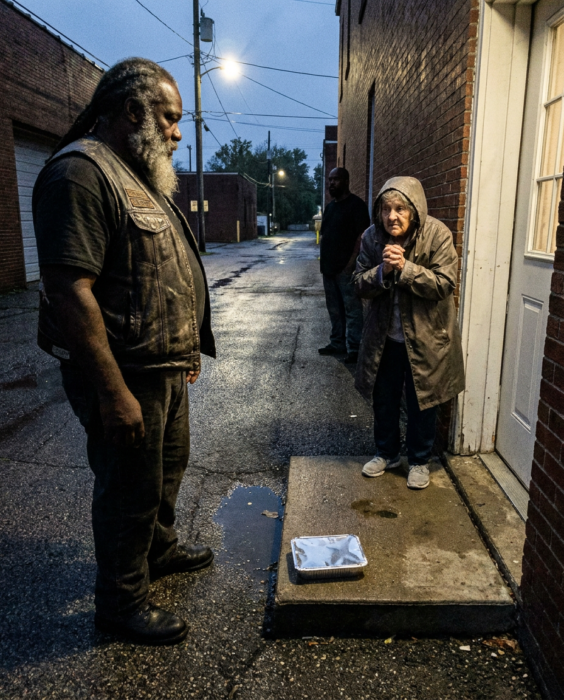
When she spoke his name, he backed away. She tried once more on another day, more softly. He did not recognize her, and her approach seemed to frighten him. With help from someone who knew the area, she learned that he accepted food when it was left at a distance. She began cooking an extra portion each evening.
“You could have asked someone closer to deliver it,” I said.
“Some nights somebody does.” She adjusted the bag on her arm. “I like to know he’s eaten.”
I regretted how the question had sounded. She was under no obligation to justify the walk to me. She had agreed to tell me because I had kept noticing, and because Thomas had seen me near the alley. What she wanted most was for me to understand how easily a well-meaning stranger could frighten him away from his regular supper.
At her gate she stopped and asked me not to tell people Thomas was her son. He had lived in town for years without anyone paying much attention to his name. She did not want curious visitors coming to look for him. I promised to keep it between us.
That night I told Cal only what she had allowed me to share: Mrs. Ward had known Thomas for a long time, and we needed to respect the distance she kept. Cal did not ask for more. He asked whether the crosswalk near her house had a working signal and whether the step stayed dry when it rained. The signal worked. The step did not always.
The next afternoon we checked the alley while Thomas was away. A broken downspout sent water across the far end during heavy rain. With permission from the building owner, Cal repaired it. He finished before Mrs. Ward made her evening trip and left no tools or new objects by the step. Thomas took his dinner at the usual time.
For several months that was the extent of our help. I watched for Mrs. Ward at the crossing. If she wanted company on the walk home, I went with her. Cal fixed a loose wheel on her shopping cart and drove her to a grocery store when she asked. We did not follow Thomas. Mrs. Ward, who had guarded the space around him for six years, began to trust that we would listen when she told us where to stop.
Then came a week of cold rain. Mrs. Ward developed a cough and spent two days in bed on her doctor’s advice. Her neighbor, Mrs. Alvarez, carried the dinners. On the first night Thomas did not take the container until nearly ten. On the second, he came only after Mrs. Alvarez had gone home.
Mrs. Ward called me both evenings. She wanted to know whether I had seen him. I could tell her when he picked up the food, but little else. I could hear how hard it was for her to remain at home while another person made the walk.
When she felt better, she returned to the alley. Thomas came out sooner. She saw him lift the container and said, “There you are,” so quietly I doubt he heard. On our walk back, she asked whether I thought there might be a way to offer him help without driving him away.
I had no useful answer. Cal didn’t pretend to have one either. He suggested speaking to people who worked with adults living outdoors and experiencing mental health difficulties. We asked Mrs. Ward first. She agreed to an introductory call, provided nobody approached Thomas that night or treated the dinner as a way to make him cooperate.
A local mental health outreach team listened to her account. They asked about Thomas’s habits, what made him comfortable, and what had happened when she had approached him years earlier. They explained that trust could take a long time. They could offer contact and services, but they would begin by meeting Thomas where he was, without taking away the choices he still made for himself.
Mrs. Ward invited the team to her kitchen. Cal and I sat with her while she showed them the photograph and a folder of older records. She had kept documents from the years she searched, even ones that had led nowhere. The team helped her identify which information might be useful and made a plan for brief, low-pressure visits near the places Thomas used.
Their first attempt lasted less than a minute. A worker introduced herself from a comfortable distance. Thomas walked away. She did not chase him. A few days later she came back at the same time and kept the conversation even shorter. Mrs. Ward asked me afterward whether the first visit had ruined everything. That night Thomas took his dinner. The following night he did too.
The club wanted to help. Some members offered blankets, rides, and food. Lena, who handled our charity events, reminded us that twenty men arriving with supplies would feel very different from one trained worker introducing herself. We asked the team what was useful. They accepted practical support for their program and told us when to leave the alley quiet. We left it quiet.
Cal struggled with that. He could take a broken part off a Harley and work on it until it fit. Here the useful work often consisted of waiting, checking whether Mrs. Ward got home safely, and asking the outreach team before doing anything new. I watched him stand across from the alley some evenings, his hands in his vest pockets, while Thomas circled the step. Cal would stay until the man picked up his dinner, then walk Mrs. Ward home.
After several weeks the outreach worker told Mrs. Ward that Thomas had begun answering simple questions. He had given his first name. He had also said he preferred people not to stand in his path. The worker respected that and asked permission before returning on later days. There was no sudden friendship. There were short conversations, long gaps, and days when he chose not to speak.
Mrs. Ward continued bringing supper. Once, from her place beside the wall, she saw Thomas exchange a few words with the worker before he took the container. She gripped my arm. “Did you hear him?”
I had heard only the sound of voices. She had been watching for signs that someone else could reach him. That night she walked home with more energy than I had seen in months.
Then Thomas disappeared for four days. His dinner sat on the step until it went cold. The outreach team checked the places where they had previously seen him and followed their usual process for locating a person they were concerned about. Mrs. Ward sat at her kitchen table with her coat on, ready to walk to the alley each evening despite knowing he wasn’t there.
On the fifth night he returned. He was tired and wanted space. The team let him have it. Mrs. Ward left the meal and waited twenty yards away. He took it after she reached the wall.
Her hands shook badly when she called me afterward. We stood outside the alley while she steadied her breath. I wanted to tell her he would stay now. I had no way to know that. Instead I walked beside her for the mile and a half home, stopping whenever she needed to rest.
It took eight months for Thomas to accept ongoing help from the outreach team.
That sentence makes the time sound smoother than it was. There were weeks when he spoke with the same worker twice and weeks when he declined every conversation. He accepted a clean pair of socks, then refused a coat. He asked where a day center was and did not go. Later he went on his own, stayed briefly, and returned another day. The team kept offering choices and checking what he wanted.
Mrs. Ward learned to let them tell her only what Thomas had agreed they could share. Being his mother did not give her every detail of his conversations. She found that hard, especially after years of knowing so little about where he was. She also understood that his trust in the workers belonged to him. When she worried, she cooked and carried the dinner as she always had.
Cal’s friendship with her deepened during those months. On Tuesdays he drove her to the grocery store. She chose ingredients while he pushed the cart and tried to remember which brand of rice she liked. She was particular about the rice. She was also quick to point out when he paid too much attention to the price of things she had already decided to buy.
He was imposing enough that people gave them plenty of room in the aisles. Mrs. Ward, small beside his leather vest, began introducing him as her friend Cal. He seemed startled the first time she said it.
I came to know her kitchen nearly as well as the alley. Tomatoes ripened on the sill in summer. A calendar hung beside the refrigerator, its squares filled with grocery trips, medical appointments, and small notes about Thomas: “Took dinner early,” “Rain—waited longer,” “Spoke to worker.” She had recorded years that way. Looking at the pages, I could see how carefully she observed him without stepping into his space.
One afternoon the outreach worker called with news. Thomas had said he wanted help sleeping somewhere indoors. The team discussed available services with him and arranged visits so he could see a place before deciding. He changed his mind twice. On the third visit he stayed long enough to talk with staff. The following week he agreed to begin treatment and move into a supported setting where he could receive care.
Mrs. Ward asked three times whether he had chosen it. The worker answered yes. Thomas had also asked what would happen to the alley dinner. Mrs. Ward pressed a hand to her mouth when she heard that. It was the first sign she had that he thought about the meal when it was not in front of him.
The night before his move, she brought rice, vegetables, and the chicken he most often seemed to eat. She put the container on the step at seven and walked back to her place by the wall. Thomas emerged sooner than usual. The outreach worker waited well away from both of them, available because Thomas had asked her to be nearby.
Thomas looked toward Mrs. Ward. She stayed still. He picked up the container, glanced at her again, and carried it behind the building. Mrs. Ward held the empty cloth bag against her chest. She had spent six years hoping he would come out. Now she was hoping he would go someplace where other people could help him too.
Cal was waiting at the corner. He asked if she wanted to walk home. She said she wanted another minute. The three of us stood there while traffic moved along the road behind us. Nothing more happened in the alley. At last she told us she was ready.
Treatment took time. Thomas had appointments, periods of rest, and setbacks that upset him. He could leave conversations when he needed to. The team helped him find routines he found useful. Mrs. Ward received occasional updates he had approved, and she sent messages through the workers when he was comfortable accepting them. She did not assume that living indoors meant he would recognize her, want a visit, or recover on anybody else’s timetable.
The first time he agreed to see her, she asked Cal to drive. She carried no food. That troubled her more than she expected. She had a small potted plant on her lap instead, chosen after a staff member mentioned that Thomas liked caring for the plants on the patio. It was a young basil plant, with three leaves large enough to brush when she moved the pot.
Thomas met her in a common room with a worker he knew. He looked at the plant before he looked at her. Mrs. Ward set it on the table between them. She said her name and that she was glad to see him. He nodded and touched one leaf. They sat together for twelve minutes. When he got up, she did not ask him to stay.
On the drive home she told Cal she had forgotten what his voice sounded like from close by. Cal kept his eyes on the road and let her talk when she wanted. At seven that evening, Mrs. Ward sat at her own kitchen table. For the first time in six years, she did not have an alley dinner to carry.
Visits continued when Thomas wanted them. Some were brief. In others he asked Mrs. Ward about the garden in her photograph, or told her which plants he was helping water. She answered what he asked. If he seemed uncomfortable with a memory, she moved on. Their conversations were neither a return to the young man in the picture nor a simple beginning. They were new conversations between the people sitting in the room.
At seven each evening, Mrs. Ward still glanced at the kitchen clock. During the first month she sometimes set out two plates before remembering where Thomas was. Then she began sending a small container of cookies to the staff for everyone to share, after checking that it was welcome. It gave her hands something familiar to do. She called Cal less often at that hour, but when she did, he answered.
Thomas grew fond of the patio. He was given a few plants to tend, then more after he showed how carefully he noticed dry soil and damaged leaves. The work suited him. Some mornings he did a little and went inside. On others he stayed out until lunch. Staff made sure he could choose his pace.
Mrs. Ward brought photographs of gardens they had kept at different houses. Thomas recognized some details: a fence with a crooked board, a row of pots along a porch, a tomato plant he had tied to a stake. He did not always connect those places to Mrs. Ward. She was glad he enjoyed looking.
Cal came to one visit at Thomas’s invitation. Mrs. Ward had told him about her large friend who rode a Harley, and Thomas had wanted to see what such a person looked like. Cal wore an ordinary work shirt rather than his vest. He sat where Thomas could leave easily and said hello. Thomas asked about the motorcycle. They discussed the weather, the condition of the roads, and whether plants could survive exhaust near a busy street. After twenty minutes Thomas returned to his watering.
“He’s got opinions,” Cal said as we walked out.
“He always did,” Mrs. Ward answered.
Fourteen months after Thomas began treatment, a worker called Mrs. Ward about a visit he had requested. Cal drove her over on a bright afternoon. I met them there. She carried the old garden photograph in its paper sleeve, though she decided to leave it in her handbag unless Thomas asked for it.
He was on the patio repotting a plant. He took his time finishing, brushed soil from his hands, and sat across from her. They spoke about the basil she had brought months earlier. It had grown tall and needed a larger pot. Mrs. Ward asked whether he wanted a cutting from the plant on her kitchen sill. He said perhaps.
Then he looked at her for a long time.
“Mom?” he said.
Mrs. Ward gripped the arms of her chair. “Yes, Thomas.”
He reached toward her hand and stopped, leaving her room to decide. She rested her fingers over his. Cal and I remained near the patio door. The worker stayed seated at another table. No one interrupted them.
Later, Mrs. Ward told me she remembered the soil beneath Thomas’s nails and the warmth of his hand. She had imagined the word “Mom” during six years of walks to the alley, but when it came, she was thinking about basil and whether she had remembered to water her own plant before leaving home.
Thomas did not call her Mom at every visit afterward. Some days he seemed sure of their connection. On others he needed her name again or preferred to talk about plants. Mrs. Ward treated the moment on the patio as a gift he had given her, not something she could ask him to repeat. She kept arriving when he welcomed a visit, and she kept learning what he liked now.
Three years later, Mrs. Ward died at seventy-nine. Thomas was living in a supported home by then and working with the plants there. He had visited her house several times with help from people he trusted. On his last visit she had been tired, so they sat on the porch and watched the light change over the small garden. He told her one of the tomato plants needed a firmer stake. She agreed.
After her death, Cal and I helped clear the kitchen. I found a stack of calendars tied with string, covering the years she had carried supper. On one early page she had written, “Thomas took the rice.” On a later one: “Stayed where he could see me.” The entries were brief, sometimes no more than a check mark. They filled the squares month after month.
I took the calendars to Thomas after asking whether he wanted them. He chose to keep two, one from the first year and one from the last. He ran his thumb over his mother’s handwriting and asked if we would keep the others safe for him. Cal made a box for them at the garage, where Daniel the carpenter—another member of our club—fitted a lid that closed without catching the paper.
Thomas returned to the alley one evening with a support worker. It was his idea. He wanted to see the step where the dinners had waited. He had not been back since moving indoors, and nobody knew whether the place would feel familiar or upsetting until he got there. The worker arranged the visit around his wishes and stayed nearby.
Cal and I were across the street. Thomas asked us to come over, so we did. He looked at the repaired downspout, the old brick wall, and the corner where he used to disappear with the container. He stood beside the step for several minutes. There was no dinner on it.
“Was she over there?” he asked.
I showed him the place twenty yards away where Mrs. Ward had always waited. He walked toward it, stopped halfway, and looked back at the step. The distance seemed different when he crossed it himself.
“She came every night?”
“As many as she could,” I said. “Mrs. Alvarez came when she was sick.”
Thomas nodded. We did not ask him what he remembered. Some parts of those years belonged to him and might never become a story he could tell us. He sat on the step for a while. At seven o’clock he stood, said he was ready to go home, and walked to the car with the worker.
After that he sometimes asked to visit at seven. The trips were occasional, planned with the people supporting him. He sat on the old step for a few minutes and watched the street. Once he brought a small potted plant, checked whether it would get enough light there, and decided it would be better off at home. He took it back with him.
The alley itself changed. The vacant building was repaired and rented. A new owner swept the step and kept the downspout clear. Cal explained why we sometimes saw Thomas there, sharing only what Thomas had said we could. The owner told us he was welcome to sit.
Our club still helped the mental health outreach team with practical requests they made for their program. We had learned to ask first, then do the job they actually needed: a lift for supplies, repairs to a day room, extra hands at a community garden. Some of the riders came to know Thomas through that garden. He showed Vince how to tell whether a plant needed water by feeling the soil below its surface. Vince had been watering his own porch plants by the calendar and admitted Thomas’s method worked better.
Cal visited Mrs. Ward’s grave from time to time. He usually brought no flowers. He would straighten a fallen decoration, clear leaves from the name, and tell me afterward if the grass needed cutting. Thomas chose when he wanted to go. On one visit he brought a cutting from the basil plant Mrs. Ward had given him. He and a staff member found a suitable place for it at home afterward, where he could care for it.
I still lived above the tire shop. At seven, I could often hear traffic from my window and see the alley step if I leaned out far enough. For years I had watched Mrs. Ward make her way to it with both hands around a hot container. After she stopped coming, I found myself checking the time anyway.
One evening Thomas was there when I came home. He sat on the step in a clean jacket, waiting for his ride. I parked the Harley well away, switched off the engine, and asked if I could sit nearby. He said yes. We watched a bus pass at the end of the road. Then he told me a plant at the supported home had produced its first flower that morning.
“What color?” I asked.
“Yellow,” he said. “She would’ve liked it.”
Cal kept Mrs. Ward’s old cloth food bag in a drawer at the garage. She had given it to him after Thomas moved indoors, saying it was too worn to carry groceries but too good to throw away. The handle had been mended twice. Cal used it to store a pair of work gloves and the small notebook in which he wrote reminders for our outreach projects.
I once asked why he kept that bag instead of buying a stronger one. He held up the mended handle and said it still did its job. Then he returned it to the drawer and went back to the motorcycle on the lift.
Thomas worked with plants several days a week. Some seasons he had more energy; in others he took on less. He chose which visits he wanted and whom he wanted to see. Mrs. Ward had worried for years about what would happen if she could no longer carry supper. She had not lived to see every day that followed, but she had met the people who now helped him find his own routines.
On the anniversary of her death, Thomas asked Cal and me to meet him at the alley. We arrived a little before seven. Thomas was already seated on the old step with his support worker nearby. He had brought a photograph from the box of calendars: himself as a young man beside Mrs. Ward in her garden.
He showed it to Cal, then handed it to me. I had seen it before, beneath the streetlight on the night she finally told me why she made the walk. Thomas looked at the photograph for a while after I returned it. At seven he slid it carefully back into its paper sleeve.
Across the street was the brick wall where she used to wait. Thomas rose and walked toward it. Cal and I stayed by the step until he turned and waved us over. We joined him there, twenty yards from the place where she had left his dinner.
Follow this page for more biker stories about the people our rides bring us beside, the trust they ask us to earn, and the lives that continue beyond one remarkable moment.