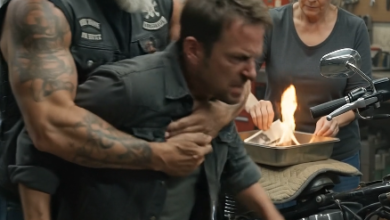
An 82-Year-Old Woman Slapped a Biker at a Route 66 Gas Station—Then She Recognized Her Son’s Leather Jacket and the Promise Carried 912 Miles Home
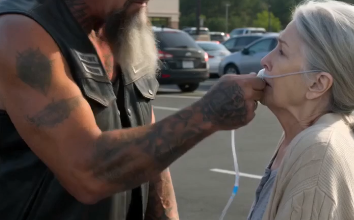
The eighty-two-year-old woman slapped me so hard my glasses struck the pavement, but when she grabbed the collar of my leather jacket, her anger vanished—and she began calling me by her dead son’s name.
Nobody moved.
The afternoon wind pushed a paper cup across the Route 66 gas station while six fuel pumps clicked around us. A trucker froze beside his cab. The teenage cashier pressed both hands against the window, and three customers raised their phones because that is what people do when a tattooed biker towers over an elderly woman.
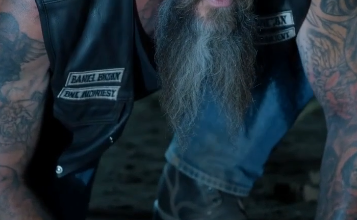
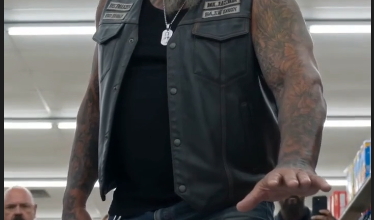
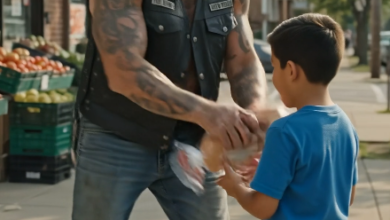
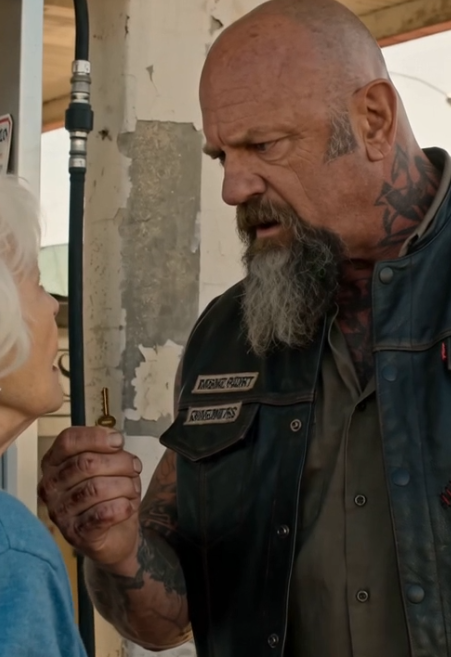
My name is Nathan “Rook” Mercer. I am fifty-six years old, six-foot-four and broad enough to make strangers step aside before I ask. My beard reaches my chest, my left eyebrow carries an old scar, and black ink covers my neck, arms and knuckles.
I had ridden 912 miles from Dayton, Ohio, on a black Harley touring bike.
I had not come to frighten anyone.
But the woman standing before me did not know that.
She wore a faded blue cardigan despite the Oklahoma heat, white orthopedic shoes and a plastic name badge that read ELEANOR. Her hand trembled after striking me, though her pale eyes remained fierce.
“Where did you get that jacket?” she demanded.
I could have answered immediately.
Instead, I bent down, picked up my glasses and wiped the dust from one lens. Behind Eleanor, the gas-station manager reached for the phone while a stocky customer moved closer, ready to intervene.
The leather creaked when I straightened.
The jacket was older than mine. Its surface had softened at the shoulders, the right pocket had been repaired with dark red thread, and an empty circle remained where a patch had once been removed.
Eleanor touched that circle.
Her fingers knew exactly where to go.
“My boy wore this,” she whispered.
Then she grabbed both sides of the jacket and pulled herself against my chest.
The same people who had expected a confrontation now watched an eighty-two-year-old woman hold a stranger like she had been waiting half her life to do it.
I kept my hands at my sides.
I had imagined this moment during every mile through Indiana, Missouri and the long Oklahoma heat. I had rehearsed what Michael “Mick” Whitaker asked me to say.
None of those words survived her embrace.
Eleanor pressed her face against the leather and breathed in gasoline, road dust and thirty-four years of memory. Then she stepped back and searched my face.
“Is he outside?”
That question nearly folded me.
I looked past her toward the old highway, where heat shimmered above the asphalt and my Harley stood alone beside pump six.
“No, ma’am.”
Her grip tightened.
“Then why are you wearing his skin?”
I reached inside the jacket, but the manager came through the door and told me to keep my hands visible. Two customers moved between Eleanor and me while someone said the sheriff was coming.
I stopped.
“Mrs. Whitaker, there’s something sewn inside this lining.”
She stared at me as if I had spoken from the bottom of a grave.
Only three people knew about that hidden pocket.
Eleanor.
Her son.
And now me.
Her fingers found the uneven red stitches beneath my left arm. She began opening them with the small silver pin from her name badge while everyone around us waited.
The first thing she pulled out was an old brass key.
The second was a sealed letter addressed in her son’s handwriting.
But beneath both objects rested a folded document bearing the name of the gas station where we stood—and when Eleanor saw the signature at the bottom, she struck my chest once with her fist and whispered:
“He came back.”
Want to know what Michael hid inside the jacket and why I carried it 912 miles instead of mailing it? Drop JACKET in the comments — I’ll share more soon.
I met Michael “Mick” Whitaker eighteen years before I rode into Bellford, and at the time I was the kind of man people were right to avoid.
I had served three years in prison for burglary, lost my marriage before the sentence ended and spent my first winter outside sleeping in a storage unit behind a Dayton motorcycle shop. I owned two shirts, a pair of work boots and a drinking problem I called temporary.
Mick owned the shop.
He found me one February morning curled beside a broken compressor, wearing a thin denim jacket while snow collected beneath the loading door. He was forty-seven then, lean and hard from years of turning wrenches, with sandy hair going gray and hands stained permanently by oil.
He did not ask for my story.
He threw a leather jacket at me.
“Shop opens in twelve minutes,” he said. “You sleeping or working?”
I worked.
The jacket hung loosely because I had lost thirty pounds inside, but it kept the cold from my bones. The right pocket had been repaired with dark red thread, and I noticed the initials beneath the collar on my first day.
M.W.
When I tried to return it that evening, Mick shook his head.
“You return things when you’re done needing them.”
He gave me minimum wage, a broom and one rule: arrive sober.
I failed on the fourth day.
Mick found a bottle inside my backpack and placed it on the workbench. He did not shout or threaten to call my parole officer. He opened the cap, poured the whiskey into a drain pan and handed me the broom.
“Again,” he said.
I failed twice more that year.
Each time, he gave me the same word.
Again.
Mick never wore club colors, though every motorcycle group in Montgomery County knew him. He repaired touring bikes for widowers, commuters, veterans and young riders who had purchased machines they could barely afford. If a customer lacked money, he accepted groceries, carpentry or a promise.
Most people kept their promises to Mick.
The Iron Lantern Riders formed around his shop without anyone officially deciding it. Men came for repairs, stayed for coffee and began calling one another when somebody broke down.
I became Rook because Mick said I moved only in straight lines, usually toward trouble.
He became the brother who stood in the way.
When I reached one sober year, he took the leather jacket from a hook and pushed it across the workbench.
“Fits you now.”
“It’s yours.”
“Not anymore.”
I noticed his hand linger over the repaired pocket.
“Who fixed this?”
“My mother.”
That was the first time he mentioned Eleanor.
He gave me no details. Mick could rebuild a transmission while explaining every worn tooth and damaged bearing, but anything involving Oklahoma made him silent.
Over the next decade, I learned his story in fragments.
He had grown up behind Whitaker’s Service, pumping fuel before his feet reached the ground from the office chair. Eleanor kept accounts, repaired uniforms and ran the station whenever her husband disappeared for days.
Michael’s father, Earl Whitaker, was a hard man who believed fear and respect were the same thing. He drank from a coffee mug that never contained coffee and treated his son like unpaid labor.
Mick learned engines to remain useful.
Eleanor learned silence to keep the household standing.
When Mick was twenty-one, four thousand dollars vanished from the station’s payroll envelope. Earl accused him. Eleanor discovered the empty envelope beneath Michael’s bed and believed what she saw.
Mick denied taking it.
Earl told him to leave.
Eleanor did not stop him.
That was the wound.
Not the accusation.
The silence.
Michael rode away on a secondhand Harley with the leather jacket his mother had sewn for his twenty-first birthday. At the end of the driveway, he looked back once.
Eleanor stood beneath the station awning.
Neither lifted a hand.
For thirty-four years, both remembered that moment differently. Eleanor believed her son chose the road over his family. Mick believed his mother had chosen Earl’s accusation over him.
Pride kept the distance open.
Shame kept it deep.
Mick built a life in Ohio. He married briefly, divorced gently and had no children. He created a family out of mechanics, customers and damaged men who needed somebody to say “again.”
I was only one of them.
Doc had returned from Afghanistan unable to remain indoors for long. Bear had lost his construction job and nearly his house. Luis “Sparks” Alvarez came to the shop after his father died and barely spoke for six months.
Mick gave each man work.
Then he made us give work to the next one.
That was his version of brotherhood.
Not matching patches.
Not loud promises.
A hand reaching backward.
Seven years before Michael died, a letter arrived from Oklahoma.
He was away collecting parts, so I placed it beside the register. The envelope bore Eleanor’s name and the gas-station address.
Mick stared at it for nearly a minute when he returned.
Then he locked it inside his toolbox.
“You going to answer?”
“No.”
“Why not?”
“Because thirty years is a long time to choose the right words.”
The following morning, the letter remained unopened.
A week later, it disappeared.
I assumed he had thrown it away. I was wrong.
Around that time, Mick began taking repair jobs none of us understood. He stopped replacing equipment in the shop. He sold his restored 1978 Harley and started riding a plain black touring model with more miles than value.
Money moved somewhere.
He never explained where.
Then he asked me to teach him online banking.
Mick distrusted anything without gears. Watching him use a laptop was like watching a bear attempt needlework, but every month he transferred money to an Oklahoma account.
The description read only W.S.
Whitaker’s Service.
I asked once.
He closed the screen.
“Some debts get interest.”
I thought he meant the missing payroll money.
What none of us knew was that Earl Whitaker had confessed before dying. Michael had never stolen the four thousand dollars.
Earl had gambled it away.
He had hidden the empty envelope beneath his son’s bed, then let Eleanor drive Michael from the only home he knew.
Eleanor learned the truth beside Earl’s hospital bed. By then, Michael had changed addresses, phone numbers and jobs so many times that she could not find him.
She wrote to old motorcycle shops. Most letters returned unopened.
One finally reached Dayton.
Inside, she had written three sentences:
I know you did not take it.
I should have believed you.
The station door is still yours.
Mick opened that letter alone.
He never answered it.
Not because he hated her.
Because forgiveness terrified him more than anger.
If Eleanor still blamed him, he could remain the wounded son. If she apologized, then he had to face the years both of them had wasted.
So he chose a different language.
Money.
Whitaker’s Service had been declining since the new interstate pulled travelers away from old Route 66. The roof leaked, two pumps failed inspection and overdue property taxes accumulated.
Mick began paying them through a lawyer.
When the station’s bank loan was sold, he purchased the debt anonymously. When Eleanor needed a new fuel tank, the same quiet company financed it. She believed a local preservation fund was helping keep the business alive.
The fund was Michael.
He called it Red Thread Holdings because of the stitching on his jacket.
For seven years, Mick bought his way back toward a building he could not bring himself to enter.
Then his hands began shaking.
At first, he blamed too much coffee. Soon he dropped sockets, forgot familiar part numbers and sat down after climbing the shop stairs.
Doctors found an aggressive neurological disease.
They gave him perhaps eighteen months.
Mick told no one for eleven.
By the time we understood, the man who had held our brotherhood together could no longer button his work shirt without help.
We were furious.
Bear shouted that brothers deserved the truth. Sparks kicked a trash can across the garage. I stood beside Mick’s chair and demanded to know why he had hidden it.
Mick waited until the room went quiet.
“You all had roads to ride.”
“So did you.”
“Mine got shorter.”
That ended the argument.
For the next seven months, the Iron Lantern Riders ran the shop. Bear handled customers. Sparks repaired electrical systems. Doc organized medication and appointments.
I stayed with Mick at night.
He refused a hospital bed until the last three weeks. Even then, we placed it inside the garage office where he could smell motor oil and hear tools striking concrete.
One night, he pointed toward my jacket.
“Take it off.”
I laid it across his blanket.
His fingers found the red stitching on the right pocket. Then he asked for a seam cutter, a needle and the small metal box from his safe.
“What are you doing?”
“Finishing a delivery.”
His hands no longer had the strength to sew, so he directed me. Inside the lining, we placed Eleanor’s unopened letter, the brass key to the station’s rear garage and the final ownership documents for Red Thread Holdings.
There was also a photograph.
It showed twenty-one-year-old Michael standing beside Eleanor beneath the station awning. His new leather jacket looked stiff and shiny, and Eleanor held the unfinished sleeve while laughing at something outside the frame.
On the back, she had written:
For every road that brings you home.
Mick had carried that photograph for thirty-four years.
The last object was a digital voice recorder.
“I want you to take the bike,” he said.
“To Oklahoma?”
“Nine hundred and twelve miles.”
“You measured it?”
“Every year.”
That stopped me.
Inside his desk, I found seven printed routes from Dayton to Bellford. Each carried a different date. Each ended at the same gas station.
Mick had planned the journey seven times.
He had never made it farther than Missouri.
“Why me?”
“Because you return things.”
The jacket.
The trust.
The dignity he had handed me when I owned none.
I understood.
“When?”
“After.”
“No.”
“Rook.”
“I’ll take you now.”
His eyes remained steady.
His body could no longer survive two hours in a car, much less the journey to Oklahoma. We both knew it.
“After,” he repeated.
Then he reached for the collar and closed his fist around the leather.
“Wear it. Don’t fold it into a box.”
“Why?”
“So she’ll know it made the road.”
Michael died at 3:16 on a Tuesday morning while rain tapped against the garage windows.
There was no speech.
No final dramatic confession.
He squeezed my wrist once, looked toward the jacket hanging beside the door and stopped breathing.
The shop seemed louder after he died. Every compressor hiss, dropped wrench and ringing telephone felt wrong because Mick was no longer there to answer it.
We buried him in Ohio beneath a plain stone bearing his name and two dates. Twenty-three motorcycles escorted the hearse, but nobody revved an engine at the cemetery.
Afterward, the brotherhood divided.
Bear believed the jacket should hang inside the shop. Sparks wanted it placed in a display case with Mick’s tools. Doc argued that we should ship the documents to Eleanor and spare her the shock of a stranger arriving in her son’s clothes.
I understood every argument.
I ignored them all.
“His last request was Oklahoma.”
Bear planted himself between me and the door. He was sixty-one, six-foot-three and shaped like a refrigerator wrapped in denim.
“That cut belongs here.”
“It belonged to his mother first.”
“We’re his family.”
“So is she.”
“Was.”
That word nearly broke the club.
Sparks shoved a chair aside and walked out. Doc removed his vest and placed it on the table. Two members said they would not support the trip.
Brotherhood sounds noble until grief asks who owns the dead.
Then it becomes a courtroom.
I did not win the argument. I simply left before sunrise.
The black Harley carried a small tool roll, two shirts and Michael’s ashes in a steel container inside the saddlebag. Eleanor did not know I was coming.
Neither did the others.
For the first two hundred miles, anger kept me warm. Indiana flattened beneath a gray sky while the engine settled into the steady rhythm Mick had tuned by ear.
Near Effingham, Illinois, the rain arrived.
It pushed across the highway in silver sheets and hammered the leather until the red stitches darkened. I stopped beneath an overpass and checked the hidden pocket.
Dry.
My phone held eleven missed calls.
Bear left no message until the twelfth.
“You don’t bury a brother twice.”
I almost turned back.
Then another sound rose beyond the rain.
V-twins.
Bear emerged first, followed by Sparks, Doc and nineteen Iron Lantern riders. Their headlights appeared through the weather one by one until the shoulder glowed behind me.
Bear shut off his engine and removed his helmet.
“You ride too fast when you’re mad.”
“You said the jacket belonged in Ohio.”
“I was wrong.”
That was the longest apology Bear had ever given.
The brotherhood had been tested.
It came anyway.
We crossed Missouri together, twenty-three motorcycles carrying one dead man’s unfinished journey. At fuel stops, strangers asked where we were going.
“Home,” Bear answered.
Outside Springfield, we encountered a fallen tree blocking the old highway. We could have returned to the interstate, but Michael’s printed route followed Route 66.
So we waited while county workers cleared one lane.
At dawn, we drank bitter gas-station coffee beside our machines. Nobody spoke much. The leather on my shoulders smelled of rain and age.
Sparks noticed something beneath the collar.
A small piece of white paper had slipped through a tear in the lining.
We opened the seam carefully and found a list written by Michael.
Twenty-three names.
Every biker traveling with me appeared on it.
Beside each name, Mick had recorded a date and a short sentence.
BEAR — KEPT HIS HOUSE.
DOC — FIRST FULL NIGHT OF SLEEP.
SPARKS — OPENED HIS OWN TOOLBOX.
ROOK — RETURNED THE BOTTLE.
Michael had kept track of the moments we came back to ourselves.
At the bottom, he had added:
THEY WILL ARGUE. THEY WILL COME.
Even dead, the man knew us.
We reached Bellford at 4:31 the following afternoon.
The other riders stopped two blocks from Whitaker’s Service. Michael had asked me to approach alone.
Twenty-three engines went quiet behind an abandoned diner.
I rode the final distance wearing his jacket.
Eleanor stepped outside with her bucket.
Then she slapped me.
The deputy who arrived at the station was named Caroline Shaw, and she had known Eleanor since childhood.
She listened to the manager, looked at my face and asked whether I wanted to press charges.
“No.”
Eleanor still held Michael’s letter.
“He stole my son’s jacket,” she said, although her voice no longer carried certainty.
“He gave it to me eighteen years ago.”
“Michael never gave away anything he loved.”
“That isn’t true, ma’am.”
I removed the key to my Harley and placed it on the pump beside us.
“He spent his life giving things away.”
The deputy asked everyone to step back. Phones lowered slowly, though nobody left.
Eleanor opened Michael’s letter.
Her eyes moved across the first line and stopped. She tried again, but the paper shook too badly.
“Read it,” she told me.
“That belongs to you.”
“My eyes aren’t working.”
We both knew her eyes were not the problem.
I unfolded the letter.
Mom,
I made Rook wear the jacket because you would recognize your stitches before you trusted his face. If you slapped him, he was warned. If you hugged him, try not to crush his glasses. He only has one good pair.
A small sound escaped Eleanor. It was almost a laugh.
Almost.
I continued.
I received your letter seven years ago. I knew the truth about the payroll before Earl died because Danny found me in 1998 and confessed. He took the money. I kept quiet because he had a baby and Earl would have sent him away too.
The revelation moved through Eleanor slowly.
Michael’s younger brother, Danny, had died twenty years earlier. She had buried him believing he had remained the loyal son while Michael carried the blame.
Mick had protected him even after losing everything.
“I accused the wrong boy,” Eleanor whispered.
“He stopped being a boy a long time ago,” I said. “But he never stopped being yours.”
The letter continued.
I wanted to answer you. Every year I planned the ride, and every year I found a reason to turn around. Anger was easy, Mom. Coming home was harder.
I cannot make up thirty-four years with paper, so I did what you taught me. I repaired what I could reach.
The station is yours. No bank owns it. No taxes are due. The key opens the rear garage because there is something inside that belongs to Rook and the brothers who brought me home.
Eleanor lowered herself onto a bench beside the office.
I handed the ownership documents to Deputy Shaw, who examined the pages and confirmed the signatures appeared notarized. Red Thread Holdings owned the station’s debt, land and remaining equipment.
Michael had transferred everything to Eleanor three days before his death.
The manager stared at the legal papers.
“The preservation fund was him?”
“All seven years,” I said.
Eleanor covered her mouth.
Every repaired pump.
Every paid tax bill.
Every anonymous envelope that prevented the station from closing.
Her son had been coming home one payment at a time.
I offered her the brass key.
She refused to take it.
“Open the garage.”
We walked behind the station while customers followed at a respectful distance. The rear building had not been used for years. Sand had gathered beneath the door, and rust covered the padlock.
The key turned.
Inside waited darkness, dust and the dry smell of old rubber.
Deputy Shaw found a switch.
Fluorescent lights flickered above a motorcycle covered with a gray canvas sheet.
Eleanor stopped in the doorway.
I pulled away the cover.
Beneath it stood a restored 1972 Harley-Davidson FLH, black with a narrow cream stripe along the tank. Michael had located the machine in Kansas six years earlier.
It was his first motorcycle.
The one he had ridden away from Bellford at twenty-one.
He purchased it from the third owner, rebuilt it in Dayton and quietly shipped it to the gas station two months before his death. The manager had been paid to keep the garage locked.
Eleanor walked toward it.
Her hand settled on the passenger seat.
“I rode there once,” she said.
“Where?”
“Three miles. He scared me half to death.”
For the first time, I could see Michael in her smile.
A photograph had been tucked beneath the seat strap. In it, Eleanor sat behind her young son, both of them laughing as the motorcycle leaned on its stand.
She pressed the picture against her cardigan.
“Where is he?”
I removed the steel container from my saddlebag.
The room changed.
Eleanor understood before I spoke.
Her knees weakened, and I caught her beneath the arms. She did not scream. She placed both palms against the container and bowed until her forehead touched the metal.
“I was waiting,” she whispered. “Tell him I was waiting.”
“He knew.”
“No. He didn’t.”
“He did, ma’am.”
I removed the digital recorder from the jacket.
Michael’s final message lasted forty-eight seconds.
His voice sounded thin, but it remained unmistakably his.
“Mom, if you’re hearing this, Rook got lost fewer times than I expected. Don’t blame him for the jacket. I made him wear it.”
Eleanor laughed through her tears.
“I should’ve come sooner. That part’s mine. You should’ve believed me. That part was yours. We can argue about the rest when you catch up.”
The recorder went quiet for three seconds.
Then Michael spoke again.
“Keep the light over pump six burning. I always looked for it.”
Eleanor held the recorder against her chest.
Outside, twenty-three engines started together.
The sound moved through the thin garage walls like distant thunder.
She turned toward me.
“Are those his brothers?”
“Yes.”
“All of them?”
“Everyone on his list.”
“Bring them here.”
The Iron Lantern Riders entered the station yard in two slow lines, engines idling low before shutting down beside the old pumps.
Eleanor stood beneath the awning wearing Michael’s jacket.
It hung nearly to her knees.
Bear removed his helmet first. His expression collapsed when he saw the tiny woman inside the leather he had fought to keep in Ohio.
He approached and lowered his head.
“Ma’am, I’m Bear.”
Eleanor examined his beard, tattoos and scarred hands.
“You wanted to steal my jacket.”
Bear looked at me.
I had told her everything.
“Yes, ma’am.”
“Michael wrote about you.”
That unsettled him more than anger would have.
“What did he say?”
“That you complain before doing the right thing.”
Sparks laughed so hard he had to turn away.
Eleanor met every rider. She knew our names from Michael’s hidden list, and with each introduction she learned another piece of the life her son had built beyond Oklahoma.
Doc told her about the nights Michael sat outside his house until he could sleep.
Sparks described the first toolbox Mick gave him.
Bear told her about nearly losing his home and finding an envelope of mortgage money taped beneath his motorcycle seat.
When my turn came, I kept it short.
“He gave me the jacket.”
Eleanor shook her head.
“No. He gave you another chance.”
She was right.
That evening, we reopened the station garage. Bear repaired the rear door. Sparks tested the wiring. Doc climbed onto the roof despite everyone telling him not to.
The teenage cashier brought sandwiches. Deputy Shaw returned off duty with coffee and a folder explaining how Eleanor could record the property transfer.
Nobody planned the work.
Bikers rarely do when the job is obvious.
We stayed four days.
One group repaired the broken fuel pump. Another painted the awning in its original white and blue. I replaced the lights above pump six and installed a new fixture bright enough to be seen from the highway.
Eleanor supervised from a folding chair.
She accepted no excuses.
On the third afternoon, she carried Michael’s ashes into the rear garage and placed the container on the seat of his restored Harley.
“What did he want?” she asked.
“He left that part to you.”
She considered the old highway beyond the doors.
Then she smiled.
“He always hated staying in one place.”
The following morning, Eleanor climbed onto the passenger seat behind me. She wore Michael’s jacket, a borrowed helmet and an expression that warned everyone against commenting on her age.
Twenty-three motorcycles waited outside.
We rode three miles west along Route 66, the same distance she had traveled behind Michael when he was twenty-one.
At a small rise above Bellford, we stopped beside a field of dry grass. Eleanor opened the container and released half the ashes into the Oklahoma wind.
They drifted toward the road.
She kept the rest.
“He still owes me an argument,” she said.
We did not laugh.
Some sentences are too honest for laughter.
When we returned, she hung the leather jacket inside the station office beneath the photograph of herself and Michael. The ownership papers went into a fireproof box.
The brass key remained around her neck.
Before we left Oklahoma, Eleanor handed me another jacket.
It was plain black leather, old but carefully maintained. The shoulders fitted almost perfectly.
“This belonged to Earl,” she said.
I hesitated.
“I don’t want his jacket.”
“Good. Neither do I.”
She placed a spool of dark red thread in my palm.
“Make it yours.”
That evening, she repaired the right pocket while I sat across from her at the station counter. Her hands moved slowly, but every stitch held.
When she finished, she pressed two initials beneath the collar.
N.M.
Then she added one short line of red thread beside them.
“Why red?”
“So you remember where home is.”
One year later, I rode back to Bellford.
This time, nobody followed me.
I wanted the last 912 miles to belong only to Eleanor, Michael and the promise that had finally reached its address.
Whitaker’s Service looked different from the highway. The pumps carried fresh paint, the windows were clean and three motorcycles stood outside the reopened garage.
The light above pump six burned even in daylight.
Eleanor was eighty-three and still working behind the counter. She had hired two young mechanics through a reentry program Michael once supported in Ohio.
One had recently left prison.
The other was six months sober.
I recognized the pattern.
Eleanor recognized my jacket.
“You kept the stitches.”
“Yes, ma’am.”
“You get lost?”
“Twice.”
“Michael said fewer than three counts as improvement.”
She poured two cups of coffee and placed one beneath the photograph on the wall. Michael’s leather jacket hung beside it, polished but not restored. Eleanor had left the cracked shoulders, faded patch circle and uneven red pocket exactly as they were.
The jacket had earned its miles.
Every October, riders from Ohio returned to Bellford. Some came because they knew Michael. Others came because they had heard about the old woman who slapped a biker and then made his entire club repair her gas station.
Eleanor corrected that version whenever she heard it.
“I didn’t make them,” she would say. “My son did.”
At sunset, she unlocked the rear garage.
Michael’s restored Harley waited beneath the lights. We rolled it outside, checked the fuel and started the engine.
The old V-twin coughed twice.
Then it settled.
Eleanor stood beside the machine with one hand on its seat. The sound filled the station yard, bounced from the garage wall and traveled toward the highway.
For a moment, she closed her eyes.
I knew what she heard.
A twenty-one-year-old son at the end of the driveway.
A motorcycle preparing to leave.
Words neither of them knew how to say.
This time, Eleanor lifted her hand.
So did I.
The light above pump six came on as evening settled over Route 66. It shone across Michael’s jacket inside the window and caught every crooked line of red thread.
He had made it home.
Follow this page for more unforgettable biker stories about misunderstood riders, unfinished promises and the quiet acts of brotherhood waiting beyond the next mile.