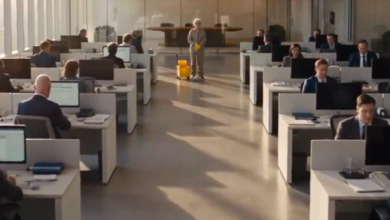
Part 2: A Young Woman at a Law Firm Was Mocked for “Only Making Coffee” for Two Years — Then Her Name Appeared on the Screen as Lead Attorney for the Biggest Case of the Year
At first, no one moved.
The words on the screen seemed too simple to be misunderstood, yet half the room kept staring as if another explanation might arrive and rescue them.
Emma Rivera, Esq.
Not assistant.
Not coordinator.
Not support staff.
Attorney.
Mason blinked twice, then looked toward the managing partner, Charles Whitman, as though this had to be an error.
Emma set the tray down on the side table.
Not dramatically.
Carefully.
The same way she had always done everything in that building.
Charles cleared his throat. “For those who haven’t worked directly with Ms. Rivera, she joined us two years ago under a confidential litigation review contract.”
The room shifted.
A few associates exchanged confused looks.
Mason’s jaw tightened.
Emma stood near the wall, hands folded in front of her, expression calm enough to make everyone else feel exposed.
Charles continued, “She was brought in after the Caldwell case showed signs of internal document tampering and witness intimidation. Her assignment was to observe workflow, review discovery movement, and identify vulnerabilities.”
That was the first crack.
Emma had not been ignored by accident.
She had been watching from the exact place where people thought she was invisible.
A junior lawyer named Hannah slowly lowered her pen.
“You mean she was undercover?” someone asked.
Emma finally spoke.
“Not undercover,” she said. “Just underestimated.”
That line did not land loudly.
It landed cleanly.
Charles nodded toward the screen, and the next slide appeared.
It contained dates, document access logs, and email chains. Nothing flashy. Just evidence arranged with brutal clarity.
Emma stepped forward and picked up the presentation remote.
Her voice was steady.
“In March, an early draft of our defense memo left the internal server eighteen minutes after it was printed in Room 4B. The partner review copy never reached Mr. Whitman’s desk.”
Several faces changed.
“In April,” Emma continued, “a confidential witness list was referenced by opposing counsel before our filing deadline.”
The room grew colder.
People who had mocked her now began remembering every time they spoke freely near her. Every complaint. Every careless joke. Every private detail said over coffee they assumed she was too unimportant to understand.
Then came the second twist.
Emma turned to Mason.
“You asked me to print twelve exhibits on May 6,” she said. “Then told me not to mention it because partners were ‘too slow to approve strategy.’”
Mason sat straighter.
“I don’t remember that.”
Emma clicked again.
A scanned sticky note appeared on the screen.
His handwriting.
His initials.
His instruction.
The room seemed to tighten around him.
But Emma did not accuse him directly yet.
She let the facts walk first.
That made it worse.
She showed how the leaked exhibits matched a later motion filed by Caldwell’s attorneys. She showed how one assistant had been blamed for misplacing files she had never touched. She showed how two paralegals were written up after mistakes that traced back to people with more expensive offices.
Hannah covered her mouth slightly.
One of the partners looked down at the table.
Because this was no longer only about a case.
It was about every person in that firm who had been small enough to blame but never powerful enough to be believed.
Emma paused at the final slide.
It showed no documents.
Only a photograph of an old courtroom badge.
Charles looked at her with unexpected softness.
Emma held the remote loosely in one hand.
“My father was a courthouse clerk for thirty-one years,” she said. “People handed him papers without looking at his face.”
No one interrupted.
“He used to tell me the law has two doors,” she continued. “One for people everyone sees entering, and one for people who keep the building standing.”
She looked around the room.
“I came through the second door.”
And for the first time in two years, nobody laughed.
The full story came out over the next hour, but it did not unfold like a victory.
It unfolded like a slow correction.
Emma had graduated law school at twenty-six, near the top of her class, then spent three years in public interest litigation defending families facing unlawful eviction. She had handled emergency hearings with no sleep, cross-examined landlords twice her age, and once won a case using a maintenance receipt scribbled on the back of a grocery bag.
She was not inexperienced.
She was not quiet because she had nothing to say.
She was quiet because listening had saved people before.
Charles explained that Emma had been recommended by a retired federal judge after Whitman & Cole realized the Caldwell case might collapse from inside the firm. They needed someone skilled enough to understand litigation, patient enough to observe office culture, and unknown enough to move freely through every department.
Emma had accepted one condition.
No one was allowed to correct the assumptions made about her.
That was the hardest twist for the room to accept.
She had allowed them to dismiss her.
Not because it did not hurt.
Because the truth needed access.
For two years, she sat in copy rooms while associates discussed strategy carelessly over speakerphone. She delivered coffee while partners treated clerks and assistants like furniture. She helped paralegals after hours and learned which departments protected each other, and which departments sacrificed the lowest-paid person first.
The case became clearer.
So did the firm.
Emma clicked to another slide.
This one showed the names of three support staff members who had been formally disciplined during the investigation period.
“All three were blamed for errors caused by attorneys who outranked them,” she said. “Two left the firm. One is still here.”
The remaining employee, a paralegal named Denise, sat near the back wall.
Her eyes filled immediately.
Emma looked at her.
“Denise flagged the first irregularity,” she said. “No one listened because she didn’t have a law degree.”
Charles looked ashamed.
Not performatively.
Actually.
Emma continued. “The Caldwell case survives because Denise kept a duplicate record of every late file transfer.”
That was the third twist.
The biggest case of the year had not been saved by confidence, expensive suits, or loud meetings.
It had been saved by the people everyone interrupted.
Denise began crying quietly.
Hannah reached over and took her hand.
Mason pushed back from the table. “This is absurd. You’re building a narrative because people were rude to you.”
Emma looked at him calmly.
“No,” she said. “I’m building a case because you leaked privileged material.”
The room froze.
Charles stood slowly.
Emma placed a sealed packet on the table.
It contained a digital transfer report, a private calendar entry, and a bank alert connected to a consulting payment from a third-party vendor linked to Caldwell’s legal team.
Mason’s face changed.
Not dramatically.
Just enough.
Enough for everyone to see the truth arrive before he spoke.
“You don’t understand,” he said.
Emma’s voice stayed level. “I understand exactly.”
Security was called quietly.
No shouting.
No chaos.
Just consequence.
Before Mason was escorted out, he looked at Emma with something between hatred and fear.
“You served me coffee for two years,” he said.
Emma nodded once.
“And you never once said thank you.”
That was the line people remembered.
Not because it was sharp.
Because it revealed everything.
After he left, no one rushed to speak. The firm’s most powerful attorneys sat in their leather chairs, surrounded by glass walls, finally understanding that talent had been standing beside them holding a tray.
Charles turned toward Emma.
“The Caldwell trial remains in six weeks,” he said. “The board has approved your appointment as lead counsel.”
Emma did not smile.
She only looked at Denise, then Hannah, then every assistant standing near the back wall because there were not enough chairs for them.
“I’ll take the case,” she said. “On one condition.”
Charles nodded.
Emma said, “Everyone who helped save it gets a seat at the table.”
The room stayed silent.
Then Charles, to his credit, moved first.
He stood, picked up his papers, and gave his chair to Denise.
One by one, others followed.
Not everyone gracefully.
But they moved.
And when Denise sat at the conference table with tearful eyes and shaking hands, Emma finally took her place at the front of the room.
Not above them.
With them.
Six weeks later, the Caldwell case did not make headlines because of office drama.
It made headlines because Whitman & Cole won.
Emma’s closing argument was described by one reporter as “quiet, precise, and devastating.” She did not perform outrage. She did not flatter the jury. She simply placed the truth in order until there was nowhere left for deception to stand.
Denise sat behind her every day of trial.
So did Hannah.
So did two former staff members Charles had personally invited back and compensated after the investigation cleared their names.
The firm changed after that, though not magically.
Culture never does.
Coffee still got made.
Copies still jammed.
People still forgot names when they were tired or careless.
But now the forgetting was noticed.
The next Monday, Emma arrived early and found the break room unusually quiet. Someone had removed the old handwritten sign that said Clean Up After Yourself — Assistants Are Not Your Mothers.
In its place was a framed note.
Respect is not a courtesy title. It is office policy.
Emma stared at it for a while, then laughed softly.
It was not perfect.
But it was a start.
Charles offered her a corner office overlooking the courthouse.
She accepted it, but kept the old coffee tray on a shelf by the window.
When visitors asked about it, she never told the full story.
She only said, “It reminds me what people reveal when they think service means silence.”
One afternoon, months later, a new intern entered her office with a nervous smile and two coffees in her hands.
“I wasn’t sure how you take it,” the intern said.
Emma looked at the cups, then at the young woman’s worried face.
“Set them down,” she said gently. “Then sit. Tell me your name before you tell me anything else.”
The intern blinked, surprised.
Then smiled.
“My name is Claire.”
Emma nodded and wrote it at the top of her legal pad.
Not because she needed to.
Because names matter most in rooms where people are easily made invisible.
Outside her office, the firm moved around her in its usual polished rhythm. Shoes clicked. Phones rang. Lawyers argued softly through glass doors. Somewhere, a coffee machine hissed.
Emma picked up the old tray, dusted one corner with her thumb, and placed it back carefully.
The metal caught the afternoon light.
Plain.
Useful.
Still there.
If this story stayed with you, follow the page for more stories about quiet people whose strength was mistaken for smallness.