A Schoolgirl Threw a Lunchbox at My Face Outside Her School — Then Her Little Brother Saw the Second One in My Hands
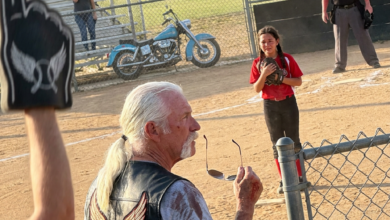
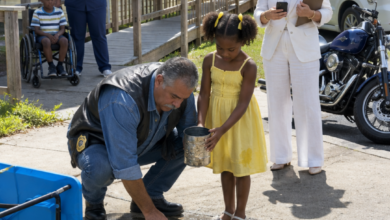
The girl threw a metal lunchbox into my face before I could remove my helmet, and by the time the school guard pinned her arms, half the parents outside Jefferson Middle School had decided the giant biker deserved it.
The corner struck my cheekbone.
Hard.
My head snapped sideways. The lunchbox hit the sidewalk, burst open, and scattered a turkey sandwich, apple slices, and two chocolate cookies beneath the boots of waiting parents.
Someone screamed.
A mother pulled her daughter behind her. Three phones rose immediately. The crossing guard reached for his radio while the school security officer, Mr. Alvarez, grabbed the girl before she could rush at me again.
“Stay away from my brother!” she shouted.
She was maybe seventeen, thin but fierce, with dark brown hair tied in a loose ponytail and a red high-school sweatshirt beneath her denim jacket. Her face was white with fear, yet her eyes held the kind of anger that only grows when fear has been given too much time.
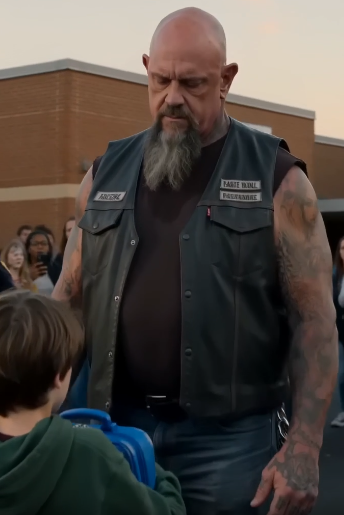
My name is Wade “Gravel” Mercer.
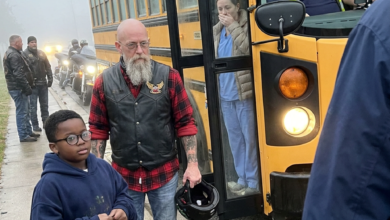
I was fifty-five, six-foot-five, and close to two hundred ninety pounds. My head was shaved, my beard hung gray across my chest, and tattoos covered my neck, knuckles, and both arms.
Standing beside a black Harley with blood beginning to run from my cheek, I did not look like the injured person.
I looked like the reason security had been hired.
“Call the police!” somebody shouted.
“He’s been following a student,” another voice said.
That rumor moved through the crowd faster than the blood moved down my face.
Mr. Alvarez kept one arm around the girl’s shoulders.
“Easy, Emma. Stop fighting me.”
“He hurt Liam,” she cried. “My brother told me everything.”
That caught me.
Not the accusation.
The name.
Liam.
I looked past her toward the school doors. Children were gathering behind the glass, pressing close enough for teachers to wave them back.
One small boy stood away from the others.
Eleven years old. Pale skin. Messy brown hair. Oversized green hoodie. Shoulders folded inward as if he had spent years trying to occupy less space.
Liam Carter.
When he saw me, he froze.
Then he noticed the second lunchbox hanging from my left hand.
It was blue plastic, scratched along one side, with a new silver latch I had installed that morning. A folded brown paper bag rested on top of it.
Emma followed my eyes.
Her anger sharpened.
“You brought something for him?”
“Yes.”
“What did you put in there?”
I did not answer.
She struggled against Mr. Alvarez again.
“You stay away from him!”
The principal came through the doors with two teachers behind her. Parents closed around us, pointing, filming, and supplying details they had invented during the previous thirty seconds.
I had threatened a child.
I had been waiting outside for days.
I belonged to a gang.
I had come to punish Liam for reporting me.
Nobody asked why an old biker would be holding a child’s repaired lunchbox at three fifteen on a Tuesday.
Nobody except Liam.
He pushed open the school door before a teacher could stop him.
“Mr. Mercer?”
Emma stopped fighting.
The boy walked down the steps, staring at the blood on my beard.
I crouched slowly, opened the blue lunchbox, and turned it toward him.
Inside was a grilled cheese sandwich cut diagonally, a thermos of tomato soup, two peeled orange halves, and a small plastic container filled with pretzels.
Nothing threatening.
Nothing expensive.
Just warm food.
Liam looked from the meal to his sister.
Then he whispered the six words that silenced the entire sidewalk.
“Emma, he isn’t the one.”
But if I had not bullied Liam, why had the boy been terrified of me for three weeks—and why had he begged me never to tell his sister what happened behind the repair shop?
I first saw Liam on a cold Monday afternoon behind Mercer Cycle Works, the motorcycle repair shop I had owned for twenty-one years.
He was sitting beside our chain-link fence with his backpack between his knees.
School had ended nearly two hours earlier.
Most children walking that route hurried past my shop because the place looked exactly like somewhere their parents had warned them about. Engines thundered behind steel doors. Men in leather carried scarred helmets beneath tattooed arms. The air smelled of fuel, hot rubber, and old coffee.
Liam stayed.
He watched through the fence while I adjusted the carburetor on a forty-year-old Harley.
When I looked up, he dropped his eyes.
“You waiting for somebody?” I asked.
He shook his head.
“You lost?”
Another shake.
I returned to the motorcycle. Five minutes later, I heard his stomach growl from twelve feet away.
I opened the small refrigerator beside my workbench and found half a ham sandwich, an apple, and a bottle of water.
When I carried them outside, Liam stood so quickly that his backpack fell over.
“I don’t want anything.”
“Wasn’t offering anything.”
I placed the food on the low concrete wall beside him.
“That’s my dinner,” I said. “I’m going to forget it’s there.”
He stared at me.
Then he stared at the sandwich.
I walked back into the shop.
When I checked the wall ten minutes later, the food was gone. So was Liam.
He returned Wednesday.
Then Friday.
He never asked for food, and I never admitted I was leaving it for him. Sometimes it was a sandwich. Sometimes leftover chili in a paper cup. Once it was an entire chicken pot pie because Tiny, one of my club brothers, did not understand the meaning of subtlety.
“Kid needs feeding,” Tiny said.
“Kid needs privacy.”
“He also needs vegetables.”
“You’ve eaten french fries for breakfast.”
“Potatoes grow in dirt. That makes them vegetables.”
Tiny was sixty, built like a refrigerator, and incapable of whispering. Liam heard every word from outside and almost smiled.
Almost.
I began noticing things.
Liam left school with other children, but slowed down whenever three older boys appeared behind him. His lunchbox was dented. One backpack strap had been cut nearly through. Some afternoons, he held his left arm close to his ribs.
When I asked what happened, he always gave me the same answer.
“Nothing.”
I knew that word.
My father had used it when he came home angry. My mother used it when neighbors noticed bruises. I used it throughout my first year in the Army, when anyone asked why I volunteered for every weekend shift.
Nothing rarely means nothing.
It means the truth feels more dangerous than silence.
One Friday, Liam arrived without his lunchbox.
I left beef stew beside the fence.
He did not touch it.
“Not hungry?” I asked.
He shrugged.
“Bad food?”
Another shrug.
“That hurts. Tiny cooked it.”
From inside the shop, Tiny shouted, “His loss.”
Liam smiled for half a second.
Then a black pickup slowed on the road. Three eighth-grade boys sat inside, driven by an older teenager. One of them pointed toward Liam.
The smile disappeared.
The pickup continued.
“Friends?” I asked.
“No.”
“Then why are they interested in you?”
“They aren’t.”
He pulled up his hood and started walking.
I let him go.
That was my first mistake.
Emma Carter was not only Liam’s sister.
For most practical purposes, she was his second parent.
Their mother, Rebecca, worked double shifts at a nursing home after their father died from a construction accident four years earlier. Emma cooked breakfast, checked homework, attended school meetings, and made certain Liam carried a packed lunch every morning.
She also knew he had changed.
He stopped eating dinner with her. He washed his own clothes late at night. He flinched when someone approached from behind.
Then she found the Harley drawing.
Liam had sketched a large black motorcycle beside a faceless man wearing a leather vest. Across the bottom, in dark pencil, he had written:
HE KNOWS WHERE I WAIT.
Emma asked who the man was.
Liam tore the page in half.
“Just somebody near school.”
“Did he talk to you?”
“I don’t want to talk about it.”
“Did he touch you?”
“No.”
“Did he threaten you?”
Liam hesitated.
That hesitation answered a question she had not asked correctly.
The next day, Emma drove past the school at dismissal. She saw me parked across the street on my Harley.
She also saw Liam notice me and immediately step behind another student.
What she did not see was the reason I had come.
The three boys from the pickup had taken Liam’s lunchbox again that morning. One of them dumped the food into a trash can. Another filled the empty box with wet leaves and shoved it back into his locker.
Liam had finally told me.
Not everything.
Enough.
I had gone to the school office and asked to speak privately with Principal Helen Brooks. I brought photographs from a security camera mounted outside my repair shop. The recording showed the same boys blocking Liam near the fence, grabbing his backpack, and throwing his belongings across the service lane.
The camera had no sound.
It did not need any.
Principal Brooks promised an immediate investigation. She asked me not to approach the students or contact their families while the school gathered evidence.
I agreed.
Then I left through a side door.
Emma saw only a tattooed stranger leaving her brother’s school.
That evening, she asked Liam again.
“Is the biker hurting you?”
Liam said, “He knows.”
Emma heard confirmation.
Liam meant I knew about the bullying.
Two words built the entire misunderstanding.
The next morning, Emma found him washing tomato soup from his green hoodie. His metal lunchbox was bent so badly the latch would no longer close.
“Who did this?”
“I dropped it.”
She did not believe him.
“Was it that biker?”
Liam lowered his head.
“He said not to make it worse.”
That was true.
I had told Liam not to confront the older boys alone because there were three of them and they were becoming more aggressive.
Emma heard a threat.
She asked what I looked like.
Liam described my height, beard, tattoos, leather vest, and black Harley.
Then he begged her not to interfere.
“Please, Emma. He’ll handle it.”
That made it worse.
By Tuesday afternoon, she had convinced herself that her eleven-year-old brother was being controlled by a grown man everyone else was too frightened to challenge.
She packed an extra lunch and drove to Jefferson Middle School.
When my Harley appeared at the curb, she did not see the repaired blue box in my hand.
She saw the monster from Liam’s drawing.
Then she threw the only weapon she had.
His lunch.
The police arrived seven minutes after the lunchbox struck me.
Officer Denise Cole stepped from the patrol car, took one look at the crowd, and sighed.
She knew me.
Her father and I had served in the same Army motor pool. I had also repaired her first motorcycle after she dropped it in a grocery-store parking lot, though she preferred that detail remain private.
“Wade,” she said, “what happened?”
“A sandwich attacked me.”
Nobody laughed.
Emma stood beside Mr. Alvarez, crying now that the anger had drained from her. Blood from my cheek had spotted the front of my shirt, and every drop seemed to increase her certainty that she had ruined her life.
“I thought he was hurting my brother,” she said.
Officer Cole looked at Liam.
“Was he?”
“No.”
“Then who was?”
Liam stared toward the school doors.
Three boys stood behind the glass.
Tyler Webb, Marcus Shaw, and Dylan Price.
All thirteen. All taller than Liam. All wearing the uncertain expressions of children who had mistaken someone’s silence for permanent permission.
Liam saw them watching.
His mouth closed.
I set the blue lunchbox on the concrete wall and opened the thermos so the soup would not keep heating.
“Food’s getting cold,” I said.
Emma stared at me.
“You made that?”
“Tiny did.”
From across the parking lot came the rumble of another Harley. Tiny rolled beside the curb, killed the engine, and removed his helmet.
He looked at my face.
“Girl has an arm.”
“Apparently.”
“Want me to be offended?”
“No.”
“Good. Soup needs pepper.”
Emma looked from one enormous biker to the other.
“Why did you bring him lunch?”
Tiny answered before I could.
“Because somebody kept destroying the ones you made.”
Liam’s face tightened.
Emma turned toward him.
“Why didn’t you tell me?”
He looked eleven again.
Not like a witness. Not like the center of a crowd. Just a small boy who loved his sister enough to hide the thing hurting him because he knew how much she already carried.
“You work after school,” he whispered. “Mom works nights. You’re both tired.”
“That doesn’t matter.”
“It matters to me.”
Emma’s shoulders collapsed.
She had believed she failed to see a predator.
The truth was quieter and more painful: her little brother had been protecting her from his pain.
Principal Brooks invited us inside. The crowd resisted leaving until Officer Cole reminded several parents that uploading video of identifiable children during a school investigation could create new problems.
Phones slowly lowered.
Inside the conference room, Liam sat between Emma and me. He chose that chair himself.
Principal Brooks placed printed security images on the table. The boys’ parents were called separately. A counselor joined us. Officer Cole explained what the camera footage showed and what still needed to be established.
Nobody demanded that Liam speak before he was ready.
That mattered.
After ten silent minutes, he reached for a pretzel.
Then he began.
The bullying started with his father’s old work boots.
Liam wore them after his own shoes split. They were too large, so he stuffed paper into the toes. Tyler noticed him limping during gym class and called him “Dead Dad.”
The name spread.
They stole his lunch because Emma wrote small notes on the napkins.
YOU’VE GOT THIS.
PROUD OF YOU.
SEE YOU AT HOME.
The boys read them aloud in exaggerated voices, then asked whether his dead father packed dessert.
Liam stopped bringing the notes home.
He kept every one of them folded inside the lining of his backpack.
Emma covered her mouth.
I looked at the wall.
There are moments when a man’s fists remember every lesson his mind has outgrown.
I had spent years learning not to obey mine.
Emma asked me later why I had not shouted when the lunchbox hit my face.
The answer began twenty-eight years earlier.
I had a daughter once.
Her name was Claire.
She had my gray eyes and her mother’s patience. When she was thirteen, girls at school began mocking the burn scar that ran from her left ear to her jaw, the result of a kitchen accident when she was four.
Claire hid it with her hair.
Then she stopped eating in the cafeteria.
I noticed none of that.
I was drinking too much, riding too far, and treating every problem as something that could be defeated by becoming louder than it was. When Claire finally told me, I went to the school and threatened the father of one of the girls.
The bullying stopped for six days.
Then it returned online.
Worse.
Now Claire believed speaking up had caused it.
She survived that year, but our relationship did not. Her mother took her to Oregon. I received birthday cards for a while, then emails, then silence.
I got sober at forty-three.
By then, apologies could not restore all the years I had frightened away.
Claire was alive. She was married. She had two children I knew mostly through photographs her mother sometimes sent.
That is a different kind of loss from death.
There is still a door.
You simply have not been invited through it.
When Liam began waiting behind my fence, I recognized the silence I had missed in my daughter. This time, I refused to solve it with threats.
I documented.
I listened.
I involved the school.
My club brothers did not all agree.
Tiny did.
Rook did not.
Rook had raised three sons and believed bullies understood only humiliation.
“Bring their fathers to the clubhouse,” he said.
“No.”
“We talk.”
“You don’t look like conversation.”
“Neither do you.”
“That’s why I’m going through the school.”
Rook rubbed both hands across his beard.
“And while the school fills out forms?”
“We make sure Liam eats.”
That was how the lunch rotation began.
Tiny cooked soup. Rook packed sandwiches. Doc, our club treasurer, bought fruit but kept choosing grapefruit because he had never raised children and thought suffering built character.
We never called it charity.
Liam came to the shop after school, swept one corner of the floor, and ate at the workbench. I paid him five dollars, which he immediately tried to refuse.
“Work gets paid,” I said.
“I barely swept.”
“Then sweep better tomorrow.”
He did.
The blue lunchbox had belonged to Claire.
I kept it in a box of things I had never managed to throw away. Its faded paint still showed the pale outline of a horse sticker. The latch had broken in 2009.
The night before Emma hit me, I found a replacement latch in a drawer, drilled two small holes, and repaired it.
I placed one of her napkin notes inside.
Not Claire’s.
Emma’s.
Liam had dropped it near the fence weeks earlier.
PROUD OF YOU. SEE YOU AT HOME.
That was the contradiction Emma could not understand when I opened the second lunchbox.
A man she believed was tormenting her brother had preserved the words she thought the bullies destroyed.
I did it because somebody should have preserved Claire’s.
Back then, nobody did.
Not even me.
The school suspended Tyler, Marcus, and Dylan while the investigation continued.
Parents demanded expulsion.
Some demanded criminal charges.
Emma demanded both until Liam stopped her in the hallway.
“I still have to come back here,” he said.
That changed the conversation.
Punishment might satisfy adults, but Liam needed a school where he could walk between classes without becoming known forever as either the victim or the boy who destroyed three classmates’ lives.
Principal Brooks arranged separate accountability meetings after consulting Liam, Emma, their mother, the counselor, and the boys’ families.
I attended only because Liam asked me.
Tyler entered first.
His father wore an expensive coat and spoke before his son sat down.
“Boys tease each other. This has been exaggerated.”
I placed a photograph on the table.
It showed Liam on the pavement while Tyler emptied his backpack into a puddle.
Tyler’s father glanced at it.
“That doesn’t show context.”
“No,” I said. “It shows your son.”
He looked at my tattoos, then at the scar on my cheek from Emma’s lunchbox.
“Are you threatening us?”
“No.”
The word disappointed him. He had prepared himself to dismiss aggression. Calm left him with nowhere to hide.
Liam spoke next.
He did not describe every incident.
He described the notes.
“My sister writes those before work,” he said. “Sometimes it’s the only thing I have from her all day.”
Tyler stared at the table.
“What did you do with them?” Liam asked.
“Threw them away.”
“No. I found most of them.”
Tyler finally looked up.
“Then why does it matter?”
Liam reached inside his backpack and removed a folded napkin.
“Because you wanted me to believe they were embarrassing.”
Silence filled the room.
Tyler’s father stopped speaking.
Marcus arrived with his mother, who cried before anyone accused her son of anything. Dylan arrived with an uncle because his father did not answer the school’s calls.
The boys were not secret monsters.
That would have made the story easier.
Tyler feared becoming the target, so he chose one. Marcus followed Tyler because belonging felt safer than thinking. Dylan made jokes because laughter kept everyone from noticing that his father had left three months earlier.
Explanations are not excuses.
They are simply where repair has to begin.
The three boys served suspensions, lost extracurricular privileges, and completed supervised restorative work. They cleaned the service lane behind my shop, replaced damaged school supplies, and spent Saturdays helping our club prepare lunches for a community pantry.
Rook supervised the first Saturday.
He made them scrub the same table four times.
“Is this necessary?” Tyler asked.
“No,” Rook said. “But neither was the soup.”
I told Rook to ease up.
He claimed he had.
Liam did not forgive them that week.
Or the next.
He did something harder.
He stopped reorganizing his life around them.
He returned to the cafeteria. He carried the blue lunchbox openly. When Tyler whispered “sorry” near the trash cans, Liam nodded once and continued walking.
No dramatic handshake.
No instant friendship.
Just space where fear had been.
Sometimes that is enough.
Emma came to my repair shop two days after the incident.
She carried a new metal lunchbox.
The same kind she had thrown.
My cheek was purple. Tiny had taken a photograph and threatened to use it on our club Christmas card.
Emma stood in the doorway while engines echoed through the garage.
“I came to apologize.”
“You already did.”
“Not properly.”
She placed the new lunchbox on my workbench.
Inside were two sandwiches, an apple, chocolate cookies, and a small first-aid packet.
Tiny looked inside.
“No soup?”
Emma almost smiled.
“I didn’t know what kind.”
“Tomato,” he said. “Pepper. No basil.”
I pushed the lunchbox back toward her.
“You don’t owe me anything.”
“I hit you in the face.”
“You were protecting your brother.”
“I was wrong.”
“Yes.”
She blinked, surprised.
Most adults would have rushed to comfort her by pretending she had done nothing wrong. That would not help her.
“You were wrong about me,” I continued. “You weren’t wrong to pay attention.”
“I should’ve asked.”
“You thought asking might give me time to hurt him.”
Her eyes dropped.
“That’s exactly what I thought.”
“You made the best decision fear allowed. Next time, give yourself more choices.”
She studied the motorcycles lined along the wall.
“Liam said you had a daughter.”
I looked at Tiny.
He suddenly became interested in a box of spark plugs.
“I do.”
“Does she know what you did for him?”
“No.”
“Maybe she should.”
“That isn’t your problem.”
Emma nodded, but she did not agree.
Three weeks later, a letter arrived at the shop.
There was no return address I recognized. Inside was a photograph of a woman standing with two children beside the Oregon coast.
Claire.
Behind the photograph was a short note.
Emma found me online. She told me about Liam. I’m not ready for everything, but you may write to the children at Christmas. Start there.
I read it twice.
Then again.
Tiny asked what it said.
I handed him the letter because my voice would not work.
He read it, cleared his throat, and walked outside without a word.
Rook followed him.
Soon five motorcycles needed urgent inspection in the parking lot, although none had mechanical problems.
I sat alone at the workbench.
Beside me rested Claire’s old blue lunchbox.
A week earlier, I had given it to Liam.
Yet there it was.
Inside, I found a green paper napkin with two lines written in an eleven-year-old boy’s uneven handwriting:
YOU’VE GOT THIS.
SEE YOU AT HOME.
I kept that one.
A year later, Jefferson Middle School placed a long wooden table near the cafeteria entrance.
Students could leave unopened food there for anyone who needed it. No forms. No questions. No names.
They called it the Second Lunch Table.
I hated the name.
Tiny loved it because he had suggested it.
Every Tuesday, our club delivered soup, fruit, sandwiches, and enough pretzels to feed a small military unit. We arrived after classes began so the motorcycles would not disrupt dismissal.
Liam joined the school music program and grew nearly four inches. He still disliked crowds, but he stopped lowering his head when he walked.
Emma graduated and began studying social work at a community college. She volunteered at the lunch table twice a month.
She never threw another meal at anyone.
Tyler, Marcus, and Dylan continued helping at our pantry after their required service ended. Not every Saturday. Not perfectly.
They came back.
That counted.
Claire allowed me one phone call that Christmas.
The conversation lasted eleven minutes.
We spoke about weather, motorcycles, her children, and nothing that could break us open too quickly. Before hanging up, she said she remembered the blue lunchbox.
“I thought you threw it away.”
“I kept it.”
“Why?”
I looked through the shop window.
Liam was outside at the wooden table, dividing sandwiches into paper bags while Emma wrote notes on napkins. Tiny was arguing with Rook about whether children ate grapefruit voluntarily.
“Because I was hoping I’d get another chance to pack it,” I said.
Claire was quiet.
Then she gave me her mailing address.
Not forgiveness.
An address.
Sometimes a door opens only one inch.
You do not force it wider.
You stand outside, keep your hands visible, and wait.
The scar from Emma’s lunchbox faded months ago, though Tiny still tells people a teenage girl defeated me in front of forty witnesses. I let him tell it.
Every Tuesday, I park the Harley outside Jefferson Middle School. The engine falls silent, my boots cross the pavement, and somebody inevitably looks nervous when they see me carrying two lunchboxes.
One goes on the table.
The other belongs to Liam.
Inside it, beneath the sandwich and orange slices, Emma always places the same message:
PROUD OF YOU.
SEE YOU AT HOME.
Liam reads it every time.
Then he folds it carefully.
And keeps it.
Follow our page for more unforgettable biker stories about misunderstood strangers, quiet protection, second chances, and the kindness hidden beneath leather vests and roaring engines.