A Pregnant Woman Slapped a Biker and Tore the Scarf From His Neck—Then She Recognized the Stitch Her Dead Husband Had Made
The pregnant woman slapped the biggest biker in the diner, ripped the faded scarf from his neck, and screamed her dead husband’s name—while twelve leather-clad riders rose around her so quickly that every chair scraped backward at once.
I was behind the counter when it happened.
My name is Claire Bennett, and I had worked at Rosie’s Roadside Diner outside Flagstaff, Arizona, long enough to recognize trouble before it reached the door. Trouble usually announced itself with a raised voice, an unpaid tab, or the sour smell of whiskey before noon.
That morning, it arrived on twelve Harley-Davidsons.
Their engines rolled across the parking lot like distant thunder, shaking the spoons inside our coffee mugs. The riders parked beneath the faded Route 66 sign, cut their engines one by one, and left a silence heavy enough to make every customer look toward the windows.
The man leading them was impossible to miss.
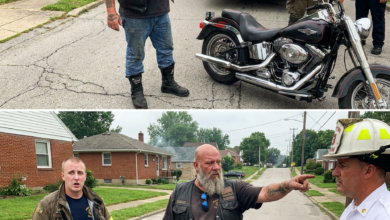
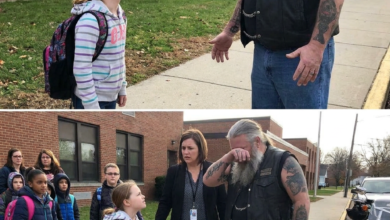
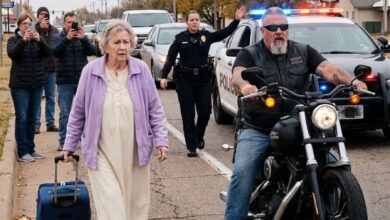
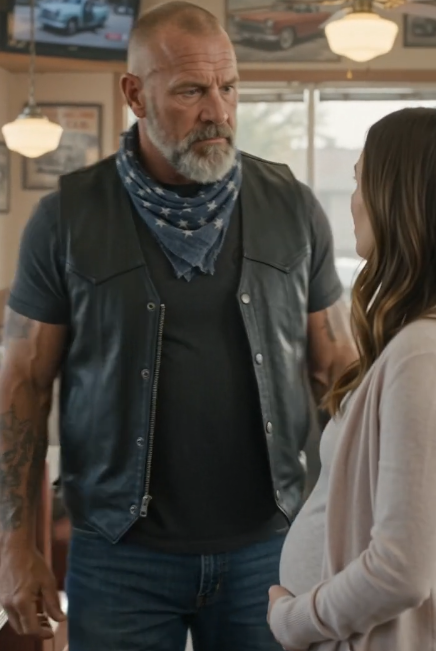
Dean “Rook” Mercer was a fifty-six-year-old white American biker, nearly six-foot-five and broad enough to fill the diner doorway by himself. His head was shaved, his gray beard reached the center of his chest, and dark tattoos covered his neck, forearms, and scarred knuckles.
He wore a plain black leather vest over a charcoal T-shirt, faded jeans, heavy boots, and a narrow blue scarf wrapped tightly around his neck.
The scarf did not belong with the rest of him.
It was soft, worn thin at the edges, and decorated with tiny white stars that had almost disappeared after years of washing. One corner had been repaired with clumsy red stitches.
Rook touched that corner before entering.
I noticed because his hand was shaking.
He and the other members of the Black River Riders took the long table beside the window. They did not order beer. They asked for coffee, eggs, toast, and directions to Cedar Grove Apartments on the north side of town.
That address belonged to Hannah Cole.
Hannah was twenty-nine, seven months pregnant, and living alone since her husband, Daniel, had died in a motorcycle crash four months earlier. She came to the diner most mornings because the apartment felt too quiet after sunrise.
That day, she sat in the last booth with both hands around a cup of peppermint tea she had barely touched.
She saw Rook’s scarf when he turned his head.
Her cup slipped from her fingers.
Tea spread across the table.
Hannah stood so fast that her hip struck the booth, and I hurried toward her because her face had gone completely white. She ignored me. Her eyes remained fixed on the fading stars around Rook’s throat.
Then she crossed the diner.
Rook rose when he saw her approaching.
“Hannah?”
She slapped him.
The sound cracked through the room.
Before anyone could move, Hannah seized the scarf and tore it from his neck. Rook’s leather vest creaked as his shoulders tightened, but he did not grab her wrist or step toward her.
The twelve bikers stood.
Customers shouted. A truck driver moved between Hannah and the table. Someone reached for a phone. Another man yelled that the bikers should leave the pregnant woman alone.
But Hannah was not looking at the men surrounding her.
She stared at the red stitches in the scarf.
“Where did you get this?”
Rook’s cheek had turned red where she struck him.
“Your husband left it.”
“No.”
“He asked me to bring it home.”
“My husband is dead.”
“I know.”
Hannah pressed the scarf against her chest as if someone might take it again. Tears appeared, but anger kept them balanced along her lower lashes.
“Daniel was wearing this the night he died.”
Rook lowered his eyes.
“No,” he said. “He wasn’t.”
The room became still.
Hannah lifted the scarf and found something tied beneath the repaired corner—a tiny brass key she had never seen before.
Rook looked at the key, then toward the eleven bikers waiting behind him.
“That,” he said, “is why it took us four months to find you.”
Rook had not always been the kind of man who delivered the belongings of dead strangers.
Twenty-seven years earlier, he had been the kind who disappeared whenever anyone needed him.
His first wife left after he spent their rent money repairing a Harley he did not need. His younger brother stopped calling after Rook missed their mother’s funeral. For several years, his address changed whenever creditors, employers, or disappointed relatives learned where he was sleeping.
Then came prison.
He served three years for helping transport stolen motorcycle parts across state lines. He never pretended he had been framed, and he never decorated the story with excuses.
“I knew,” he told me later. “I wanted the money anyway.”
The Black River Riders did not rescue him from that past. They simply refused to let it become the only thing true about him.
Marcus “Doc” Allen gave him work cleaning tools in a fabrication shop. Luis Ortega taught him how to rebuild transmissions properly instead of stealing replacement parts. Club president Walter “Preacher” Knox gave him one rule.
“If a brother trusts you with something, it reaches home.”
Rook lived by that rule because he knew what happened when a man did not.
Over the years, club members trusted him with spare keys, hospital paperwork, ashes, wedding rings, and messages they lacked the courage to deliver themselves. He became the one who finished difficult journeys.
Daniel Cole met him at a fuel station outside Gallup, New Mexico.
It was a cold October night, four months before the diner confrontation. Rook and three club brothers were returning from a charity ride when they found a man crouched beside an old green Harley, attempting to secure a loose saddlebag with electrical tape.
That man was Daniel.
He was thirty-two, lean, brown-haired, and wearing a denim jacket that did little against the desert cold. The blue scarf with the faded stars was wrapped around his neck.
Rook stopped to help.
Daniel recognized the Black River emblem on the motorcycles and asked whether they knew anything about older shovelhead engines. Rook said they knew enough to avoid buying one from a liar.
Daniel laughed.
Within thirty minutes, the loose bracket was repaired. Daniel bought everyone burnt gas-station coffee and explained he was riding toward Colorado to retrieve something before his daughter was born.
“You mean your son,” Doc said, nodding toward the blue scarf.
Daniel smiled.
“My wife says girl. I say boy. The baby says nothing.”
The scarf had belonged to Hannah.
She wore it on her first date with Daniel, on the night he proposed, and during the courthouse ceremony where they married with only two witnesses. When Daniel left for Colorado, she tied it around his neck because the weather report warned of freezing temperatures.
Before leaving Flagstaff, they argued.
Daniel refused to explain why he needed to make the trip. Hannah accused him of keeping secrets when they could barely afford rent and had a baby coming. He told her he would explain everything when he returned.
Those became their last angry words.
Three days later, a state trooper knocked on Hannah’s apartment door.
Daniel’s motorcycle had left a mountain road during rain. He died before paramedics arrived. The coroner returned his wallet, wedding band, boots, and damaged jacket.
But not the scarf.
Hannah believed it had been lost at the crash site.
She did not know Daniel had given it to Rook two days earlier.
Rook and the others saw Daniel again near Durango, Colorado.
This time, Daniel’s motorcycle was running well, but he looked exhausted. He had spent most of the night outside a storage facility, waiting for the manager to arrive.
Rook asked what he was retrieving.
Daniel hesitated before opening a dented storage unit.
Inside stood a wooden cradle.
It had curved walnut rails, a small crescent moon carved into the headboard, and one unfinished side where fresh wood remained lighter than the rest.
Daniel’s father had started building it before cancer took him. Daniel had been seventeen then, too angry to enter the workshop after the funeral. His mother eventually moved away, and the cradle remained locked in storage for fifteen years.
When Hannah became pregnant, Daniel decided to finish it.
He had quietly taken carpentry lessons and spent months repairing the damaged wood. The final piece was waiting in Durango, along with several letters his father had written before dying.
Daniel showed the bikers one of those letters.
On the front, in faded ink, were the words:
FOR THE DAY MY SON BECOMES A FATHER.
Daniel did not open it.
He wanted Hannah beside him when he did.
The cradle would not fit on his motorcycle, so he rented a small utility trailer. Rook helped secure it with straps while sleet began tapping against the metal roof.
That was when Daniel removed Hannah’s scarf.
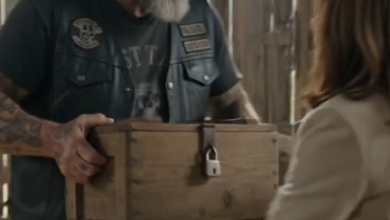
He folded it carefully, tied a tiny brass key beneath the repaired corner, and handed it to Rook.
The key opened a compartment hidden beneath the cradle.
“Keep this dry until we stop for the night,” Daniel said. “My jacket zipper’s broken.”
Rook tucked the scarf inside his vest.
They planned to meet at a motel near Pagosa Springs.
Daniel never arrived.
Rain had covered the mountain road before sunset. Witnesses later said a deer crossed near a blind curve. Daniel avoided it, lost control on wet pavement, and struck the guardrail.
Rook reached the scene after the ambulance had left.
A state trooper told him Daniel had died.
The cradle remained inside the trailer, damaged but intact. The motorcycle lay beyond the shoulder beneath a silver emergency blanket. Rook stood in the rain with Hannah’s scarf inside his vest and realized the last thing Daniel had trusted him to carry was still against his chest.
He could have handed everything to the police.
He almost did.
Then he remembered Preacher’s rule.
If a brother trusts you with something, it reaches home.
Daniel had never worn the Black River patch. He had shared only two days of road, three cups of terrible coffee, and a promise to meet at a motel.
That was enough.
Rook brought the cradle and trailer to a repair shop in Durango. He planned to locate Hannah within a week, return the scarf, and explain what Daniel had been doing.
Then he opened the hidden compartment with the brass key.
Inside were eleven letters, a small velvet box, a digital recorder, and a notebook containing Daniel’s plans for his child’s first year.
There was also an envelope addressed to Hannah.
The rain had reached it.
The ink was bleeding.
Rook could have delivered the damaged envelope immediately, but Doc warned that the wet pages might fall apart if handled. A paper conservator in Denver agreed to dry and separate them.
The work would take time.
Meanwhile, the cradle needed repair. One rail had cracked during the crash, and the crescent moon had split through its center.
Rook called Hannah twice from an unfamiliar number.
She did not answer.
He left no voicemail because he could not find the correct words. What could he say?
Hello. I met your husband shortly before he died.
I have your scarf.
I also have a cradle, several letters, a recording, and the explanation he never came home to give you.
Each version sounded cruel when spoken aloud.
Rook decided to finish restoring the cradle first.
Preacher disagreed.
“Bring her the scarf,” he said. “She deserves to know.”
“I bring half the truth, she spends another month wondering about the other half.”
“She already thinks everything is gone.”
“That’s why I won’t arrive with broken pieces.”
The argument split the club.
Several members believed Rook was turning Daniel’s final belongings into a personal redemption project. Others understood why he could not place shattered wood and water-damaged letters in a pregnant widow’s hands.
Then money became a problem.
The conservator’s bill was larger than expected. Replacing the cradle rail required matching walnut that was no longer commercially milled. Daniel’s trailer had storage fees, and the motorcycle insurer refused to release certain items without additional paperwork.
Rook sold a set of vintage exhaust pipes.
Doc gave up the money he had saved for dental work. Luis drove overnight to retrieve salvaged walnut from his uncle’s workshop in New Mexico. Preacher paid the storage balance despite still believing the scarf should have been returned sooner.
Brotherhood did not mean agreement.
Sometimes it meant remaining in the room after every man had said the worst thing he was thinking.
The scarf stayed around Rook’s neck during those four months.
He wore it because the repaired letters and recorder traveled in a weatherproof pouch beneath his vest, and he refused to risk separating the key from them. Every evening, he checked the red stitches Daniel had mentioned.
He never washed it.
He barely slept.
By January, the cradle was restored. The letters had been preserved, although some words remained blurred. The digital recorder still worked.
Rook finally searched Daniel’s public memorial page and found a photograph of Hannah outside Rosie’s Roadside Diner.
He and eleven club members rode six hundred miles to Flagstaff.
They came as a group because the cradle was secured inside a club trailer and because none of them believed Rook should deliver the promise alone.
They reached Cedar Grove Apartments shortly after eight in the morning.
Hannah was not home.
A neighbor said she usually ate breakfast at Rosie’s.
That was how twelve intimidating men, one restored cradle, eleven letters, and a dead husband’s final promise arrived in my parking lot beneath the pale Arizona sun.
Hannah stood in the center of the diner with the scarf pressed against her chest.
The customers who had surrounded her slowly backed away when they realized Rook was not going to retaliate. His cheek remained red, and four thin scratches marked his neck where Hannah’s fingernails had caught his skin.
“I’m sorry,” she whispered.
Rook shook his head.
“No need.”
“I hit you.”
“I noticed.”
A nervous laugh escaped someone near the counter, then died immediately.
Hannah held up the brass key.
“What does it open?”
Rook glanced at Doc.
“Something outside.”
The Black River Riders formed a quiet path to the parking lot. Customers followed at a distance, several still holding their phones, though nobody recorded now.
A black utility trailer stood behind the motorcycles.
Rook opened its rear doors.
Inside was Daniel’s cradle.
Hannah did not move.
The walnut shone beneath the morning light. The repaired crescent moon remained visible because Rook had refused to hide the crack completely. A narrow red seam followed the break, matching the clumsy stitches Daniel once placed in Hannah’s scarf.
Rook believed repaired things should remember surviving.
Hannah approached the cradle with one hand beneath her stomach. Her fingers found Daniel’s initials beneath the lower rail.
Then she saw a small brass lock set into the base.
Her hand trembled so hard that I helped guide the key.
The compartment opened.
Inside rested the preserved letters, the velvet box, the notebook, and the recorder.
Hannah touched none of them at first.
She simply lowered herself onto the trailer floor and breathed.
Rook remained outside.
He was close enough to help but far enough to give her the choice.
Finally, Hannah lifted the velvet box.
Inside was a tiny silver bracelet engraved with the name Grace.
“My daughter’s name,” she said.
Rook looked toward the pavement.
“Daniel was right?”
“He knew. I told him the morning he left.”
The bracelet had been Daniel’s reason for making the secret journey urgent. His father had given him a similar one before dying, but it had been stolen years earlier. Daniel had found the original silversmith’s son in Colorado and commissioned a copy for his child.
Hannah opened the notebook next.
Daniel had written lists in his uneven handwriting.
Learn to install the car seat.
Stop swearing before the baby copies me.
Make Hannah sleep when she says she is fine.
Teach Grace that motorcycles are loud, not evil.
Never let her believe being afraid means being weak.
The final page contained only one sentence.
Bring them both home.
Hannah covered her mouth.
Rook turned away.
His hands closed into fists, then opened again.
“There’s one more thing,” he said.
He nodded toward the recorder.
Hannah pressed the button.
Static filled the trailer.
Then Daniel’s voice returned to the world.
“Han, if you’re hearing this, Rook probably found a way to make this whole thing look more dramatic than it needed to be.”
Several bikers lowered their heads.
Even Rook almost smiled.
Daniel explained the cradle, the letters, the trip, and the key. He apologized for leaving after their argument. He said he had wanted to bring home something that proved he could become more than the unreliable man he had once been.
Then his voice softened.
“I took your scarf because it still smells like that perfume you wore when we got married. I’ll give it back when I’m home. Don’t stay angry too long.”
The recording ended.
Hannah sat motionless.
The scarf remained beneath her chin.
Rook finally spoke.
“He did bring it home.”
Hannah looked at him through tears.
“No,” she said. “You did.”
The crowd expected Hannah to thank him.
Instead, she stepped down from the trailer, walked directly toward Rook, and grabbed the front of his leather vest.
Every biker stiffened.
Hannah pulled him into an embrace.
Rook’s arms remained at his sides. He looked toward Doc as if someone needed to explain what he was supposed to do.
Then he placed one enormous hand carefully between Hannah’s shoulders.
She cried against the chest of a man everyone had feared ten minutes earlier.
Rook did not cry.
But his jaw moved as though he were grinding down words he could not safely release.
“I thought someone stole it from his body,” Hannah said.
“Nobody stole it.”
“You wore it for four months?”
“Couldn’t lose the key.”
“You could have put it somewhere safe.”
Rook touched the scratches on his neck.
“Seemed safe enough.”
Hannah laughed through her tears.
Then she noticed the red seam across the repaired crescent moon. She ran her fingers over it and looked from the cradle to the matching stitches in the scarf.
“Daniel sewed this after it caught on a fence during our second date.”
“He said his repair looked terrible.”
“It did.”
“He was proud of it.”
“He was proud of anything that worked twice.”
That sentence struck Rook harder than the slap.
He sat on the trailer edge and looked at the repaired moon. For the first time, I saw past the tattoos, beard, scarred hands, and stiff leather.
He looked tired.
Not road tired.
Soul tired.
Hannah sat beside him.
“Why did you do all this for someone you barely knew?”
Rook stared at the motorcycles lined across the parking lot.
“Because he asked.”
“That cannot be the whole reason.”
“No.”
He told her about his younger brother, Aaron.
Eighteen years earlier, Aaron called Rook from a hospital in Nevada. Their mother’s belongings had been placed in two cardboard boxes, and Aaron asked him to come help carry them home.
Rook promised he would.
Then he became drunk, missed the bus, and avoided his brother’s calls for six months because shame was easier than apology.
Aaron died of a heart condition the following winter.
Rook never saw him again.
“I’ve been late before,” he said. “Wasn’t going to be late this time.”
Hannah reached for his hand.
The biker who could lift an engine block alone allowed a pregnant widow to hold his scarred fingers as if they belonged to something fragile.
Grace Daniel Cole was born six weeks later.
The Black River Riders returned to Flagstaff the day Hannah brought her home. They did not roar into the hospital parking lot or form a dramatic escort.
Rook arrived in an old pickup because he had learned newborns disliked loud engines.
He carried the restored cradle upstairs with Doc and Luis. They placed it beside Hannah’s bed, checked every joint twice, and argued quietly over whether one leg sat unevenly.
Hannah tied the blue scarf around the upper rail.
The faded stars hung above Grace while she slept.
Rook stood at the bedroom door with his boots on the hallway tile, unwilling to step onto the carpet until Hannah invited him inside.
“Want to hold her?” she asked.
“No.”
“That sounded fast.”
“I break things.”
“You rebuilt a cradle.”
“Wood doesn’t move.”
“Sit down, Rook.”
He sat.
Hannah placed Grace in his arms.
The child weighed less than one of his boots. Rook held her with both hands, elbows locked, barely breathing. Grace opened her eyes, studied his beard, and wrapped four fingers around the edge of his vest.
Rook looked terrified.
Then the baby sneezed.
He laughed.
It was not the loud laugh Lily drew from him in parking lots or the rough bark shared across club tables. It was smaller, almost rusty, as if some forgotten part of him had moved for the first time in years.
Hannah kept Daniel’s letters inside the hidden compartment beneath the cradle.
Each year on Grace’s birthday, she opened one.
Daniel’s father had written them for milestones he knew he would miss—first steps, first day of school, first heartbreak, first time becoming a parent. Daniel never had the chance to read them, but his daughter eventually heard every word.
Rook became part of that ritual.
He rode to Flagstaff each spring with the Black River Riders. He inspected the cradle until Grace outgrew it, repaired her first bicycle, attended school concerts, and stood in the back row at every birthday party as though expecting someone to tell him he did not belong.
Nobody did.
The blue scarf was returned to Rook only once.
On Grace’s fifth birthday, Hannah wrapped it around his neck before the club rode home.
“She wants you to keep it warm,” Hannah said.
Rook looked at Grace.
The little girl nodded solemnly.
“For how long?”
“Until next year.”
He wore it for six hundred miles.
The stars were nearly gone by then, but the red stitches held.
They still do.
Follow our page for more unforgettable biker stories about misunderstood riders, impossible promises, and the quiet acts of loyalty hidden beneath leather, tattoos, and road-worn hearts.