Part 2: A Poor Mother Couldn’t Afford a Christmas Gift — The Present Her Son Gave Her the Next Morning Left Everyone Choked Up
Part 2
Rachel Moore had learned to make disappointment quiet.
She learned it after her husband, Daniel, died in a warehouse accident three winters earlier, leaving behind a seven-year-old boy, a stack of unpaid medical bills from the week doctors tried to save him, and a toolbox Rachel could not bring herself to move from the hall closet. She learned it when friends brought casseroles for two weeks and then returned to their own lives, not cruelly, just naturally, because grief is a house people visit but cannot live in with you. She learned it when Caleb stopped asking why his father’s work boots were still by the door and began placing his own sneakers beside them, like two generations of waiting.
Money became something Rachel could hear.
The rent had a sound. Heavy, metallic, final.
The electric bill had a sound. Thin and sharp, like paper cutting skin.
Groceries had a sound too, softer but constant, like a drawer opening every morning and asking how much love could be stretched before becoming hunger.
That Christmas Eve, the city outside their apartment glowed with lights Rachel had no energy to hate. Storefronts were painted with snowflakes. Churches announced candlelight services. Families carried bags tied with ribbons, and children pressed faces to toy displays with the full confidence of being wanted by the world.
Rachel wanted to give Caleb one thing that did not feel like an apology.
Just one.
She had been saving for the red truck since the first week of December. Tips from the diner went into an old coffee can behind the flour. Quarters from laundry change. Five dollars Mrs. Alvarez from 2B gave her for fixing the mailroom light because the landlord never came when called. Two crumpled bills Caleb’s school principal had quietly returned from an overpaid field trip form. Rachel added everything and counted again each night after Caleb slept.
She got close.
Then the heater in their apartment stopped working.
The landlord said he would send someone after the holiday. Rachel bought a space heater from the thrift store because Caleb woke up coughing when the room got too cold. The heater cost nine dollars.
The red truck slipped away.
On Christmas Eve morning, she still tried.
She worked a double shift at Miller’s Diner, washing plates until her fingers wrinkled, refilling coffee for travelers stranded by snow, smiling when customers joked that “at least tips must be good on Christmas Eve,” though most left less than usual because generosity has a strange way of becoming theoretical when the bill arrives. Her manager, Pete, gave her a leftover pumpkin pie with a dented crust and said, “For the kid,” as if he had not cut her hours twice that month.
By evening, she had twelve dollars and forty-three cents.
She went to Walton’s Market anyway.
That was the first small reveal, though nobody in the aisle knew it.
Rachel was not careless with money.
She was making one last attempt at dignity.
The red truck sat on the bottom shelf beneath plastic dinosaurs and boxed puzzles. It looked brighter than she remembered, almost ridiculous under fluorescent lights. She picked it up and held it against her coat for one second, imagining Caleb’s face in the dim apartment, the way his mouth would open before any sound came out, the way he would try not to seem too excited because he had learned, too young, that his happiness could make his mother feel guilty.
She turned the box over.
Twenty-one dollars and ninety-nine cents.
The price tag might as well have been a locked door.
Behind her, customers moved through the aisle with impatience sharpened by holiday stress. A woman in a green scarf sighed because Rachel was blocking the discount paper. A man reached over her shoulder for a board game without saying excuse me. Somewhere near the front, a child cried because he wanted candy and did not yet understand that wanting can become dangerous when parents have no answers.
Rachel stood frozen.
Then she carried the truck toward the register.
She had a desperate thought.
Maybe the tag was wrong. Maybe it would ring up cheaper. Maybe there was a sale sign she had missed. Maybe if she explained, someone would let her put down twelve dollars and return with the rest after New Year’s.
But the checkout line was long, and every cart seemed full of proof that other mothers had managed better.
Rachel looked at the truck in her hands.
Then at the loaf of bread and soup in her basket.
Food or toy.
Warmth or ribbon.
She turned before reaching the cashier and placed the truck behind discounted wrapping paper, not because she wanted to hide it from the store, but because she could not bear to put it back where Caleb might see it on another day.
That was what the teenage cashier saw.
A woman hiding merchandise.
That was what the man near the greeting cards saw.
That was what judgment prefers: a simple picture with no room for the story around it.
“Ma’am?” the cashier called.
Rachel stopped.
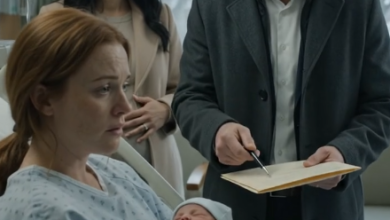
The cashier was seventeen, White American, with acne along his jaw and a Santa hat tilted crookedly over his blond hair. His name tag said Tyler. He looked nervous more than cruel, but nervous people can still embarrass others when rules stand behind them.
“You can’t put unpaid items there.”
A few heads turned.
Rachel’s chest tightened.
“I know. I’m sorry. I was putting it back.”
“That’s not where it goes.”
“I know.”
The woman in the green scarf looked at Rachel’s coat, her wet boots, the small basket.
Rachel reached behind the wrapping paper, pulled out the truck, and walked it back to the shelf. Every step felt louder than it should have. She placed it on the bottom shelf with care, as if apologizing to a child who was not there.
When she checked out, Tyler avoided her eyes.
The total for bread, soup, and a small carton of milk was eleven dollars and eighty-six cents.
Rachel paid in bills and coins.
She walked home with fifty-seven cents in her pocket.
Snow fell gently, making even the dumpsters behind the apartment look softened, forgiven. Rachel wished snow could cover more than streets. She wished it could cover the look on Tyler’s face, the woman’s sigh, the empty place in the closet where a present should have been hidden.
In apartment 3A, Caleb had taped paper snowflakes to the window.
He was ten, White American, with Daniel’s dark blond hair, Rachel’s blue eyes, and a seriousness that made adults call him “an old soul,” which Rachel secretly hated because children should not have to earn compliments by carrying adult sadness gracefully.
He looked up from the kitchen table when she entered.
“You’re late.”
“Diner was busy.”
“Did you eat?”
That question hurt.
He should have asked about Santa.
Rachel held up the dented pie.
“Pete gave us dessert.”
Caleb smiled politely.
“That’s nice.”
His eyes flicked to the grocery bag.
Rachel saw him trying not to look for a shape that might be a present.
She put the bread away slowly.
“I’m sorry, baby,” she said.
He looked at her too quickly.
“For what?”
She had planned a speech on the walk home. Something honest but gentle. Something about Christmas being more than gifts without making it sound like a lesson poor parents tell children because the world gave them no better options.
But the words broke apart when she saw his face.
“I couldn’t get much this year.”
Caleb looked down at his hands.
“It’s okay.”
It was not okay.
That was the second reveal Rachel could not yet see.
Caleb was not surprised.
He had known.
Part 3
Caleb had known since December ninth.
That was the truth Rachel would not learn until later, and by then the knowledge would hurt and heal in the same breath.
On December ninth, Caleb woke up thirsty after midnight and found his mother sitting at the kitchen table under the stove light, counting coins into little piles. She had her diner apron still tied around her waist and her head bowed so low that a strand of brown hair had slipped over her face. The apartment was cold enough that she wore gloves with the fingertips cut off, the ones she used when sorting laundry in winter.
Caleb stood in the hallway where the floorboard did not creak.
He watched her count.
Then count again.
Then press both hands over her eyes.
Beside the coins was a folded advertisement from Walton’s Market. The red truck was circled in blue pen.
Caleb went back to bed quietly.
The next day at school, his teacher, Mrs. Donnelly, asked the class to write a letter to someone they loved, not to Santa, not to a celebrity, but to a real person who might need kind words during the holiday season. Most children groaned. One asked if spelling counted. Ethan Parker wrote to his dog. Maya Thompson wrote to her grandmother in Florida. Caleb sat with his pencil above the paper for a long time.
Then he wrote: Dear Mom, I know.
He erased it.
Too dangerous.
He began again.
Dear Mom, If Christmas had no stores, I think you would still know how to make it.
Mrs. Donnelly noticed him pressing hard into the paper.
She was forty-eight, Black American, with gentle eyes, silver bracelets that clicked softly when she wrote on the board, and the ability to recognize when a child was trying to fold a big feeling small enough to fit between lines. After class, she asked if Caleb wanted help finishing.
He shook his head.
“Is it private?” she asked.
He nodded.
“Then fold it carefully,” she said. “Private things deserve neat folds.”
That sentence stayed with him.
Caleb started making the gift that afternoon in the school library while waiting for Rachel to finish her shift. Not the truck. Something else. Something he could build with paper, glue, borrowed crayons, and the kind of attention his mother had given him every day without ever wrapping it.
He called it The Book of Things Mom Gave Me Without Buying Them.
At first, it was only five pages.
Then ten.
Then Mrs. Donnelly found him stapling notebook paper badly and brought him a blank composition book from her desk drawer. It had a bent cover and a sticker mark from last year’s supply closet, but Caleb touched it like it was expensive.
“Can I pay you back?” he asked.
“You can write well,” she said.
So he did.
Page one: The time you put your gloves on my hands when mine got wet, even though yours were cold.
Page two: The time you let me have the last pancake and said you were not hungry, but I saw you drink extra coffee.
Page three: The time you fixed Dad’s old lunchbox so I could use it for school, and you didn’t cry until you thought I was in the bathroom.
Page four: The time you told me Dad would be proud of my science fair bridge, then looked at his toolbox for a long time.
There were drawings too.
The two of them on the bus, snow outside the windows. Rachel asleep at the kitchen table with bills around her, but Caleb drew a blanket over her shoulders because he wished he had done that. The space heater glowing orange. Daniel’s boots by the door. A small picture of Miller’s Diner, with Rachel carrying three plates at once like a circus performer.
That was the first twist in Caleb’s gift.
It was not a child trying to replace a toy.
It was a child recording every invisible act of love before the world could convince his mother they did not count.
Caleb worked on it in secret for two weeks.
At school. At the library. Once in the stairwell outside apartment 3A while Rachel showered after work. Mrs. Alvarez from 2B caught him there and asked what he was doing. He panicked and nearly dropped the book.
She did not pry.
Mrs. Alvarez was seventy-one, Mexican American, widowed, with white hair pinned at the back of her head and a voice that could cut through nonsense without losing warmth. She had lived in the building for twenty-two years and had seen Rachel carrying groceries, laundry, grief, and Caleb’s winter boots when the boy fell asleep on the bus.
“Secret Christmas business?” she asked.
Caleb nodded.
Mrs. Alvarez looked toward the apartment door.
“For your mother?”
He nodded again.
She studied him, then went inside her apartment and returned with a roll of red ribbon saved from a gift basket someone had given her at church.
“Good gifts need ribbon,” she said.
Caleb looked at it.
“I don’t have tape.”
“Then come to my kitchen.”
That was the second twist.
The building had noticed Rachel more than Rachel knew.
Not loudly. Not enough to pay rent or solve everything. But enough to gather small kindnesses in corners: ribbon from Mrs. Alvarez, a working stapler from Mr. Chen in 1C, an old shoebox from the college girls in 4B, a sheet of gold tissue paper from Father Miguel after Caleb told him he needed “something that looks like Christmas but not too much.”
The gift became a neighborhood secret.
Not because everyone was meddling.
Because sometimes people who cannot fix a life still want to protect one holy little moment inside it.
On Christmas Eve, while Rachel stood in Walton’s Market with twelve dollars and forty-three cents, Caleb was in Mrs. Alvarez’s kitchen wrapping the composition book in tissue paper and placing it inside the shoebox. He added one more thing: a small wooden ornament from Daniel’s toolbox. It was not really an ornament at first. It was a flat piece of scrap wood Daniel had once sanded smooth for a project he never finished. Caleb used a marker to draw three stick figures on it: Mom, Dad, Me. Then he wrote the year beneath it.
Mrs. Alvarez watched him.
“You sure you want to give her that?” she asked softly.
Caleb nodded.
“She misses him more at Christmas.”
“So do you.”
He kept drawing.
“I know.”
“Children are allowed to miss people too.”
Caleb’s hand stopped.
He did not look up.
“I don’t want her to be sadder.”
Mrs. Alvarez’s face softened.
“Oh, mijo,” she said quietly. “Sometimes a person cries because sadness finally has somewhere warm to sit.”
Caleb thought about that while tying the ribbon.
When Rachel came home with bread, soup, milk, and the dented pie, Caleb already knew there would be no truck. He looked anyway, because hope is stubborn, especially in children, but he had already prepared his face.
“It’s okay,” he told her.
Rachel thought he was forgiving her.
He was protecting her.
That night, after soup and toast and a slice of pie they both pretended was better than it was, Rachel hung one strand of old lights around the window. Three bulbs did not work. Caleb said it looked like stars with missing teeth, and Rachel laughed so hard she had to sit down.
They watched a Christmas movie on her old laptop until the screen froze at the same scene twice.
At bedtime, Rachel tucked the quilt around Caleb.
“I wish I could’ve done more,” she whispered.
He pretended to be sleepier than he was.
“You did.”
She kissed his forehead.
After she closed the door, Caleb stayed awake, listening to her move around the apartment. He heard the sink. The cupboard. The soft scrape of a chair. Then silence.
He waited until the apartment was completely still.
At 12:08 a.m., he slipped out of bed and placed the shoebox beneath the window lights because they had no tree. He arranged it carefully beside Daniel’s lunchbox, which Rachel used to store Christmas cards, and the space heater humming near the wall.
Then he went back to bed and lay awake until dawn.
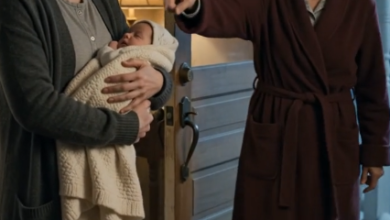
At 6:22 Christmas morning, Rachel opened her eyes to the smell of coffee.
Not good coffee. Instant coffee. But made.
Caleb stood beside her bed wearing pajama pants too short at the ankles and one of Daniel’s old flannel shirts over his T-shirt. His hair stuck up on one side. His face was solemn in the way children become solemn when trying to make a moment feel official.
“Merry Christmas,” he said.
Rachel sat up, confused.
He placed the wrapped shoebox in her lap.
“I got you something.”
Her heart twisted.
“Baby, you didn’t have to—”
“I wanted to.”
She looked at the red ribbon.
“Where did this come from?”
“Mrs. Alvarez.”
Rachel blinked.
“And the box?”
“College girls upstairs.”
“The paper?”
“Father Miguel.”
“The gift?”
Caleb swallowed.
“Me.”
Rachel went very still.
He looked suddenly afraid.
“Not like that. I mean, I made it.”
She opened the box.
Inside was the composition book, the wooden ornament, and a folded note on top.
Mom, I know you wanted to buy me the red truck. I wanted it too. But I made you this because I think you forgot how many presents you already gave me.
Rachel covered her mouth.
Caleb stood with his hands clenched at his sides.
She opened the book.
By page three, she was crying.
By page seven, she could no longer read aloud.
By page twelve, there was a knock at the door.
Mrs. Alvarez stood there with a plate of warm cinnamon rolls.
Behind her were Mr. Chen, the college girls from 4B, Father Miguel, and Pete from the diner holding the red remote-control truck in a Walton’s Market bag.
Rachel stared at them.
Pete looked uncomfortable, as if kindness made him itch.
“Kid came by the diner last week asking if extra chores were legal,” he said. “Figured somebody should look into the truck situation.”
Caleb’s eyes widened.
“Mr. Pete.”
“Don’t get used to it,” Pete muttered, but his eyes were wet.
The entire hallway went quiet when Rachel held up the composition book with shaking hands.
Nobody clapped.
Nobody made a speech.
They just stood there, looking at a poor mother who thought she had failed Christmas and a little boy who had turned her invisible love into pages no one could ignore.
Part 4
Rachel did not open the red truck right away.
That surprised Caleb.
For a moment, he looked worried, as if some rule of Christmas had been broken and he had failed to understand it. Pete stood in the hallway with the bag hanging from one hand, Mrs. Alvarez balanced the plate of cinnamon rolls against her hip, and Father Miguel pretended to inspect the broken light fixture overhead because he was the kind of man who gave people privacy by looking at ceilings.
Rachel kept holding the composition book.
The truck was wonderful.
Of course it was.
Red plastic, black wheels, small remote taped inside the box. The exact one from the bottom shelf at Walton’s Market. The one she had carried halfway to the register before shame turned her around.
But the book in her lap felt heavier than any toy.
Not heavy with sadness.
Heavy with proof.
She turned another page.
The time you worked on Thanksgiving and came home with mashed potatoes in a cup for me.
The time you made Dad’s shirt into a pillow because I said I forgot his smell.
The time you let me sleep in your bed during the thunderstorm, even though you said you were not scared, but I think maybe you were too.
Rachel pressed the page against her chest.
No mother wants her child to notice sacrifice too early. There is a particular ache in being loved by a child old enough to see what you tried to hide and young enough to think it is their job to comfort you for it.
She reached for Caleb.
He came to her immediately.
She pulled him into her arms, the shoebox tipping sideways, the ribbon sliding onto the floor.
“I’m sorry,” she whispered into his hair.
He pulled back just enough to frown at her.
“For what?”
“For making you worry about grown-up things.”
Caleb thought about that.
Then he said, “I don’t worry about them all the time.”
That was not the reassurance he meant it to be, but Rachel laughed through tears because it was honest and because the alternative was breaking apart.
Mrs. Alvarez set the cinnamon rolls on the counter and began quietly clearing space as if she had lived there her whole life. Mr. Chen fixed the loose chain on the window blinds without being asked. The college girls plugged in the old lights again and twisted one bulb until it flickered back to life. Pete put the truck on the kitchen table, then stood awkwardly near the door with both hands in his coat pockets.
Rachel looked up at him.
“You didn’t have to do this.”
Pete shrugged.
“Probably true.”
“Thank you.”
He glanced at Caleb.
“Thank the kid. He negotiated.”
Caleb looked embarrassed.
“I asked if I could wash dishes.”
“He’s ten,” Rachel said.
“I said no,” Pete answered quickly. “Relax. I gave him napkins to fold for exactly seven minutes and then felt weird about it.”
Father Miguel smiled.
“Generosity can be inefficient.”
Pete pointed at him.
“Don’t start churching this up.”
They laughed then, all of them, and the hallway seemed warmer than the space heater could explain.
Later that morning, after everyone left and the apartment was quiet again, Caleb finally opened the truck. He did it carefully, saving the twist ties because Rachel had taught him that small useful things should not be thrown away too quickly. The truck bumped across the kitchen floor, crashed into a chair leg, reversed, spun, and knocked over one of Daniel’s old work boots by the door.
Caleb froze.
Rachel did too.
The boot fell sideways, laces spilling open.
For three years, she had not moved those boots.
She cleaned around them. She warned Caleb not to trip over them. She told herself they stayed because grief had a right to occupy space, though some nights she wondered whether she kept them there because if Daniel’s boots remained by the door, some impossible part of him had not fully left.
Caleb set the remote down.
“I’m sorry.”
Rachel looked at the boot.
Then at the wooden ornament in her hand: Mom, Dad, Me.
She stood, walked to the door, and picked up the boot.
It was heavier than she expected, filled with dust, memory, and the shape of a man’s foot that would never return home from work. She held it for a long moment, then placed it upright beside the other.
“No,” she said softly. “It’s okay.”
That was the quiet ending of one kind of waiting.
Not all grief.
Just the part that believed nothing could be touched.
In January, Rachel started carrying the composition book in her work bag. She did not show it to customers or talk about it during lunch breaks. But on hard days, when someone complained that coffee was cold or sent back eggs twice, when her feet hurt and tips were low and the rent sound started knocking around in her head, she would go into the supply closet, open one page, and remember that Caleb had been counting something other than what she lacked.
Page eighteen became her favorite.
The time you sang in the kitchen even though you said you had a bad voice. You do have a bad voice, but it made the apartment feel less empty.
She laughed every time.
By February, Mrs. Donnelly submitted a copy of Caleb’s book project to a district writing showcase without using Rachel’s full story, only with permission to share a few pages. The title made several teachers stop at the display table: The Book of Things Mom Gave Me Without Buying Them. Parents read it during conference night and grew quiet. Some took photos. One father wiped his eyes and told his teenage daughter they should call Grandma.
Rachel attended the showcase in her diner uniform because she came straight from work.
Caleb stood beside her, proud and embarrassed.
A woman she did not know approached and said, “You must be an amazing mother.”
Rachel almost corrected her.
She almost said she was late on bills, tired too often, impatient some mornings, afraid almost every night. She almost said amazing mothers probably had better boots, full refrigerators, emergency savings, and gifts under real trees.
Instead, she looked at Caleb.
“I’m his mother,” she said.
That felt truer.
Spring came slowly.
The space heater went back into the closet. The apartment windows opened. Daniel’s boots moved from the door to a small shelf Rachel made from scrap wood Mr. Chen helped sand. She placed the wooden ornament between them, not as a shrine, but as a marker of a family that had changed shape and remained a family anyway.
Caleb still played with the red truck, though not as much as Rachel expected. The batteries died twice. The left front wheel started wobbling by March. He kept it on the windowsill beneath the paper snowflakes he refused to take down until Easter.
One evening, Rachel asked him why.
He shrugged.
“It reminds me of the book.”
“The truck does?”
“Kind of.”
“How?”
He thought carefully, as he always did when feelings required engineering.
“Because I wanted it a lot. But then everybody helped get it. So now when I see it, I don’t just think about the truck.”
“What do you think about?”
He looked out the window, where the laundromat sign blinked below and Mrs. Alvarez crossed the sidewalk with a grocery bag in each hand.
“I think maybe we’re not as alone as we thought.”
Rachel turned away under the excuse of stirring soup.
Some sentences from children are too large to receive while looking directly at them.
Years later, the red truck would sit on a shelf in Caleb’s room, scratched and dusty, long after he outgrew it. The composition book stayed with Rachel, its cover softened from being opened again and again. On the inside flap, she eventually taped a photograph from that Christmas morning: Caleb in Daniel’s flannel, Rachel holding the book, Pete half-visible in the doorway with the toy bag, Mrs. Alvarez smiling like she had known all along the day would become something worth remembering.
When Caleb became a teenager, he sometimes rolled his eyes at Rachel’s sentimentality, as teenagers must. But he never asked her to put the book away. Once, during a winter much later, when money was better but life was still life, Rachel found a new page tucked inside the back cover.
The time you kept the book.
That was all it said.
She sat on the edge of her bed and held the page for a long while, listening to the heat come through the vents in an apartment that no longer shook above a laundromat.
On Christmas mornings after that, Rachel still gave gifts when she could.
Socks. Books. A better winter coat. A used guitar Caleb swore he would learn and mostly did. But every year, before anything was unwrapped, she took out the wooden ornament and placed it somewhere visible.
Mom, Dad, Me.
Three stick figures.
One child’s handwriting.
A poor Christmas that had somehow become the richest memory in the room.
And when Rachel thought back to that night in Walton’s Market, to the red truck she could not buy and the shame she thought would follow her home forever, she no longer remembered only the aisle, the sighing woman, the cashier, or the fifty-seven cents in her pocket.
She remembered dawn.
A shoebox.
A boy in a too-big flannel shirt.
And the sentence that changed the shape of her grief.
I think you forgot how many presents you already gave me.
Follow this page for more heartfelt stories about family, dignity, and the quiet love people give when they think no one notices. 🌷