A Biker Ripped Away a Blind Man’s Cane and Ran — Then He Returned With a New One Made From His Dead Brother’s Harley
The biker tore the white cane from my hand and ran before I could call for help, leaving me blind, disoriented, and surrounded by strangers who believed they had just witnessed a robbery.
My name is Samuel Reed. I was sixty-three years old, had been blind for nearly sixteen years, and knew the sidewalks along Central Avenue in Albuquerque better than many sighted people knew their own kitchens.
That afternoon, rain had turned the pavement into noise.
Water hissed beneath passing tires. Shoes slapped through puddles. A loose metal sign knocked against a pole somewhere to my right. The storm drains swallowed runoff with a deep rushing sound that made every intersection harder to read through my cane.
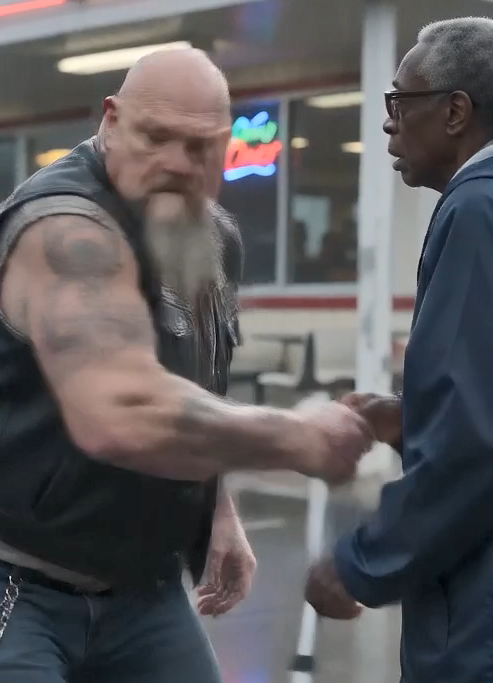
I had stopped beneath the awning of a Route 66 diner when a line of motorcycles pulled into the parking lot.
The first Harley shut down ten feet away.
Heavy boots crossed wet concrete. Leather creaked. A chain wallet struck denim. The biker smelled of rain, gasoline, and engine heat.
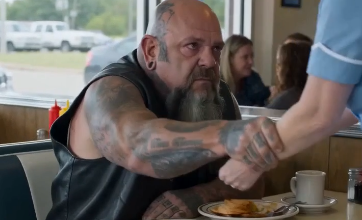
“Sir,” he said. “I need your cane.”
I tightened my grip.
“No.”
He took it anyway.
One second, the handle rested against my palm. The next, a hand closed around the shaft, twisted it free, and disappeared into the rain.
“Hey!”
People shouted.
Someone yelled that the biker had robbed a blind man. Chairs scraped behind me. A woman ran past while calling police. Three men chased the thief across the parking lot.
I could do nothing but stand beneath the awning with one hand extended into empty space.
The cane was not an accessory. It was how I measured curbs, located steps, found doorways, detected obstacles, and told my body where the safe ground ended. Without it, the familiar sidewalk vanished beneath my shoes.
A second biker approached but stopped before touching me.
“My name is Leon,” he said. “I’m with the man who took your cane. May I offer you my arm?”
“You’re with him?”
“Yes.”
“Then bring it back.”
“He saw something.”
“What?”
Before Leon could answer, a child screamed.
The sound came from beyond the parking lot, near the drainage channel bordering the road. It was followed by another noise—water striking concrete, people shouting, then a man barking orders in a voice deep enough to cut through the storm.
“Hold my boots!”
I recognized the first biker’s voice.
His name was Ray “Hammer” Dawson. I learned that later. At the time, he was simply a six-foot-four, 285-pound stranger with my cane and a crowd chasing him.
Leon guided me toward the sound after receiving my permission. We moved slowly, his arm steady beneath my hand. Rain struck my face while the voices ahead became clearer.
A maintenance grate had shifted under the force of the runoff. An eight-year-old boy had slipped into the shallow drainage channel and been carried toward the narrow opening beneath the roadway. His mother could see his hands, but she could not reach him.
Hammer lay flat on the flooded pavement while two bikers anchored his legs. My cane extended beyond his arm into the channel.
“Grab the handle!” he shouted.
The boy cried that he could not.
Hammer moved farther forward.
Metal scraped concrete.
Then I heard my cane bend.
The crowd went silent for half a breath before several people pulled together. A child coughed. A woman sobbed. Someone shouted for blankets.
The boy was alive.
My cane was not.
Hammer approached me after paramedics arrived. His breathing was heavy. Water dripped from his beard onto his leather vest. He placed the broken sections into my hands but kept hold of them long enough to make sure I had a secure grip.
“I’m sorry,” he said.
“You should be.”
“I know.”
“You could have asked.”
“I did.”
“You could have waited for my answer.”
“The kid couldn’t.”
That evening, Hammer gave me a standard replacement cane purchased from a medical-supply store. I expected that to end our connection.
It did not.
The following morning, thirty Harleys stopped outside my apartment, and Hammer placed a second cane across my palms. Its professionally fitted shaft was lightweight and reflective, but its curved chrome grip had been shaped from an old motorcycle handlebar.
A name was engraved beneath my thumb.
Daniel Dawson.
Hammer’s older brother.
The man whose blindness had once taught the frightening biker exactly what taking my cane would cost me.
Want to know what happened to Daniel and why Hammer had saved his Harley’s handlebar for fourteen years? Drop CANE in the comments — I’ll share more soon.
Part 2 — The Sidewalk I Knew by Sound
Losing my sight did not happen at once.
For several years, the edges disappeared first. Doorframes surprised my shoulders. People seemed to enter conversations without approaching. Streetlights developed halos, and printed words required stronger lamps until light itself became more glare than help.
The diagnosis was retinitis pigmentosa.
Doctors used careful language. Progressive. No cure. Adaptation. Training. Each word sounded reasonable until I returned home and stood in the kitchen, unable to find the mug I had used every morning for eleven years.
I was forty-seven.
I taught music at a community college and played piano at a hotel lounge three nights a week. My hands knew intervals, chords, and the distance between keys without help from my eyes. I told myself music would make blindness easier.
It did not.
Music gave me one room in which I remained competent. Everywhere else, I became afraid of pouring coffee, crossing streets, accepting help, and rejecting too much of it.
The white cane changed that.
I hated it initially. The tapping announced my blindness before I could decide whether strangers deserved to know. People raised their voices when speaking to me. Some grabbed my arm without permission. Others became so determined not to offend me that they refused assistance when I asked directly.
My orientation and mobility instructor, Denise Harper, taught me to separate the tool from the reactions it created.
“The cane isn’t asking anyone to pity you,” she said. “It’s gathering information.”
I learned curb detection, shoreline travel, auditory alignment, controlled crossings, and public transit. I learned that independence did not mean doing everything without people. It meant deciding what assistance I accepted and how it was given.
By the afternoon Hammer took my cane, it had become an extension of my body.
It was a graphite folding model with a rolling tip, sized to my stride and marked with a strip of blue tape beneath the handle. I knew the weight of every segment. I could tell whether one joint had not seated correctly by the slight change in vibration.
Hammer noticed none of that when he grabbed it.
What he noticed was reach.
He had parked with the Iron Lanterns because the rain had become too heavy for safe riding. Thirty motorcycles crowded the diner lot while their riders waited for the storm to weaken.
Hammer was their road captain.
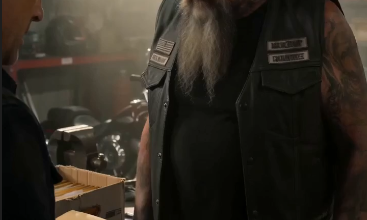
People described him to me afterward: white, fifty-six, shaved head, long salt-and-pepper beard, tattooed forearms, scarred knuckles, plain black leather vest, faded shirt, jeans, chain wallet, and heavy boots. I did not need the description to understand why people feared him. Fear altered voices. It tightened breathing and changed the distance strangers kept from a man.
Hammer had been watching the drainage channel when the grate shifted.
The child, Mateo Ruiz, stood beneath an umbrella beside his mother. A sudden surge of runoff pushed water across the sidewalk. Mateo stepped backward, the loosened grate tilted, and his leg dropped through the opening.
His mother caught his coat.
Then the fabric tore.
He fell into the channel.
Hammer crossed the parking lot while everyone else was still trying to understand what had happened. The opening beneath the road was too narrow for an adult, and the water prevented anyone from safely climbing into the channel without equipment.
Emergency services were called immediately.
They were several minutes away.
Mateo did not have several minutes.
Hammer saw my cane and calculated the distance without considering what removing it would do to me. He asked once. I refused because I did not understand his urgency.
Then he made the choice.
Leon told me later that three members of the club nearly stopped him.
Boone Mercer caught Hammer’s shoulder as he ran.
“You just stole a blind man’s cane.”
“Kid in the drain.”
Boone released him.
Leon returned to me because Hammer shouted, “Don’t leave him alone.”
That detail mattered.
It did not excuse the theft. It did not restore my control. But Hammer had not forgotten that I would be stranded without the tool. In the four seconds available, he assigned someone to remain with me.
His brother had taught him that.
I knew nothing about Daniel Dawson then.
I only knew Hammer had destroyed a cane that took weeks to replace through insurance and expected an apology to settle the debt.
He learned quickly that I did not accept simple endings.
Part 3 — The Child Beneath the Road
Leon guided me toward the drainage channel while describing the ground beneath us.
“Pavement slopes down. Puddle ahead. Step left.”
His voice remained calm despite the shouting. He did not pull me, steer my shoulders, or grab my wrist. He allowed me to hold his arm just above the elbow and moved half a step ahead.
Someone had taught him proper sighted-guide technique.
I wondered who.
At the edge of the crowd, the sound became a map.
Mateo’s mother cried from the left. Several people stood in the roadway, warning drivers to stop. Water rushed below us. Hammer lay near the channel opening while Boone and two other bikers held his boots and belt.
My cane scraped against concrete.
“Kid,” Hammer called, “I’m putting a handle near your right hand.”
Mateo coughed.
“I can’t see it!”
“You don’t need to see it. Listen to my voice.”
There was irony in that sentence no one else understood yet.
Hammer moved the cane through the water. The rolling tip struck the wall twice. He adjusted the angle, careful not to jab toward the child’s face.
“Your hand is six inches left.”
Mateo cried that the water was pulling him.
“I know,” Hammer said. “Grab when it touches you.”
A woman shouted that rescuers were less than two minutes away.
Hammer answered without looking back. “Keep them coming.”
He was not pretending to replace professionals. He was trying to maintain the child’s position until they arrived.
The cane handle struck something soft.
Mateo screamed.
“My arm!”
“Can you close your hand?”
“Yes.”
“Then hold.”
Hammer instructed the men behind him to pull only enough to keep tension. The cane was never designed to carry a child’s weight against moving water. Its folding joints began to slip.
I heard the first one crack.
“That’s going to break,” I said.
Leon relayed the warning.
Hammer answered, “I know.”
The boy’s mother pleaded with him to hurry.
Hammer did not.
A panicked pull could have torn the cane from Mateo’s grip or broken it before another reach was possible. Hammer kept speaking, guiding the child closer in inches.
The second joint bent.
Then firefighters arrived.
They brought proper rescue equipment, stabilized the opening, and took control. Hammer continued holding the cane until a firefighter secured Mateo with a rescue line and lifted him from the channel.
The crowd erupted when the child appeared.
Mateo coughed, cried, and called for his mother. Paramedics wrapped him in blankets and transported him for evaluation. He had bruises and mild hypothermia but no serious injury.
People surrounded Hammer.
The same strangers who had chased him moments earlier now tried to shake his hand, touch his shoulder, and record his face. He ignored them.
He came to me.
The broken cane arrived in four pieces.
One joint had separated completely. Another remained attached by internal cord. The shaft carried deep scratches where it had struck the concrete channel.
Hammer placed the handle in my palm.
I folded my fingers around it.
“Mateo?” I asked.
“Talking.”
“Hospital?”
“Going now.”
“Then your emergency is over.”
“Yes.”
“Mine isn’t.”
The crowd quieted.
Without my cane, I could not walk home independently. The blue tape beneath the handle identified it as mine, but the rest of the shaft had become unusable.
Hammer apologized.
I told him an apology was not transportation.
He offered his arm.
I refused.
He offered to drive me home.
I asked whether he expected a blind man to climb onto the back of a motorcycle in a thunderstorm after having his cane stolen.
Leon laughed once, then disguised it as a cough.
Hammer did not laugh.
“No,” he said. “Truck.”
I accepted after he identified himself, described the vehicle, and agreed that Leon would ride with us. Before leaving, Hammer purchased the only mobility cane available from a nearby medical-supply store.
It was the wrong length.
The tip was wrong.
The grip felt cheap, and the shaft transmitted almost no useful feedback. It could keep me from walking into a wall, but it could not return the precise information my own cane had provided.
Hammer heard my frustration.
“Tell me what’s wrong with it.”
“Everything.”
“Specific.”
So I explained.
The cane required proper sizing. The shaft needed low weight with strong vibration transmission. The reflective section had to remain visible. The handle shape mattered because hours of use could create pressure points. The tip needed to match my technique.
Hammer listened like a mechanic receiving a fault report.
When we reached my apartment, he walked me to the door but did not touch me without asking. Rainwater dripped from his vest onto the hallway floor.
“Tomorrow,” he said.
“Tomorrow what?”
“I fix the specific things.”
“This isn’t a motorcycle.”
“No.”
“You cannot weld me a medical device in your garage.”
“No.”
“Then what are you planning?”
“Calling someone who knows more.”
That answer was the first reason I believed he might return.
Part 4 — Daniel’s Handlebar
Hammer’s older brother Daniel lost his sight at forty-one after complications from an autoimmune condition damaged both optic nerves.
Before that, Daniel had ridden motorcycles for twenty-five years.
The brothers bought their first broken Harley together when Hammer was seventeen and Daniel was twenty-two. The motorcycle arrived in boxes, its fuel tank dented, its wiring ruined, and one handlebar bent nearly three inches out of alignment.
They rebuilt it in their father’s shed.
Daniel taught Hammer to hear compression, feel a loose bearing through the frame, and stop forcing a bolt when the threads no longer felt right. Hammer learned engines from his brother before he learned them from any manual.
The motorcycle became Daniel’s.
When his sight began failing, he kept riding longer than he should have. Hammer knew it. Daniel knew it. Neither wanted to say aloud that the machine was becoming unsafe in his hands.
The final ride ended without injury.
Daniel returned from a short trip after dusk, parked inside Hammer’s garage, and handed over the key.
“You keep it,” he said.
Hammer refused.
Daniel placed the key on the workbench and walked away from the motorcycle without touching it again.
For nearly a year, he barely left his apartment.
He rejected cane training because the first folding cane issued by his clinic felt flimsy compared with the solid controls of a motorcycle. He said it made him look helpless. He said he knew every room in his home. He said people would move around him.
Then he walked into a half-open garage door and broke his nose.
That was when he met Denise Harper, the same orientation and mobility instructor who later trained me.
I did not know Daniel. Our training periods were years apart, but Denise remembered him. Hammer called her the night after Mateo’s rescue and explained what he had done to my cane.
Her response was not gentle.
“You took it without consent?”
“Yes.”
“You left him unsupported?”
“Leon stayed.”
“You still took his mobility.”
“Yes.”
“Did you save the child?”
“Yes.”
“Both things can be true.”
Hammer repeated that sentence to me later.
Both things can be true.
He had used the only tool long enough to reach Mateo. He had also stripped away my independence without giving me time to understand.
Daniel had taught him how serious that was.
During Daniel’s first training session, he swung the cane too hard, complained about every instruction, and accused Denise of talking to him like a child. She placed the cane against his palm and told him he could leave whenever he wanted.
He could not find the door.
The silence that followed changed him.
Within six months, Daniel traveled independently through Albuquerque. Within a year, he volunteered at a veterans’ rehabilitation center, teaching newly blind mechanics how to label tools and organize workspaces by touch.
He never rode alone again, but Hammer built a sidecar so they could continue traveling together.
The original Harley remained in the garage.
Daniel died fourteen years before I met Hammer. Cancer took him at fifty-two, after three months in which the brothers said little about death and argued constantly about spark plugs, baseball, and hospital coffee.
Hammer sold most of Daniel’s motorcycle to finance adaptive equipment for the rehabilitation center. He kept three things: the key, the dented fuel tank, and the original chrome handlebar they had straightened as teenagers.
The handlebar hung above his workbench for fourteen years.
After he broke my cane, Hammer removed it.
He did not intend to turn an entire steel motorcycle handlebar into a heavy, unsafe mobility device. Denise stopped that idea before he voiced it fully. Instead, she connected him with Luis Ortega, a certified assistive-technology specialist who built and fitted custom mobility tools.
Together they designed a proper cane.
The shaft remained lightweight graphite with reflective white and red sections. The folding joints met professional specifications. The rolling tip suited my travel technique.
Only the grip carried Daniel’s Harley.
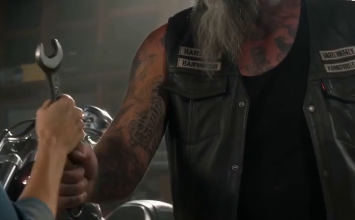
Luis cut a short section from the old handlebar, reduced unnecessary weight, rounded every edge, and fitted it over a balanced handle core. Hammer polished the chrome but left one shallow scratch from the brothers’ first repair.
Beneath the grip, he engraved a name.
DANIEL DAWSON.
Not as decoration.
As provenance.
The last motorcycle control his brother had held became the handle of a tool that allowed another blind man to move forward.
Part 5 — The Cane Across My Palms
Thirty motorcycles arrived outside my apartment the next morning.
Hammer had told the club not to come.
That was why they came.
Boone said brotherhood did not mean helping only when invited. Leon said brotherhood sometimes meant standing far enough away to avoid making the help about yourself.
They compromised by parking across the street.
I heard the engines settle into silence before someone knocked on my door. Hammer identified himself. Denise and Luis stood with him to ensure the fitting was performed correctly.
“You brought witnesses?” I asked.
“Experts.”
“Better.”
Luis placed the new cane across my palms.
The chrome grip felt cool. It was heavier than foam but balanced by the handle core. My thumb found the old scratch.
“What is this?”
“Part of Daniel’s handlebar,” Hammer said.
I did not answer immediately.
He told me the story without embellishment. No dramatic claims that Daniel guided his hands. No suggestion that the gift repaid what he had taken. Hammer understood replacement and restitution were not identical.
“I damaged your cane,” he said. “This one doesn’t erase that.”
“No.”
“I used his handlebar because he hated his first cane.”
“So did I.”
“He learned better.”
“So did I.”
Hammer placed Daniel’s motorcycle key in my other hand.
“This stays with you if you want it.”
I closed my fingers around the key. “Why?”
“He’d say the handle needs a key.”
“That makes no practical sense.”
“He didn’t always require sense.”
Denise fitted the cane and observed while I tested it along the hallway. The length matched my stride. The rolling tip followed the floor cleanly. Vibrations traveled through the shaft and reached the chrome grip with surprising clarity.
The handlebar had once transmitted an engine’s movement.
Now it transmitted the sidewalk.
At the front steps, thirty bikers waited without speaking. I tapped the edge, located the first drop, and descended.
Boone approached only after asking permission.
“Mr. Reed, Mateo’s family is here.”
The boy stood beside his mother. His voice was smaller than I expected. He apologized for breaking my cane.
“You didn’t break it,” I told him.
“The water did.”
“Then the water owes me an apology.”
Mateo laughed.
He placed a folded card in my hand. The paper carried raised lines. Denise had helped him create a tactile drawing of the rescue: a drainage channel, several people holding one another, and a long cane reaching toward a small hand.
“Which one is Hammer?” I asked.
Mateo guided my fingers toward the largest figure.
Of course.
His mother thanked me for allowing Hammer to use the cane.
“I didn’t allow it.”
Her voice faltered.
“That matters,” I said. “But your son being alive matters too. Both things are true.”
Hammer stood several feet away.
He recognized Daniel’s lesson when he heard it.
The crowd that chased him had also gathered. Some wanted photographs. I refused. Mateo’s rescue belonged to him and his family before it belonged to anyone’s social-media feed.
One woman asked whether I forgave Hammer.
“Forgiveness isn’t a switch,” I said. “Ask whether the cane works.”
I crossed the sidewalk.
The new cane found every seam, curb, and obstacle. The chrome grip warmed beneath my palm.
“It works,” I said.
Hammer’s boots shifted against the pavement.
That was the only relief he allowed himself to show.
Part 6 — The Route 66 Drain Walk
The city repaired the broken grate and inspected similar drainage points along Central Avenue. Mateo’s mother had reported the loose metal two weeks earlier, but the request had been routed incorrectly. The rescue forced officials to examine how those reports were prioritized.
Hammer distrusted promises.
Every month during the rainy season, the Iron Lanterns walked the route with neighborhood volunteers. They did not enter drains or perform technical inspections. They reported visible hazards, marked safe distances, and kept pedestrians away until city crews arrived.
The motorcycles remained parked.
The work happened on foot.
I joined them.
At first, thirty bikers moved like thirty independent weather systems. They blocked sidewalks, spoke over one another, and assumed holding a blind person’s elbow counted as assistance.
I trained them.
“Ask before touching.”
“Let the person hold your arm.”
“Describe obstacles before reaching them.”
“Do not move someone’s cane.”
Boone raised his hand during the first session.
“What if a kid is being pulled into a drain?”
The room became quiet.
I turned toward his voice.
“Then you may hear me complain afterward.”
Hammer almost laughed.
The club also raised money for replacement mobility equipment not fully covered by insurance. They refused to name the fund after Daniel because Hammer did not want his brother reduced to a plaque.
We called it the Keep Moving Fund.
Mateo contributed the first seven dollars from his allowance.
My custom cane remained my daily tool. The chrome grip developed fine scratches from walls, tables, bus seats, and ordinary life. Hammer offered to polish it.
I refused.
“Daniel left one scratch,” I said. “I’m adding mine.”
On the anniversary of the rescue, I visited Hammer’s garage. Daniel’s dented fuel tank still hung above the workbench, but the space where the handlebar had rested was empty.
Hammer had mounted my broken cane beneath it.
“You kept that?”
“History.”
“It looks terrible.”
“Accurate history often does.”
He had joined the four broken sections without hiding the damage. The bent joint remained visible. Beneath it, he placed Mateo’s tactile drawing.
No caption.
None was needed.
Part 7 — The Handle That Remembered Two Roads
Three years after the storm, Mateo walked with me along Central Avenue.
He was eleven, taller, and embarrassed by the rescue story whenever adults told it too loudly. I understood. Being saved could become another identity strangers forced upon a person.
We did not discuss the drain.
He described passing buses, storefronts, traffic lights, and a dog asleep beneath a café table. I corrected him when he said “over there” instead of giving a useful direction.
Hammer followed behind us with Leon.
Their boots remained several steps back.
At the repaired drainage channel, Mateo stopped.
“You knew we were here?” he asked.
“The water sounds different against the new grate.”
He listened.
“I don’t hear it.”
“You don’t have to hear everything I hear.”
We stood there while traffic moved along Route 66. My cane rested against the curb, Daniel’s chrome handle warm beneath my palm.
Hammer approached.
“Drain secure?” he asked.
“Ask the city engineer.”
“Looks secure.”
“You once believed looking was enough.”
“Not anymore.”
Mateo asked about the handlebar again. Hammer told him how Daniel and he rebuilt the old Harley, how they straightened the chrome in their father’s shed, and how Daniel later learned to travel with a cane.
“What happened to the motorcycle?” Mateo asked.
“Most of it helped buy equipment for other people.”
“And the handlebar?”
Hammer tapped the grip gently with one scarred knuckle.
“Still traveling.”
The Iron Lanterns waited at the far end of the block. Their motorcycles stood in a long dark line beneath the evening light. Engines started one by one when we reached them.
Hammer offered me his arm.
I took it.
Not because I could not walk independently. My cane worked. The sidewalk was familiar. The crossing signal emitted a clear audible pattern.
I accepted because companionship was not the opposite of independence.
At my apartment, Hammer placed Daniel’s old motorcycle key in my hand. I still carried it on the same ring as my front-door key.
“Handle holding up?” he asked.
“Better than the man who made it.”
“That was Luis.”
“Then definitely better.”
He laughed, climbed onto his Harley, and pulled away with the club. The engines rolled west along Central Avenue until traffic swallowed their sound.
I unfolded the cane and found my front step.
Chrome touched pavement.
The road answered.
Follow our page for more powerful biker stories about frightening misunderstandings, quiet rescues, tested brotherhood, and the unexpected objects that carry love farther than anyone planned.