A BIKER JUMPED OFF HIS MOTORCYCLE AND PUNCHED THROUGH THE WINDSHIELD OF AN AMBULANCE ON AN EMERGENCY RUN—THEN HE STEPPED BACK AND SCREAMED, “CHECK THE STRETCHER!”
Part 2
The biker was in the back of the ambulance before the nurse finished the word.
He climbed in past her without asking. He ripped off his torn gloves and threw them on the floor.
“Bag-valve mask,” he said. “Where?”
The nurse stared at him.
“Left cabinet,” she stammered. “Who are you?”
“Respiratory therapist. Pediatric ICU.” He already had the cabinet open. “Get your intubation kit. I’ll bag her. Go.”
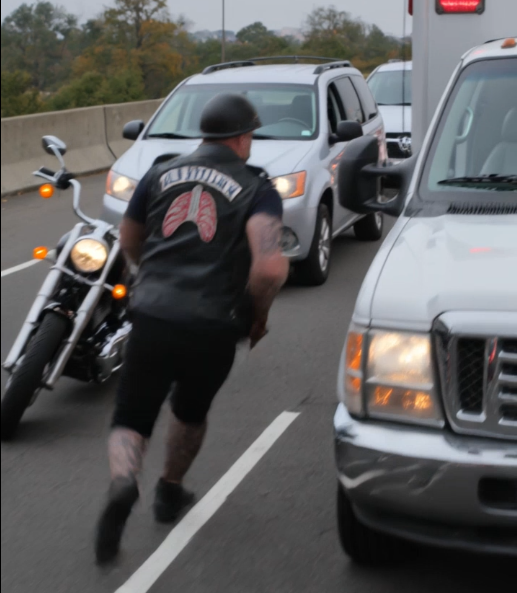
Erica stood frozen at the back doors with both hands over her mouth.
The huge man fitted a clear mask over Paisley’s nose and mouth and began squeezing the bag in a slow, steady rhythm. His enormous tattooed hands were completely steady. He watched her chest rise and fall.
“Come on, sweetheart,” he murmured. “Come on. Breathe with me.”
The nurse tore open a sterile kit with shaking fingers.
“Sats are at sixty-eight,” she said.
“I know. We’ll get them back. Stay calm.”
Paisley’s small body was still twitching. The monitor shrieked.
Squeeze. Release. Squeeze. Release.
Erica couldn’t breathe. She could only watch the gray in her daughter’s lips and the numbers on the screen.
Seventy-two.
Seventy-nine.
Eighty-six.
Paisley’s body went still. The seizure stopped.
The nurse leaned over with a laryngoscope, a small lighted blade. Her hands were trembling.
“I’ve got you,” the biker said quietly, still bagging. “You know how to do this. Take your time.”
The nurse took a breath. She slid a fresh breathing tube down Paisley’s throat in one smooth motion.
“Tube’s in.”
The biker connected the bag to the tube and kept squeezing. He listened to both sides of Paisley’s chest with the nurse’s stethoscope.
“Good breath sounds both sides,” he said. “You did it.”
Ninety-two.
Ninety-six.
The monitor stopped screaming.
Erica’s knees gave out. She sat down hard on the bumper of the ambulance and sobbed.
Sirens wailed up the shoulder of the interstate. An Oklahoma City police cruiser pulled in behind the ambulance, followed by a highway patrol car.
The officer who stepped out had watched the video somebody had already sent to dispatch. A biker had punched an ambulance.
He walked straight to the back doors with his hand on his belt.
“Sir,” he said to the huge man kneeling in the ambulance, “step out of the vehicle. Now. Hands where I can see them.”
Part 3
The biker didn’t argue.
He handed the breathing bag to the nurse. He showed her the rhythm one more time, squeeze, release, every three seconds. Then he climbed out of the ambulance with his bleeding hands raised.
The officer turned him around against the side of the ambulance and handcuffed him.
“Wait,” Erica gasped from the bumper. “Wait, he—”
“Ma’am, we’ve got multiple 911 calls,” the officer said. “Including yours. He assaulted an emergency vehicle on an active run.”
Erica’s face went hot. She had called 911 on him. She had told them he was harassing the ambulance.
The ambulance driver, Brian Hughes, had climbed out of the cab. He was staring at the shattered windshield with his hands on his head.
“We need to get her to Meridian,” he said shakily. “Now. We can’t drive with that windshield.”
“Fire’s sending a second unit,” the highway patrol trooper said. “Three minutes.”
Erica looked at the handcuffed biker.
He was looking past the officer, into the back of the ambulance, watching the nurse squeeze the bag. He was watching Paisley’s chest rise and fall.
Paisley had been sick with asthma since she was two. Most of the time, an inhaler was enough. Sometimes it meant a night in the ER.
But at four o’clock that morning, it was different. Paisley woke up gasping and couldn’t stop. Her lips turned blue in the car on the way to Shawnee Regional. By six, the doctors had put a breathing tube down her throat and connected her to a ventilator.
She needed a pediatric ICU. The closest one was at Meridian Children’s Hospital in Oklahoma City, forty minutes away.
Meridian sent its own critical care transport ambulance to pick her up.
Erica wasn’t allowed to ride along. So she had followed in her minivan.
She had watched the whole way. She had never once seen anyone in the back window of that ambulance with her daughter.
The second ambulance arrived. The crew moved Paisley across, and the nurse climbed in beside her, still bagging.
Erica turned to the officer.
“Please,” she said. “Where are you taking him?”
“County jail, ma’am. He’ll be charged.”
The biker looked at her for the first time. His eyes were dark and tired.
“Go with your daughter,” he said quietly. “Don’t worry about me.”
Part 4
Paisley reached the pediatric ICU at Meridian Children’s Hospital at 8:42 a.m.
By ten o’clock, she was stable. Her oxygen levels were normal. The doctors ran a scan of her brain to check for damage from the minutes she’d gone without air.
At eleven, they came back with the results.
“It’s clear,” the pediatric intensivist told Erica. “We don’t see any injury.” She looked at the chart. “Whoever bagged her on that highway did it fast and did it right. A few more minutes and we’d be having a very different conversation.”
Erica wept in the hallway.
At noon, two people in business clothes walked into the family waiting room.
One was a woman with a lanyard who introduced herself as the hospital’s patient relations manager.
The other was a man in his fifties in a crisp gray suit. He shook Erica’s hand warmly.
“Mrs. Grant, I’m Phil Granger, vice president of operations for Meridian Health,” he said. “First, let me say how thankful we are that Paisley is doing well.”
“Thank you,” Erica whispered.
“Second,” Granger said, sitting down across from her, “I want you to know that Meridian takes the safety of our crews extremely seriously. What happened on that highway this morning was a violent assault on one of our ambulances while it was transporting your daughter.”
Erica stared at him.
“Our preliminary review indicates that the sudden stop caused by that individual is likely what dislodged Paisley’s breathing tube,” Granger said gently. “He put her life in danger. We’ve already shared our findings with the district attorney.”
“That’s not what happened,” Erica said slowly. “He was honking at the ambulance before. For a mile. He was trying to—”
“Mrs. Grant, you called 911 yourself and reported him for harassing the ambulance. Didn’t you?”
Erica opened her mouth. Then she closed it.
She had. She had seen him swerving and honking and thought he was dangerous.
What if Granger was right? What if the biker caused it?
“We’d like you to give a statement to the police,” Granger said, sliding a business card across the table. “And of course, Meridian will be waiving all of Paisley’s medical bills from today.”
He stood up and buttoned his jacket.
When he was gone, Erica sat alone in the waiting room for a long time.
Then the door opened again. It was the young nurse from the ambulance, still in her navy scrubs. Her face was pale.
“Mrs. Grant,” she said quietly. “I’m Lauren. Can we talk somewhere private?”
Part 5
They sat in an empty supply room at the end of the hall. Lauren Kozak closed the door and leaned against it.
“That man is lying to you,” she said.
Erica stared at her.
“Your daughter’s tube didn’t come out from the stop,” Lauren said. Her voice was shaking. “It came out before. Probably four or five minutes before. Her monitor recorded the alarms.” She swallowed. “I didn’t hear them.”
“Why not?” Erica whispered. “Where were you?”
“In the front seat,” Lauren said, and she started to cry. “Filling out the transfer forms on the laptop and calling report to the ICU on the radio.”
“Why weren’t you in the back with her?”
“Because I was supposed to have a partner,” Lauren said. “Critical care transport for an intubated child requires two clinicians in the back. Always. One to monitor the patient constantly, and one to handle the radio and the paperwork.”
“But there was only you.”
“There was only me.” Lauren wiped her eyes. “Meridian cut our transport staffing in January. Mr. Granger’s office sent a memo saying single-clinician coverage was ‘acceptable when necessary.’ It’s been necessary almost every day since.”
She pulled a folded piece of paper out of her scrub pocket.
“This is the third time this month I’ve been sent out alone with an intubated kid,” she said. “I wrote it up after the first time. And the second. I have copies of my reports right here.”
Erica looked at the paper.
“And the computer tablet in the back of the ambulance has been broken for six weeks,” Lauren said. “We put in a work order. They said there was no money in the budget to fix it. So the only way to do the transfer paperwork the hospital requires is on the laptop mounted up front.”
Erica felt sick.
“Brian, the driver, didn’t see anything either,” Lauren said. “He was driving. And that biker…” She shook her head. “He was riding right beside us, looking through the back window. He must have seen her tube come out. He must have seen her start seizing. He honked and waved for a mile. We thought he was just some road rage guy. We ignored him.”
Erica sat very still.
“Who is he?” she asked. “He knew exactly what to do. He knew it better than anyone I’ve ever seen.”
Lauren looked up at her.
“Mrs. Grant,” she said, “he works here. In the PICU. Upstairs. He’s the respiratory therapist who’s been taking care of your daughter’s ventilator all morning on the chart.”
She paused.
“Well, he was. Until they arrested him.”
Part 6
His name was Dominic Kerr.
He had been a pediatric respiratory therapist at Meridian Children’s Hospital for fourteen years. Everyone on the PICU called him Airway. He was the person doctors paged when a child’s breathing tube was difficult to place. He was the one who could calm a screaming toddler on a ventilator in thirty seconds.
He had just finished a twelve-hour night shift. He was riding his motorcycle home to Shawnee on I-40 eastbound when he saw a Meridian transport ambulance heading west.
He knew that ambulance. He knew every transport rig Meridian owned.
He glanced in the back window as it passed.
He saw a child on a stretcher. He saw a breathing tube hanging loose, and no one beside her.
He didn’t think. He crossed the median at the next turnaround and chased it.
The county released Dominic on bond at six o’clock that evening. He walked out of the jail in his leather jacket with his right hand wrapped in gauze.
Erica Grant was waiting for him in the parking lot.
“I called 911 on you,” she said before he could speak. “I told them you were harassing my daughter’s ambulance.”
“I know,” Dominic said. “You were right to. That’s what it looked like.”
“Why didn’t you tell them who you were?”
“Didn’t matter who I was,” he said. “Mattered whether she was breathing.”
He pulled out his phone.
“My helmet has a camera,” he said. “I ride with it on every day.”
He played it for her standing in the jail parking lot.
The footage showed the white ambulance from beside it at highway speed. Through the small rear window, Erica could see her daughter on the stretcher. The tube shifted, slipped, and then fell out.
Then came eight full minutes of footage. Dominic was honking. He was pulling up to the driver’s window and pointing, shouting, waving. The driver stared straight ahead. Through the windshield, the nurse sat in the front seat with a laptop open on her knees.
Then the traffic slowed. Then came the punch.
Erica put her hand over her mouth.
“There’s another one,” Dominic said. “A trucker named Gus Doyle was two lanes over the whole time. He has a dashcam. He saw me chasing the ambulance and filmed it for the cops, thinking I was a nut.” He almost smiled. “He posted it on Facebook an hour ago. Said he owed me an apology.”
Dominic’s phone buzzed.
He looked at it, and his face went still.
It was an email from Meridian Health Human Resources.
Effective immediately, you are suspended without pay pending investigation of your conduct on March 12.
It was signed by Phil Granger.
Part 7
Erica sat in Dominic’s pickup truck in the jail parking lot. Neither of them said anything for a while.
Then she noticed the tattoo on the inside of his left forearm.
Among all the other ink, there was one small, simple drawing. It was a pair of lungs, done in thin blue lines, with a single name and a year beneath them.
BEN. 2012.
“Who’s Ben?” she asked.
Dominic looked down at it for a long time.
“In 2012, I was two years into the job,” he said quietly. “Working at a hospital in Tulsa. I got sent on a transport alone. A four-year-old boy named Ben with pneumonia, on a ventilator. Rural hospital to the city. Should’ve been two of us in the back. They were short that night.”
Erica didn’t say anything.
“About twenty minutes in, he coughed hard and his tube came out,” Dominic said. “I was alone. I had to bag him, and get the new tube ready, and call it in, and watch his heart rate, all at once.” He swallowed. “It took me too long. Four minutes, maybe five.”
He looked out the windshield.
“Ben lived,” he said. “But he had a brain injury from the lack of oxygen. He’s sixteen now. He uses a wheelchair. He can’t talk much. I go see him every month in Tulsa. His mom still lets me in the door, which is more than I deserve.”
“It wasn’t your fault,” Erica whispered.
“It wasn’t only my fault,” Dominic said. “I’ve spent twelve years fighting short staffing on transports. I’ve written letters. I’ve gone to meetings. I’ve testified to the state.” He shook his head. “Nobody listens until something happens.”
He looked at Erica.
“When I saw your daughter through that window, alone, with her tube out,” he said, “I saw Ben. I’d have punched through a bank vault.”
Erica took a long, shaky breath.
“Phil Granger told me you caused it,” she said. “He wants me to give a statement against you.”
Dominic nodded slowly. “I figured.”
“I’m not going to,” Erica said.
She pulled out her phone and opened her email.
“Lauren Kozak just sent me this,” she said. “The Oklahoma City Board of Health is meeting Thursday night about ambulance staffing. Public hearing.”
She looked at him.
“We’re going,” she said.
Part 8
The Oklahoma City Board of Health met in a crowded hearing room downtown on Thursday evening.
The room was full.
Gus Doyle’s dashcam video had spread across every news station in Oklahoma. So had Dominic’s helmet camera footage, after Erica posted it with his permission. Nurses from three different hospitals had come. So had paramedics, parents, and reporters.
Thirty bikers sat in the back rows in black leather jackets. They were the Iron Lung Riders, a motorcycle club made up of respiratory therapists, nurses, and paramedics from across Oklahoma. Dominic had ridden with them for nine years.
They didn’t say a word.
Phil Granger sat in the front row with Meridian Health’s lawyer.
Lauren Kozak testified first. She laid her three staffing complaints on the table. She held up the January memo from Granger’s office: Single-clinician coverage acceptable when necessary. She held up the work order for the broken rear computer, unrepaired for six weeks.
Then Dominic’s helmet footage played on the big screen.
The room watched Paisley’s breathing tube slip loose through the ambulance’s back window. They watched eight minutes of a biker honking and pointing and shouting. Nobody inside looked.
A woman in the audience started crying.
Then the board’s chairman, Dr. Harold Wiggins, a retired emergency physician, held up a printout.
“This is the monitor data from Paisley Grant’s transport,” he said. “The low-oxygen alarm first sounded at 8:02 a.m. The ambulance windshield was broken at 8:10. That is eight minutes of an unanswered alarm on a critically ill child.” He looked straight at Phil Granger. “The tube came out long before any sudden stop. Mr. Granger, your office told the district attorney otherwise.”
Granger’s face went red.
“There’s one more thing,” Dr. Wiggins said. “Meridian Health’s annual report shows that executive bonuses this year were tied to a target for reducing transport staffing costs. Mr. Granger, did you receive one?”
Granger’s lawyer leaned over and whispered in his ear.
Granger didn’t answer.
Then the door at the back of the room opened.
Erica Grant walked in, pushing a wheelchair.
In it sat Paisley, eight years old, still pale, with a pink blanket over her lap and an oxygen tube under her nose. She had been discharged from the hospital that afternoon.
She was holding a drawing.
The room went silent as Erica wheeled her down the aisle to the front row, where Dominic was sitting.
Paisley held out the drawing to him with both hands.
It showed a giant man on a motorcycle, with a cape. He was punching through a window full of crayon cracks.
Underneath, in careful second-grade letters, it said:
MY HERO BROKE THE GLASS.
Part 9
Here’s how the rest of it went.
That night, the Oklahoma City Board of Health voted unanimously for a new rule. Every critical care ambulance transporting an intubated patient within city limits must have at least two medical clinicians in the patient compartment at all times. There are no exceptions and no “when necessary.”
The state legislature passed a similar law for all of Oklahoma six months later. People in the capitol called it Paisley’s Rule.
The district attorney dropped every charge against Dominic Kerr the next morning.
Meridian Health’s board of directors fired Phil Granger within the week. A state health department investigation found that his staffing cuts had sent critical patients out with a single clinician more than two hundred times in three months. Meridian was fined four hundred thousand dollars. It hired eighteen new transport nurses and respiratory therapists.
Lauren Kozak was promoted to transport team supervisor. Her first act was to tape a sign to the dashboard of every Meridian ambulance.
NOBODY RIDES ALONE.
Meridian reinstated Dominic with full back pay. They also offered him a new position as director of transport safety. He said yes on one condition. He wanted to keep working one night shift a week in the PICU.
A week after the hearing, an envelope arrived at Dominic’s house from Meridian Health.
Inside was a copy of the invoice for the replacement ambulance windshield. It came to eleven hundred and forty dollars. Stamped across it in red ink was the word PAID.
Behind it was a handwritten letter from the hospital’s chief executive officer.
Mr. Kerr, Meridian will cover the cost of the windshield. We could never cover what we owe you. Thank you for seeing what we failed to see.
Dominic framed both and hung them in his garage.
Paisley Grant made a full recovery. She hasn’t had a severe asthma attack in two years. She’s in fourth grade now, and she still asks her mom to drive past Meridian Children’s Hospital sometimes so she can wave at the ambulances.
Last summer, Dominic rode to Tulsa for his monthly visit with Ben. This time, Erica and Paisley drove up behind him.
Paisley sat beside Ben’s wheelchair in his family’s backyard and showed him her drawing of the man with the cape. Ben couldn’t say much. But he laughed when he saw the crayon cracks in the window, and he pointed at Dominic.
Dominic had to go stand by the fence for a while.
He never wears gloves on his right hand anymore when he rides. There’s a thin white scar across his knuckles from the windshield.
“Best glass I ever broke,” he says when anyone asks.
People see a huge, tattooed biker smash the windshield of an ambulance on the interstate, and they decide what kind of man he is before the glass hits the ground. Drivers filmed him. A mother called 911 on him. A hospital executive in a gray suit tried to send him to prison. Phil Granger was the one who had been sending children out alone to save money. Sometimes the man breaking the glass is the only one looking through the window.
If this story stayed with you, follow our page. We share stories like this one every week, about the people who refuse to look away.