A BIKER GRABBED A 10-YEAR-OLD GIRL’S WHEELCHAIR AND THREW IT INTO A PARK LAKE—TWO MEN SEIZED HIS COLLAR, THEN SOMETHING UNDER THE WATER WENT “POP.”
Part 2
Kara Monroe stared at the steam rising off Willow Lake. She couldn’t make sense of the words her daughter had just said.
“Hissing,” she repeated.
“Last Thursday,” Lila said. “When I plugged it in. And it was hot on my legs today.” Her lip trembled. “I told you.”
Kara had told the dealer. She’d called them twice.
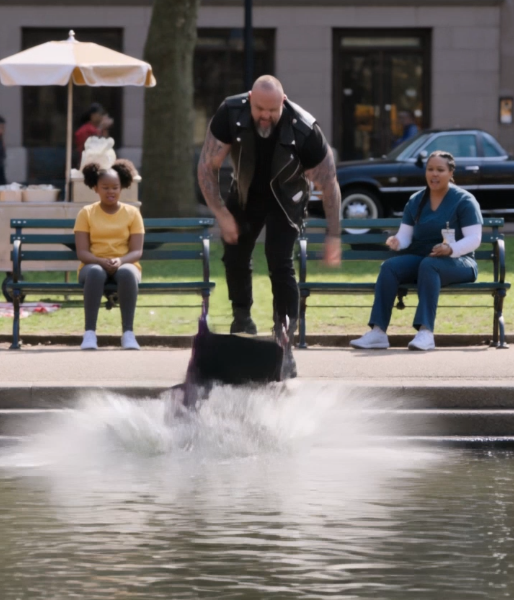
The biker had stepped away from the tree. Mike and the other man stood frozen, staring at the lake. Nobody was holding him anymore.
He walked over slowly and knelt down on the grass beside Lila, careful to stay a few feet away so he wouldn’t scare her.
“I’m sorry I grabbed you, kiddo,” he said. His voice was low and rough. “I didn’t have time to ask.”
Lila looked at him with wet eyes. “Was my chair going to blow up?”
The biker hesitated. Then he nodded.
“Your battery was going into something called thermal runaway,” he said. “That’s when a lithium battery starts heating itself up from the inside and can’t stop. First it swells. Then it starts venting gas. That’s the hissing sound. And it smells sweet, kind of like nail polish remover.” He looked at the steaming water. “I smelled it from the path. Then I heard it.”
“How long?” Kara whispered.
The biker looked at her.
“Thirty seconds,” he said. “Maybe less. Once it vents like that, it goes fast. Fire comes out of the cells like a blowtorch.” He paused. “Right under where she was sitting.”
Kara felt her knees give out. She sat down hard on the grass and pulled Lila into her lap.
“Why the lake?” Mike asked hoarsely. He was pale. “Why’d you throw it in the lake?”
“Can’t put out a lithium fire with an extinguisher,” the biker said. “You’ve got to cool it down. Lots of water. There was a whole lake right there.”
Sirens wailed from the park entrance. A Sacramento Fire Department engine pulled up on the grass, followed by a police cruiser.
The fire captain was a tall woman in her fifties with a gray braid. She took one look at the steam still drifting off the lake and swore under her breath.
She walked over to Kara.
“Ma’am,” she said, “is that your daughter’s chair out there?”
“Yes.”
“What brand is it?”
Kara told her.
The captain’s face went very still.
Part 3
The chair was a MobiStride Pathfinder X, a top-of-the-line pediatric power wheelchair, purple, with a custom seat cushion and a joystick Lila had decorated with butterfly stickers.
Kara had fought for it for a year.
Lila was born with spina bifida. She’d used a manual wheelchair until she was eight, but her arms tired too fast, and she was falling behind at school. Her doctor wrote a prescription for a power chair. The insurance company denied it twice. Kara appealed, wrote letters, and filled out forms on her breaks in the ER break room.
Finally, eight months ago, they approved it. Valley Mobility Supply delivered it. Lila cried the first time she drove it down the hallway at school by herself.
The fire captain, Captain Diane Rojas, stood on the shore with her hands on her hips while two firefighters waded in to pull the chair out with a hook. The battery compartment under the seat had split open. The cells inside were swollen and blackened.
“That’s the third Pathfinder X I’ve heard about this year,” Captain Rojas said quietly.
Kara looked up. “The third?”
“There was a house fire in Phoenix in February. A garage fire outside Atlanta in April. I’ve got a friend on the fire investigation team in Phoenix. Both were MobiStride Pathfinders, charging overnight.” She shook her head. “Both reports said cause undetermined.”
“Was anyone hurt?” Kara whispered.
“The kid in Atlanta wasn’t in it. The one in Phoenix…” The captain hesitated. “He got out. His bedroom didn’t.”
Kara pressed her face into Lila’s curls.
The biker was standing a few feet away with his arms folded, watching the firefighters drag the chair onto the grass.
Captain Rojas turned to him.
“You knew what you were smelling,” she said. “That wasn’t luck. Who are you?”
“Rhett Garner,” he said. “I own Garner Battery Works on Folsom Boulevard. We rebuild and repair lithium packs. E-bikes, scooters, golf carts, mobility chairs.” He paused. “Before that, I was an electrician in the Navy. Twenty years.”
The captain nodded slowly.
“Mr. Garner,” she said, “I’d like you to look at that battery with my fire marshal before anybody else touches it.”
Rhett nodded.
Kara watched the big man walk to the blackened chair on the grass and crouch beside it. He didn’t touch it. He just stared at the swollen cells for a long time.
Then he looked up at Captain Rojas.
“These cells were bad before they ever went in that chair,” he said.
Part 4
The video went viral by Monday morning.
The teenager by the shaved ice cart had uploaded it. It showed the huge biker throwing a disabled girl’s purple wheelchair into a lake while she screamed, and two men grabbing him by the collar.
The first version he posted cut off before the steam.
By the time he posted the full clip, a million people had already seen the short one.
Biker throws disabled girl’s wheelchair in lake.
Animal. Lock him up.
Somebody find this guy’s shop and leave reviews.
Garner Battery Works got two hundred one-star reviews in a single day.
On Tuesday afternoon, a black sedan pulled up outside Kara’s apartment. A man in his fifties got out in a navy suit with a lawyer beside him.
“Mrs. Monroe, I’m Douglas Wren, vice president of customer relations at MobiStride Medical,” he said, shaking her hand warmly. “First, I want to say how sorry we are about what happened to Lila. No child should go through that.”
Kara let them in.
Wren sat on her couch and opened a leather folder.
“We’ve reviewed the situation,” he said. “And frankly, Mrs. Monroe, our chairs are among the safest on the market. What we believe happened is very clear. A stranger threw your daughter’s chair into a lake. Submerging a lithium battery in water can cause a short circuit and a reaction. That’s what you saw.” He smiled sympathetically. “That man destroyed your daughter’s chair.”
Kara stared at him.
“But it was hissing before,” she said. “It was hot for two weeks. I called your dealer twice.”
“Battery packs run warm,” Wren said smoothly. “That’s normal.” He slid a document across the coffee table. “As a gesture of goodwill, MobiStride would like to provide Lila with a brand-new Pathfinder X, free of charge. We just need you to sign this.”
Kara picked it up.
It was a release. It said the damage to the chair was caused by “intentional submersion by a third party.” She would agree not to make “disparaging statements” about MobiStride products to the media or on social media.
That morning, her insurance company had called. They were denying her claim for a replacement chair. Intentional damage by a third party, they’d said. It wasn’t covered.
Lila had no chair. She couldn’t go to school. She had a doctor’s appointment Friday, and Kara didn’t know how she’d get her there.
Kara’s hand shook. She reached for the pen.
Her phone buzzed on the table.
It was a text from a number she’d saved on Sunday.
Don’t sign anything. —Rhett
Part 5
Rhett Garner was sitting in Kara’s kitchen two hours later with Captain Rojas and the Sacramento fire marshal, a quiet man named Tom Ishida.
Douglas Wren had left angry, with the release unsigned.
Rhett had brought his laptop.
“First,” he said, “the video.”
He pulled up the full clip. It wasn’t the teenager’s. It came from a different angle. A grandmother on a picnic blanket had been filming her grandson feeding ducks, and Lila’s chair was in the background.
He slowed it down.
At 3:31:14, before Rhett ever appeared on screen, a thin wisp of gray vapor drifted out from beneath the seat of Lila’s purple chair while she sat in it feeding the ducks.
At 3:31:19, it thickened.
At 3:31:22, Rhett walked into the frame with his motorcycle, stopped, and turned his head.
At 3:31:26, he lifted Lila out.
“That battery was venting before I touched it,” Rhett said. “Before it ever got near water.”
Fire Marshal Ishida nodded slowly. “We took the pack apart yesterday at our lab,” he said. “Mr. Garner was right. The cells inside are from a supplier overseas. The separators, the thin layers inside each cell that keep the positive and negative sides from touching, are defective. They’re too thin and badly made. Over time, they break down and the cell shorts internally. Then it heats up and goes into runaway.”
“So it wasn’t the water,” Kara said.
“The water stopped it from turning into a fire,” Ishida said. “The defect was already there.”
Kara put her hands over her face.
Then Rhett’s laptop chimed with a new email.
He opened it. The sender’s address was a random string of letters at a free email service. There was no name.
The message was only one line.
You found one. There are 1,200.
Part 6
The anonymous sender agreed to meet two days later at a coffee shop in Davis, twenty minutes outside Sacramento.
She was a woman in her late thirties with tired eyes and a laptop bag clutched against her chest. Her name was Anita Desai, and she was a senior quality assurance engineer at MobiStride Medical.
“I’ve worked there six years,” she said quietly. “I believed in those chairs. I still believe in what they do for kids.” She swallowed. “But I flagged this battery supplier fourteen months ago.”
She opened her laptop and turned it around.
It was an internal quality report with her name at the top, dated fourteen months earlier.
Cell supplier for Pathfinder X battery packs failing separator thickness standards in 11% of random samples. Risk of internal short circuit and thermal runaway. Recommend immediate supplier change and recall of affected units.
“How many chairs?” Rhett asked.
“One thousand two hundred and six,” Anita said. “Sold in forty-one states. All with batteries from that supplier.”
“And MobiStride did nothing?” Kara asked.
“They switched suppliers for new chairs,” Anita said. “Quietly. But there was no recall. Douglas Wren killed it.”
She pulled up an email chain.
A recall right now costs us $4.2 million and kills the Brennan Medical acquisition. We are NOT doing a recall. Roll out a “voluntary battery service upgrade” over the next 18 months through dealers. No public notice. If there are field incidents, cause undetermined until proven otherwise. —D. Wren
Kara read it twice. Her hands were shaking.
“Brennan Medical?” Rhett asked.
“A huge medical device company,” Anita said. “They’re buying MobiStride for sixty million dollars. The deal closes in July. Douglas and the other executives get bonuses worth millions when it closes. A recall would tank it.”
“So they were going to let kids sit on bombs for eighteen months,” Kara said, her voice breaking. “For a bonus.”
Anita nodded miserably.
“After Phoenix, I begged them,” she said. “After Atlanta, I begged again. Both fires were marked undetermined. I knew exactly what they were.” She looked at Kara. “When I saw the video of your daughter’s chair on Monday, I couldn’t sleep. That’s when I emailed Mr. Garner.”
“What do you need from us?” Rhett asked.
Anita closed the laptop.
“I’m going to the FDA,” she said. “But I need physical proof. The cells from that chair.”
“The fire marshal has them,” Rhett said. “In an evidence locker.”
Anita let out a long, shaky breath.
Part 7
That night, Rhett drove Kara and Lila home from the coffee shop in his pickup truck, since Lila had no chair. He carried Lila up the three flights of stairs to their apartment himself.
At the top, Lila looked at his left forearm.
Among the tattoos was a small orange phoenix rising from flames. Under it, in plain script, was a name.
CALLIE.
“Who’s Callie?” Lila asked.
Rhett was quiet for a moment.
“My daughter,” he said. “She’s sixteen now.”
He set Lila down gently on the couch and sat on the arm of it.
“When she was ten, the same age as you, she got a hoverboard for Christmas,” he said. “Cheap one, off a website. She charged it in her bedroom at night.” He looked at his hands. “Two weeks later, it went into thermal runaway at three in the morning while she was asleep.”
Kara sat down slowly in the chair across from him.
“I was home on leave,” Rhett said. “I heard the smoke alarm and kicked in her door. The whole corner of her room was on fire. I got her out the window.” He touched his forearm. “She’s got scars on her arm and her shoulder. She’s okay now. She’s tough. But I quit the Navy after that and spent two years learning everything there was to know about lithium batteries.”
He looked at Lila.
“I can smell a bad cell from across a parking lot,” he said. “I smelled yours from the path. I wasn’t going to let it happen again.”
Lila didn’t say anything. She just reached up and touched the little phoenix on his arm with one finger.
The next morning, Rhett called a meeting of his motorcycle club, the Iron Current Riders, at his shop. Thirty-four riders showed up.
He showed them the video. Then he told them about the insurance company and Lila’s empty bedroom corner where her chair used to sit.
“Five days,” Rhett said. “Her doctor’s appointment is Friday. I want her rolling into it on her own wheels.”
That afternoon, Rhett got another notification. He’d been served with papers.
MobiStride Medical was suing him for destruction of property and defamation.
Part 8
The Iron Current Riders raised fifty-two thousand dollars in four days.
They posted the full video, the grandmother’s clip showing the smoke before Rhett touched the chair. Within forty-eight hours, the story had flipped. The same people who had called him a monster on Monday were donating by Wednesday. Garner Battery Works got eleven hundred five-star reviews in a single night.
On Thursday morning, Anita Desai walked into the FDA’s regional office in Oakland. She carried her internal report, Douglas Wren’s emails, and a sealed evidence bag of battery cells from Fire Marshal Ishida.
On Thursday afternoon, the FDA called MobiStride’s headquarters.
On Friday morning, the agency issued a mandatory recall notice for all 1,206 MobiStride Pathfinder X power wheelchairs with the defective battery packs. Every affected chair had to be replaced at no cost to families.
Brennan Medical canceled its acquisition of MobiStride within six hours.
MobiStride’s board fired Douglas Wren that same evening. The lawsuit against Rhett Garner was withdrawn before he even hired a lawyer.
And at 9:30 Friday morning, an hour before Lila’s doctor’s appointment, the low rumble of thirty-four motorcycles came rolling into the parking lot of Kara’s apartment complex.
Kara carried Lila down three flights of stairs.
In the middle of the parking lot, surrounded by thirty-four bikers in black leather, sat a brand-new pediatric power wheelchair. It was a different manufacturer, one with the safest battery system on the market, which Rhett had personally inspected cell by cell.
It was purple. It had butterfly stickers on the joystick.
On the back of the seat, someone had added a small embroidered lightning bolt, the same one on the backs of the Iron Current jackets.
Lila couldn’t speak. Kara set her gently in the seat. Lila touched the joystick and rolled forward three feet, then spun in a slow circle, laughing and crying at the same time.
The bikers cheered.
“Who sewed the lightning bolt?” Lila asked when she could finally talk.
A teenage girl stepped out from behind Rhett’s motorcycle. She was sixteen, with her dad’s dark hair pulled back and a long-sleeved shirt pushed up just enough to show the edge of an old scar on her forearm.
“I did,” she said, smiling. “I’m Callie.”
Part 9
Here’s how the rest of it went.
The FDA recall replaced all 1,206 MobiStride Pathfinder X chairs within four months. Every family got a new battery pack or a new chair at no cost. Fire investigators in Phoenix and Atlanta reopened their “undetermined” cases. Both were reclassified as battery failures in recalled MobiStride chairs, and the families received full settlements.
MobiStride Medical paid more than nine million dollars in federal penalties. Douglas Wren was charged with obstruction and concealing a known safety defect in a medical device. He pleaded guilty and was sentenced to three years in federal prison. Two other executives who signed off on his plan resigned in disgrace.
Valley Mobility Supply, the dealer that told Kara the hissing was “normal” twice, was investigated by the state and lost its license to sell medical equipment.
Anita Desai received federal whistleblower protection. She works for the FDA now, reviewing medical device safety reports.
The Iron Current Riders didn’t stop at one chair. The fifty-two thousand dollars they raised was enough for twelve more new power wheelchairs. They went to twelve kids across Sacramento County whose families were stuck in insurance appeals. Rhett inspected every battery himself before delivery.
Lila went back to school the following Monday. Her best friend helped her put new butterfly stickers on the joystick.
Every few weeks, Lila and Callie go to Willow Lake Park together and feed the ducks. Callie taught Lila how to tell if a battery is getting too hot, and what a bad cell smells like. Lila taught Callie how to do a perfect 360-degree spin in a power chair. Callie still can’t do it right.
Last fall, Rhett started teaching a free battery safety class at the Sacramento Fire Department training center every month. It’s for parents of kids with power wheelchairs, e-bikes, and hoverboards. Captain Rojas co-teaches it.
Lila is the class’s official assistant. She stands up in front of a room full of grown-ups in her purple chair. She tells them what thermal runaway is, what a swollen battery looks like, and what venting gas smells like.
“If your kid says it’s hissing,” she always tells them at the end, “believe them.”
The old purple Pathfinder X, scorched and waterlogged, hangs on the wall of Garner Battery Works on Folsom Boulevard, right above the front counter. Underneath it, Callie painted a sign.
WE LISTEN.
People see a huge, tattooed biker throw a disabled little girl’s wheelchair into a lake, and they decide what kind of man he is before the splash settles. Two men grabbed him by the throat. A million strangers called him a monster. Douglas Wren was the one who had been letting twelve hundred children sit on defective batteries to protect a bonus. Sometimes the man who looks like he’s taking everything away from a child is the only one who heard what she was trying to say.
If this story stayed with you, follow our page. We share stories like this one every week, about the people who believe children when no one else will.