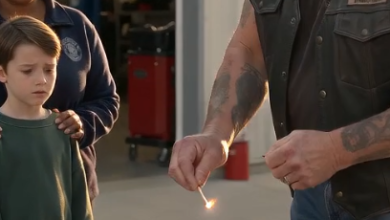
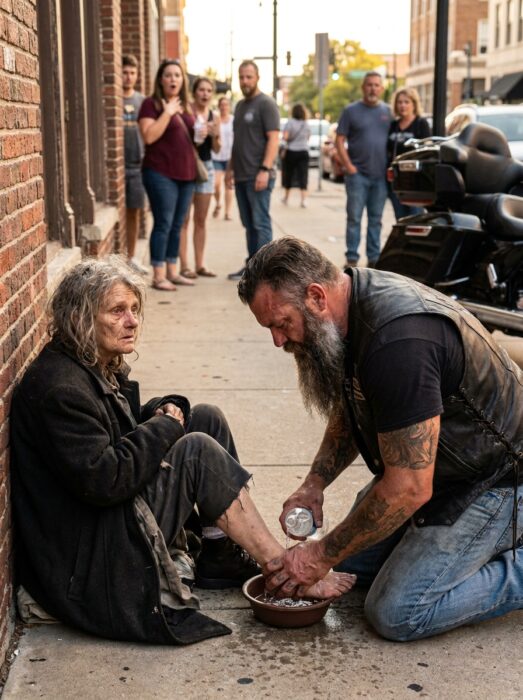
Part 2: A 6’5 Tattooed Biker Knelt to Wash a Homeless Woman’s Wounded Feet — Then She Whispered the Name His Mother Had Used 35 Years Earlier
Part 2
David’s earliest memory of his mother was not her leaving.
It was her singing beside a kitchen window.
Her name was Evelyn Mercer, though David remembered his father calling her Evie during the years before every conversation in their house became tense.
She had auburn hair then, green eyes, and a habit of singing incorrect lyrics whenever she forgot the real ones. David remembered flour across her cheek, the smell of Ivory soap, and the way she tapped twice on his bedroom door before entering.
He also remembered the last morning.
Evelyn packed one small suitcase while David ate cereal at the kitchen table. She knelt beside him, held his face between both hands, and told him to be good.
“Are you coming back?” he asked.
She looked toward the hallway, where his father stood beyond David’s view.
“I love you,” she answered.
That was not the answer he needed.
The front door closed.
David ran after her in socks, but his father caught him before he reached the street.
For years, David believed he had failed to run fast enough.
His father, Raymond, worked construction and treated emotion as an illness that disappeared when ignored. He never struck David, but silence can bruise a child in places nobody examines.
When David asked why Evelyn left, Raymond said, “Some people aren’t made to stay.”
When David asked whether she loved him, Raymond said, “Eat your dinner.”
No photographs of Evelyn remained in the living room. Her name disappeared from conversation. Eventually, Raymond told relatives she had probably died.
David accepted that possibility because death hurt less than imagining his mother alive and choosing every morning not to return.
At fourteen, he began spending time at a motorcycle repair shop owned by Walter “Deacon” Price, a Vietnam veteran with a missing finger and no patience for self-pity.
Deacon taught David to rebuild carburetors, weld cracked frames, and understand that broken machinery deserved diagnosis before judgment.
He did not realize the boy needed someone to apply that rule to people.
David bought his first motorcycle at seventeen. The machine barely ran, but it offered something his childhood had not: the ability to leave without being abandoned.
He could choose the direction.
He could choose when to return.
The Iron Lanterns became his family gradually, not because they promised loyalty, but because they practiced it. They arrived when David’s father died. They stood beside him when our first pregnancy ended in miscarriage. They rebuilt our porch after a storm and brought groceries when I spent three months recovering from surgery.
David became one of the club’s most dependable members.
If someone called, he came.
Perhaps that was his answer to childhood.
Nobody waiting for David would wonder whether he had chosen not to return.
Still, he never searched seriously for Evelyn. He claimed there was nothing to find, but I knew the truth was more complicated.
Finding her dead would confirm the loss.
Finding her alive might confirm something worse.
So David built a life without an answer.
Then, thirty-five years after the front door closed, he knelt before a barefoot stranger and heard the voice he had spent most of his life trying to forget.
Part 3
Neither David nor Evelyn spoke for several minutes after recognizing each other.
People continued moving along the sidewalk. A delivery truck rattled past. Somewhere nearby, a car alarm began repeating the same useless warning.
David remained kneeling.
Evelyn kept one hand over her mouth.
Finally, she reached toward his face but stopped before touching him.
“You got so big,” she whispered.
It was an absurd sentence.
It was also the only sentence available to a mother who had last seen her son at five years old and now found him built like a wall in front of her.
David looked at the sores across her feet.
“You need a doctor.”
Evelyn withdrew.
“No hospital.”
“Those wounds are infected.”
“I can’t.”
“You can.”
His voice was firm but not forceful.
“I’ll stay.”
The promise changed her expression.
Perhaps hospitals had removed her before. Perhaps authority had become dangerous during the years David knew nothing about. He did not ask.
He finished cleaning her feet, applied antibiotic ointment around the least damaged areas, and wrapped both with gauze from his first-aid kit.
Only after the work was completed did he sit beside her.
“Where have you been?” would have been the obvious question.
David asked something else.
“Have you eaten?”
Evelyn shook her head.
He bought soup from a nearby diner because she said her teeth hurt too badly for anything solid. She ate slowly while David called me.
I remember the exact words.
“Sarah, I found my mom.”
I thought he meant a grave.
Then I heard traffic behind him and a woman coughing.
“Is she alive?”
“Yes.”
“Are you sure it’s her?”
A long silence followed.
“She knew me.”
David told me they were going to the emergency room. Before hanging up, he said something that revealed how frightened he was.
“Can she come home?”
There was no practical reason to say yes immediately.
We knew nothing about Evelyn’s health, mental state, addictions, debts, or the people who might be searching for her. We had one guest room, limited savings, and no experience caring for someone who had survived prolonged homelessness.
But marriage had taught me that David rarely asked for anything while still needing it.
“Yes,” I said. “Bring her home.”
At the hospital, doctors treated infected ulcers, dehydration, malnutrition, and an untreated fracture in her left foot that had healed badly. She also suffered from chronic lung disease and severe anemia.
A social worker asked where she lived.
Evelyn looked toward David.
He answered.
“With us.”
The social worker glanced at his leather vest, then at the frightened woman gripping his sleeve.
“Are you family?”
David’s jaw tightened.
“She’s my mother.”
Evelyn began crying again.
The hospital kept her overnight. David slept in a chair beside the bed, though Evelyn repeatedly told him he could leave.
“I waited thirty-five years,” he said. “One night won’t hurt me.”
The following afternoon, he lifted her carefully into his arms because the wheelchair could not cross the narrow space beside his motorcycle.
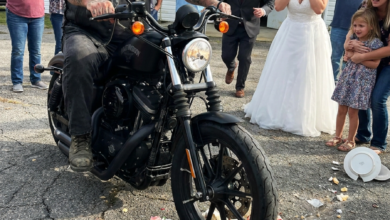
He had called Deacon to retrieve the Harley and bring our truck, but Evelyn saw the motorcycle and touched the fuel tank.
“You always wanted one,” she said.
David stared at her.
She remembered.
Not everything.
But enough.
Inside her torn canvas bag, the hospital social worker found three shirts, an empty pill bottle, a plastic spoon, and a photograph wrapped inside six grocery bags.
The photograph showed a five-year-old boy sitting on a porch step with one front tooth missing.
David.
On the back, in faded ink, Evelyn had written:
MY SON. I WILL COME BACK WHEN I AM SAFE.
She had carried that photograph through thirty-five years of shelters, sidewalks, bus stations, and winters nobody in our family knew she had survived.
David read the sentence once.
Then he folded the photograph and returned it to the plastic.
He still did not ask why.
Part 4
When David carried Evelyn through our doorway, I understood immediately that whatever story existed behind her disappearance would not be demanded that night.
She looked terrified of our clean living room.
People who have lived without security sometimes distrust comfort because comfort can be removed.
Evelyn apologized for the dirt on her coat.
She apologized for the smell.
She apologized for needing help with the bathroom and for eating the soup I placed before her.
Every apology sounded rehearsed.
David set her bag beside the guest-room bed.
“This room is yours.”
“For tonight?”
“For as long as you need it.”
She looked toward him.
“I don’t want trouble.”
“You’re not trouble.”
“You don’t know that.”
David’s face tightened, but he kept his voice gentle.
“I know your feet hurt. I know you need sleep. Everything else can wait.”
During the first week, Evelyn slept on top of the blankets while wearing her coat. She hid bread inside pillowcases and filled cups with tap water, placing them beneath the bed as though preparing for scarcity.
She woke whenever the furnace started.
If one of David’s club brothers knocked at the door, she retreated into the bathroom until the motorcycle engines disappeared.
We adjusted slowly.
I placed food where she could see it without asking permission. David installed a small lock on the guest-room door so she could control who entered. Deacon and the other Iron Lanterns began parking at the far end of the driveway and shutting off their engines before approaching.
Not everyone approved.
One club member named Curtis asked David whether bringing Evelyn home was wise.
“She walked out on you,” Curtis said.
David was changing the bandage on her foot when he answered.
“Today she can’t walk at all.”
“That doesn’t erase what happened.”
“No.”
“Then why are you doing this?”
David secured the gauze.
“Because the wound in front of me needs care.”
Curtis did not understand.
Deacon did.
He took Curtis outside and explained that the club’s idea of brotherhood meant standing beside a man even when his mercy made them uncomfortable.
That was the brotherhood test.
It is easy to support anger.
Forgiveness asks more from everyone nearby.
Over the next several months, Evelyn gained weight and strength. She moved from a walker to a cane. Her hair was washed, cut, and slowly grew silver rather than gray with dirt.
A dentist repaired what teeth he could.
A doctor adjusted medication for depression, anxiety, and a condition Evelyn had left untreated for decades.
No diagnosis explained everything.
David never asked one to.
Sometimes Evelyn attempted to begin the story.
“Your father and I—”
David would stop folding laundry and look at her.
“You can tell me if it helps you.”
She swallowed.
“Don’t you want to know?”
“I want you to be okay.”
“That isn’t the same thing.”
“No.”
He sat beside her.
“But you don’t owe me pain just because I survived without an explanation.”
Evelyn never completed the sentence.
Perhaps she feared her reason would sound inadequate. Perhaps the truth involved shame, illness, violence, addiction, or choices she could no longer untangle.
David left the door open.
He did not drag her through it.
Part 5
Evelyn lived with us for eight years.
During the first year, she remained cautious, as though expecting us to announce that her time had expired. During the second, she began leaving her bedroom door open.
By the third, our home smelled occasionally of cinnamon because she had remembered how to bake apple bread.
David claimed it tasted exactly like childhood.
I could never tell whether that was true.
The Iron Lanterns gradually adopted her. Deacon called her Miss Evie. Younger members repaired the porch steps, planted flowers beneath her window, and brought thrift-store mystery novels after learning she loved detective stories.
Evelyn attended club cookouts but sat away from the loudest tables. She watched David constantly.
Sometimes I caught her looking at him with the grief of a mother studying the years she had missed.
David did not punish her with those years.
He showed her photographs.
His first motorcycle.
Our wedding.
The house before renovation.
The dog we lost.
The ultrasound image from the pregnancy that ended.
Evelyn cried over that one.
“I should have been here for you,” she said.
David rested his hand over hers.
“You’re here now.”
That became their language.
Not what had happened.
What could still happen now.
Evelyn learned that David disliked onions, still slept with one foot outside the blanket, and could not pass a stranded motorist without stopping.
David learned that she loved cardinals, hated mint toothpaste, and collected buttons because buttons had once been useful currency inside a shelter sewing room.
They did not recover thirty-five years.
No human relationship can recover lost time.
They built eight new ones.
On Evelyn’s seventy-eighth birthday, David took her for a motorcycle ride. He modified the Harley with a secure passenger seat, backrest, and additional foot supports.
She wore a borrowed leather jacket and a helmet several sizes too large.
They traveled only four miles.
When they returned, Evelyn’s hands remained wrapped around David’s waist.
“I used to imagine hearing you come home,” she told him.
David shut off the engine.
“I’m home.”
She pressed her face against his back.
“I know.”
The photograph of five-year-old David stayed framed beside her bed. The grocery bags were replaced with glass, but the faded sentence remained visible.
I WILL COME BACK WHEN I AM SAFE.
David never asked when safety had finally arrived.
Perhaps it arrived the moment he knelt without knowing her name.
Part 6
Evelyn’s health began declining during her seventh year with us.
The damage from untreated illness, poor nutrition, and decades of exposure could not be reversed completely. Her lungs weakened. Her heart struggled. Hospital visits became more frequent.
David attended every appointment.
When nurses asked who he was, he answered, “Her son,” with a pride that made Evelyn lower her eyes.
The final winter was difficult.
Evelyn needed oxygen and rarely left the house. David moved a recliner near the front window so she could watch birds and see motorcycles entering the driveway.
One evening, she asked me whether David truly never wanted an explanation.
“He wanted his mother,” I said. “That became more important than the explanation.”
“What if the reason was terrible?”
“Then telling him should help you, not punish you.”
She looked toward the garage, where David was repairing a club brother’s motorcycle.
“I left because I thought disappearing would protect him.”
I did not ask from what.
That was her story to give.
She touched the photograph beside her chair.
“Then I became someone who couldn’t find the way back.”
“David knows you were lost.”
“How?”
“He was lost too.”
Evelyn closed her eyes.
“Did I ruin him?”
I thought of the man who stopped for stranded drivers, rebuilt playground equipment, and once spent an entire night beside a club brother going through withdrawal.
“You hurt him.”
The honesty made her flinch.
“But you didn’t ruin him.”
During Evelyn’s final week, hospice placed a bed in our living room. Her breathing became shallow, and the skin around her ankles thinned until even blankets caused discomfort.
David filled a basin with warm water.
He sat on the floor and began washing her feet.
The same way he had downtown.
Slowly.
Carefully.
No rushing.
Evelyn watched him through half-closed eyes.
“Do you remember?” she whispered.
“The sidewalk?”
She nodded.
“I looked terrible.”
“You looked tired.”
“I was ashamed.”
“You didn’t need to be.”
Her fingers moved weakly against the blanket.
“David, I need to say something.”
He continued drying between her toes.
“I’m listening.”
“I’m sorry.”
The room became still.
I stood near the kitchen doorway, uncertain whether to leave. David kept one of Evelyn’s feet resting inside his palm.
“For leaving,” she continued. “For all the birthdays. For making you believe you weren’t worth coming back to.”
David lowered his head.
Thirty-five years of questions stood between them.
He asked none.
“Mom, you don’t need to carry that tonight.”
“I need you to forgive me.”
He looked up.
“Thirty-five years ago, you walked away. The day I found you, I forgave you before I knew you were you.”
Evelyn began crying.
David placed the towel over her feet.
“I knelt down to wash the feet of a stranger. Then I realized I was washing my mother’s feet.”
His voice broke.
“What difference did it make?”
Evelyn reached toward him.
David leaned close enough for her hand to touch his beard.
“Love is love,” he whispered.
She died before sunrise with David sitting beside her and both of her clean feet wrapped warmly beneath the blanket.
Part 7
After Evelyn’s funeral, David placed the old photograph inside his leather vest.
Not the original.
That remained with me.
He carried a copy over his heart, beside the Iron Lanterns patch, through every ride for the next several years.
People often asked whether he regretted not demanding answers.
David always gave the same response.
“Answers explain a wound. They don’t automatically heal it.”
Six months after Evelyn died, the Iron Lanterns began visiting the downtown outreach center on the first Sunday of every month.
They brought socks, shoes, wound-care supplies, bottled water, hygiene kits, and gift cards. Medical volunteers handled injuries requiring professional treatment.
David handled the basin.
He would sit on a low stool and ask each person the same question.
“May I help you?”
Some said yes.
Some refused.
He respected both answers.
A local reporter once asked why a man his size chose to kneel.
David looked toward the line of people waiting beneath the shelter awning.
“Because you can’t look down on somebody while you’re washing their feet.”
The reporter asked whether he hoped to find another lost relative.
David smiled sadly.
“Everyone belongs to somebody.”
Years later, I returned downtown with him on Evelyn’s birthday. A woman sat near the same brick wall where he had found his mother.
She was younger than Evelyn had been, but exhaustion had aged her face. Her shoes had split across both soles.
David approached slowly.
He offered water.
Then socks.
Then help.
The woman asked his name.
“David.”
“Why are you doing this, David?”
He lowered the basin to the sidewalk.
“Someone taught me it matters.”
He did not explain further.
He knelt.
The city moved around him, loud and impatient. People passed carrying phones, coffee, shopping bags, and private grief.
David poured the water slowly.
His scarred hands remained steady.
The first time he had knelt there, he believed he was helping a stranger.
He had been helping his mother.
Eventually, he understood those were not different acts.
Follow the page for more unforgettable biker stories about rough-looking people whose quiet compassion proves that love does not need a history before it becomes real.