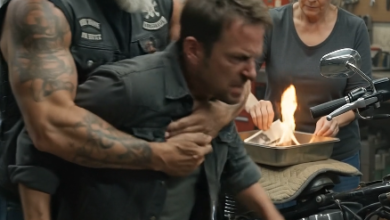
Part 2: A 300-Pound Biker Kept Holding a Tiny Laminated Card Outside a Classroom Window — And the Reason Made the Whole School Quiet
Part 2
Before Boone Mercer became a problem for the school office, he was a problem for every assumption I carried into parent-teacher night.
He arrived late, at 6:37 p.m., when most parents had already visited classrooms and moved toward the gym for cookies and bad coffee. I remember the sound before I saw him: a deep V-twin rumble rolling into the parking lot, low enough to make the windows hum.
Several parents looked up.
One father near the book fair muttered, “Great.”
Boone killed the engine fast.
That mattered later.
He did not rev. He did not perform. He parked at the far end of the lot, away from the minivans, took off his helmet, and stood for a moment beside the Harley as if gathering himself before walking into a building full of small chairs and polite judgment.
When he reached my classroom door, he had to turn slightly to fit through.
He wore a black leather cut over a gray T-shirt, jeans darkened at the knees, heavy boots dusted red from the shoulder of old Route 66, and a silver chain tucked carefully so it would not swing. His hands looked rough enough to bend metal. His nails were cut clean.
That was the first seed.
I noticed because men with his hands usually carried grease under the nails. Boone did not. His fingers were scarred, yes, and one knuckle sat crooked, but he had cleaned himself carefully before coming to talk about a little girl’s reading level.
“Ms. Holloway,” he said.
His voice was not loud.
It did not need to be.
“Mr. Mercer.”
“Boone’s fine.”
He did not sit until I offered. When he did, the child-sized chair gave a small plastic groan under him, and his face reddened in a way that made me feel cruel for noticing.
Grace came with him that night. She stood pressed against his leg, one hand holding the hem of his cut, the other clutching a small notebook with unicorn stickers on the cover. Boone rested one huge hand gently on the top of her head, not pushing, not claiming, just there.
“She reads good at home,” he said.
“She reads well here too,” I replied.
His eyes flicked up, worried.
“I ain’t much for school words.”
“I understood you.”
Grace looked at him and whispered, “You said it fine.”
Boone nodded once, like her opinion carried more weight than mine.
I told him Grace was bright, kind, careful, and anxious. I used the professional word because teachers are trained to soften hard truths with soft labels. Boone did not flinch. He did not deny it. He did not blame me, the school, other children, or her mother.
He reached inside his cut and touched something in the inner pocket.
The card.
I did not see it yet.
“Her mama had it too,” he said.
That was the second seed.
Grace’s mother, I later learned, had died two years earlier in a wreck outside Clinton on a rainy stretch of I-40. Boone did not tell me that night. He only said “her mama” and then stopped like the words had teeth.
Boone had not always been steady.
Lila at the diner told me pieces over time. He had spent six months in county jail in his twenties after breaking a man’s jaw behind a bar. He had struggled with pills after a construction accident crushed two discs in his back. He had lost jobs. Lost friends. Lost years. Then he had gotten clean, joined a sober riding club called the Ash & Iron Brotherhood, and built a life around two things: his daughter and the miles between the garage, school, church basement meetings, and home.
His brothers called him Bear.
Not because he was fierce.
Because bears looked clumsy until something small needed guarding.
Part 3
The crisis did not start with Boone.
It started with an assembly.
Red River Elementary hosted a “Speak Up, Stand Tall” morning for the second grade, which sounded harmless when the counselor planned it. Each child would step onto the small cafeteria stage, say one sentence into a microphone, and receive a paper certificate. Parents were invited if they could come.
Grace hated microphones.
I knew that.
Her file knew that.
The counselor knew that, but schools sometimes confuse encouragement with pressure when a program already has a printed schedule. Grace’s sentence was simple: “My favorite book is Charlotte’s Web.” She had practiced it with me five times. She had practiced it with Boone fifteen times, according to the note he sent in her folder.
The morning of the assembly, Boone arrived early.
He parked across the street, where he always did. His Harley idled only long enough to settle, then went quiet. Through the classroom window, I saw him take the laminated card from his inner pocket and check it the way other men check a wallet.
Grace saw him too.
She touched two fingers to her own chest.
He lifted the card.
The day might have survived if everything had stayed small.
It did not.
At 8:55, the cafeteria filled with parents, grandparents, siblings, office staff, and two school board members who happened to be visiting. The room smelled of floor wax, breakfast syrup, and nervous children. Folding chairs scraped. The microphone squealed. Someone laughed too loud.
Grace’s hands went cold.
I was standing behind the class line when she whispered, “Window.”
“There’s no window in the cafeteria, honey.”
She stared at me.
I saw the mistake then.
Boone had been her anchor from outside the classroom, and we had moved her into a room with cinderblock walls.
Her name was fourth.
The first child spoke. Applause.
The second child spoke. Applause.
The third child forgot his line, giggled, then shouted, “My dog eats socks!” The room laughed sweetly. He bowed. More applause.
Grace stepped toward the stage.
Halfway up the steps, she stopped.
The microphone stood taller than it should have. The cafeteria lights buzzed. Parents lifted phones. Mr. Gaines stood near the side door, smiling the tight smile administrators use when they are trying to make a morning look successful.
Grace looked for a window that was not there.
Her mouth opened.
No sound came out.
Someone in the back whispered, “Poor thing.”
Another parent said, “Isn’t that the biker’s kid?”
Grace heard it.
Her whole body folded inward.
I moved toward the stage, but Boone moved first.
He had been standing outside the cafeteria exit doors, beyond the glass panel, not inside, because Mr. Gaines had told him visitors needed badges and background checks if they came past the office. Boone had obeyed. He stood in the cold by the side doors, card in hand, waiting where he was allowed.
When Grace froze, he stepped closer to the glass.
That was all.
Mr. Gaines saw him and panicked.
“Sir,” he said through the door, “you need to step away.”
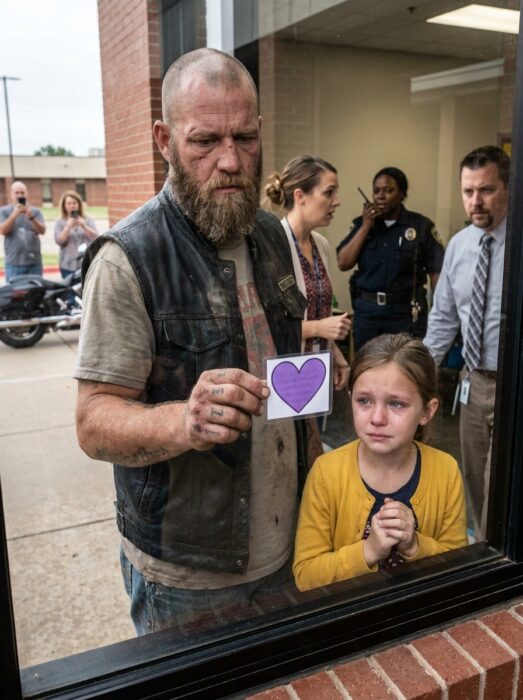
Boone lifted the card toward the small glass panel.
Parents turned.
Phones shifted from children to him.
A 300-pound biker outside a school door holding something up to a crying child onstage. The image looked wrong if you did not know the language between them.
Mr. Gaines opened the door six inches.
“I said step away.”
Boone did not raise his voice. “She needs the card.”
“You cannot intimidate a school event.”
“I’m not.”
“You need to leave.”
Grace made a sound then, small and broken.
Boone’s jaw clenched so hard I saw it move from across the cafeteria. His hand shook. His eyes went wet, but he did not cry. He just kept that laminated card pressed against the glass.
“Baby,” he said, low enough that only those near the door heard him. “Read your own words.”
Mr. Gaines reached for the card.
That was the false climax.
Everyone thought Boone would snap.
I thought it too.
His shoulders rose. His left hand curled. The old version of the man, the one from bar fights and jail records and whispers, seemed to step into the room before he did.
Then Boone opened his fist.
He placed his palm flat against the doorframe.
“Don’t touch it,” he said.
His voice was rough.
Not threatening.
Begging with armor on.
The security officer arrived behind Mr. Gaines.
Grace started crying onstage.
The assembly fell apart.
And the whole school saw the biker as the problem because no one had bothered to read the card.
Part 4
The first twist came from Grace.
Not Boone.
Not me.
Not the counselor or the principal or the school board members watching with stiff faces.
Grace stepped off the stage, walked past me, past the microphone, past the paper certificates, and went to the cafeteria door where her father stood outside like a banned man holding the only thing she trusted.
She put her small hand against the glass.
Boone put the laminated card against the same spot on the other side.
Their hands did not touch.
The card sat between them.
And Grace read the words aloud.
“I am Grace Mercer. I get scared. I can still do hard things.”
The room went silent.
Not polite silent.
Ashamed silent.
Grace kept reading, her voice shaking but getting stronger with every word.
“My heart beats fast, but it is not the boss of me. My dad holds this when I forget. I signed it because I said it first.”
Boone bowed his head.
That was when I finally saw the bottom of the card through the glass.
Grace M.
A crooked signature in purple marker.
Beside it was another signature, smaller, faded, written in adult handwriting.
Maddie M.
Grace’s mother.
That was the second twist.
The bravery card was not new.
The first version had belonged to Maddie Mercer, Boone’s wife, who used to have panic attacks so severe she kept folded index cards in her purse with sentences she had written on good days. Boone had carried one after she died, not because he understood anxiety, but because he did not know what else to do with her handwriting.
According to Boone, Maddie had called them “borrowed courage.”
Not courage you owned forever.
Just enough for the next five minutes.
After the wreck, Grace began carrying one of Maddie’s old cards in her backpack. Then she lost it during recess. She cried for three hours. Boone tore the house apart, checked the trash, walked the playground with a flashlight, and finally found the card in a storm drain, ruined by water.
That night, Grace made her own.
Boone took it to the truck stop near I-40 and paid two dollars to laminate it.
The third twist was that Grace had signed the card for herself, but Boone carried it because she asked him to.
Not because he wanted control.
Because control was exactly what anxiety stole from her.
“She said if I held it up,” Boone told me later, “then she didn’t have to ask out loud.”
The fourth twist was Boone’s own fear.
He was not standing outside the classroom window because he wanted to be seen. He was standing there because the inside of school buildings made his chest close. After Maddie’s death, after court dates, after custody hearings where strangers asked whether a man with his record should raise a fragile little girl, Boone learned to keep himself where people could watch him.
Outside.
Visible.
Accusable.
He thought it made Grace safer if no one could say he was hiding.
The fifth twist belonged to the Ash & Iron Brotherhood.
The bikers I had assumed were waiting at the diner because school property made them nervous were actually waiting because Boone had asked them not to come. He did not want fifty leather cuts near his daughter’s school. He knew how fear multiplied. So his brothers parked two blocks away at Ruby’s Route 66 Diner every Tuesday and Thursday, drinking black coffee, watching Boone stand alone, and leaving him alone only because brotherhood sometimes means honoring a man’s hard boundary.
That morning, they did not stay away.
When the security officer told Boone he could be trespassed, six bikers appeared at the edge of the parking lot. Then twelve. Then twenty. Big men in leather, gray beards, tattooed arms, boots on concrete. They did not cross onto school property. They stood on the public sidewalk beside the diner, silent as fence posts.
Parents gasped.
Mr. Gaines went pale.
I thought things had gotten worse.
Then one of the bikers, a Black man in his sixties named Preacher, raised both hands and took one step back from the curb.
The others followed.
One step back.
A message.
We are here.
We are not coming closer.
Boone saw them.
His jaw loosened.
Grace saw them too.
For the first time that morning, she smiled.
Not big.
Enough.
Then she turned from the door, walked back to the microphone, and said her sentence.
“My favorite book is Charlotte’s Web.”
The room applauded carefully at first.
Then louder.
Boone stayed outside.
The card stayed against the glass.
Part 5
The revelation came after the assembly, in my classroom, with the blinds half-drawn and twenty-one children at recess pretending not to watch through the door window.
Mr. Gaines wanted a meeting.
Boone wanted to leave.
Grace wanted everyone to stop talking like she was not there.
So I did the only useful thing I had done all morning. I pulled a small chair beside my desk for Grace, an adult chair for Boone, and told Mr. Gaines to close the door.
Boone did not sit right away.
He looked at the chair, then at Grace.
She nodded.
Only then did he lower himself into it carefully, as if even furniture deserved not to be broken by accident.
He placed the laminated card on my desk.
No one touched it.
The card was worn at the edges. The lamination had bubbles near one corner. Inside, the handwriting was purple and crooked, with a tiny star over the letter I in “bravery.” On the back, in faded blue ink, were Maddie’s old words.
Breathe once. Find one true thing. Stay.
That was the sixth twist.
Boone had not invented Grace’s courage.
Her mother had left a trail.
Boone had simply picked it up with hands everyone expected to be too rough for something that small.
Mr. Gaines cleared his throat. “Mr. Mercer, you have to understand how this appeared.”
Boone looked at him.
“I do.”
That stopped him.
Boone continued. “That’s why I stand outside the fence. That’s why I don’t wave. That’s why my club stays at Ruby’s. I know what I look like.”
Grace’s face tightened.
“I don’t care what you look like.”
“I know, bug.”
“I care when they make you leave.”
Boone’s eyes dropped to the card.
“I wasn’t leaving.”
“You almost did.”
“No.”
“You put the card down.”
His mouth opened.
Closed.
The biggest man I had ever seen looked defeated by a seven-year-old in purple sneakers.
Grace pushed the card toward him.
“You forgot.”
Boone stared at it.
Then he picked it up and read the first line quietly.
“I am Grace Mercer.”
Grace corrected him. “No. The back.”
Boone turned it over.
His thumb covered Maddie’s signature for a second, then moved away.
He read the words his dead wife had written years before.
“Breathe once. Find one true thing. Stay.”
Nobody spoke.
Outside, recess noise rose and fell. A ball bounced against brick. Somewhere down the hall, a copier jammed and beeped uselessly.
Mr. Gaines sat down.
Not because anyone told him to.
Because shame gets heavy.
“I owe you both an apology,” he said.
Boone did not make it easy for him.
He did not say it was fine. He did not rescue the man from discomfort. He just nodded once, which was more mercy than most people deserved.
Grace looked at me.
“Can the card stay in the window?”
I thought about policies, appearances, parent complaints, hallway cameras, and all the small rules schools use to keep from seeing the person in front of them.
Then I thought about Grace onstage, reading her own fear down to size.
“Yes,” I said. “But we’ll do it right.”
That afternoon, I taped a small laminated copy of the card to the inside corner of our classroom window, low enough for Grace to see from her desk. Boone still brought the original on hard mornings, but now he did not have to stand there every day.
The school counselor made a “bravery drawer” for children who needed small anchors. Not toys. Not distractions. Anchors. A smooth stone. A ribbon. A photo. A note from home. A card with words written by their own hands.
We did not announce it.
We did not make posters.
We just made room.
The next week, Boone came to school with the Ash & Iron Brotherhood for career day.
It was my idea.
Mr. Gaines nearly choked when I suggested it.
But they came clean and quiet, no readable patches, no loud engines near the entrance, boots wiped twice at the mat. Preacher talked about being a retired paramedic. A Latino rider named Cruz talked about welding. A white rider named Miller explained road maps and weather planning. Boone showed the children how to check a bicycle tire for air because, as he said, “wheels don’t care how old you are.”
Grace sat in the front row.
Not hiding.
Watching.
When Boone finished, one boy asked if bikers were scary.
Boone looked at Grace.
Then at the boy.
“Sometimes,” he said. “So are thunderstorms. Doesn’t mean rain hates you.”
That was the longest metaphor I ever heard him make.
It was enough.
Part 6
The ritual changed slowly.
At first, Boone still came every morning and stood near the fence, card in hand. He did not lift it unless Grace looked toward the window. Some days she never did. Those were good days. Boone would tuck the card back into his inside pocket and ride away toward the garage with the low sound of the Harley fading behind the buses.
Some days, Grace looked before announcements ended.
He lifted the card.
She breathed once.
That was enough.
By winter, Boone came three mornings a week.
By spring, once.
On the last day of school, Grace walked to the window just before dismissal, raised her hand, and showed him something from inside the classroom.
A new card.
This one said:
I can carry it today.
Boone stood outside the fence, reading it through the glass.
His face did not change much.
His hand went to the inside pocket of his cut, where the old card still lived. Then he tapped his chest twice and nodded.
The Ash & Iron Brotherhood started a quiet tradition after that. Every August, before school began, they rode to Ruby’s Route 66 Diner before sunrise. No parade. No fundraiser banner. No cameras unless some trucker caught them by accident through the window.
They sat in the back booth with coffee, leather creaking against vinyl seats, and laminated cards spread across the table.
Not all for children.
One was for a veteran who could not enter grocery stores when they were crowded. One was for Preacher’s granddaughter before chemotherapy. One was for Cruz, who had been sober nine years but still wrote “call before you break” on a card he kept inside his wallet. One was for Boone.
His card was the oldest.
Breathe once. Find one true thing. Stay.
Grace is eleven now.
She still has anxious mornings, because stories do not fix children like broken tail lights. But she sings in the school choir. She reads announcements over the intercom once a month. She keeps the new card in her backpack, not because she needs it every hour, but because brave does not mean empty pockets.
Boone still rides the same black Harley down old Route 66.
He still looks like a man strangers misread from a distance.
He still carries the original bravery card in his cut, sealed in a plastic sleeve with Maddie’s fading signature on the back and Grace’s crooked purple name on the front.
The tiny card has softened at the corners from his thumb.
That detail ruins me.
All that leather.
All that road dust.
All that weight.
And a card small enough for a child’s lunchbox sitting over his heart.
Part 7
Last month, I saw Boone outside Red River Elementary again.
Not at the fence.
Not by the classroom window.
He was sitting on his Harley across the street near Ruby’s, one boot on the pavement, helmet resting on the tank, coffee cooling in his left hand.
The morning was cold enough that exhaust from cars hung low over the drop-off lane. Parents hurried children toward the doors. Backpacks bounced. The flag rope clinked against the pole.
Grace walked in with two girls from choir.
She did not look scared.
Halfway to the door, she turned.
Boone lifted the card from his pocket.
Not high.
Just enough.
Grace rolled her eyes the way daughters do when love embarrasses them in public. Then she smiled and lifted her own card back.
Two small rectangles across a street.
One old.
One new.
The bell rang.
Grace went inside.
Boone stayed there until the front doors closed, then tucked the card into his leather cut and pressed his palm over it for a second. His brothers were waiting at the diner window, pretending not to watch.
He started the Harley.
The engine settled into that deep, steady pulse that once made half our school nervous. Now it sounded like something leaving only after making sure it could.
Boone pulled onto Route 66 without looking back.
The card rode over his heart.
Still signed.
Still brave.
Follow the page for more stories about the people we judge from the outside, before we see what they carry.