Part 2: A Six-Year-Old Girl Brought Her Piggy Bank to “Buy” Her Father Out of Jail—Then a Biker Recognized the Military Tattoo on the Prisoner’s Wrist
Part 2 — The Medicine Daniel Could Not Buy
Daniel Mercer did not wake that morning intending to steal.
He woke at 4:37 because Lily was coughing.
Not the ordinary cough children bring home from school. This one came from deep in her chest, tight and dry, followed by the small frightened pause in which she waited to learn whether the next breath would arrive.
Daniel sat beside her bed and helped her use the rescue inhaler.
One puff.
Wait.
A second puff.
Lily’s shoulders slowly lowered.
Daniel remained beside her long after the wheezing eased. He counted her breaths while dawn began leaking through the blinds of their two-bedroom apartment near Winchester Road.
He knew how to count breathing.
Daniel had been an Army combat medic.
For eleven years, he measured pulses beneath body armor, cleared airways inside armored vehicles, packed wounds beneath helicopter noise, and told frightened soldiers to look at him instead of whatever was happening around them.
He had remained calm beneath gunfire.
Insurance telephone menus defeated him.
Lily’s asthma had worsened during the previous year. Her pediatric pulmonologist prescribed a different controller inhaler after the generic medication failed to prevent nighttime attacks.
The new inhaler cost $412.68 without insurance.
Daniel’s policy would cover it only after receiving prior authorization confirming that Lily had tried and failed another preferred medication. The doctor’s office submitted the paperwork. The insurer requested additional notes. The clinic faxed them. The insurer said two pages were missing.
The process restarted.
Daniel called every day.
He wrote confirmation numbers on the back of an envelope. He recorded the name of each representative and the time of every conversation.
None of those names could help Lily breathe at 4:37.
Daniel had worked security at a distribution warehouse after leaving the Army. The job offered modest insurance, irregular overtime, and enough money to keep their apartment.
Then the warehouse lost a contract.
Thirty-seven workers were laid off.
Daniel’s final paycheck covered rent and electricity. He sold his television, a hunting rifle, and most of his military gear. He retained one dress uniform, his medical bag, and the watch Luke Dawson had once given him.
Lily’s mother had died in a highway collision when Lily was two. There were no second incomes or shared custody arrangements to absorb a missed paycheck.
Daniel applied for unemployment benefits, temporary Medicaid coverage for Lily, and pharmaceutical assistance. Every application moved on a different schedule.
Her lungs followed none of them.
The night before his arrest, Lily slept sitting upright against three pillows. Daniel called the pulmonology after-hours line. A nurse told him to seek emergency treatment if the rescue inhaler failed and promised to flag the authorization request again.
Daniel had already accumulated emergency-room bills.
He was not refusing care.
He was afraid of what would happen after receiving it.
That morning he went to Ridgeway Pharmacy because an automated message said Lily’s prescription was ready. At the counter, the technician told him insurance still had not approved it.
Daniel showed her the reference numbers.
She called the plan.
The answer remained no.
He asked what he could pay.
The pharmacy owner reduced the price as far as permitted, but it remained hundreds of dollars. Daniel’s debit card declined. He had twenty-eight dollars in the bank and eleven in his wallet.
The owner offered to contact the doctor about an alternative.
Daniel had already tried alternatives.
He stood at the counter holding the inhaler box while another customer waited behind him.
Then Lily called.
Mrs. Ortiz had been watching her. Lily said her chest felt “squeaky” again.
Daniel looked at the medicine.
He made his choice.
He placed the box beneath his work shirt and walked toward the exit. A pharmacy employee stopped him before the doors opened.
Daniel could have run.
He did not.
He returned the inhaler and waited for police. When officers arrived, he admitted taking it and explained why.
The pharmacy owner had already reported the theft. Store policy and corporate insurance required documentation. Daniel was arrested for misdemeanor shoplifting and transported to the South Precinct for processing.
Mrs. Ortiz heard the word bail during a telephone call with an officer.
Lily heard it too.
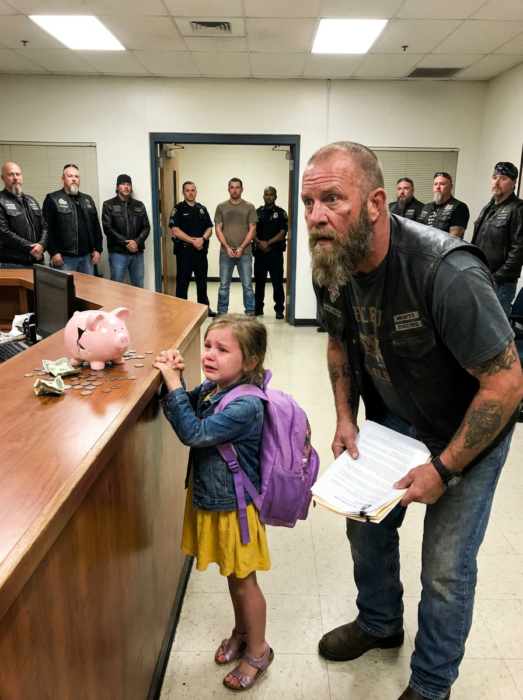
She had been saving coins for a bicycle with purple streamers. Her piggy bank contained birthday money, tooth-fairy dollars, and quarters Daniel gave her whenever she helped fold laundry.
Lily carried it to the station.
By then, the Iron Saints were already there.
We were applying for a parade permit for a charity ride intended to raise money for the pediatric wing of St. Anne’s Hospital. Thirty motorcycles were expected. We had planned banners, food trucks, and a route along Highway 51.
It felt important until Lily placed twenty-three dollars on the counter.
Our permit application listed a fundraising goal of $15,000.
Her piggy bank held everything she possessed.
Preacher watched her count the coins through the clear gap beneath the ceramic pig.
“What happens if it isn’t enough?” she asked Sergeant Brooks.
The sergeant crouched until their eyes were level.
“This isn’t your debt.”
“But he did it for me.”
That sentence moved through our group like cold air beneath leather.
I understood Daniel before meeting him. I did not approve of what he had done. Neither did he. Desperation does not make theft legal, but legality does not explain what a father hears when his child struggles for air.
We began calling people.
Not to erase his decision.
To make sure it would not become the last decision available to him.
Part 3 — The Father Who Would Not Call Himself a Hero
The pharmacy owner arrived shortly before noon.
His name was Nathan Shah, a second-generation pharmacist whose parents had opened Ridgeway Pharmacy thirty-four years earlier. He carried Lily’s prescription bag in one hand and the incident report in the other.
He looked uncomfortable before anyone spoke.
“I didn’t know about the child,” he said.
Sergeant Brooks reminded him that Daniel had explained at the store.
Nathan lowered his eyes.
“I heard him. I didn’t listen.”
Corporate procedures were not entirely responsible. Daniel had taken medication without paying. Employees had been instructed to report theft immediately. Nathan worried that failing to document one incident would create problems with licensing and insurance.
Still, he had choices after the report.
He could inform the prosecutor that the medicine had been recovered, restitution had been made, and he did not want incarceration. He could support diversion. He could help request emergency authorization.
Nathan did all three.
The Iron Saints paid the legal price of the inhaler. Nathan applied additional pharmacy assistance, reducing the actual cost. Lily’s physician sent an urgent appeal to the insurer and provided samples sufficient for several weeks.
The inhaler was no longer behind a counter.
It was in Lily’s hands.
The bondsman arrived next. He explained the fee. Preacher paid it from our club emergency account before I could argue.
“You paid last time,” he said.
“Last time was your nephew.”
“Still paid.”
Brotherhood keeps terrible records and excellent memory.
The veterans’ legal-aid attorney, Maya Bennett, spoke with the prosecutor’s office. Daniel had no criminal record. His military history, immediate confession, recovered merchandise, restitution, and the pharmacy owner’s position made him a strong candidate for pretrial diversion.
Nothing was guaranteed.
But he could go home pending the next hearing.
When officers brought Daniel into the interview area, Lily ran toward him. Sergeant Brooks stopped her only long enough to remove his cuffs.
Daniel knelt.
Lily wrapped both arms around his neck.
“I brought my bike money.”
His face tightened.
“You weren’t supposed to come here.”
“I’m buying you.”
“I’m not for sale.”
“The police have you.”
A few officers looked away.
Daniel held his daughter for several seconds, then examined the prescription bag in her hand. The label carried her name.
“How?”
I told him.
He stood slowly.
“No.”
Preacher assumed Daniel objected to accepting help from bikers.
“Brother, it’s handled.”
Daniel shook his head.
“It isn’t.”
“The pharmacy’s paid.”
“I stole.”
“Medicine was for your child.”
“That explains it. Doesn’t change it.”
He asked officers to return the bond money.
Maya explained that posting bond did not erase responsibility. He would still attend court, comply with conditions, and complete whatever diversion plan the prosecutor approved.
Daniel looked at Lily.
“I teach her wrong has consequences.”
I stepped closer.
“Going home with her can be one.”
He studied me.
Most people noticed my size first. Daniel noticed my hands. Combat veterans often watch hands. Mine remained open.
“You military?” he asked.
“No.”
He glanced at the club patch.
“Then you don’t know what responsibility means.”
Boone shifted behind me.
I raised one finger without turning. He stopped.
Daniel was not insulting me. He was building a wall from the only materials he still owned: guilt, duty, and the belief that punishment could restore control.
I knew the wall.
My younger brother Luke used to build the same kind.
Luke was eleven years younger than me. I taught him to ride a bicycle, throw a punch, and lie to our mother about broken windows. He joined the Army at nineteen despite my objections.
Before his first deployment, I asked why.
“Somebody has to carry weight,” he said.
Daniel used nearly the same words in the interview room.
“I made the choice. I carry it.”
He raised his hands while speaking.
The sleeve of his work shirt slid backward.
The tattoo on his wrist showed a blue powder keg and crossed red bayonets incorporated into a battalion crest—the mark Daniel and several soldiers from his unit received after returning from their first deployment with the 10th Mountain Division.
Luke had worn a smaller version on his upper arm.
I stared.
Daniel noticed.
“What?”
“Where’d you serve?”
He named the province in Afghanistan.
My mouth went dry.
“Year?”
He told me.
Behind him, Lily squeezed the prescription bag. Plastic crackled inside the quiet room.
“What unit?” I asked.
Daniel gave the battalion and company.
The details matched.
I asked whether he knew Specialist Luke Dawson.
Daniel did not answer.
His face changed first.
The resistance left his shoulders. His eyes moved across my beard, nose, and brow, searching for Luke inside a face aged by eleven additional years.
“You’re Ray,” he said.
Nobody outside my family called me that.
“How do you know?”
Daniel looked toward the floor.
“He carried your picture.”
My brother had kept one photograph of us inside his helmet band: Luke at fifteen, me at twenty-six, both standing beside the unfinished Harley in our father’s garage.
The official letter describing Luke’s death mentioned Daniel once.
Staff Sergeant Daniel Mercer remained with Specialist Dawson and personally assisted his recovery to the evacuation point.
I had read that line hundreds of times.
I had imagined the soldier as older, stronger, almost mythical. I never pictured a tired father in a gray warehouse shirt standing barefoot in borrowed station shoes because police had removed his boot laces.
“You brought him back,” I said.
Daniel’s jaw tightened.
“Yes.”
He spoke the word like an admission.
I stepped closer.
“What happened?”
“Not here.”
“I’ve waited ten years.”
“So have I.”
That confused me.
Then Daniel looked at Lily.
My brother had given him something during their final hour.
Daniel had been trying to return it ever since.
Part 4 — The Name in Luke’s Final Letter
Daniel agreed to leave the station only after Maya repeated that bond was not forgiveness and diversion would still require accountability.
He signed the release papers.
The piggy bank remained on the counter.
Lily asked Sergeant Brooks whether the police needed the money now. The sergeant returned every coin to the ceramic pig and taped a small crack near its ear where it had struck the countertop.
“You keep this,” she said.
Lily shook her head.
“My daddy is coming home. It worked.”
There was no logical answer to that.
Daniel carried Lily outside. Eight black Harleys waited beneath the sun. Their cooling engines clicked while traffic moved along Raines Road.
I offered to drive them home.
Daniel said Mrs. Ortiz had a car.
I asked for five minutes.
He looked toward Lily, then nodded.
We sat inside the precinct’s small community room. Preacher remained near the door. Maya took Lily and Mrs. Ortiz to a vending machine so Daniel could speak privately.
Daniel began with the attack.
Luke’s squad had been moving between two compounds when gunfire struck from elevated ground. The first shots separated Luke and Daniel from the others. Luke was wounded while helping another soldier reach cover.
Daniel treated him behind a low wall.
He called for evacuation.
The route remained exposed.
Luke knew how serious the injuries were. Daniel never lied to patients, but he did not answer when Luke asked whether he would make it.
That silence answered enough.
“He talked about you,” Daniel said.
“What’d he say?”
“That you’d be mad.”
“Was.”
“He said you told him not to enlist.”
“Did.”
“He said you’d pretend the last conversation was an argument.”
I looked away.
Our last conversation had been an argument. Luke called from overseas at three in the morning. I had been drinking. He accused me of missing our mother’s medical appointment. I accused him of choosing the Army over family.
I ended the call first.
For ten years, I carried those last words as if anger had been the only thing between us.
Daniel corrected that.
“Afterward, he told the guys you were the reason he knew brothers could fight and still come back.”
My hands closed.
Leather creaked beneath my fingers.
Daniel continued.
Luke’s condition worsened. Daniel stayed beside him until the recovery team reached their position. During those final minutes, Luke removed a small metal token from his pocket.
It was shaped like a motorcycle ignition key.
I knew it.
Dad had cut that key from the first Harley engine we rebuilt together. The motorcycle was long gone, but Luke and I passed the key between us whenever one of us faced something difficult.
I gave it to him before his deployment.
Luke placed it in Daniel’s hand.
“Give this to Hammer,” he said.
Daniel heard the name but did not know it was mine.
He placed the key inside his medical pouch.
Then Luke died.
Recovery required moving quickly. Daniel lifted him onto his shoulders and carried him toward the evacuation point when the litter team became separated. Another soldier helped during the final distance.
Daniel remained with Luke until the helicopter departed.
After returning to base, he found my name and address through Luke’s emergency records. He wrote three letters.
He never mailed them.
“Why?”
Daniel stared at the table.
“Couldn’t figure out what to say.”
“The key would’ve said enough.”
“I know.”
“Ten years.”
“I know.”
Anger rose before I could stop it.
“You had something of his.”
Daniel met my eyes.
“And you think I forgot one day?”
The room became still.
He described returning home with nightmares, a damaged shoulder, and guilt attached to every person he could not save. The Army medically separated him two years later. His marriage failed under the weight of sleeplessness, anger, and silence.
The key remained in a small envelope with my name.
Daniel moved six times.
He carried it through each address.
Twice, he drove toward my motorcycle garage after finding the Iron Saints online. Both times, he turned around.
“I brought your brother home,” he said. “But I couldn’t bring him back. Families look at medics like we know the difference.”
I understood then.
Daniel did not consider himself the man who recovered Luke.
He considered himself the medic who failed to save him.
“Where’s the key?” I asked.
“In my apartment.”
“Still?”
“Yes.”
I stood.
Daniel rose too.
For one second, neither of us knew whether to shake hands, embrace, or remain strangers connected by the worst hour of his life.
I chose the smallest thing.
“Let’s get Lily home.”
At Daniel’s apartment, he removed an envelope from a metal ammunition box. My name had been written across it in faded black marker.
Inside were the ignition key, Luke’s unit photograph, and three unfinished letters.
The first letter explained how Luke died.
The second apologized for failing him.
The third contained only one sentence:
Your brother made sure another soldier reached cover before he let me treat him.
I read it twice.
Daniel stood near the kitchen door.
“You should’ve had that ten years ago.”
“Yeah.”
“I’m sorry.”
I placed the metal key in my palm.
It was warm from the room.
“Luke trusted you.”
“I couldn’t save him.”
“He didn’t ask you to.”
Daniel’s face tightened.
“He asked me to bring this home.”
“You did.”
“Ten years late.”
“Still home.”
Lily entered holding the piggy bank. She placed it beside the ammunition box.
“Did Daddy bring your brother?”
The question cut through every adult explanation.
I looked at Daniel.
“Yes.”
She touched her father’s wrist tattoo.
“He brings people.”
Daniel lowered his head.
That was the moment he finally accepted the bond.
Not because I paid it.
Because his daughter still saw him as someone who came back carrying others.
Part 5 — Twenty-Three Dollars Became Breathing Room
Daniel’s criminal case did not disappear.
The pharmacy owner submitted a statement supporting a noncustodial resolution. Restitution had been paid, the medicine recovered unopened, and Daniel had no prior record.
The prosecutor approved pretrial diversion.
Daniel completed community service, financial counseling, and a theft-prevention class. He attended every court date early and refused special treatment based solely on military service.
“I did it,” he said. “I finish it.”
Six months later, the charge was dismissed after he completed the program. The record later became eligible for expungement under state procedure.
Lily’s inhaler authorization was approved before the samples ran out.
That should have been the ending.
It was not.
During the weeks after the arrest, we learned that Lily was one of dozens of children in Shelby County facing delays, denials, high deductibles, pharmacy shortages, or gaps between insurance coverage and immediate medical need.
A pediatric nurse told us about parents rationing inhalers.
A school counselor described children sharing nebulizer supplies between households.
One mother spent three nights in an emergency room because the controller medication her son needed cost more than her monthly car payment.
The Iron Saints had planned a general hospital charity ride.
We changed it.
Maya connected us with a licensed nonprofit and pediatric social workers who understood medication assistance. Nathan Shah, the pharmacy owner, offered to coordinate with prescribers, insurers, manufacturer programs, and charitable foundations.
The club raised money.
We did not hand cash directly to families or purchase medicine without prescriptions. Funds went through the nonprofit and participating pharmacies. Social workers verified need. Clinicians determined treatment.
We named the program Twenty-Three.
Not because twenty-three dollars could buy a four-hundred-dollar inhaler.
Because twenty-three dollars was everything Lily had.
The name reminded us that giving is measured differently when the donor is six.
Our first charity ride drew ninety-four motorcycles. We started at the Iron Saints garage near Highway 51 and ended at a community park beside the children’s clinic.
Daniel refused to be featured.
He worked parking security in a reflective vest and kept the access lane clear for families. Lily sat at a folding table drawing purple motorcycles with inhalers attached like rocket boosters.
The event raised $31,000.
That money covered copay assistance, urgent bridge prescriptions, transportation to specialty appointments, spacer devices, nebulizer components, and professional help navigating prior authorizations.
The first child assisted was Lily.
The second was a nine-year-old boy whose mother’s insurance had ended after a divorce.
The third was a teenager who hid his empty inhaler because he knew his father had no money until payday.
Each case looked different.
The fear sounded the same.
A child asked whether the next breath would arrive. An adult stared at a price and calculated what else could be lost.
Daniel began volunteering with the program after completing diversion. His medical background made him valuable, but we kept his role clear. He did not prescribe or give clinical advice. He helped families organize paperwork, prepare questions, and find qualified assistance.
He knew insurance language.
More importantly, he knew what panic did to people.
When a father became angry during an intake meeting, Daniel did not judge him. He moved the child away from the argument, waited until the man’s voice lowered, then helped write down the next three calls.
“One thing at a time,” Daniel said.
The same words he had used with wounded soldiers.
Employment remained difficult. Background checks showed the pending charge until dismissal. The warehouse replaced laid-off workers through a contractor. Daniel applied to security companies, but several rejected him.
The Iron Saints garage needed overnight security.
Preacher offered Daniel the job.
Daniel refused.
“You’re paying a debt.”
Preacher shook his head.
“Paying an employee.”
“You didn’t need security before.”
“We had Boone.”
Boone looked offended.
Preacher continued. “That’s why we need security.”
Daniel accepted only after reviewing the hours, wage, duties, and taxes. He insisted on earning the position.
He did.
He arrived fifteen minutes early for every shift. He created a visitor log, installed better exterior lighting, organized first-aid equipment, and stopped club members from borrowing tools without signing them out.
Within a month, everybody hated his clipboard.
Within two, nobody could operate without it.
Lily spent afternoons at the garage when school closed. She did homework in the office while engines rumbled beyond the wall. The Iron Saints learned how to identify her warning signs: persistent coughing, shoulder movement, difficulty speaking, and the quiet fear that arrived before wheezing.
An emergency action plan hung inside the office.
No one relied on improvisation.
Three years after the police-station morning, Twenty-Three had helped 240 children obtain prescribed medication or related support.
Some required one bridge refill.
Others needed months of navigation.
We did not claim to repair the health-care system. We kept children from falling through specific gaps while professionals worked the longer problem.
At the annual report meeting, Maya placed Lily’s piggy bank on the table.
The taped crack near one ear remained.
Lily was nine by then. She had outgrown the yellow dress and no longer remembered every detail of the station.
She remembered one thing.
“I bought Daddy,” she said.
Daniel corrected her.
“No, ma’am.”
Hammer pointed toward the pig.
“She bought time.”
Part 6 — The Pig Behind Glass
The piggy bank sits inside a glass cabinet at the Iron Saints garage.
Not as a trophy.
As a warning.
The twenty-three dollars and seventeen cents remain inside. Sergeant Brooks counted every coin before returning it to Lily. Years later, Lily donated the pig to the program on one condition.
“Nobody spends my bike money.”
We agreed.
Beside it rests Luke’s old ignition key.
I placed the key there after asking Daniel. It belonged to my family, but the journey home belonged to both of us.
The glass cabinet contains no dramatic inscription. Only a small card identifies the objects, the program, and the number of children assisted.
Daniel unlocks the cabinet every Monday to dust the shelves.
He always cleans the pig first.
Then the key.
We rarely discuss Afghanistan. Some weeks Daniel tells me something small about Luke: the hot sauce he carried, the socks he traded, the way he pronounced certain names incorrectly.
Those details returned my brother more completely than the official letters ever did.
Luke was not only the casualty in a uniform photograph.
He was a twenty-four-year-old who cheated at cards and complained about powdered eggs.
Daniel began riding with us during the second year.
He purchased an old Harley-Davidson Road King that needed more repair than its value justified. The club rebuilt it over winter. Daniel paid for every part, though Boone quietly returned several payments by hiding cash beneath his garage clipboard.
Daniel found the money.
Boone tried again.
The argument continues.
Daniel did not join the Iron Saints immediately. He attended rides, worked events, and went home without asking for a patch.
When he finally applied, Preacher asked why.
Daniel glanced toward the glass cabinet.
“Still carrying things.”
That answer was enough to begin—not complete—the process.
Brotherhood was not granted as repayment for Luke.
Daniel earned it on his own road.
Part 7 — The First Breath of the Ride
On the third anniversary of Lily’s arrest-day rescue, 240 children and their families gathered at the community park.
We did not call it a celebration of what happened.
Daniel still disliked that language.
A desperate decision had led to something useful, but he refused to make the theft noble.
“I should’ve asked for help sooner,” he told parents. “That’s the part worth repeating.”
Lily stood beside him with a purple bicycle.
The original streamers had faded, but the Iron Saints replaced them. She had saved again after donating the piggy bank. Daniel bought the bicycle only when she accumulated the same twenty-three dollars herself.
Before the charity ride began, Lily used her inhaler under her father’s supervision. Then she placed a child-sized helmet over her braids and climbed into the sidecar attached to Daniel’s Road King.
I rode at the front.
Daniel rode behind me.
Our engines started one by one, each V-twin beat striking the morning air until conversation became impossible.
At the first red light, I checked my mirror.
Daniel’s right hand rested on the throttle. The unit tattoo remained visible beneath his glove. Lily waved from the sidecar.
Ten years earlier, that hand had carried my brother toward a helicopter.
Three years earlier, police had placed a cuff around the same wrist because Daniel used it to take medicine he could not afford.
Now it guided his daughter along Highway 51 while hundreds of riders followed, raising enough money to help the next parent before panic became a crime.
A reporter asked me afterward why the Iron Saints stayed involved.
I told her the truth.
“Daniel brought my brother home. Ten years later, he stole asthma medicine for his daughter and ended up in handcuffs. I stood there watching that little girl place her whole piggy bank on a police counter.”
I looked toward Daniel and Lily.
“This country owed him better. I owed him more.”
The reporter asked whether the debt was paid.
“No.”
Some debts should not end.
That evening, I returned Luke’s ignition key to the glass cabinet. Lily’s ceramic pig stood beside it, its cracked ear held together by one strip of yellowed tape.
Metal key.
Twenty-three dollars.
Two objects carried into the same police station by different roads.
Daniel switched off the garage lights. Lily waited outside wearing her purple helmet. The Road King started, and the sound rolled against the building before settling into a steady idle.
Father and daughter rode home together.
The pig kept watch in the dark.
Follow our page for more unforgettable biker stories about hidden service, tested brotherhood, and ordinary people whose smallest acts leave the deepest marks.