For Thirty Years, a Veteran Raised His Flag Alone at Six Every Morning — Then a Young Biker Heard the Ninth Name He Whispered Beneath It
Walt invited Mason through the gate after the flag was raised. Cal and I stayed on the sidewalk until he asked us in too. The other riders headed to work, starting their engines down the street so the conversation on the porch could remain quiet.
Up close, Walt looked smaller than he had from the road. He was in his eighties, with thin white hair and hands that trembled a little when he carried four mugs of coffee outside. His back straightened when he spoke to Mason. They sat facing each other across a narrow porch table while the rest of us took the steps.
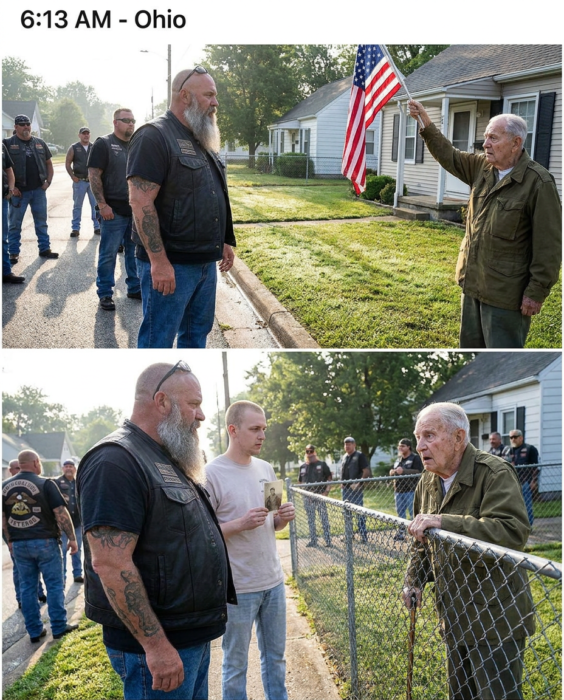
The photograph showed Corporal Daniel Hale. Mason had known that name all his life. Walt knew the man behind it: someone who whistled while cleaning equipment, borrowed books he never returned on time, and wrote home whenever he could find paper. He was quick to help new men settle in. Walt remembered how Daniel could make an ordinary meal last through an entire conversation because he talked more than he ate.
Mason asked questions with the photograph balanced on his knee. Had his grandfather spoken about home? Yes. He had a wife and a small son, Mason’s father, whose picture he carried folded into a pocket. Had he been afraid? Walt said they all were at different times. Daniel made jokes when he was frightened, which sometimes helped the others and sometimes annoyed them. Did he know the men whose names Walt had said that morning? Walt answered each question carefully. They had served together long enough to learn one another’s habits.
Walt did not begin with the battle. Mason had asked for a person, and Walt gave him one.
The twelve men died during a battle overseas in 1970. Walt was the only one from their immediate group who returned. After he came home, the years filled with work, children, bills, and attempts to speak about that day that rarely went well. Families received official information, but the men who had known each other did not always know how to find those families or what they might want to hear.
Walt had been especially close to Daniel. He had intended to contact Daniel’s widow, but he kept putting it off. At first the memory was too raw. Later he worried that turning up with details she had not requested would make things harder. Daniel’s widow moved. Walt lost the address he had saved. By the time Mason’s father was grown, Walt assumed the family had made whatever peace it could without him.
Mason did not blame him. He said his grandmother had kept Daniel’s photograph beside her bed until she died. She had told her son that Daniel was kind and stubborn. Mason’s father passed on those two words because they were what he knew. Mason wanted to hear more, but he was not asking Walt to carry the family’s missing years all at once.
Walt’s own wife, Ruth, had understood more of his silence than most people. She was the person who suggested the flag ritual. Thirty years earlier, after he woke again from a troubled night, she asked whether it might help to give the names a particular time rather than struggle with them alone at any hour. They put up the flagpole together. Walt began raising the flag at six and saying each name beneath it.
When Ruth died, he kept going. His children lived out of state and called often, but there were hours in the house that felt unusually long. Six o’clock gave one part of every day a shape. On mornings when he was ill, he moved more slowly. Once a neighbor helped him manage the line while he stood beside the pole. He still came outside.
Cal listened without interrupting. He had assumed, as I had, that the flag honored Walt’s service in a general way. Walt corrected that gently. The twelve names belonged to twelve particular men, not a single idea. He could remember which one sang badly, which one collected postcards, and which one promised to teach his daughter to fish. The small details stayed with him as stubbornly as the battle itself.
After an hour Mason looked tired. Walt offered to speak again when he was ready. Mason asked if he could bring his father next time. Walt said yes, if his father wanted to come. Before leaving, Mason asked about the ninth name. Walt said it as he had beneath the flag: “Daniel Hale.” Mason nodded, folded the photograph into its sleeve, and put it back inside his vest.
Mason’s father, Paul, arrived the following Saturday. He was fifty-eight, worked in a warehouse, and had driven past Walt’s neighborhood countless times without knowing what happened at six in the morning. He stood with us by the fence while Walt raised the flag. At the ninth name Paul closed his eyes.
Afterward we went inside. Walt had laid a notebook on the dining table. It held the twelve names and what he remembered about their families. Some entries were only a hometown or a first name. Others included addresses from decades earlier. Daniel’s page contained a note about a wife and a little boy, and the description “kept their picture dry.”
Paul read it twice. He had been too young to remember his father’s voice. His mother had saved letters and the formal notice of death, but she had not known the details of his last day. Paul told Walt he wanted to hear what he could remember, even if it was difficult. Walt asked whether he wanted Mason there. Paul said yes.
We gave them the room. Cal and I waited on the porch while Walt spoke. Through the closed screen door I heard only pieces: places, names, a long pause, then Paul asking something. No one had come to hear a practiced story. Walt was reaching across years for a day he had spent much of his life trying to keep contained.
Later he asked us back in. He had been clear about the limits of his memory. The battle was chaotic. He knew what he saw and what others close by told him at the time; he would not invent what he could not know. Daniel had helped pull three wounded men away from an exposed area toward cover while fire came in around them. Walt saw him go back for the third. Daniel was struck before he could return. The three men he helped reached other soldiers who cared for them. Daniel died there.
Paul sat with both hands around an untouched cup of coffee. Mason looked at his grandfather’s photograph on the table. Walt told them Daniel had been afraid that morning, as any of them might have been. He moved anyway when men needed him. Paul asked whether Daniel said anything at the end. Walt said he had not heard words he could honestly repeat. He knew Daniel had carried the family picture. He had seen it when they packed his belongings.
For years Paul had imagined an unknown place and an unknown ending. He had not expected every question to be answered. Knowing that his father had pulled three men to safety gave him one firm thing to bring home. He asked for their names. Walt remembered two clearly and believed he could find the third in his old papers.
The conversation continued over several visits. Walt found letters Ruth had stored in a box, including correspondence from another surviving unit member who had served nearby. He and Paul compared dates. Mason copied documents with Walt’s permission. We did not treat Walt’s account as an official correction to the records; it was one witness’s memory, supported where possible by what he had kept. That distinction mattered to him. He wanted Daniel’s family to know the truth he held, including where his recollection ended.
At the garage, Mason told the club about the three men Daniel had helped. He had Walt’s permission to share that much. The room went quiet. Vince asked whether Walt knew where the other eleven families were. Mason said he had a few old addresses and little more.
Our club had people skilled at searching records, making phone calls, and organizing work that took months. Lena suggested we ask Walt whether he wanted help finding relatives. It was his notebook. He might want the names said at six and nowhere else. Mason carried the question to him the next day.
Walt said he would like families to know what he remembered, provided we approached them carefully. Some might already know; some might not want contact. We would give each family a choice. He asked that we begin with the names and information he had written down, then check the records rather than rely on memory alone.
The search took shape at our garage table. Lena made twelve folders, one for each man. Daniel’s held copies of the photograph and Paul’s contact details. The others began with whatever Walt had: a hometown, a letter, or a former address. We would keep notes about whom we had contacted and what they had agreed to share. We would not post the names online asking strangers to identify families.
Meanwhile the six o’clock visits continued. Mason began coming when his work shift allowed. Paul joined him some mornings. Walt kept the same pace with the flag line. He said all twelve names, including Daniel’s, whether the fence was empty or filled with riders.
Fourteen months is a long time to look for nine families and a short time to make up for decades without contact. We learned both truths as the folders slowly filled.
Some leads ended at disconnected numbers. One former address was now a parking lot. Two men had common names that belonged to many people in the same state. Lena spent evenings checking records that were available to her, then verified promising leads through appropriate sources before anyone made a call. Walt’s children helped with his old letters. Paul remembered a name his mother had mentioned years before. Each bit of information had to be handled with care.
Our first successful call reached a daughter who was a baby when her father died. She had kept a photograph of him holding her in a backyard. She wanted to meet Walt but asked that he not begin with the battle. When they spoke, Walt told her about her father’s habit of carving tiny figures from scraps of wood. She laughed because she owned one: a crooked little bird she had never known he made. Only later did she ask about his final day.
Another family declined contact. We thanked them and closed that lead. Walt was disappointed, but he respected their choice. A third asked for a letter rather than a visit. Mason helped Walt write it, then stepped away while Walt added the personal details in his own hand.
The club’s part was mostly ordinary work. We paid for postage, made copies, helped Walt reach a phone when his hands shook too much to handle the small buttons, and drove him to meetings he agreed to attend. He never asked us to speak in his place. He was tired after some conversations and energized after others. Ruth was no longer there to sit with him afterward, so Cal or one of Walt’s children called that evening if Walt wanted company.
Paul and Mason made their own place in the routine. Paul brought a copy of Daniel’s last letter to show Walt. It talked about weather, meals, and the hope of teaching his little boy to ride a bicycle when he came home. Walt remembered Daniel talking about that bicycle. Paul had learned to ride from an uncle. He did not say this with bitterness. He was pleased to know what his father had imagined for him.
Mason asked Walt about the three men Daniel helped. They found two families willing to talk. One man had lived for many years after the battle; his daughter remembered him mentioning a soldier named Hale. The other family had letters that referred to the same day. Their accounts added details but did not turn that day into a tidy story. Walt read them slowly. He said he was glad those men had reached home.
By the end of fourteen months we had made contact with relatives of nine of the twelve men. That included Daniel’s family. Three folders still held only partial leads. Lena kept them open without promising we would find everyone. Walt touched each folder before closing the box one evening. He was grateful for the nine families and wanted the remaining names kept with equal care.
The anniversary of the battle was approaching. Walt had usually spent it alone, sometimes on the phone with his children. Paul asked whether relatives who wished to come might stand with him at six. Walt said they were welcome, but he worried his yard could not hold many people. The family across the street offered the edge of its driveway. A neighbor helped clear the sidewalk. Cal spoke with the town about where visitors could park. We planned for a quiet morning that would leave access clear for everyone on the street.
More people wanted to attend than we expected. Adult children came with their own children. A brother who had kept his soldier’s letters brought a niece. Some relatives traveled from other states. Not all nine families could be there, and nobody was asked to justify staying home. Those who came numbered more than seventy by the time everyone stood along the sidewalk.
We arrived early. Walt’s daughter had helped him brush his jacket and fasten a cuff that bothered his fingers. Mason checked the flag line so it would run freely. Paul stood near the fence holding Daniel’s photograph inside his coat. Cal kept our riders together at the far end of the group so the families had room closest to Walt.
At six, the street was full of people and completely still. Walt raised the flag. He spoke each of the twelve names aloud for the first time I had heard, strong enough for the front row to hear and for the rest to receive them as they passed from person to person afterward. At the ninth, Paul stood straighter. Mason’s hand found his father’s shoulder.
When the flag reached the top, Walt held his salute. Along the street, more than seventy people did the same. I could hear the flag moving above us and a bird calling from the tree by Walt’s porch. Then Walt lowered his hand, looked at the crowd, and gave the same small nod he had given six bikers more than a year before.
After the flag ceremony, Walt invited people to the community hall for coffee. He knew he could not speak privately with every family in one morning, so Lena had arranged separate tables where people could talk, exchange contact details if they wished, or simply sit. There was no microphone. Walt visited each table as long as his energy allowed.
A granddaughter brought a photograph of one of the twelve men at a county fair before his service. Walt had never seen him out of uniform. He studied the picture of his friend holding a paper cup and grinning toward someone beyond the frame. “That’s him,” Walt said. “Always looking at whoever was about to do something foolish.” The granddaughter wrote his words on the back of a copy to take home.
Paul spent much of the morning with a family Daniel’s actions had touched. The daughter of one man he helped showed him a photograph of her father many years later, standing in a garden with two children. Paul did not know what to say at first. The woman told him he did not owe her anything. She had wanted him to see that her father had made it home and had spoken with gratitude about Daniel.
Mason stood near them, holding the photograph of his grandfather. For most of his life it had been the only image he could summon when the family said Daniel’s name. He still valued it. Now he also had Walt’s stories, the repairably ordinary ones about borrowed books and slow meals, and the difficult account of the day Daniel died. Mason told me later that he was glad Walt had said his grandfather was afraid. It made the courage he had heard about belong to a person he could imagine.
The annual gathering did not turn Walt’s front yard into a public monument. The families who wished to stay connected found their own ways. Some wrote letters. Some returned the next year. A few spoke with one another for the first time after decades of holding separate pieces of the same history.
The club established a simple schedule for the six o’clock flag raising. Walt had not asked for a daily audience. Cal asked whether he wanted company. Walt said yes, provided the riders did not feel obligated to perform a ceremony for him. We agreed that at least one of us would come when possible, quietly and on time. If a rider could not make it, he told the next person. Walt still raised the flag himself when he was able. He liked seeing a familiar face at the fence.
Some mornings the companion was Mason. He lived about three miles away, a distance that had become an uncomfortable fact to him. For years the man who knew Daniel’s last day had been that close. Mason could not recover the mornings before they met. He could arrive for the next one.
Other mornings it was Vince, who brought a thermos because Walt’s coffee maker had become unreliable. Lena came in winter and noticed ice on the front step before Walt did. Cal visited after late shifts at the garage, looking as though he needed sleep but standing straight at six. I often took Thursdays, the morning when I had first seen Walt from the road.
Walt’s children visited more often after meeting the families. They had grown up knowing their father carried memories he could seldom explain. The search gave them names and stories, and it gave them people to call when they wanted to ask about his earlier life. His daughter brought her own children to stand by the fence one summer. Walt taught them how to keep the flag from touching the wet grass as they folded it later.
The twelve folders remained in his dining room. We continued looking for relatives of the three men whose families we had not reached. A new lead sometimes arrived; most led nowhere. Walt never removed their pages from the box. When someone asked about the anniversary gathering, he spoke of twelve men. Nine families had answered us, but all twelve had stood with him each morning.
Walt lived four more years after Mason came to his gate. He grew slower during that time. Some days his hands could not manage the flag line, so a rider or neighbor helped him raise it. On other days he wanted to do everything himself and took twice as long. Whoever came waited.
He also learned to accept ordinary help. Cal repaired the porch rail. Walt’s daughter arranged groceries. Mason came by to change a lightbulb and stayed an hour listening to a story about Daniel trying to cook breakfast with a pan too small for everyone. Walt laughed at the memory, then insisted Mason take the leftover pie from his refrigerator. He had begun saving things he knew the younger man would eat.
There were mornings Walt spoke the names aloud and mornings he moved his lips without sound. I never asked which kind of day meant he remembered more. He remembered the men. He also remembered when a neighbor’s dog needed surgery, when Vince’s grandson started school, and which road Mason took to his new job.
On Daniel’s birthday, Paul joined them at six. He brought the small photograph of his father and the copy of the final letter. Afterward he and Walt went inside for breakfast. Paul told me later that they talked mostly about bicycles. Walt had found an old one in his shed and wanted advice about whether it could be repaired for a neighbor’s child. Paul took it home to look at it. Daniel’s wish to teach him to ride was something neither man could change; repairing that old bicycle gave them a good reason to meet the following week.
The anniversary gatherings continued, smaller than the first but steady. Families brought new photographs and sometimes new questions. Walt answered what he could. Paul and Mason helped visitors find one another when Walt was tired. The community hall made coffee. Our club handled chairs and parking. What had once belonged to a single front yard now belonged, in different ways, to many families.
Walt died in his sleep four years after we first stood at his fence. His daughter called Cal before dawn. She said her father had asked that the flag be raised at six if someone could come. Cal called the club. Nobody issued a grand invitation. Riders who were awake came; others heard in time to join them.
Forty people stood outside the house that morning. There were bikers, neighbors, Walt’s children, Paul, Mason, and relatives of several men from the twelve folders. Cal checked the flag line. Walt’s daughter carried the flag from the porch, folded as her father had taught her. She asked Mason to help raise it.
They worked together. The line moved through the pulley with the same small sound I had heard on the first morning. At the top, Mason held the rope steady while Walt’s daughter secured it. Paul began the names. Others who knew them joined softly. He said Daniel’s ninth, and then the three that followed.
We stood until the last name had been spoken. No one hurried away. Walt’s daughter went inside to put on the coffee. Cal helped fold the empty flag bag and set it by the door. The street slowly returned to its morning sounds: a car starting, a screen door closing, the tires of a delivery truck passing at the far intersection.
Walt’s family kept the house for a while. His daughter came often, and the flowers along the walk survived because neighbors watered them. She offered the twelve folders to the families they concerned, keeping copies of the shared records with their permission. Mason helped sort photographs at the dining table where Walt had first told Paul about Daniel.
The old flagpole stayed. At six on the mornings someone could come, a member of the club met a neighbor or one of Walt’s relatives there. Walt’s daughter decided how it would be used while the house remained hers. Some mornings the flag rose; on others the visitors simply stood beside the empty pole and spoke the names they knew.
Mason visited on the anniversary. He brought his grandfather’s photograph and the copy of the letter, the same things he had carried to Walt’s gate years earlier. Paul came with him. They arrived a few minutes before six, when porch lights were still visible along the street.
Paul had once known his father from a photograph and two words passed down by his mother: kind and stubborn. Mason had inherited even less. Walt gave them stories with grease, borrowed books, frightened men, and a family picture kept dry in a pocket. Father and son could speak of Daniel differently now. They could also speak of Walt, who had carried his name into every morning they had lived three miles away.
On my way to the garage, I still took Walt’s street sometimes. It was quiet at that hour. One morning I saw Mason standing by the pole with a neighbor while the flag climbed. I parked down the block and walked over. Mason made room for me at the fence.
At six, we stood together and said twelve names.
Follow this page for more biker stories about the people we meet on early roads, the memories they carry, and the families who finally get to hear them.