Part 2: A Biker Was Stopped for Following a School Bus — Then He Pointed Underneath and Said, “There’s Crying”
Part 2
My name is Nora Whitfield, and I was the teacher’s aide assigned to Bus 14 that afternoon.
That meant I was supposed to count children, remind them not to stand before their stops, help the younger ones with backpacks, and make sure the ride home stayed ordinary enough that parents never had a reason to know my name.
But ordinary disappeared before we reached the second block.
I first noticed the motorcycle in the driver’s mirror. Our driver, Denise Parker, a fifty-year-old Black American woman with twenty-three years behind a school bus wheel, glanced at it once, then again, then frowned in that quiet way adults do when something has not become a problem yet, but has started asking to be noticed.
“He’s still back there,” she said.
I looked through the rear window.
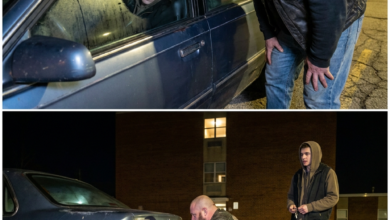
The biker was keeping pace behind us, never close enough to bump us, never far enough to seem accidental. His motorcycle moved slowly, almost painfully slowly, as if he were holding traffic back on purpose.
Some children waved.
Some laughed.
A few whispered that he looked scary.
Ethan did not look back at first. He was too busy searching the floor, the seat beside him, and the loop on his backpack strap. His service dog, Milo, was supposed to be waiting with his mother at the school office because Ethan had therapy after school. Milo was a small cream-colored poodle mix trained to help him through sensory overload, transitions, and panic that could arrive faster than adults could explain.
Something had gone wrong at dismissal.
A substitute staff member had opened the side gate too early. Older students had rushed past. A delivery truck had backed near the curb. In that confusion, Milo had slipped from the office doorway and chased after the bus.
No one on the bus knew.
Ethan only knew Milo was gone.
At first, he whispered, “Where’s Milo?”
Then he said it louder.
By the time we turned onto Oak Street, he was crying so hard the children around him started crying too, not because they understood, but because panic in a small space spreads like spilled water.
I knelt beside him in the aisle.
“Ethan, sweetheart, breathe with me.”
He shook his head.
“No Milo.”
“I know. We’ll find him.”
But I did not know that.
That is the sentence that still hurts.
Outside, the biker knew more than all of us.
He had seen Milo run under the bus near the first turn. He had seen cars behind him edging forward too fast. He had understood in a split second that if he passed us, the dog might panic into the road, and if he backed off, the dog might be crushed by traffic.
So he did the only thing he could do.
He became a moving shield.
And every adult who saw him decided he was the threat.
Part 3
The false climax began when the first parent shouted.
Bus stops can turn into little courts of public opinion faster than anyone wants to admit. One frightened adult says something, another confirms it, a third records it, and suddenly a man’s face, clothes, and silence become evidence before anyone knows what has happened.
At Oak Street, the fear had a full audience.
Parents had stepped into the street. Children were pressed to the bus windows. Denise had shut the doors but not the engine yet, because she was waiting for police instructions. Ethan was still rocking, still whispering Milo’s name, and every second of noise seemed to pull him farther from us.
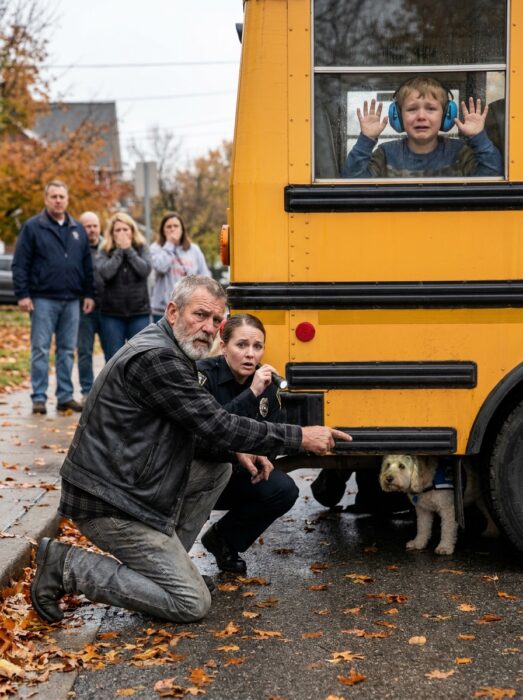
Officer Carla Bennett stood between Hank and the bus.
“Sir, step away from the vehicle,” she said.
Hank raised both hands.
“Yes, ma’am.”
That startled me when I heard it later. He was not defiant. He was not aggressive. He was not trying to make a point. He had been accused in front of an entire street, and still the first thing he did was make the officer feel safe.
The father in the navy jacket pointed at him.
“He was following kids.”
Hank looked at the man once, then looked away.
“I was following the sound.”
The father scoffed.
“What does that even mean?”
Hank pointed under the bus again.
“It means something little is trapped under there.”
Officer Bennett crouched with her flashlight. The second officer began moving parents back from the curb. Denise finally turned the engine completely off, and the sudden quiet changed everything.
No rumble.
No brake hiss.
No shouting for one brief second.
Then the whimper came again.
This time, everyone heard it.
Inside the bus, Ethan lifted his head.
“Milo.”
I looked toward the front.
Denise looked at me.
We both understood at the same time, and neither of us wanted to believe it.
Officer Bennett aimed the light farther under the rear axle.
“There’s a small dog in a vest,” she said.
Ethan stood too fast.
I caught him gently before he could run toward the stairs.
“Milo is under there,” he said, voice breaking.
“Yes,” I told him. “And they’re going to help him.”
Outside, Hank took one careful step forward.
Officer Bennett held up her hand, and he stopped immediately.
“I can reach him,” Hank said. “But nobody starts that bus.”
Denise leaned out the driver’s window.
“It’s off. It stays off.”
Hank nodded, then lowered himself flat onto the wet pavement with the patience of a man who understood that saving something frightened required more softness than strength.
Part 4
Getting Milo out took seven minutes, though it felt much longer.
The little dog was wedged near a metal crossbar under the bus, not badly injured, but trapped by one loop of his blue service vest. He was shaking so hard that his tags clicked faintly against the frame. His eyes were wide, his paws tucked under him, and every movement around him made him flinch.
Hank did not yank.
That mattered.
A stronger man could have hurt Milo by trying to save him too quickly. Hank moved slowly, talking the whole time in a low voice that barely rose above the wind.
“Easy, little brother. Nobody’s starting this thing. I got you.”
Officer Bennett lay near the other side with the flashlight.
“Can you see the buckle?”
“Barely.”
“Need something to cut it?”
“No blade near him unless we have to.”
That answer changed something in her face.
The parents heard it too.
The biker they had feared was more careful with that little dog than many people are with apologies.
Milo whimpered and snapped once when Hank’s fingers brushed the strap. Hank did not jerk back.
“Fair enough,” he murmured. “I’d bite me too.”
A nervous laugh moved through the crowd, but it faded quickly because Ethan was now standing at the bus door with me beside him, both hands pressed to his chest, fighting the kind of panic that can break a child from the inside.
“Milo is scared,” he whispered.
“Yes,” I said.
“He needs me.”
“He knows you’re here.”
I do not know whether that was true.
I said it because Ethan needed something to hold.
Under the bus, Hank finally worked the loop loose. He slid backward slowly, one arm wrapped around Milo’s small trembling body. The dog was dirty, damp, and alive. His blue vest was twisted sideways, but the moment his paws touched open air, he lifted his head toward the bus.
Ethan made a sound I will never forget.
Not a word.
Not a cry.
A child’s heart recognizing its missing piece.
Hank sat up on the pavement and held Milo carefully, waiting for permission before moving closer. Officer Bennett nodded toward the bus.
“Bring the boy down slowly.”
I helped Ethan step onto the curb.
He ran the last three feet.
Milo wriggled from Hank’s arms into Ethan’s, and the boy dropped to his knees on the wet sidewalk, holding the dog against his chest while Milo placed one shaking paw on his leg exactly the way he had been trained to do.
The street went silent.
Then Ethan looked at Hank.
For a second, everyone expected him to hide behind me, his dog, or the bus door.
Instead, he leaned forward and wrapped both arms around the muddy biker’s neck.
Hank froze.
Then his eyes closed.
And every parent on Oak Street had to live with what they had almost believed.
Part 5
Ethan’s mother arrived eight minutes later, breathless and terrified.
Grace Miller was thirty-two, white American, a pediatric nurse still wearing navy scrubs beneath her coat. She had abandoned her car half a block away when another parent called and said the bus had been stopped by police. She reached the scene already expecting disaster, then saw her son sitting on the curb with Milo in his lap and a huge biker kneeling nearby like he was afraid to take up too much space.
“Ethan.”
He leaned into her without letting go of Milo.
“Milo ran under the bus,” he said.
Grace looked at the dog, then at Hank, then at Officer Bennett.
“What happened?”
The officer answered before anyone else could.
“This man followed the bus to keep the dog from being hit.”
Grace’s face changed. It moved through fear, confusion, relief, and shame in the space of a few seconds because she had seen Hank’s vest too. She had almost made the same mistake as everyone else, only faster.
She knelt beside him.
“Thank you.”
Hank shook his head.
“Get him checked by a vet. That’s enough.”
But Ethan reached for Hank’s sleeve.
“You heard Milo?”
Hank nodded.
“Not at first. I saw him running. Then I heard him when he got stuck.”
“You didn’t leave.”
“No.”
“Why?”
Hank looked at the little dog in the boy’s lap, then at the line of parents standing behind them.
“Because little things get missed when everybody’s watching for big danger.”
Officer Bennett heard that.
So did the father in the navy jacket.
He stepped forward awkwardly, rubbing one hand over the back of his neck.
“I owe you an apology.”
Hank looked up at him.
The street seemed to wait for anger.
Hank only said, “Next time, look under the bus before you decide what’s behind it.”
The father nodded, unable to answer.
Grace wrapped one arm around Ethan and touched Milo’s head with the other hand.
Milo was still trembling, but his breathing had slowed. Ethan’s had too. That was what service animals do, and the whole street had just watched the tiny dog calm the child after the biker saved the dog.
It was a circle of rescue none of them expected.
Officer Bennett turned to Hank.
“Can I have your name for the report?”
“Hank Mercer.”
“Any injuries?”
He looked at his scraped forearms and muddy vest.
“No, ma’am.”
Ethan lifted Milo’s paw and placed it gently on Hank’s boot.
Hank stared at the small paw as if it had thanked him better than any adult could.
Then he whispered, “You’re welcome, partner.”
Part 6
The video never went viral because Officer Bennett made sure the worst parts were not filmed.
That might sound like a small detail, but it mattered.
A few parents had recorded the beginning, when they thought Hank was dangerous. Several stopped recording when they realized they were wrong. One mother deleted her clip right there on the sidewalk after watching Ethan hug the biker.
She cried while doing it.
“I was going to post it,” she admitted to Grace. “I thought I was warning people.”
Grace looked at her son, still holding Milo.
“Please don’t.”
The woman nodded.
She did not post.
Instead, the story traveled the old way first, through phone calls, neighborhood texts, and parents retelling it with less confidence each time. By evening, most versions included the same sentence: We thought he was following the children, but he was protecting a dog.
The school district reviewed dismissal procedures.
Service animals were given a new check-in protocol. Bus drivers were trained to stop immediately if any adult reported an animal near the vehicle. A small mirror was added beneath the bus frame at the depot’s recommendation. None of that sounded emotional, but it was. Sometimes love becomes a checklist because someone almost got hurt.
Hank did not ask for attention.
He rode away after giving his statement, jeans damp, vest streaked with mud, one elbow scraped from the pavement. Ethan watched him go from his mother’s arms, Milo tucked beneath his chin.
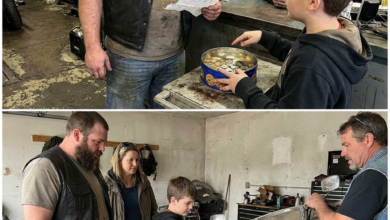
The next afternoon, Grace brought Ethan and Milo to the small repair shop where Hank worked.
The sign outside read Mercer Cycles & Small Engine Repair.
Hank came out wiping his hands on a rag, surprised to see them.
Ethan held a folded piece of paper.
It was a drawing of a yellow bus, a tiny dog, and a biker lying under the wheels with one arm stretched out. The proportions were wrong. The meaning was perfect.
At the top, Ethan had written in careful letters:
Hank heard him.
Hank took the picture slowly.
His throat moved.
“That’s pretty good, partner.”
Ethan looked at the motorcycles behind him.
“Are they loud?”
“Sometimes.”
“Milo doesn’t like loud.”
“Then we won’t start them.”
So they stood in the quiet shop with every motorcycle silent, because for once, the loudest thing about a biker was not his engine.
It was the fact that he had listened.
Part 7
After that day, Hank became part of Ethan’s world in a careful way.
Not suddenly.
Not loudly.
Children like Ethan do not always accept people because adults decide they should. Trust had to arrive slowly, through predictable visits, quiet greetings, and the promise that no motorcycle would start without warning.
Hank understood.
Every Friday afternoon, if Ethan wanted, Grace brought him and Milo by the repair shop for ten minutes. Hank would sit on an upside-down bucket near the open bay door, Milo would sniff the same tire, and Ethan would ask one question.
Sometimes it was about engines.
Sometimes it was about dogs.
Sometimes it was about why people thought Hank was bad.
That question hurt the adults more than the child.
Hank answered it simply.
“Because people get scared and guess wrong.”
“Do you get mad?”
“Sometimes.”
“What do you do?”
“Try not to become what they guessed.”
Ethan thought about that for a long time.
Then he nodded like it was a machine he could understand.
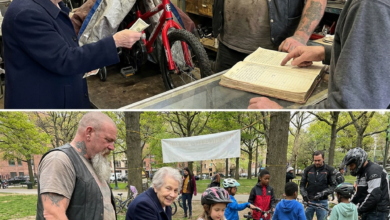
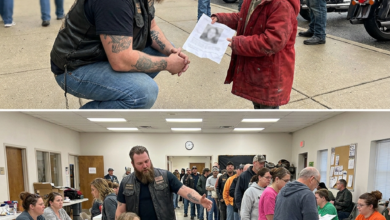
Months later, Mill Creek Elementary held its safety day, and Officer Bennett invited Hank to speak. He refused at first. Then Grace told him Ethan wanted to introduce him.
That changed the answer.
Hank arrived without his motorcycle running. He parked across the lot and walked in with his helmet under one arm. The same parents who had once stared at him with fear now watched their children gather around him, asking about helmets, brakes, mirrors, and why listening matters.
Ethan stood beside him with Milo.
“This is Hank,” he told the class. “He heard Milo when we didn’t.”
No speech could have done better.
Hank looked down at the boy, then at the little dog sitting calmly at his feet.
The room was full of children, teachers, parents, and one biker who had once been mistaken for danger because he refused to leave a school bus unprotected.
At the end, Ethan hugged him again.
This time, Hank knew what to do.
He bent carefully, kept one hand visible, and let the little boy decide how long the hug lasted.
Outside, Bus 14 waited under the maple trees.
Its engine was off.
Its wheels were still.
And beneath it, for once, every adult looked before moving on.
Follow the page for more stories about the people we almost judged before we finally saw them.