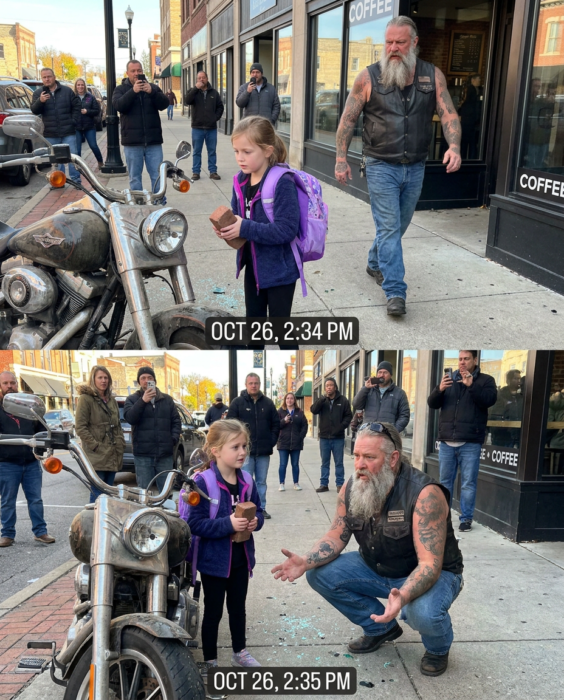
A Seven-Year-Old Smashed the Headlight of My Harley in a Crowded Street — Then She Asked Me to Stay Until the Man Behind Her Went Away
June kept her eyes on the bus shelter while I gave the dispatcher our location. I told her a child had broken my motorcycle headlight and appeared frightened of someone nearby. I was careful about that last part. I had not seen anyone approach June. I didn’t know whether the person she feared was still there.
The dispatcher asked whether June was injured. I looked at her hands. There was a narrow red mark on one thumb, but no cut that I could see. She said she was fine. When the dispatcher asked if she knew her mother’s number, June nodded and recited it without looking away from the corner. The cashier, Elena, borrowed a pen and wrote it on the back of my coffee receipt.
The receipt stayed in my pocket for months.
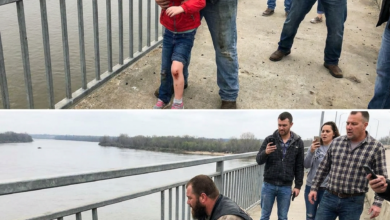
A man in a blue work shirt stepped forward and said he had watched the whole thing. He pointed to my headlight, annoyed on my behalf. “She went straight for it,” he said. “She knew exactly what she was doing.”
“I believe you,” I told him.
June heard that and flinched. I wished I had chosen different words. I meant only that I understood she had aimed for the light. I had no idea why she had needed me to hear it.
I asked Elena if we could bring June inside. The shop’s front tables faced the street, and the dispatcher thought a public place with other adults was sensible. June hesitated when she saw the door. I pointed through the window to a table from which she could still see the bus shelter. She followed us in.
I left the Harley at the curb with its headlight broken. That sounds obvious, but every ordinary part of the afternoon kept trying to pull my attention back to it: my helmet on the coffee counter, a bill I’d have to pay, the sound of glass being swept up outside. I had bought the bike used and spent two winters repairing it. For a few minutes I still resented the damage. Then June asked if she could sit facing the window, and I pulled the chair out for her.
Elena brought water in a paper cup. June held it without drinking. When a city bus pulled up, she leaned forward. The bus left, and her shoulders lowered a fraction.
My name is Cole Maddox. Around the club, they call me Grinder, a name left over from a machine shop job and an accident with a stuck bolt. Most people in Springfield knew me only as the large man on the old Harley. I can’t blame anyone who expected me to shout that afternoon. Before I got sober, I had been good at shouting. I had also spent a night in a county cell years earlier after an argument outside a bar. I hadn’t struck anyone, but I had frightened the people trying to get past me. I remembered their faces more clearly than I remembered what the argument was about.
June could tell I was angry without my saying it. I kept both hands on the table where she could see them.
My phone buzzed. It was Rook, another member of our riding club, asking whether I was still meeting him at the garage. I called him back and said I wouldn’t be there yet. I gave him a short account of what had happened.
“Need me down there?” he asked.
“Give me a few minutes. The police are coming.”
I knew what it would look like if several men in leather vests arrived while a little girl was trying to explain why she was scared. Rook understood. He said he would wait, then asked me to call if June’s mother needed anything.
When I put the phone away, June was turning her paper cup between her palms. I asked whether the man she had mentioned knew her name. She said, “I don’t think so.”
“Did he talk to you?”
“Today he did.”
That was the first new piece she had given us. Elena took the chair beside her. I asked June what he had said, but she pressed the rim of the cup flat with her thumb and looked toward the door. I let the question rest.
A police cruiser came into view, and June slid off her chair. For an instant I thought she meant to run. Instead, she walked to the window and stood behind the frame, where she could see the bus stop without being seen easily from the street.
The bus shelter was empty.
June stared at the space beside it. Then she pointed to a parked car beyond the intersection and said, very quietly, “That’s where he goes when he sees me looking.”
Officer Dana Bell arrived with another officer a few minutes later. I met them at the coffee shop door so June could remain at the table with Elena. Bell listened as I explained the headlight and the call to dispatch. She asked me to show her exactly where June had been standing. We went outside, avoiding the glass Elena had gathered into a little pile beside the curb.
From that spot, Bell could see the bus shelter, the parked car, and the entrance to the coffee shop. She understood why June had wanted the front table. She still had questions, and she went inside to ask them herself.
I stayed near the counter. I couldn’t hear every word over the grinder and the traffic outside, and Bell spoke to June gently enough that I didn’t try. June pointed through the glass twice. The second time, Bell’s partner stepped out and walked toward the intersection. He didn’t run. He spoke into his radio and kept his eyes on the sidewalk ahead of him.
Elena came over with the coffee I’d abandoned earlier. It had gone cold. She offered to make a fresh one; I said the old one was fine. I drank some and found I couldn’t taste it.
Bell asked June whether she would like her mother there. June nodded at once. Elena called the number from the receipt. It rang long enough that I thought it would go to voicemail. A woman answered over what sounded like restaurant noise, and Elena stepped away to tell her where June was and that she was safe with a police officer. She was careful not to make guesses about the man.
After the call, June seemed to grow smaller in the chair. “She’ll lose her shift,” she said.
“She said she’s coming,” Elena replied.
June stared at the cup. That was when I learned she had walked part of the way home by herself after school. Her mother, Tessa, worked an afternoon restaurant shift and an evening cleaning shift several days a week. A neighbor usually met June at the end of the block, but that neighbor had been recovering from surgery and could no longer do it. Tessa had arranged phone check-ins at the library and at home while she sought another arrangement. June knew where to go if she needed help. She had gone into stores before to wait out the rain. None of that explained why she hadn’t gone into the coffee shop first.
Bell asked. June’s answer came in pieces.
She said she had seen the same man on Monday near the bus stop. On Tuesday he was by the library steps. On Wednesday he had crossed the street when she crossed. She had told herself it might be a coincidence. That afternoon, Thursday, she saw him again after leaving school. She went into a pharmacy and waited by the greeting cards. When she came out, he was across the street.
Bell asked if he had spoken to her there. June nodded. She rubbed the bent paper star on her backpack zipper and said he had asked whether she was walking home alone. She had kept going. Near my parked Harley, she saw him stop too.
“Why didn’t you come into this shop?” Bell asked.
June looked over at me. “He was going to leave.”
I remembered my helmet on the counter and my coffee waiting beside it. Through the window, anyone on the street could have seen me inside. June had seen my motorcycle, then seen me reaching for the helmet.
“I needed him outside,” she said.
I had no answer for that. I wanted to ask why she had not called for help, why she had not shouted or run to the cashier. Those were adult questions formed in a room where she was finally safe. Out on the sidewalk, she had made a choice in seconds. She knew breaking the headlight would bring the owner to her. She knew he might be furious. She had judged that a furious adult standing with her was better than being alone.
I went outside when Tessa arrived so mother and daughter could have a moment. Tessa wore black work shoes and an apron folded into her bag. She rushed past me, then came back once June was in her arms. She tried to apologize for the Harley. I told her Bell was still finding out what had happened and the motorcycle could wait.
“I’m her mother,” Tessa said. “I should have known.”
I had seen June’s backpack, her careful phone number, and the way she worried about her mother’s shift. Tessa had plainly made arrangements. One had fallen through, and something frightening had followed. I said I was glad June had found us. Tessa went back inside.
Bell’s partner returned before dark. He had checked the bus shelter and the car June had pointed out. Nobody was there. Two adults nearby remembered a man at the corner, but neither had watched where he went. Bell told June they would follow up. Tessa held her hand while Bell took down the details.
It seemed possible, for a moment, that this was all we would learn that day. June had reached a safe place. Her mother was with her. Bell had a description, and I had a broken headlight. The danger appeared to have passed.
Then Elena said she remembered something. The coffee shop camera faced the window and caught part of the sidewalk. Bell asked the manager to preserve the recording. As he went to get the key to the office, June looked at the screen over his shoulder and whispered, “He knows when I come out.”
The camera did not show everything June had described. It covered the space outside the coffee shop, a slice of the bus shelter, and the reflection of traffic in the shop window. Bell told us that at the start, before anyone had looked at the recording. A camera angle can settle one question while leaving three others open.
The manager let Bell review the recording in the office. I stayed with Tessa and June. When Bell came back, she asked Tessa whether she had photos of June from earlier that week showing what clothes she had worn. She also asked whether June recognized the man in a still frame. Tessa put a hand on June’s shoulder and looked to Bell, who held the phone low enough that June could choose whether to look.
June looked once. “That’s him.”
Bell didn’t tell us much more then. She had officers checking nearby businesses, and she needed to compare June’s account with what the recordings actually showed. I heard later that the pharmacy had kept its camera footage as well. Bell and her colleagues asked the businesses for copies; Elena wrote down which days June had mentioned so they wouldn’t lose the Monday recording if the system overwrote it.
Rook called again. I stepped onto the sidewalk to answer. The broken headlight hung above the front fender, and a strip of chrome reflected the late sun through the damaged lens.
“Her mom’s here,” I told him. “They’re looking at cameras.”
“Need me?”
“Maybe tomorrow. We need to know what they find.”
He paused. “You sound different.”
I was watching a father hurry two children past the bus shelter. I wondered how many ordinary walks I had seen from that curb without ever paying attention to who was waiting at the far end.
That evening, I got a ride home from Rook and left the Harley at the coffee shop with the manager’s permission. I didn’t want to ride it after dark with the light broken. Rook brought his truck the next morning, and we took the bike to our garage. The headlight could be repaired. I had already found a replacement part by the time Bell called.
She told me I could come to the station to give a fuller account of what June had said when she first approached me. She did not ask me to investigate anything. I repeated her words as closely as I could and said where each of us had been standing. Bell also wanted to know who else had heard her. Elena had, and the man in the blue shirt had been nearby.
A few days later, after Bell had spoken to Tessa about what could be shared, I learned what the cameras showed. The coffee shop footage from that Thursday caught a man near the bus shelter before June reached my bike. He was partly hidden by a parked car. When June stopped at the curb, he stopped too. After she struck the headlight and I came outside, he moved away.
The pharmacy footage showed him outside while June waited among the greeting cards. Other recordings placed a man matching his appearance along portions of her route on the three previous afternoons. The footage couldn’t show what he intended. It showed June had reason to recognize him, and it showed he had opportunities to leave the area that he did not take.
Bell called that first thing June had done “finding a witness.” She said it in the station hallway, almost to herself. I thought of June holding the brick and looking straight at me. She had made certain people would gather. She had made certain I would come out. If that man came closer, she would no longer be the only person who could describe him.
Two days later, Bell phoned Tessa with news that the man had been arrested. Tessa told me later, with Bell’s permission to pass along the outline, that officers found him that Thursday afternoon roughly forty yards from where June had been standing, after reviewing the description and checking the surrounding streets. A records check showed an active warrant from another state involving a child abduction case. Bell was cautious about the details because the case was still moving through the courts.
The distance stayed with me. Forty yards was shorter than the length of the block I walked from the station to my truck. June had watched him from our coffee shop window while we discussed where her mother was and whether she had glass on her thumb.
I told Rook that night. He stood beside the Harley and looked at the cracked lens without touching it. I expected him to say we should organize riders immediately, put vests on every corner, make it clear nobody could trouble those kids again.
He said, “Ask the school what help they can actually use.”
Rook’s answer irritated me for about a second. Then I remembered June’s face when she had first seen the patrol car. A row of unfamiliar bikers waiting outside her school could frighten children as easily as reassure them. If we meant to help, we had to listen to the families and the people responsible for getting those children home.
I called Tessa before I called anyone else. She was grateful June had found me. She was also exhausted, short a restaurant shift, and trying to arrange care for the next afternoon. She needed that solved before she could think about anything larger.
So the first useful thing our club did was small. Rook found out whether his sister, who already worked with a local after-school program, knew of an open place. She did. Tessa made the call herself. June had a supervised place to go while the adults worked out the rest.
I thought the broken headlight had been the cost of keeping June safe that afternoon. I was beginning to see how much longer her family had needed help.
June did not become cheerful as soon as the man was arrested. When I saw her a week later, she was sitting beside Tessa at a table in the same coffee shop, carefully peeling the paper wrapper off a straw. Elena had invited them in after her shift. I had asked Tessa if it would be all right for me to stop by; she said June wanted to tell me something.
June said she was sorry about the headlight.
“You already said that,” I told her.
“I know. Mom said I could say it again.”
Tessa gave a tired smile. I told June I had been angry when I heard the glass break. I also told her I was glad she had got my attention. Both things were true, and she deserved to hear them plainly.
She asked whether the bike was fixed. I said it was safe in the garage. Her gaze went to the window, where I had parked my truck instead. She seemed relieved that I had not disappeared with the motorcycle.
I had brought the bent paper star that had come off her backpack zipper while Bell spoke to her. I’d found it under the table afterward and put it in my jacket pocket. Tessa checked that it was hers; then June fastened it back on with Elena’s help. For the first time since I’d met her, she talked about school. The star was from a reading project. She had made it herself, and one point bent because she kept rubbing it on the walk home.
That gave an ordinary explanation to something I had watched her do all afternoon. I was grateful for it. I was also sorry that her school project had become a way to steady her hands.
Rook and I met with Tessa, the after-school coordinator, and a school administrator a few days later. We brought one idea, and they changed most of it. We thought club members could stand along June’s route at dismissal. The coordinator pointed out that children should know exactly which adult they were meeting and where. Parents needed to consent. Volunteers needed screening, training, and a clear instruction to contact school staff or police if something seemed wrong. Nobody wanted a rider deciding on his own that a child should be followed home.
We listened. The first afternoon there were two approved volunteers, one at each end of a short stretch between the school and the after-school center. They wore ordinary coats with volunteer badges supplied through the program. I stood with Rook at the far crossing. Our job was to be present, help children use the marked crossing when asked, and call the coordinator if a child who was expected did not arrive. A school staff member handled the roster.
June walked that route with a group. She saw me, raised two fingers in a small wave, and kept going. I waved back. Her friend asked whether I had a motorcycle. June answered before I could. “His is in the garage.”
The club argued about the project that night. Some members wanted to add more streets at once. Others worried we had promised something we could not sustain. Rook sided with the second group, and for once I did too. A volunteer who shows up for a week and vanishes can leave families relying on help that has gone. We put our names on a calendar, took the training the coordinator required, and started with the route we could cover.
Tessa joined one planning meeting after her shift. She corrected us when we talked as though June had been walking entirely alone by choice. Tessa had arranged check-ins and had been searching for a replacement when the neighbor became ill. The after-school opening solved an immediate problem, but it took calls and a fee she could manage only after the program helped her apply for assistance. She wanted other parents told where to find that help before they reached the point she had.
So our little crossing effort changed. The coordinator added information about after-school places and pickup plans to a handout for families. Our volunteers could point parents to the school office, but the school handled the arrangements. I learned the difference between being available on a corner and assuming I knew what a family needed.
There was another difficult part. For weeks, strangers online shared a phone video of June beside the broken headlight. It showed me coming out of the coffee shop and her holding the brick. It stopped before anyone heard why. People argued about how I should have reacted; some blamed Tessa without knowing anything about her shifts or the arrangement that had fallen through. I asked the man who had posted it to take it down. He did, eventually. Tessa had to live with the comments longer than the video was up.
June never saw most of them. Tessa made sure of that. Still, when someone at the crossing called June “the brave girl with the brick,” I watched her grip the strap of her backpack. I asked the volunteers to use her name only when they knew her and to let her have ordinary afternoons.
At the garage, I looked again at the replacement headlight I had ordered. I installed a working light on another bike I used for rides. June’s damaged lamp remained on the Harley, which I kept off the road. Rook offered to remove it and put it on a shelf, where it would be easier to keep clean.
“Leave it,” I said.
I couldn’t yet explain why I wanted the Harley exactly as it had looked when June saw it. Rook set the tools down and left it alone.
Our first winter at the crossing was harder than the first fall. In September, several men had offered to help because they were moved by June’s story. In January, when rain soaked through gloves and the school changed its dismissal time for a week, the calendar had empty squares.
Rook called people one by one. I covered more afternoons than I had planned. Then Tessa came to a meeting with two other parents. They did not own motorcycles. One worked nights and could cover Mondays; the other could do Thursdays. They went through the same approval process and took their places on the schedule.
I had been calling it the club’s project. After that meeting, I stopped. Families, school staff, and volunteers kept it going. We were part of it, and we could be replaced when we were sick or working late. That made the route more dependable.
June still saw me there sometimes. At first she checked both ends of the street before crossing. Later she talked with her friends all the way from the school gate. I noticed the change because I kept looking for her. Tessa told me gently that June didn’t need me to report on every afternoon. She was right. I learned to watch the crossing and let June walk with the other children.
The court case concerning the man took time. Tessa received updates through the proper channels; I knew only what she chose to tell me. I did not ask June about him. Some days she wanted to come into the coffee shop and see Elena. Other days she went straight to the after-school center. The adults around her followed her lead where they could.
The broken Harley stayed in the garage. I dusted it when I cleaned the other bikes and put a small piece of clear tape over a loose edge of the lens so it would not cut anyone who brushed past. I never replaced that headlight. Once, Rook caught me staring at it after a volunteer meeting.
“You can keep it without standing here all night,” he said.
I closed the garage and went home.
By the end of the first year, the coordinator asked whether we could help another school set up a similar route. We shared the schedule we had learned to keep, along with the mistakes we had made. Their school chose its own volunteers and its own corners. Two more schools asked after that. The work grew slowly because each place needed people who could actually be there at dismissal, through cold days and changed shifts.
Three years after June broke the light, participating schools and community groups had arranged routes near eleven schools. Some had riders on the volunteer list; many did not. Rook still covered Tuesdays near the first crossing. I took Thursdays when the machine shop let me leave in time.
I had put a small handwritten card inside the Harley’s windshield in the garage. It was for the people who asked why the headlight remained broken. It said, “June got herself help here.” I did not use her full name. Anyone who knew her could understand it; anyone who didn’t had no reason to go looking.
One afternoon June came to the garage with Tessa to drop off a volunteer schedule. She was ten then, taller, with a different backpack. She read the card while I talked with her mother. I waited for her to ask me to take it down.
Instead, she looked at the headlight and said, “You still haven’t fixed it.”
“No.”
“I was really scared you would yell.”
“I know.”
She touched the edge of the windshield, well away from the glass. Then she went back to Tessa, and they left together. I turned off the garage light after they had driven away.
Last spring, I was standing at the crossing when a first grader stopped in front of me. He asked if I was the man with the broken motorcycle. His older sister had told him about it. I said I was.
“Can you still ride it?” he asked.
“That one stays in the garage.”
He considered this and ran to catch up with his group. A staff member counted the children as they reached the after-school door. Across the street, Rook held up a hand to a driver who had stopped at the marked crossing. The driver waited. The children went through.
By then June no longer used that route. She was old enough to attend a school farther away, and Tessa’s hours had changed. I still saw them occasionally at Elena’s coffee shop. June usually had a book open. She spoke to me about the book, or about nothing in particular. She never had to tell the story for my benefit.
People ask what I said when she hit my Harley. I tell them I came outside angry. I tell them she was shaking and asked me to stay. The rest belongs to her unless she wants to speak about it.
The bike is behind my workbench, under a cover that doesn’t quite reach the front wheel. Its headlight remains cracked, held together at one edge by clear tape. The card inside the windshield has curled in the summer heat, but I can still read it.
When I leave the garage for my Thursday shift at the crossing, I pass that old lamp on the way out. I remember June standing beside it with a brick in her hands. I remember setting my helmet down because she had asked me to stay.
Outside, Rook is usually waiting by his truck. We check the time, drive to our corners, and stand there until the last children have gone through.
The glass is still broken. June made it home.
If you’d like more biker stories about the people behind the leather vests, follow the page. I’ll share the next one here.