SIX BIKERS INTERRUPTED A FACTORY’S CLOSING CEREMONY—THEN A RETIRED FOREMAN RECOGNIZED THE NAME ON AN EMPTY LUNCHBOX
SIX BIKERS WALKED INTO THE FACTORY’S CLOSING CEREMONY, AND ONE SET A DENTED LUNCHBOX DOWN BESIDE THE CAKE.
“You left him out.”
Rosa Boone said it into a silence Charles Mercer had been hoping would last just long enough for him to skip the last paragraph of his speech. He was supposed to thank the committee, shake hands with an executive he had met that morning, then cut the sheet cake.
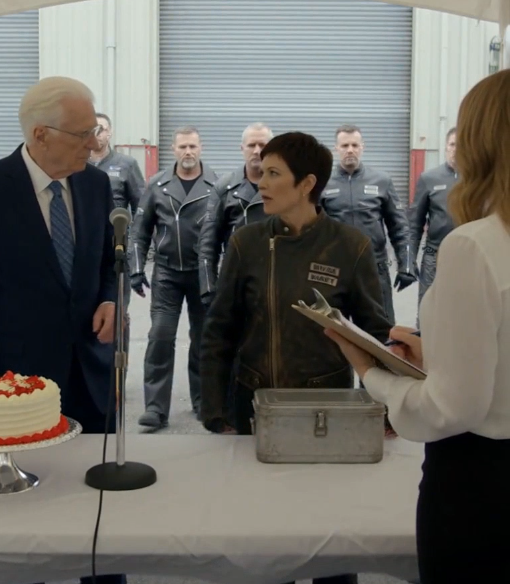
From where he stood, he could see the closed loading doors of West Branch Tool Works beyond the tent. For most of his life you could hear those doors rolling up from the highway outside the little Pennsylvania town. Now the only sounds were the wind picking at the tent walls and six motorcycle engines ticking down in the parking lot.
His daughter leaned close. “Dad. Do you know her?”
Charles recognized Rosa by the way she held herself. At nineteen she’d leaned one shoulder against the supply cabinet and waited for him to tell her whether she’d passed the inspection test. Now she wore a black leather jacket rubbed pale at the elbows. Five people in riding gear had come in behind her. They stopped well short of the table, as if somebody had told them in advance where to stand.
The lunchbox was a square steel one with a cracked brown handle. One corner had been flattened so badly it couldn’t have sat level even when it was new. Rosa steadied it as somebody at the next table started to get up.
“Ma’am,” said the event coordinator, “there are people still waiting to speak.”
Rosa glanced at the brass plaque on the easel beside the cake. Under the plant name, the engraver had fitted three lines of names. Charles had run his finger down that list at breakfast, enjoying the feeling of remembering faces he hadn’t seen in years.
“Then he can go first,” Rosa said.
She flicked open the latch. There was a name inside the lid, written in marker too faded for Charles to read from the podium. He stepped closer. He knew that sloping capital M even before he could make out the stain beneath it, a dark crescent where a thermos had leaked coffee for so many years the smell had outlasted the man who carried it.
Rosa lifted a single photograph from the empty box. In it, seven people stood at the factory’s side door, their hands black from the night’s work. She turned it over.
Charles looked down at the handwriting on the back. The paper shook a little before he realized whose hand was moving.
“I signed that.”
Part 2
“You did,” Rosa said. She let go of the photograph as soon as he had it securely.
The writing on the back was so ordinary it seemed like a trick of the light. He’d written the shift and the month in black ballpoint, then the names from left to right. Underneath, in the sideways hand he used when there wasn’t enough room, he’d added, For Mateo, who actually got all of us to stand still. That was all the signature had meant to him then. A man had asked for a copy of a picture and Charles had put a little joke on the back.
Now he could see the great empty spaces between that photograph and the plaque.
“Mateo Ruiz,” he said.
The coordinator looked at her clipboard, a reflex Charles sympathized with. He’d spent years looking down at a clipboard when someone told him he had a problem. You could put off looking at a person remarkably long if there were columns to follow.
“He cleaned the molding line,” Charles told her.
Rosa turned her head. “He did a lot more than that.”
Charles deserved the correction. Mateo had known every latch and hose on that line. He’d turned up early to clear the grit from a track so the first shift could load its first run without stopping. He’d taught Rosa how to tell by the sound whether the old cabinet had closed properly, a small useful thing that nobody thought needed a page in a training book because someone always seemed to know it. When the plant went to two shifts, he carried two shirts so he could change before he rode home rather than blow dust through the trailer he shared with his daughter.
At the far end of the tent someone said Mateo’s name and someone else said Oh, with the lunchbox as if that were his last name too.
The coordinator introduced herself as Beth. She wore a white blouse so new there was still a fold down the back. Charles had seen her in the rain before anybody arrived, sliding slabs of cardboard under the back table to keep the coffee urn straight. He remembered thinking someone ought to bring her an umbrella. He’d gone inside to warm up instead.
“We’ve got a few minutes before the photographer goes,” Beth said. “I can work something in.”
Rosa looked at the plaque again. “Were these supposed to be the people who kept the place running?”
The microphone stood unattended. Charles could hear his own breathing in the gap. That was in fact almost exactly how he’d planned to introduce the names. Four of the people listed were dead. A grandson had driven from Pittsburgh to see his grandfather’s name. Charles found himself worried the boy would think they were insulting him by changing the ceremony.
He turned over the picture. Mateo’s face was so small he had to hold it near his glasses. The man wasn’t smiling for the camera. He had turned to the person beside him, elbow out, because Rosa was laughing and had bumped him just as the shutter went.
“We should get the picture somewhere it won’t get frosting on it,” Charles said.
Rosa pulled a paper napkin from the stack. She unfolded it flat across the white tablecloth and waited for him to set the photograph down himself.
Charles did. Then he lifted the plaque off the easel, carefully enough that nobody could mistake it for a gesture of anger, and set it face up on the table next to the picture.
Part 3
It was his daughter Meredith who brought over a second easel. She’d found it by the guest book, where a piece of cardboard thanked visitors for coming, and she knocked a little mud off its legs before she opened it. Charles thought she meant him to put the plaque back up. Instead she laid a piece of stiff board across the ledge so the small picture could lean against it.
“You can see it better here,” she said.
It was Meredith’s childhood voice, the one she’d used swearing she could fit both somebody’s grandma and a borrowed dog in the back seat of their car. A little practical and a little impatient, as if the solution were already waiting for the adults to catch up.
Beth motioned the photographer over while she had the chance. He crouched for a shot. Rosa put a hand in front of the picture, polite and flat.
“Can you wait a minute?” she asked. “I’d like to tell you who’s in it first.”
The photographer took his finger off the shutter. He looked about twenty. He picked up a pen off the table and reached into his back pocket for an envelope to write on.
One of the bikers, a narrow woman named Jo, pointed out the young man she’d married and then divorced and still called the first Sunday of every month. One was a man with a silver hearse-driver’s tie under his jacket who had brought his wife and stood with her to the side so she could sit when her knee started to hurt. A third was a grandmother who’d once had to catch a bus in from the next county because she’d sold her car to make her rent. Rosa had driven to get her after the bus stopped coming that far. They’d all come because they’d heard the factory was closing and assumed the people they knew would want to be there.
Charles hadn’t seen some of them since the last night shift was cut. A few had brought him cakes on his sixtieth birthday. Others had never been employees on paper.
“You can use the front for the photo,” Rosa told the photographer. “I’ll copy the writing out so you spell it right.”
Charles waited until the man went to fetch a light.
“Did Mateo ever see the list?” he asked. He’d seen Rosa at a gas station the winter after her father died, a year and a half before the closing. She had held the nozzle while the rain came down the back of her jacket, and he had turned his old truck around the pump twice trying to remember a thing he could say without making her stand there any longer. In the end all he’d said was hello.
“He wrote the first version,” Rosa said.
She turned the lunchbox lid toward him. At the back of the box, flush to one wall, was a folded piece of graph paper Charles had missed. Rosa slid it out and laid the folds open. Between a phone number for a plow mechanic and a shift swap were the names of seven people, including her father’s. After three there were arrows to make sure he spelled the last names right. At the top it said Wall if they get around to it.
Charles remembered a day he’d announced there would be a wall in the break room with portraits of the crews. It was the sort of promise that cost nothing when you said it standing on your feet between bells.
“That’s when he started asking me for copies,” Charles said.
Rosa nodded. “He wanted the people who kept getting moved to see where they’d been.”
Part 4
In the hall behind the tent, Charles took off his jacket and hung it over a wire chair. At seventy-one he got hot doing things he’d once done half asleep. He needed a minute away from the public address system and the little noises people made as they changed their minds about him.
Rosa brought in two cups of coffee. She put his beside the first aid cabinet, where the paint was still a lighter green from years of gloves hanging beside it. She drank her own without sugar. When he knew her as an apprentice she used four packets and drew a little pyramid with the wrappers.
“Who gave them the names?” she asked.
“Accounts sent a list of employees who’d stayed long enough,” he said. “They expected me to catch what they missed.”
“Did you?”
He thought about saying he’d caught his share. He’d corrected a married name, added a man who’d been moved to a sister factory while he waited for an operation, and dug up a date for a woman whose employment card had been made out with the wrong birth year. He’d remembered Mateo perfectly well. When the list came with a blue bar across the top that said Direct Payroll, he’d decided there’d be a separate list for the contract crew.
“I asked if there would be a second one,” he said. “I sent that email, then I forgot to follow up.”
Rosa looked down the old hall. They could still hear people talking in the tent through a set of double doors. “Dad would’ve told me to go easy on you,” she said. Her look said that obligation belonged to him, not to her.
Behind her was a row of coat hooks and the shallow slot where the staff once collected its mail. When Rosa had been a kid, Mateo had occasionally driven her to the plant to meet the morning school bus. On those mornings, the sleeping bag in the car would be warm by the time they got there from overnight work at his second job. Charles had once opened the front office for her. He’d set her up on a vinyl chair with a pencil and a sheet of tracing paper and got her to draw the tail of a bird on an old postcard. She’d left him half an apple inside the fold.
“I didn’t think I’d get past that table,” she said at last. “I asked a few people to come so I would actually do it. If my legs remembered we were together, I thought my mouth might work.”
Charles walked as far as the end of the hall and put his head through the door. The other five bikers had settled in with visitors. Jo was talking to the grandson, putting both hands around an invisible object to show him how his grandfather used to wrap a thermostat in a rag to get it back to the shop without dropping it.
“You could’ve asked me beforehand,” Charles said.
“I did. Three messages. I only had your old number.”
There was heat in his face before he knew what she was going to say next. He had let the factory shut off his phone three months early so he could be done with calls about furniture and keys. It had felt like an act of self-respect after years of crossing a room to pick up for bad news. He had never told the people he actually wanted to hear from how to find him.
“I’ve got a pen,” he said, patting his breast pocket.
Rosa shook her head. She took out her phone, told him to give her the number, and rang him right there in the hall so they both knew she had it right.
Part 5
When they came back, Beth was trying to hold the ceremony together with a pencil and two paper plates. She’d managed to make room for another person to speak. The executive had left anyway. Somebody had called the bakery to ask how long the buttercream could stand in the wind.
Charles heard two former workers arguing in the aisle about who counted as night crew. One had driven a truck and slept in the cab next to the bays. Another had a wife who cleaned the shop’s offices part-time and had never set foot on the production floor. Their voices weren’t raised yet. You could hear them searching for a way to ask whether they belonged.
“We’ll never get all the names before the end of today,” Charles told Beth.
“Could start a list,” she said. She took a look at Rosa. “If that’s what you want. I can give you space.”
Rosa asked her when the name on a new list would get seen again. Beth answered her directly. The steel plaque was going to the town library. There were already talks with the local history room, but all Beth could promise that day was an address, the originals returned, and a date she could commit to collect names. Charles was glad she’d given up sounding like the person the committee had wanted at the microphone. She was much better to talk to when she told him what she knew.
A woman about Charles’s age came up with a receipt from a department store she must have bought shoes in two days ago. On the back she’d written a name and number. Her brother had worked minor repairs in the old tool room. He wore the same uniform through twenty-three Christmas mornings, she said, but the plant had paid the shop across town. She set the receipt against the lunchbox like paper might cling to steel on its own.
Meredith put a clean placemat down for names. Two more people came over before Charles remembered why he ought to go back to the microphone.
He turned it on. He heard the speaker pop. On his old closing remarks the last line had been bolded in case he got emotional and lost his place. Now he took the speech out of his pocket and laid it on a chair.
“On the plaque, we printed the employee names I was given,” he said. “I saw that missing people would be a problem and I let the plaque go ahead. That’s my part in it.”
There was a longer silence than the one after Rosa came in. Charles didn’t try to fill it.
“Rosa,” he said when she looked up, “will you tell these people your father’s name? Anything else you tell us is up to you.”
She came up with the box. It was sturdy enough to sit on the broad ledge of the podium if she leaned it against the microphone stand. The metal gave a soft click. She adjusted it carefully, the way somebody sets down a drink on a windowsill that’s a little too narrow.
“Mateo Ruiz,” she said. “He always wanted a picture of every crew because he thought you ought to be able to point to the thing you did with your life.”
She didn’t speak another word for a while. In the rear of the tent, a man who had already stood to get his coat sat down again.
Part 6
Rosa wrote the other six names under the picture before they cut the cake. The family in the front row asked her why Mateo’s lunchbox had that dent. Rosa smiled at the question. She told them he had hung it off the handlebars while he kicked a borrowed motorcycle to life on his first payday, then watched the box drop and land on the worst corner. “That’s why you have pockets,” he’d told her after she grew old enough to get one of her own, and she had been embarrassed for years to find that she’d put every key she ever owned in a pocket because he’d said so.
The grandfather on the plaque had lent him the motorcycle. Jo knew that, though she hadn’t known how the lunchbox got dented. She called the grandson back and laid the picture flat so he could look. There was the same vehicle in a dark window, just a fender and the back tire. She pointed them out with one finger, without touching the photograph. It happened to be the first time the grandson had heard his grandfather ride a motorcycle when he wasn’t trying to horrify his mother.
Charles had expected the factory’s last day to reduce to a series of pictures, but it kept becoming things people said to one another. The driver found out a custodian had routinely been the one to leave an outside light on for him. The custodian’s widow said she’d never understood what he meant when he got up again to check that somebody had his light. Beth wrote their family names with space between each so there would be somewhere to write a date.
On the side of the cake that hadn’t been cut yet were the factory’s years of operation. Someone asked whether to save that piece for the committee. Meredith looked round, then took it to the two people alternately washing mugs and putting the remaining coffee into carafes. They had coats on under their aprons and a radio going between them at the far end of the table.
Rosa came back to reclaim her lunchbox. She checked the hinge while Charles collected the loose pages. “My dad used to drag me to these things,” she told him. “I wouldn’t sit in the front anymore after I got old enough to see who always got called up. I thought that was something he’d been willing to put up with.”
Charles looked at the photograph again. “I think he was showing you who was there.”
Rosa considered it. “Some days he was pleased I was trying to get out of here,” she said. “He left brochures on the counter about schools in other states. Printed them at the library so he could circle the fees. I thought he was trying to send me away.”
“Would you have gone?”
“I did go.” She smiled down at the lunchbox. “Three states over. Three years. I called him every Sunday.”
Charles kept a finger on the corner of the group picture because the wind had finally got through the tent flap. He thought about how many children he’d watched leave town, how quickly he’d given them an explanation for why they didn’t come back. He had paid so little attention to where other people went on a Sunday.
Rosa tucked the picture inside. This time she put the paper with the names on top so it would be the first thing anybody saw when she lifted the lid.
Part 7
A month after the ceremony, the library set up a long folding table for people to bring in things that had belonged to the plant. In the first hour a woman set down the ruler she had used to check the position of ceramic parts in a box. You could buy the same ruler in a grocery store for less than a dollar, she said. Nobody had wanted it back. After forty years, she could still put her thumb on precisely the part of the edge that was worn down.
The librarian asked what the parts were for. The woman showed her with hands that kept the original distance between finger and thumb even when she turned to talk to Meredith. Charles typed the name she gave him, then asked her to say it again so he could spell it right. She watched the screen and said it was the first thing anybody had asked her about her job since the plant moved the day shift. She took her ruler home but said they could keep the picture they took of it.
The folding table had a little collection box for names waiting to be checked. Charles understood the caution. A man had brought in an old softball program and a nephew whose grandfather swore it was proof that somebody had worked in the plant. The program had nicknames and positions, but they had no way yet to tell which men played for the plant and which came from the feed store down the road. The librarian let the nephew scan it anyway, then wrote down what they knew and what they were still looking for. He went out to find his grandfather’s friend in time to get back before dark.
Rosa came with a packet of photos and the lunchbox in a cloth grocery bag. Beth had offered to ask the sponsors for a marker at the factory site naming all the shifts and the people who’d come in from other companies. Rosa said she’d be content to put in a run of pictures here first. “A marker’s good for the people who know where to look,” she said. “Here somebody can walk in on a Tuesday without needing to look for us.”
She pushed a picture from a year nobody at the table remembered toward Charles. It showed Mateo at the steel doors posing with a man whose name Charles knew but had only heard spoken in a way he wasn’t sure how to write. The first name was Lee. The last name was on a little slip tucked behind the picture, in two different languages, with the date and Mateo’s initials.
Rosa slid it across the table. “Can you keep both versions?”
They went to find the librarian, who made them a field for exactly that. Charles had another moment later when he caught Rosa looking at a photo of her father standing beside a club motorcycle that he had repaired for somebody. All six of the riders had asked to be notified when there was a date for the photographs to go up. In their group text Jo had said she wouldn’t be first through the door for once. She would hold it.
Charles took an inventory form over to Rosa and asked if she wanted to leave the actual lunchbox or a photo of it.
“Just a picture,” she said. “I use it every day.”
It was the first time anybody had asked. Charles wrote that down too.
Part 8
The steel plaque went in a case beside the photographs, with room left at the end for a second case if the collection grew. Charles went the first Saturday morning it was open. He had heard a woman was coming whose mother had delivered supper to the plant through an arrangement that went back to before he worked there. He hoped she had noticed the cake table the day of the closing. Charles could laugh, now, at the way Rosa had made something look as ordinary as a table setting when she walked in and set the lunchbox down.
He came while the lights were still being turned on. Rosa was already there in her jacket, taking a picture of Beth pinning a loose edge of paper back up on the bulletin board. The other riders were outside in a semicircle, giving the woman on the door a hard time about the brass knob that stuck in the cold. None of them had been willing to be the person who came last.
Charles found a new label below the photograph of the seven of them. Rosa had helped transcribe his handwriting. It still included his crooked little joke at the end. He thought about asking her to take it off. A signed joke looked like a strange thing to be proud of when there was such a pile of work left for Mateo’s shift to receive anything like the visible record that others had. As he was thinking it, Meredith arrived with a bag of pumpkin muffins she had paid a teenager at the bakery to wrap one at a time.
“Look at the other labels,” she said.
In one, a woman remembered how an old coworker took apart his lunch every morning just to get the mustard off the bread because his wife still made it the way their son ate it. In another, a press operator had written the names of the people on his crew in the order they learned to get his dog to sit. A supervisor’s granddaughter remembered the day the factory ordered red gloves instead of white and her grandfather brought a pair home to make a hat for a snowman. Every person whose photo Charles had seen before was there in some new way. Nobody had got it quite as complete as they wanted.
The woman who came looking for the supper ledger had one of the muffins. Her mother had died eight years ago and nobody knew if the ledger still existed. She brought a dishtowel with a tiny burn on the edge, folded small in her handbag. Rosa went with her to find a photograph somebody had taken of the old front office. She thought if the woman could see which door the delivery trolley came through, there might be names attached to that memory. They sat down two chairs apart and pulled the pictures closer.
Before he went home, Charles offered to help Rosa carry her bag out. She opened it and handed him the lunchbox. He carried it from the room where they kept the pictures to the door where Jo was waiting with her shoulder against the jamb.
He could have put the box in Rosa’s hand as soon as he got outside. Instead he waited beside her bike until she had zipped both pockets shut. She held the box close and let him step out of the way.
“Did they get Dad’s name right?” she asked.
“They did,” he said.
When Charles passed the hall again a little before Christmas, the lunchbox traveled with Rosa to the shift she actually worked. The library put up a second run of pictures. If you see a photograph like those in a hometown display, there may be someone close enough to hear you ask whose face you recognize. Start with their name.


