Part 2: A Six-Foot-Four Biker Snatched the Microphone From a Little Girl During Her Talent Show — And the Reason Made Her Mother Cry in Front of the Whole School
PART 2 — THE MAN WHO SAW THE SPARK
Ray Lawson had spent thirty-one years noticing dangerous things other people ignored.
Before the leather vest, before the gray beard, before the motorcycle club, before strangers mistook his size for threat, Ray had been an industrial electrician at a manufacturing plant outside Evansville. He knew the smell of overheated insulation. He knew the soft angry buzz of bad grounding. He knew that small sparks were often the polite warnings electricity gave before it stopped being polite.
He also knew schools.
His wife, Linda, had been a cafeteria manager for twenty-four years before cancer took her. She had loved school events because children sang off-key with their whole souls and parents cried over homemade programs printed crooked on pastel paper. After Linda died, Ray avoided schools for a while because the smell of floor wax and cafeteria rolls made him miss her too sharply.
He came to the talent show only because his neighbor, Caleb Ortiz, was performing a magic trick and had asked Ray to be there.
“Mom works nights,” Caleb had said, holding a deck of cards on Ray’s porch. “And I don’t want nobody clapping for me just because they’re teachers.”
Ray answered, “I clap loud.”
Caleb grinned.
“That’s why I asked you.”
So Ray came.
He sat near the aisle because old habits made him choose exits and sightlines. He watched the children with the solemn attention of a man who understood courage sometimes came in sneakers and glitter hair clips.
Mia caught his attention before she even performed.
She stood near the stage curtain, breathing into her hands, trying not to cry. I saw Ray glance at her, then look away quickly, as if tenderness was something he did not want caught on his face.
What none of us saw was what he saw next.
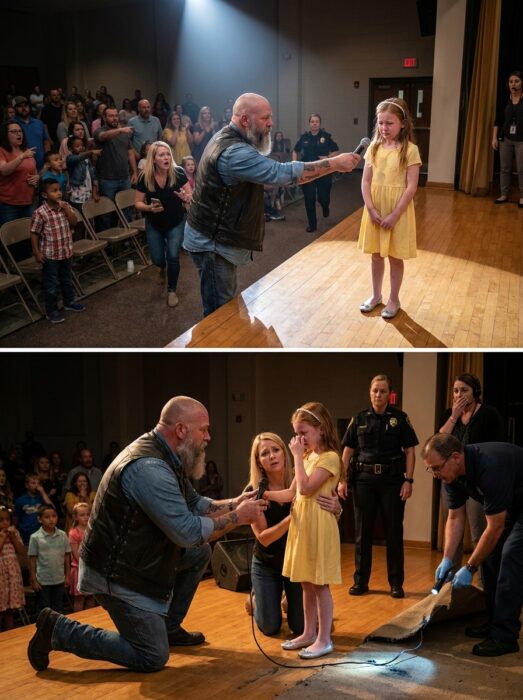
When Mr. Donnelly adjusted the microphone stand, the cable dragged across the metal edge of a small stage monitor. The black rubber coating had already been worn thin. The movement split it further. A spark snapped under the lip of the carpet.
Ray sat forward.
He waited half a second, hoping he had imagined it.
Then another spark came.
Tiny.
Fast.
Near where Mia’s silver shoe would land if she stepped closer during her song.
Ray looked toward the sound booth. Mr. Donnelly was busy trying to restart the music track. I was watching Mia. Officer Reed was near the back doors. Allison was recording.
Mia lifted the microphone with both hands.
Ray had no time to build a sentence acceptable to frightened adults.
No time to ask permission.
No time to explain the science of current, damp carpet, exposed wire, and a child touching a connected microphone.
So he chose the terrible option.
He became the villain for ninety seconds.
Later, people asked why he did not shout first.
He said, “I did. My body just got there before my words.”
That answer stayed with me.
Because sometimes the difference between harm and safety is not whether someone appears polite.
Sometimes it is whether someone moves fast enough to be misunderstood.
PART 3 — THE LITTLE GIRL WITH THE YELLOW DRESS
Mia Bennett had waited all year for that talent show.
She was not the loudest student in fourth grade. She did not rush to the front of lines or volunteer first. She kept her drawings tucked inside folders and sang mostly when she thought no one could hear.
The first time I heard her voice, she was cleaning paintbrushes after art club and humming beside the sink. I stopped in the hallway. The note was pure, soft, almost accidental.
When I asked if she wanted to sing in the talent show, she shook her head so hard one curl fell into her eyes.
“No, thank you.”
“You have a beautiful voice.”
She looked panicked.
“That’s okay. I don’t need to use it in public.”
For weeks, she refused.
Then her grandmother got sick.
Mia began sitting with her after school, singing quietly because the older woman said music helped the bad days feel smaller. When her grandmother entered hospice, Mia decided she wanted to sing the song at the talent show and send a recording.
“She might not be able to come,” Mia told me. “But she can still hear it.”
That was why Allison recorded from the second row.
That was why Mia’s hands shook around the microphone.
That was why Ray’s interruption wounded so deeply before it saved her.
To the crowd, he had stopped a performance.
To Mia, he had nearly ruined a gift meant for someone she loved.
When the microphone vanished from her hands, her whole face collapsed. She did not understand exposed wiring or stage hazards. She understood only that the biggest, scariest man in the room had walked into her brave moment and taken it away.
After the power was cut and the danger discovered, she cried differently.
Children often do that.
They cry first from embarrassment.
Then from fear.
Then from the shock of adults being shaken.
Allison climbed onto the stage after Officer Reed cleared a safe path. She wrapped Mia in her arms and kept saying, “You’re okay. You’re okay. You’re okay,” the way parents do when they are speaking as much to themselves as to the child.
Mia looked past her mother toward Ray.
He stood near the curtain, holding the unplugged microphone with both hands, his eyes fixed on the floor.
I will never forget his face.
He looked like a man who had done the right thing and still hated the cost.
PART 4 — THE AUDITORIUM CHANGES SIDES
Crowds are dangerous because they can change direction faster than conscience can catch up.
The same parents who booed Ray began whispering apologies they were too embarrassed to say aloud. A few looked at the floor. Several replayed the moment in their minds, replacing their first judgment with the evidence they now had.
Officer Reed handled it better than any of us.
She walked to Ray first.
“Sir, I need your name.”
“Ray Lawson.”
“You saw the wire?”
“Yes, ma’am.”
“Before you moved?”
“Yes.”
“Why didn’t you say it?”
He looked at Mia, then at the damaged cable.
“I tried.”
Officer Reed nodded.
Not fully satisfied.
But no longer suspicious.
Mr. Donnelly unplugged the entire sound system. Paul taped off the stage edge. The principal, Mrs. Callahan, announced a short emergency intermission and asked everyone to stay seated while the equipment was checked.
Nobody moved much.
Mia sat with her mother on a folding chair near the curtain.
Ray stayed several feet away.
When I approached him, he immediately said, “I’ll leave if she wants.”
“She asked if you would stay.”
He blinked.
“She did?”
“Yes.”
His jaw worked once.
“I scared her.”
“You saved her.”
His eyes did not soften.
“Both can be true.”
That was when I understood the kind of man he was.
Not a man who needed to be called a hero.
A man who understood that saving someone does not erase the fear they felt while being saved.
He did not excuse himself with the outcome.
He owned the hurt he caused, even though he caused it to prevent something worse.
That kind of responsibility is rare.
PART 5 — THE SECOND MICROPHONE
We found a battery-powered microphone from the gym office.
No cables.
No stage monitor.
No risk.
By then, several performers had been rescheduled, parents were restless, and the little magic show Caleb had invited Ray to see had become almost forgotten. The principal asked Mia whether she wanted to go home.
Mia shook her head.
“I want to sing.”
Allison looked uncertain.
“You don’t have to.”
“I know.”
Mia looked toward Ray.
“But he stayed.”
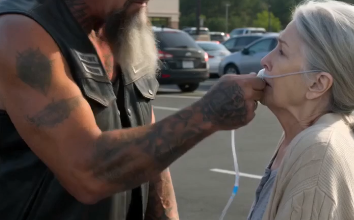
Ray had moved to the back corner of the auditorium, probably hoping to disappear. That is hard to do when you are six-foot-four in a leather vest.
Mia walked toward him with the battery microphone in both hands.
The room watched.
Ray slowly stood.
Mia stopped a few feet away.
“Are you still listening?”
His voice came out rough.
“Yes, ma’am.”
“Then I can sing.”
That sentence broke something open in the auditorium.
Not applause yet.
Something quieter.
Permission.
The crowd understood that the performance now belonged to Mia again.
Not to fear.
Not to the accident.
Not to the misunderstanding.
To her.
She returned to the center of the stage. This time, Ray stood near the back wall, arms folded, not like a guard exactly, but like someone prepared to notice every dangerous thing in the room before it could reach her.
Mia sang.
Her voice trembled on the first line.
Then steadied.
By the second verse, Allison was crying too hard to record properly. I took over the phone. Officer Reed stood near the aisle with wet eyes. Mr. Donnelly kept both hands away from the sound board as though it had betrayed him personally.
Ray did not clap when Mia finished.
Not at first.
He simply bowed his head.
Then Mia looked directly at him and smiled.
He clapped once.
Then again.
Then the whole auditorium rose.
Mia received the only standing ovation of the night.
Not because she had the biggest voice.
Because she had sung after being frightened, after being interrupted, after nearly losing more than a song.
Courage, I learned that night, is not always stepping onto the stage.
Sometimes it is returning to the microphone after everyone has seen you cry.
PART 6 — WHAT RAY HAD LOST
After the show, Allison found Ray near the parking lot.
He was standing beside his motorcycle, helmet in hand, clearly trying to leave before gratitude became uncomfortable.
Mia ran ahead of her mother.
Ray stiffened, then crouched immediately so he would not tower over her.
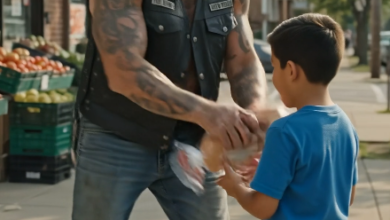
Mia held out the program.
“Will you sign it?”
Ray looked baffled.
“Why?”
“Because you were part of my song.”
He looked at Allison as if asking permission.
Allison nodded, tears still on her cheeks.
Ray took the program carefully and wrote only:
Keep singing. — Ray
Mia studied it.
“Do you have kids?”
Ray’s face changed.
Allison started to intervene, but Ray answered.
“I had a daughter.”
Mia looked up.
“Had?”
“She passed a long time ago.”
“Was she a singer?”
Ray swallowed.
“She was loud enough.”
Mia smiled a little.
Ray did too, though it hurt him.
Later, Allison told me Ray explained more privately. His daughter had died as an adult from complications after a house fire. He did not dramatize it. He did not make Mia carry the weight of it. He only told Allison that when he saw the spark near Mia’s foot, his body remembered a night when no one saw danger quickly enough.
“I wasn’t saving my daughter,” he said. “I know that. But I wasn’t going to stand there and watch another mother lose hers if I could move.”
Allison hugged him.
At first, Ray did not move.
Then he gently patted her shoulder with the awkwardness of a man who had long ago forgotten what to do with comfort when it was offered to him.
PART 7 — THE MAN IN THE BACK ROW
The video spread the next day.
Not the first clip.
That one showed Ray grabbing the microphone and Mia crying. Someone posted it with an angry caption before the full story came out.
For nearly three hours, people online called him cruel, dangerous, unstable, and exactly what they expected a biker to be.
Then Officer Reed released a statement.
The school posted the damaged cable photo.
Allison shared the full video: the spark, the power cut, Ray returning the microphone with both hands, and Mia asking him to stay.
Everything changed.
People apologized in the comments.
Some meant it.
Some only hated being wrong publicly.
Ray ignored most of it.
When a local reporter asked for an interview, he said no. When they asked again, he agreed only if Mia’s singing was mentioned before his name.
That was his one condition.
Not his heroism.
Her song.
A month later, Maple Creek held a safety fundraiser to replace old auditorium equipment. Ray showed up with ten bikers from his club and a donation collected from rides, repair shops, and people who had heard the story.
He handed the envelope to Mrs. Callahan.
“Get the kids a sound system that doesn’t try to kill them.”
It was the closest thing to a joke he made all night.
The new system arrived before the winter concert.
At that concert, Mia sang again.
Ray sat in the back row.
Same leather vest.
Same gray beard.
Same terrifying profile.
But this time, children waved at him.
Parents nodded.
Officer Reed sat two seats away and handed him a program.
Before Mia performed, she looked toward the back.
Ray lifted one hand.
She smiled.
Then she sang.
No sparks.
No screams.
No one booing.
Just a child’s voice filling a room that had learned the difference between appearance and truth the hard way.
Years later, I still think about those ninety seconds.
How quickly we judged him.
How ugly the room became.
How a man can look like danger while being the only person who sees it.
Ray Lawson did not save Mia because people trusted him.
He saved her knowing they would not.
That is a different kind of courage.
The kind that accepts blame when there is no time to explain.
The kind that lets a child hate you for a moment so her mother does not have to mourn her forever.
The kind that walks onto a stage full of boos because a spark is small, a wire is hidden, and a little girl is about to sing into danger.
Mia still has the program he signed.
Under his words, she later wrote her own:
He scared me. Then he stayed.
That may be the truest sentence in the whole story.
Because sometimes love does not arrive gently enough to be understood at first.
Sometimes protection looks like interruption.
Sometimes a hero gives the microphone back with shaking hands and says:
“I’m sorry I scared you.”
And sometimes the child he saved wipes her tears, lifts her chin, and asks the one question that restores the room:
“Will you stay and hear me sing?”
Follow the page for more unforgettable biker stories about rough-looking strangers, misunderstood heroes, and the quiet courage it takes to be hated for a moment so someone else can live.