The Bride Was Accused of Failing to Protect Her Husband’s Family’s Reputation – Her Mother-in-Law’s Words Silenced the Entire Table
“She clearly doesn’t understand how to protect her husband’s family’s reputation,” someone said, loud enough for the entire reception table to hear.
The music did not stop. The champagne still sparkled under the chandelier. But something inside that room shifted. Forks hovered midair. Smiles stiffened. Conversations thinned into silence.
And the bride—my friend Caroline—sat perfectly still.
I remember the way her fingers tightened around the stem of her glass. Not shaking. Not dramatic. Just a quiet tightening, the way a woman does when she refuses to let her dignity slip in public.
It was her wedding night.
And already, she was on trial.
No one shouted. No one pointed.
But there it was—the accusation, laid gently on linen and crystal as if it were just another course being served.
Caroline did not respond. She did not defend herself. She did not look at her husband.
She simply lowered her eyes, as though she had been expecting this moment all along.
That is what made it hurt to watch.
Because when a woman braces before the blow lands, you know she has already felt the wind of it coming.
And I remember thinking, very quietly to myself:
What had she done that was so unforgivable?
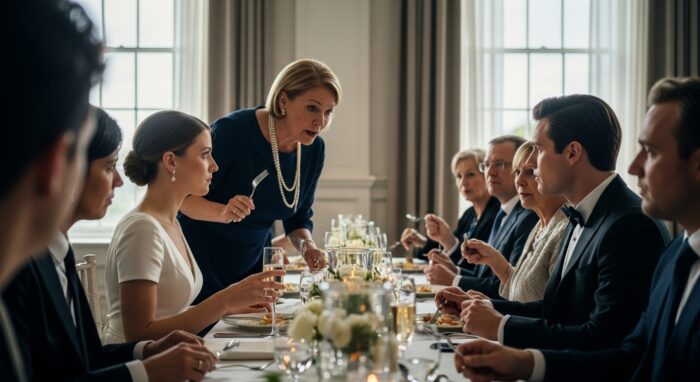
Caroline did not grow up in the same world as the man she married.
Daniel came from old Boston money—polished dining rooms, legacy charities, quiet influence. The kind of family that speaks softly but carries long memories. Reputation mattered. Appearances mattered. Lineage mattered.
Caroline came from something simpler.
Her father had been a mechanic. Her mother, a school secretary. They lived in a modest Cape Cod house with chipped shutters and a vegetable garden that fed them through summer. She paid her way through nursing school with weekend shifts and student loans. She carried herself with that steady, grounded strength you see in women who have learned to survive without applause.
She never pretended to be something she wasn’t.
That, I suspect, was the first thing they held against her.
At the rehearsal dinner, one aunt had asked—too casually—whether Caroline planned to “continue working after the honeymoon.” As if tending to patients in the ICU were a charming hobby she might eventually outgrow.
Caroline smiled and said yes.
Not defensive. Not apologetic. Just yes.
At the wedding itself, she chose a simple silk gown. No cathedral veil. No diamond tiara. Just her grandmother’s pearl earrings and a bouquet of white roses from a local florist she had known since childhood.
“She could have done more,” someone whispered near me.
More what? I wanted to ask.
More sparkle? More spectacle? More submission?
But Caroline never rose to it.
She greeted every guest warmly. She made sure the older relatives had comfortable chairs. She personally thanked the catering staff before dinner was served. Graceful. Thoughtful. Unshaken.
And then there was the matter of the guest list.
Caroline had insisted on inviting three women from the oncology ward where she volunteered. Breast cancer survivors. Women who had no one else to celebrate their remission with. They arrived in modest dresses, slightly ill at ease among tuxedos and heirloom jewelry.
That was when the looks began.
Tight smiles. Raised brows. Quiet murmurs about “keeping things appropriate.”
Daniel held her hand under the table. But he did not correct his relatives.
And Caroline—God bless her—absorbed it all in silence.
Not because she was weak.
But because she was measuring something far larger than their approval.
The comment about “protecting the family’s reputation” was not the first slight of the evening.
It was simply the most public.
It came from Daniel’s cousin Meredith—a woman with impeccable posture and a talent for smiling without warmth. She raised her glass slightly, as if making a toast, and delivered the line with surgical precision.
A few people laughed.
Not loudly. But enough.
Then came the follow-up.
“It’s just… some invitations felt unexpected,” Meredith added. “We have standards to uphold.”
There it was.
No longer subtle.
Caroline’s cheeks flushed—not crimson, just faintly pink. The way a woman flushes when she refuses to cry.
Someone across the table asked, “Didn’t you consult Daniel’s parents before finalizing the guest list?”
It sounded polite.
It wasn’t.
Caroline opened her mouth. Closed it again.
Daniel shifted in his chair. His jaw tightened, but still he said nothing.
And then the final cut landed.
“Marriage,” Meredith continued, swirling her wine, “means understanding you represent more than yourself now.”
The room grew very quiet.
Even the string quartet faltered for a second.
Caroline slowly set her glass down. Deliberate. Controlled. Composed.
I saw her swallow.
I saw her glance—not at Daniel—but at his mother.
Margaret Whitfield sat at the head of the table, silver hair swept back neatly, eyes unreadable. She had built half the charitable foundations that bore the family name. She understood reputation better than anyone in that room.
And she had not yet spoken.
The tension thickened.
Was this where Caroline would be gently corrected? Publicly humbled? Quietly instructed on how to behave going forward?
Every eye shifted between the bride and the matriarch.
Caroline remained silent.
Not submissive.
Not ashamed.
Just waiting.
And in that silence, something unexpected began to take shape—something no one at that table, except perhaps Margaret, had anticipated.
Because sometimes, the woman being judged is not the one who misunderstands the meaning of family.
Sometimes, it is the room itself.
And Margaret finally lifted her glass.
Margaret did not raise her voice.
She didn’t need to.
She simply placed her napkin beside her plate, folded her hands, and looked slowly around the table—at her nieces, her cousins, her old friends, the trustees who had known her for decades. The room quieted on its own. That kind of authority doesn’t shout. It waits.
“I’d like to clarify something,” she said softly.
The words were not sharp. But they carried weight.
“Caroline did consult someone about the guest list.”
A few faces shifted.
“She consulted me.”
There was a small pause. The kind that makes people sit straighter.
Margaret continued, calm as ever. “Those three women sitting by the window? They are alive because of the oncology program our foundation funds.” She let that settle. “And that program exists because Caroline came to me six months ago and showed me the gaps in our outreach.”
You could almost hear the air thin.
“She did not embarrass this family,” Margaret went on. “She expanded it.”
No one moved.
“She volunteered quietly at that hospital for years before she met my son. She never mentioned our name. Never asked for support. She only asked for help when she realized more women could be treated if funding increased.” Margaret’s eyes moved deliberately to Meredith. “She insisted the donation remain anonymous.”
Daniel turned toward his wife then, his expression no longer tight—but stunned.
Margaret’s voice remained even. “The reason those women are here tonight is because Caroline told me that survival deserves witnesses. She said no woman should ring the remission bell alone.”
Across the room, one of the oncology guests pressed a hand to her mouth.
Margaret’s fingers rested lightly on the tablecloth. “If there is any misunderstanding about reputation, let me correct it. Our family name stands for service. And tonight, Caroline honored that more fully than anyone in this room.”
No applause followed.
Just stillness.
A heavy, humbling stillness.
Meredith’s glass remained untouched. Someone coughed. Another looked down at her plate.
Caroline sat very quietly. Her eyes glistened—but she did not cry. She did not gloat. She did not defend herself.
She simply reached for Margaret’s hand.
And Margaret squeezed it back.
That was all.
No spectacle. No grand speech. Just truth, laid gently but firmly across the same white linen where accusation had been placed an hour before.
And in that moment, the room understood something it had failed to see:
The bride had never needed to protect the family’s reputation.
She had already been protecting its soul.
Phần 5 – Kết thúc chiêm nghiệm (Giá trị gia tăng)
I have attended many weddings in my lifetime.
I have seen expensive disasters and modest miracles. I have watched women shrink themselves to fit expectations, and I have watched others burn bridges just to prove a point.
But what stayed with me from that night was not the wealth. Not the music. Not even the revelation.
It was Caroline’s silence.
Her measured restraint. Her quiet confidence. The way she endured suspicion without scrambling to justify herself.
There is a particular kind of strength that does not rush to explain. It trusts that time—and truth—will speak eventually.
And Margaret understood that too.
She did not humiliate the relatives who had whispered. She did not scold. She did not shame them publicly.
She simply realigned the room.
That is something women of a certain age learn, if they are wise enough: power does not always look like volume. Sometimes it looks like composure. Sometimes it looks like waiting until the right moment—and then choosing words that cannot be argued with.
Later that evening, I watched Meredith approach Caroline. Her posture softer. Her smile no longer sharpened at the edges. I could not hear what she said.
But I saw Caroline nod.
Grace again.
As the night wound down, the three women from the oncology ward stood near the dance floor, laughing with guests who had earlier avoided their table. One of them caught Margaret’s eye and mouthed thank you.
Margaret simply inclined her head.
I thought about how easily a woman can be misjudged when she does not fit the frame others have prepared for her. How quickly kindness can be mistaken for naïveté. How often dignity is confused with weakness.
And I realized something else.
The most dangerous woman in a room is not the loudest one.
It is the one who knows exactly who she is—and does not feel compelled to prove it.
When I left that wedding, the chandeliers were dimming and the staff were clearing plates. Caroline and Daniel stood together near the doorway, greeting the last of their guests.
She looked peaceful.
Not triumphant.
Just steady.
And I remember thinking, as I stepped into the cool night air, that marriage is not about entering a family with your head bowed.
It is about entering it whole.
And sometimes, the greatest defense of a family’s reputation is simply being the kind of woman who refuses to let it be small.
Post 1 – Hook Version A (≈420 words)
She was accused of humiliating her husband’s wealthy family in the middle of her own wedding reception—while every crystal glass trembled in stunned silence.
The comment didn’t come as a whisper.
It came clean. Precise. Delivered with a thin smile across white linen and silverware.
“You should have protected this family’s reputation.”
The bride—Caroline—sat still in her ivory gown, sunlight pouring through tall windows behind her. Daytime reception. Bright. Beautiful. And suddenly suffocating.
Guests froze mid-bite. A fork hovered above salmon. Champagne caught the light like it didn’t know where to land.
From where I stood, just a few feet away, it looked ugly.
Ugly in that polite, expensive way only certain families can manage.
Daniel’s relatives came from old Boston money. Generations of quiet influence. Charity galas. Names engraved on buildings. The kind of people who speak softly and judge loudly.
Caroline didn’t grow up like that.
Her father fixed engines. Her mother packed school lunches and worked double shifts. Caroline paid her own way through nursing school. ICU nurse. Night shifts. No silver spoon.
And today—on the day she married into wealth—she had made one choice that, apparently, crossed a line.
She invited three breast cancer survivors from the oncology ward where she volunteered.
Three women in modest dresses, seated near the back windows.
To some, they didn’t “fit.”
That’s what the cousin implied when she raised her glass and said the bride didn’t understand how marriage meant representing “more than yourself.”
You could feel the accusation hanging in the air.
Caroline’s fingers tightened around her champagne stem. Her cheeks flushed, but she didn’t argue. She didn’t apologize.
Daniel sat beside her, jaw tight. Silent.
And that silence felt louder than anything.
Because in that moment, it looked like she had embarrassed him. Like she’d overstepped. Like she didn’t understand the world she’d married into.
Around the table, older women exchanged looks. Men shifted in their seats. Someone muttered something about “standards.”
Caroline slowly set her glass down.
She glanced—not at her husband—but at his mother at the head of the table.
Margaret Whitfield.
The matriarch.
The woman whose name alone could steady or shatter this room.
Margaret hadn’t spoken yet.
Not once.
And that was the most dangerous part.
Because when a powerful woman stays quiet during public humiliation, you don’t know whether she’s about to correct the bride… or defend her.
The air thickened.
Caroline inhaled slowly.
And then Margaret placed her napkin on the table and began to stand.
If you think you know what happened next… you probably don’t.
Part 2 is waiting in the comments.
Post 2 – Hook Version B (≈420 words)
In the middle of her wedding lunch, a bride was publicly shamed for “bringing the wrong people” into her husband’s family—and no one stopped it.
Not at first.
The daylight was harsh and clear, pouring through tall reception hall windows. Everything was visible. Every expression. Every flicker of discomfort.
“You don’t seem to understand what this family represents,” a woman in pearls said evenly, tilting her head just enough to wound without raising her voice.
The bride—Caroline, 38, ICU nurse, daughter of a mechanic—didn’t flinch.
But she didn’t defend herself either.
From my seat near the end of the table, it looked like she’d miscalculated something important. Like she had stepped into a world she didn’t fully grasp.
Daniel, her groom, came from generational wealth. Boston society. Foundations. Influence. Polished reputations guarded carefully over decades.
And today—on the day she officially joined them—Caroline had apparently embarrassed them.
Why?
Because she invited three women from the cancer ward she volunteered at. Survivors. Fighters. Women who had rung remission bells and had no family to celebrate with.
They wore simple dresses. They laughed too freely. They didn’t carry the quiet reserve of old money.
To certain relatives, that was enough.
Forks stopped midair. A violinist faltered. A cousin leaned forward and added, “Marriage isn’t just about love. It’s about responsibility.”
Responsibility.
The word landed like a verdict.
Caroline’s lips pressed together. Her shoulders straightened. She didn’t shrink. But she didn’t fight.
And that’s what made it worse.
Because silence can look like guilt when you don’t know the whole story.
Daniel shifted in his seat. His jaw tightened. Still—he said nothing.
Around them, whispers began to ripple. Questions about judgment. About discretion. About reputation.
The bride slowly reached for her water glass instead of her champagne.
Measured. Controlled.
From across the room, the groom’s mother—Margaret Whitfield, 62, widow, philanthropist, founder of half the charities attached to the family name—watched without expression.
She hadn’t intervened.
Not yet.
And the longer she remained still, the more it felt like Caroline was standing alone.
The accusation hung in the air like something final.
Then Margaret rose from her chair.
No rush. No drama.
Just quiet authority.
And the room fell completely silent.
What she said next changed everything—but not the way anyone expected.
If you think this story ends with humiliation, wait until you read what really happened.
Part 2 is in the comments below.