Part 2: An Old Man Ate Breakfast Alone at the Same Diner Every Day and Was Mocked as “Homeless” — Until the Owner Hugged Him and Called Him Dad
Rosie’s Diner had been on Route 6 longer than most people remembered.
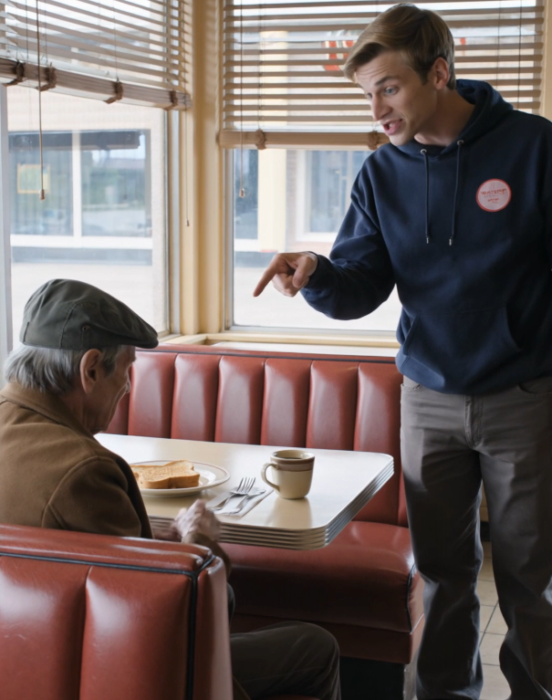
It had red vinyl booths with cracks near the seams, a bell above the door, and a pie case that fogged slightly whenever the kitchen got busy.
Truckers stopped there before sunrise.
Teachers grabbed coffee after school drop-off.
Retirees sat near the counter and argued about baseball like the season had personally betrayed them.
Walter Briggs had his booth.
Last one by the window.
Third from the restrooms.
Back facing the wall.
View of the road.
Rosie had never asked why he chose it.
Some habits come from grief.
Some from war.
Some from waiting so long that the body begins to believe waiting is a place.
Walter was seventy-nine, a white American man with silver hair, a narrow frame, and hands marked by old labor.
He did not smell bad.
He did not beg.
He did not ask for discounts.
But his coat was worn, his cap was stained at the brim, and his voice had the careful softness of someone used to being overlooked.
Every morning, Lila brought his order before he said it.
“Two eggs, wheat toast, black coffee, extra plate.”
Walter always nodded.
“Thank you, sweetheart.”
He said sweetheart the way old men sometimes do when they mean no harm and have forgotten the world no longer trusts softness from strangers.
Lila was twenty-six, Black American, sharp-eyed, and protective of people who tipped quietly.
She noticed things.
Walter never touched the extra plate.
He always turned it slightly toward the empty side of the booth.
He always set one paper napkin beside it.
Some mornings, he folded that napkin into a small square.
Other mornings, he left it flat and pressed one finger on the corner as if keeping it from blowing away, though the windows were closed.
One Tuesday, Lila asked if he was waiting for someone.
Walter looked out at the road.
“Aren’t we all?”
She did not ask again.
Rosie noticed different things.
She was forty-eight, Latina, dark-haired, strong-armed from years behind a grill, and known for remembering customers’ orders better than their names.
She had bought the diner nine years earlier after the old owner retired.
People said she saved it.
Rosie always said the diner saved her first.
She came out from the kitchen when Walter’s coffee cooled too long.
She checked if his toast was too hard.
She slipped oatmeal raisin cookies into a paper bag and pretended they were mistakes.
Walter accepted them every time.
“Your husband still likes these?” Rosie asked once, because Walter wore a wedding ring.
“My wife,” Walter corrected gently.
Rosie flushed.
“I’m sorry.”
“No need.”
“Does she come in sometimes?”
Walter looked at the extra plate.
“Not anymore.”
That was the first small door.
Rosie respected it and did not push.
The young contractors changed the air when they arrived.
Four men in their twenties and early thirties, all white American, wearing company hoodies and boots too new to have earned much mud yet.
They took the center table and filled it with voices.
At first, it was harmless noise.
Coffee refills.
Jokes about the worksite.
Arguments over fantasy football.
Then they noticed Walter.
One man, Kyle, had a grin that sharpened whenever he found an audience.
Another, Mason, laughed too quickly.
They started with whispers.
Then louder comments.
“Same coat every day.”
“Bet he sleeps in that booth.”
“Maybe Rosie should charge rent.”
Lila warned them once with her eyes.
They missed it.
Rosie warned them once with her voice.
“Eat your breakfast, boys.”
They laughed and raised their hands like schoolchildren pretending innocence.
Walter did not look up.
That made it worse.
There is a certain kind of cruelty that grows when it meets no resistance.
On the morning of the dollar bill, rain streaked the front window.
Walter arrived later than usual, breathing harder, his hair damp beneath his cap.
Lila brought coffee first.
His hands shook when he lifted the cup.
“You okay, Mr. Briggs?”
“Yes, ma’am.”
“You sure?”
He nodded, but his eyes were fixed on the road outside.
Rosie watched from the pass window.
The contractors watched from the center table.
Kyle smirked when Walter ordered the extra plate.
“Breakfast date running late again?”
Mason laughed.
Walter’s thumb moved to his wedding ring.
Lila turned sharply.
“That’s enough.”
Kyle lifted both hands.
“I’m just saying, if he’s feeding ghosts, maybe ghosts should tip.”
Then he took a dollar from his wallet, slid it across the floor, and sent it skidding beneath Walter’s booth.
The diner froze.
Walter looked down at the bill.
For a moment, he seemed smaller than his coat.
Then he bent slowly and picked it up.
His face was not angry.
That disturbed Rosie more than anger would have.
It was the face of a man receiving something ugly and deciding not to hand it back.
Rosie pushed through the kitchen doors.
She walked toward him fast, wiping her hands on her apron, her eyes already filling.
Because when Walter bent down, his coat opened.
And Rosie saw the old photograph in his inside pocket.
A little girl in pigtails.
A diner counter.
A man’s hand resting protectively on her shoulder.
The photograph had cracked at the edges, but Rosie knew the child.
She had seen that same picture once in a box she thought was lost forever.
It was her.
And the man beside her was Walter Briggs.
Not a stranger.
Not a drifter.
Not the sad old customer by the window.
Her father.
Rosie reached Walter before anyone else moved.
She did not ask permission.
She bent down beside the booth, wrapped both arms around him, and said the word she had not said to him in thirty-one years.
“Dad.”
The room did not breathe.
Walter closed his eyes, and the dollar bill slipped from his hand onto the floor.
Lila covered her mouth.
Kyle’s grin disappeared so completely that his face looked unfinished.
Rosie pulled back enough to see Walter’s face.
“Why didn’t you tell me?”
Walter looked at her like a man trying to stand in a flood without grabbing anything.
“I didn’t know how.”
The answer was too simple for what it carried.
Rosie sat across from him, in the place where the extra plate had waited every morning.
That small movement broke something in Walter.
His hand reached toward the plate, then stopped halfway.
Rosie saw it.
She saw the napkin folded beside it.
She saw the coffee cup placed where someone else might have sat.
She saw years arranged in quiet ritual and realized she had been serving his grief without knowing its name.
“Start with why you came here,” she whispered.
Walter looked toward the contractors, then at the other customers, then back at Rosie.
“You don’t need this in front of everybody.”
Rosie’s voice shook.
“They already made it everybody’s business.”
That was the first hard thing she had said all morning.
Walter nodded once.
He kept his eyes on the table.
“I came because your mother loved this place.”
Rosie flinched.
“My mother never talked about you.”
“I know.”
“You left.”
Walter absorbed it.
“Yes.”
The room tilted again.
Kyle, still standing near the center table, looked relieved for one second, as if perhaps the old man deserved judgment after all.
Then Walter continued.
“I left because your mother asked me to.”
Rosie stared at him.
“No.”
“She was trying to protect you.”
“From what?”
Walter’s hand moved to his chest, where the photograph had been.
“From the man I came back from war as.”
The diner grew quieter.
Even the grill seemed to hiss more softly from the kitchen.
Walter did not turn his pain into theater.
He only gave it pieces.
He had served in Vietnam when he was barely twenty.
He came home with medals, nightmares, and a temper that scared him more than it scared anyone else.
He loved his wife, Elena.
He adored his baby daughter, Rosa Maria, who once sat on his lap at a diner counter and stole bites of pancake from his plate.
But after the war, his body came home faster than his mind.
Some nights, a dropped pan sent him under the kitchen table.
Some mornings, he could not hold Rosie because he feared his own hands.
He never hit them.
He said that quickly, not to excuse himself, but because the truth mattered.
But fear does not need bruises to fill a house.
One evening, when Rosie was five, she ran toward him while he woke from a nightmare on the couch.
He shoved backward so hard a lamp shattered.
Rosie screamed.
Elena stood between them with their daughter behind her.
The next morning, she packed a bag and said, “Get well somewhere else, Walter, or she will spend her life waiting for you to become safe.”
Walter left.
Rosie heard only that he abandoned them.
For years, that was the story.
He sent money through Elena’s sister.
Letters too.
Most were returned.
Some were unopened.
When Elena remarried and moved, Walter lost the address.
By the time he found them again, Rosie was a teenager, and Elena told him his return would only reopen a wound the child had survived.
“I believed her,” Walter said.
Rosie’s face crumpled.
“You believed staying away was love?”
Walter looked at his hands.
“I believed I had already taken enough.”
That was the twist no one at the center table had expected.
The man they mocked for looking like he had nothing had spent decades refusing to claim anything he feared he had lost the right to touch.
Rosie pressed both hands flat on the table.
“Mom died thinking you never tried.”
Walter swallowed.
“I went to her funeral.”
Rosie looked up sharply.
“What?”
“I stood outside the church. Back row in the rain.”
Rosie remembered that day.
Her mother’s service.
The gray sky.
A man under an umbrella across the street, gone before anyone reached him.
“That was you?”
Walter nodded.
“I saw you leave with your husband. You looked strong. I thought maybe that was enough.”
Rosie gave a broken laugh.
“Strong is what people call you when they don’t know what else to do.”
Walter’s eyes filled.
“I know that now.”
Lila placed a hand on the counter to steady herself.
Mr. Donnelly, a retired mailman in booth two, wiped his glasses with a napkin and gave up pretending they were fogged.
The young contractors had stopped looking at one another.
But the story had one more turn.
Rosie pointed at the extra plate.
“Why every morning?”
Walter looked at it for a long moment.
“Because your mother once told me if I ever had the courage to face you, I should start where our family was happiest.”
Rosie’s voice was barely there.
“This diner?”
Walter nodded.
“Before it was Rosie’s, it was Mae’s. We came every Friday when you were little. You sat right there.”
He touched the empty side of the booth.
“You used to tap the spoon against your orange juice and tell me you were making music.”
Rosie closed her eyes.
A memory returned not as an image, but as sound.
A spoon against glass.
Her mother laughing.
A man’s warm hand stopping the cup before it tipped.
She had thought she invented that memory.
Walter continued.
“When I found out you bought the place, I came in once. Just to see.”
“When?”
“Opening week.”
Rosie stared at him.
A thin old man had ordered coffee and left a hundred-dollar tip on a five-dollar check.
She had framed the receipt behind the register because it said, “For the new owner. Keep the lights warm.”
“That was you,” she whispered.
Walter nodded.
“I came back the next morning. Then the next.”
“Why didn’t you tell me then?”
“Because you smiled at me like a customer.”
He gave a sad, gentle breath.
“And it was the first time in thirty years you smiled at me without pain attached.”
Rosie covered her mouth.
That was why he sat alone.
That was why he ordered the extra plate.
That was why he paid every morning and never asked for anything the diner did not offer everyone else.
He had not come to reclaim his daughter.
He had come to be near the life she built, in the only way he believed would not harm it.
Rosie stood suddenly and turned toward the contractors.
Her voice was not loud.
That made it stronger.
“You boys wanted to know if he was homeless.”
Kyle looked at the floor.
Rosie picked up the dollar bill from beneath the booth.
“This man paid my first month’s payroll when I almost lost this diner.”
Walter looked startled.
“Rosie.”
“No.”
She faced the room.
“He left envelopes in the mail slot for three years. No name. Just cash when the freezer broke, when the roof leaked, when Lila’s mother got sick and I couldn’t cover shifts.”
Lila’s eyes widened.
“That was him?”
Rosie nodded.
“I thought it was some retired customer who loved the pie.”
Walter looked embarrassed now, almost panicked.
“It wasn’t meant to be known.”
Rosie turned back to him, tears sliding freely.
“Neither was your loneliness.”
The sentence landed harder than any accusation.
Kyle stood slowly.
He looked twenty-four again, not grown enough for the damage his mouth had done.
“Sir,” he said, voice rough, “I’m sorry.”
Walter looked at him.
The whole diner waited.
Walter did not perform forgiveness.
He did not punish him for an audience either.
After a long moment, he said, “Eat your breakfast before it gets cold.”
Kyle sat down, ashamed in a way that might last long enough to become useful.
Rosie slid into the booth again.
For the first time, the extra plate was not empty.
She pulled Walter’s untouched toast toward herself and took one bite.
Walter laughed once.
It was small, stunned, and almost boyish.
Rosie looked at him through tears.
“You still order wheat toast?”
“You used to steal the white bread.”
“I was five.”
“You were quick.”
The diner exhaled.
Not all at once.
But enough.
After that morning, Walter still came to Rosie’s Diner at 6:15.
Some things do not change because they are repaired.
They change because someone is finally sitting on the other side of them.
The last booth by the window became theirs.
Rosie did not sit every morning.
She had bacon to turn, orders to call, coffee to pour, and a diner that refused to run on sentiment alone.
But she came out when she could.
Sometimes for ten minutes.
Sometimes only long enough to steal a corner of toast and complain that Walter still drank coffee like motor oil.
He began answering.
Not too much.
Not all at once.
He told her about Elena’s old laugh.
About the motel room where he spent his first year away from them learning how to sleep without terrifying himself.
About the counselor at the VA who taught him to place both feet on the floor and name five things he could see.
Rosie told him about her children.
About the husband she lost to cancer.
About buying the diner with more fear than money.
About hating him for so many years that the hatred became part of the furniture.
Walter listened to all of it.
He did not ask her to forgive the empty years.
That made it easier for her to let pieces of them soften.
Kyle and his crew kept coming in until the job down the road ended.
They were quieter after that morning.
On their last day, Kyle walked to the register and handed Rosie an envelope.
“For the breakfast wall,” he said.
Inside was not money.
It was a photograph he had taken from his truck weeks earlier.
Walter sitting alone in the window booth before sunrise, hands around his coffee, the empty plate across from him glowing in the diner light.
Rosie stared at it.
Kyle swallowed.
“I thought it looked sad when I took it. Now I think maybe it was waiting.”
Rosie did not say he was forgiven.
She only placed the photograph beside the register, under the old framed receipt Walter had left years before.
That winter, Rosie changed the menu.
She added “Walter’s Breakfast.”
Two eggs.
Wheat toast.
Black coffee.
One extra plate if needed.
No explanation printed beneath it.
Regulars understood.
Strangers asked sometimes.
Rosie would look toward the window booth and say, “Some meals are bigger than hunger.”
On Walter’s eightieth birthday, the diner filled before dawn.
Lila baked a cake even though breakfast people pretend cake is not breakfast until someone cuts it.
Mr. Donnelly brought a card signed by customers.
Rosie placed a small wrapped box beside Walter’s coffee.
He opened it slowly.
Inside was a key.
Not to her house.
Not yet.
Not to a past they could not reopen.
It was a key to the diner’s side door.
“In case you get here before me,” Rosie said.
Walter held the key in his palm.
His hand trembled the way old hands do when carrying something that weighs more than metal.
“You sure?”
Rosie leaned against the booth.
“Dad, you have been paying rent in silence for years.”
He looked down and laughed softly.
Then he cried, not hiding it well enough to fool anyone.
Months later, on a spring morning bright with clean rain, Walter came in carrying a small envelope.
He placed it beside Rosie’s coffee.
Inside was the old photograph of her as a little girl at Mae’s counter, the one from his coat pocket.
The cracks had been repaired by a local photo shop.
Rosie saw the child in pigtails.
Her mother smiling.
Her father’s hand on her shoulder.
On the back, Walter had written one sentence.
“I was happiest when you were close enough to steal my toast.”
Rosie read it twice.
Then she slipped into the booth across from him and took the extra plate.
The diner moved around them.
Forks tapped.
Coffee poured.
The bell over the door kept ringing people in from the road.
Walter pushed half his toast onto her plate without asking.
Rosie took it without thanking him.
Some families return loudly.
Others come back one breakfast at a time.
Follow this page for more heartfelt stories about quiet love, second chances, and the people we often misjudge too quickly. 🌿