Part 2: A 6’5 Biker Drove Four Hours Every Weekend to Be a Visiting Grandpa for Older Foster Kids — But the Name in His Notebook Explained Everything
Part 2
My name is Miriam Cole, and I have been director of Mercy Ridge Children’s Home for nineteen years, which means I know the sound hope makes when it is trying not to embarrass itself.
It sounds like a teenager not looking at the driveway.
It sounds like a chair pushed back too quickly when an engine comes up the road.
It sounds like a girl saying, “I don’t care,” while fixing her hair in the reflection of a microwave door.
Older foster kids learn to lower expectations the way other children learn multiplication. Slowly at first. Then all at once. By ten, some of them have already memorized what adults say when leaving. By thirteen, they can predict which couples want a baby. By fifteen, they joke about turning eighteen like it is a punchline instead of a door opening into traffic.
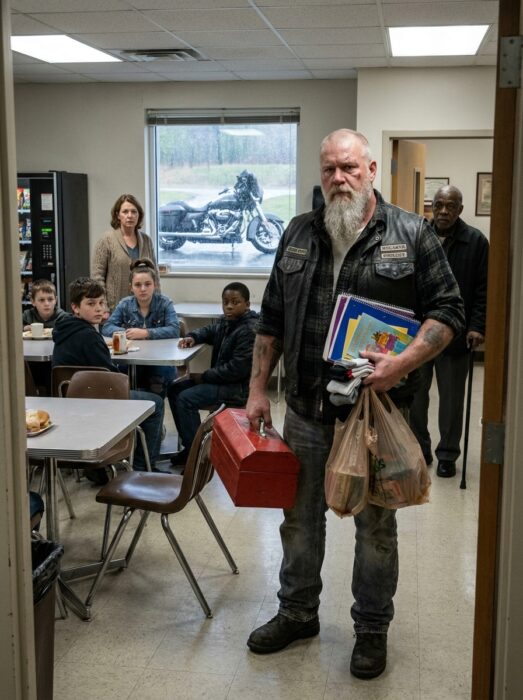
Walter understood that before I explained it.
He never asked, “Why are they so hard to reach?”
He knew.
Hard to reach is sometimes just hurt with armor on.
He had been armor once.
The parts of his past came out the way old bolts come loose, one at a time and only after enough pressure. He had grown up near Joplin with a father who disappeared, a mother who worked nights, and a temper that made adults label him before anyone asked what he was carrying. At sixteen, he lived in a boys’ home for seven months.
At seventeen, he ran.
At twenty-two, he went to prison after a fight outside a gas station near I-44. He never dressed it up. He hurt a man. He lost years. He came out older, angrier, and almost proud of needing nobody.
The Harley came later.
Then sobriety.
Then the Iron Table Riders.
They were not saints, and Walter would have laughed if anyone said they were. They were mechanics, retired firefighters, roofers, truckers, veterans, one nurse, and a widower who made better biscuits than most diners. Their clubhouse sat outside Springfield, in a metal building that smelled like coffee, oil, old leather, and men trying to become less useless.
Preacher ran the volunteer training before Mercy Ridge ever did.
He was a seventy-year-old Black rider with a white beard and a knee brace, and he had one rule for anyone who wanted to come with Walter.
“Kids ain’t roadside attractions.”
That meant no pictures without approval. No biker parade for attention. No promises of adoption unless legal steps had already begun. No asking a kid, “You remember me?” if the adult had missed three months.
“Show up quiet,” Preacher said. “Leave clean.”
The brotherhood was tested early.
Some riders wanted the easy version. Christmas toy drop. loud engines. group photo. feel-good ride. Walter refused.
“If you come,” he told them, “you learn their names and you come back.”
Most did not come.
Six did.
Cruz, a forty-three-year-old Latino mechanic, taught basic tools. Rosa, a fifty-two-year-old Latina nurse, helped with cooking and first aid. Miller, a white retired lineman, taught kids how to read an electric bill. Denise, a Black school bus driver, taught them how to plan a route across town without panicking. Preacher mostly sat and listened, which made him the most useful man in the room.
Walter did not try to become everyone’s favorite.
He became predictable.
That was better.
Part 3
The crisis happened the Saturday he did not arrive at 8:57.
By then, Walter had been coming for ten months. Not almost every Saturday. Every Saturday. Two hours down from Springfield before sunrise, three hours with the kids, two hours back if weather behaved, longer if it did not.
He missed weddings.
He missed rides.
He missed a poker run that raised money for a rider’s surgery and sent cash instead. He came with a fever once and sat outside in his truck until Rosa threatened to report him to himself.
So when 8:57 came and the driveway stayed empty, the whole building tried to pretend it did not matter.
At 9:03, Kayla said, “Maybe he finally got tired of us.”
She was fifteen, white, sharp-tongued, and two years past believing people stayed because they wanted to.
At 9:08, Marcus, a Black fourteen-year-old who liked engines and trusted no adults who talked too much, said, “His bike probably broke.”
At 9:11, Ben stared at the door and said nothing.
By 9:20, the staff had stopped pretending too.
I called Walter.
No answer.
I called Preacher.
No answer.
Rain started by 9:30, hard enough to blur the windows. The kids drifted toward the cafeteria, not because they cared, of course, but because the vending machines were there and nobody wanted to look disappointed in the hallway.
Then Jason walked out.
Jason was thirteen when Walter first came, now fourteen, with red hair, pale skin, and a talent for finding the cruelest sentence in any room. He had been placed with us after three failed kinship homes and one pre-adoptive family that sent him back with his belongings in trash bags.
He trusted Walter least.
That meant he watched for him most.
At 9:42, I found Jason in the entryway wearing no coat.
“Going somewhere?” I asked.
“Just outside.”
“In the rain?”
“It’s my rain.”
That was how he talked when pain had the wheel.
I stepped closer.
He backed up.
“Don’t therapy me.”
“I was going to hand you a coat.”
He laughed once, empty.
“Why? Visiting Grandpa isn’t coming.”
The words hit the lobby harder than his fist would have.
Then the front door opened.
Not Walter.
Cruz.
He came in soaked, leather dark with rain, face tight. Behind him came Denise and Miller. No bikes. No noise. Just three adults with water dripping from their sleeves and worry they had not managed to hide.
Cruz looked at me first.
“He’s okay.”
The kids heard “he” and stood straighter.
“Where is he?” Kayla asked.
Cruz hesitated.
That hesitation nearly ruined everything.
Jason saw it and bolted toward the door.
Cruz moved to block him. Too fast.
Jason shoved him.
Miller stepped forward.
Denise said, “Stop.”
Everyone froze.
That was the brotherhood test.
Not whether bikers could handle a mouthy teenager. Of course they could. The test was whether they could remember a scared kid does not become a threat just because he pushes first.
Cruz lowered both hands.
“Sorry,” he said.
Jason stood shaking, soaked already from the open door, eyes wet but furious.
“You said he comes.”
Cruz nodded.
“He does.”
“He didn’t.”
“No.”
“Then he lied.”
The lobby went silent.
Cruz looked like he wanted to defend Walter with every bone in his body. Instead, he swallowed it.
“Maybe,” he said.
That was the right answer.
Children who have been abandoned do not need adults explaining why absence does not count. They need adults honest enough not to sand the sharp edge off the empty chair.
At 10:06, we heard an engine.
Not the Harley.
A pickup.
Walter climbed out of Preacher’s old truck with one arm in a sling, rain running down his beard, boots hitting the puddles heavy and uneven. Preacher came around the driver’s side, glaring at him like he had spent two hours losing an argument.
Walter had gone down on slick pavement outside Marshfield. Not badly. No gore. No drama. A bruised shoulder, cracked rib, bike damaged enough to stay behind.
He should have gone home.
He came anyway.
Jason stared at him from the doorway.
Walter stopped in the rain.
No excuses.
No speech.
He only said, “I’m late.”
Jason’s face broke for half a second before he rebuilt it.
“Yeah.”
Walter nodded.
“Won’t count it as showing up on time.”
Then he reached into his vest with his good hand and pulled out a soaked paper bag.
Inside were sixteen breakfast burritos, smashed but warm.
Jason looked at them.
Then at the sling.
Then at Walter.
“You stupid?”
Walter almost smiled.
“Frequently.”
That was the false climax.
We thought the story was about a biker proving he would come even injured.
It was not.
It was about why being late scared him more than pain.
Part 4
The name Eli came out that afternoon.
The rain kept falling, and the kids were restless in that strange way relief can become anger when it has nowhere to sit. Walter stayed through lunch though every movement cost him. Rosa rewrapped his shoulder. Denise scolded him. Preacher called him an old fool three times, which in biker language meant he had been scared.
Jason watched from the corner.
At 1:15, he walked over to Walter’s table and dropped the black notebook in front of him.
It had fallen from Walter’s vest when Rosa changed the sling.
“Who’s Eli?” Jason asked.
Every adult in the cafeteria stopped breathing.
Walter did not reach for the notebook.
He looked at Jason, then at the kids nearby, then at me. His face had gone still in the way men go still when the past enters a room without knocking.
“My grandson,” he said.
That was the first twist.
None of us knew Walter had a grandson.
Not in the file. Not in his interviews. Not in the careful little stories he allowed around the edges of himself.
Jason’s mouth tightened.
“So you got a real one.”
Walter nodded.
“Had.”
The word changed the room.
Eli had been twelve when Walter met him. Not by blood, not at first. Walter’s daughter, Rebecca, had married a man with a son from another relationship. Walter was new to sobriety then and trying to rebuild a relationship with Rebecca after years of being the kind of father she had every right to keep at a distance.
Eli liked motorcycles.
That was the bridge.
Walter promised to come every Saturday to teach him small engine repair at the old garage. First Saturday, he came. Second too. Third, he forgot because a club ride ran long and he was too proud to admit he had chosen noise over a boy waiting by a window.
Then Rebecca’s marriage collapsed.
Custody changed. addresses changed. phone numbers changed. Eli went into foster care for reasons Walter still could not discuss without grinding his jaw so hard it seemed to hurt.
“I was not legally anybody,” Walter said.
His voice had turned rough.
“I told myself that meant I couldn’t do anything.”
He found Eli seven months later in a group home outside Joplin.
By then, Eli had stopped asking when he was coming.
Walter tried to visit.
Paperwork said no.
Then yes.
Then maybe.
Then Eli ran from placement at sixteen, aged into the kind of street life that eats boys who act tougher than they feel. Walter looked for him for years. Found him twice. Lost him three times. The last call came from a hospital in Kansas City after an overdose.
Eli was twenty-one.
He died before Walter arrived.
No dramatic goodbye.
No last apology.
Just a hallway, a vending machine humming, and a nurse handing a huge man a plastic bag with a broken watch and a bus card inside.
Walter had kept the bus card.
It was taped to the first page of the notebook, under Eli’s name.
Beside it was one sentence.
Never make a kid wonder if Saturday matters.
That was the second twist.
Mercy Ridge was not charity.
It was penance sharpened into practice.
Jason looked angry, but his anger had changed direction.
“So we’re your do-over?”
Walter shook his head immediately.
“No.”
“Sounds like it.”
“No,” Walter said again, and this time his voice carried the weight of a tool dropped on concrete. “A do-over is about me. Showing up is about you.”
Jason stared at him.
Walter pushed the notebook across the table.
“You can hate that I’m late. You can hate why I started. But don’t let my dead kid carry what I owe you.”
That sentence was ugly and honest.
It did not ask for forgiveness.
Jason looked down at Eli’s name for a long time.
Then he said, “He wasn’t your kid.”
Walter’s eyes went wet.
No tear fell.
Bikers like him do not cry easy. They just sit in rain too long and pretend water on their face explains everything.
Finally, Walter said, “He should’ve been.”
That was when Kayla, who had been listening from the vending machine, walked over and placed one of the smashed burritos in front of him.
“You missed breakfast,” she said.
Walter looked at it.
Then at her.
“Yeah.”
She sat down across from him.
“Don’t miss lunch.”
Part 5
After Eli, the pieces made sense.
The calendar was not organization. It was protection against forgetting what forgetting had cost. Walter circled Saturdays months ahead because he did not trust good intentions without ink on paper.
The birthday cards were not sweetness.
They were insurance.
Every month, he checked the file with my permission and wrote down which child had a birthday coming. Not for a party if they did not want one. Not for attention. Just so no teenager would spend a whole day pretending they did not notice nobody remembered.
The grocery lessons came from Eli too.
Walter had once found him in a convenience store parking lot eating dry ramen from the package because nobody had taught him how to shop cheap without starving. So at Mercy Ridge, he taught the older kids eggs, rice, beans, rotisserie chicken math, laundry soap math, and how to read unit prices without feeling ashamed.
The toolbox mattered.
Not because every kid wanted to be a mechanic, though Marcus did. Because Walter believed tools gave a child one small conversation with the world where effort produced a result. A loose hinge could tighten. A bike tire could hold air. A lamp could turn on again.
Children in care need proof some things respond when handled carefully.
The club changed too.
After the missed Saturday, Walter tried to quit.
He came to my office the next week, shoulder still taped, beard trimmed badly, notebook in hand.
“I made it about me,” he said.
“No.”
“You heard Jason.”
“I heard a boy scared enough to tell the truth.”
Walter set the notebook on my desk.
“Maybe I should step back.”
I said, “Ask them.”
He looked horrified.
Good.
Adults often make decisions for children because asking them creates answers we cannot control.
That Saturday, I called a house meeting. No speeches. No pressure. Walter sat at the edge of the room, leather cut folded beside him, hands open on his knees like his first volunteer interview.
I asked the kids one question.
“Do you want Grandpa Walt to keep coming?”
Silence.
Then Ben, who was eleven by then and still small enough to hide behind vending machines but too proud to do it often, said, “Can he be late if he tells us?”
Walter’s mouth tightened.
“Yes,” I said.
Kayla said, “Can he bring Denise too sometimes?”
Denise smiled from the doorway.
Marcus said, “Can we fix his bike?”
Cruz said, “Absolutely not,” at the same time Walter said, “Maybe.”
Jason said nothing for a long time.
Then he shrugged.
“He can come. But no dying.”
Walter closed his eyes.
“I’ll do my best.”
That was as close to a contract as broken people get sometimes.
The biggest revelation came from the kids themselves.
They had started a notebook of their own.
They called it the Saturday Book.
No adult knew until Kayla showed me. Inside were dates, drawings, jokes Walter had told badly, meals he had burned, things he taught, things kids wanted to ask next time, and one page titled Proof Adults Came Back.
Under it, they had written names.
Walter. Rosa. Cruz. Denise. Preacher. Miller.
Not family, exactly.
Not replacement.
Evidence.
When Walter saw it, he did not touch the page.
He only took off his glasses, rubbed both hands over his face, and said, “Damn.”
Then he fixed the cafeteria sink because tears embarrassed him and plumbing did not.
Part 6
The ritual became ordinary, which was why it worked.
Every Saturday, the engine stopped at 8:57 if weather allowed. If weather did not allow, Walter called by 7:30. If he was sick, he sent Preacher with a sealed envelope that said, “Not gone. Sick. Back next week.”
The kids pretended to mock the envelopes.
They kept them.
Saturday mornings had a rhythm.
Coffee for staff. pancakes if Walter was confident and cereal if we were lucky. Tool hour after breakfast. Life hour after that. Sometimes life hour was how to shake hands without shrinking. Sometimes it was how to say no to a boss. Sometimes it was how to change a tire, read a lease, unclog a drain, apologize without making excuses, or leave a room before anger picked your next sentence.
Walter never called it mentoring.
He hated that word.
“Sounds like I got a clipboard,” he said.
He did have a clipboard eventually.
Kayla made him one out of cardboard and duct tape, then wrote “Grandpa Business” across the top in marker. He carried it with deep seriousness because teenagers can smell disrespect from three rooms away.
The Iron Table Riders took turns coming after the kids approved them.
Not all at once.
Never too loud.
Rosa taught basic first aid and how to talk to doctors without disappearing inside shame. Miller taught knots, outlet safety, and how not to get cheated by a landlord. Denise taught bus routes and how to keep your documents in a folder. Cruz taught engines, but more importantly, he taught Marcus that asking twice does not make you stupid.
Preacher taught silence.
That may have been the hardest class.
He would sit with a kid on the porch and say nothing for ten minutes. At first they hated it. Then they chose him when words ran out.
Jason aged out at eighteen.
That sentence still scares me.
But he did not leave with trash bags. Walter and the riders made sure of that. He left with two duffels, a tool set, a phone plan paid for three months, a bus pass, copies of every document in a waterproof folder, and three adults who had written their numbers on paper because phones break and kids raised by systems know better than anyone how fast contacts disappear.
At the door, Jason looked at Walter.
“You still coming here?”
“Every Saturday I can.”
“I won’t be here.”
Walter nodded.
“I know.”
Jason shifted his duffel.
“So what’s the point?”
Walter’s voice dropped.
“You’ll know where to find me.”
Jason looked away.
Then he hugged him.
Fast.
Angry.
Real.
Walter did not grab too hard. He let Jason decide when the hug ended.
That night, the Harley did not leave until after dark.
Walter sat on the porch alone, leather creaking when he leaned forward, boots on the steps, Eli’s bus card in his vest, Jason’s new apartment address folded beside it.
The engine finally started low.
Not triumphant.
Just steady.
Part 7
People like to ask whether Walter adopted any of the children.
That is not the right question.
He did not adopt all of them. He could not. No one could. Legal systems are not fairy tales, and love does not erase case plans, trauma, relatives, judges, money, age, or the fact that teenagers are people, not empty rooms waiting for someone’s rescue fantasy.
What Walter did was less dramatic and harder to keep doing.
He came back.
He came when they were rude. When they ignored him. When they tested him. When they turned sixteen and said they did not need anybody. When they turned eighteen and acted like leaving without a phone call would prove they had never cared.
He came back after rain.
After a cracked rib.
After his Harley was repaired.
After Jason left.
After Kayla graduated.
After Ben finally stopped hiding behind the vending machine and started answering the door before the engine fully died.
Last month, I found Walter in the cafeteria at 11:40 on a Saturday morning, teaching three teenagers how to sew on a button. His hands were too big for the needle. The kids were laughing at him, not cruelly this time. He allowed it.
Outside, six Harleys sat in the lot, engines cold.
Inside, the air smelled like pancakes, coffee, leather, and floor cleaner.
On the wall near the kitchen, the Saturday Book had become three books. The first one was full. The second was nearly there. The third had a clean first page waiting.
Walter’s black notebook sat beside his coffee.
Eli’s name still lived on page one.
Now other names followed.
Not to replace him.
To keep him from being the last boy Walter failed to find in time.
At noon, Ben walked in from the porch and said, “Grandpa Walt, you’re late for Uno.”
Walter stood slowly, knees stiff, leather cut heavy on his shoulders, silver beard catching the window light.
“I’m coming,” he said.
The kids groaned because he always said that.
But they moved over.
They made room.
And outside, on old Route 66, the trucks kept passing while one huge biker sat at a cafeteria table, losing at cards to children old enough to know what it meant when someone showed up again.
The engine waits.
The chair is filled.
Follow the page for more stories about the people we judge too quickly, and the steady love that keeps showing up.