Part 2: The Toughest Biker in the Club Refused Every Wednesday Job, Until a New Prospect Followed Him and Found Him Signing Bedtime Stories to Deaf Children on a Library Floor
Tyler did not mean to get caught.
That was what he told us later, though nobody believed him.
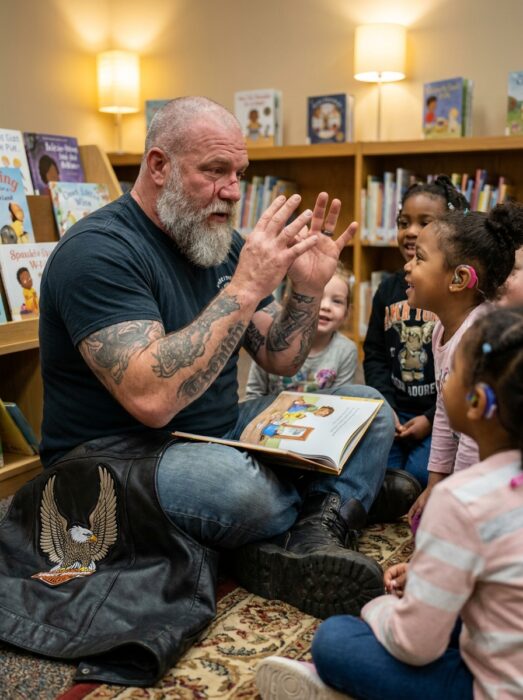
He crouched near the hallway outside the library’s children’s room with the guilty posture of a man who knew curiosity had carried him past good sense. Through the narrow window, he saw Stone sitting on a blue rug shaped like a pond, surrounded by small chairs, low shelves, stuffed animals, and a mural of cartoon owls reading books under a painted moon.
It should have looked ridiculous.
Stone did not belong there, at least not according to the version of him the world saw first. He looked like a man built for scrapyards, highways, and late-night diners where nobody asked why your knuckles were scarred. His beard was too rough for that soft yellow room. His tattoos looked too dark against the bright walls. His boots were too heavy on the carpet.
But the children did not see him that way.
They saw his hands.
That was the first thing Tyler noticed.
Stone’s hands, which at the yard could throw a chain over a truck axle or rip loose a rusted bumper, moved with a softness that made the room seem to slow down around them. His fingers shaped words in the air. His face changed with each character in the story. His eyebrows rose. His mouth formed silent expressions. His shoulders became part of the sentence.
The book was about a bear who lost his hat.
Stone signed the bear as stubborn and tired, which made the children laugh without sound, their faces opening in a way that hit Tyler harder than noise would have.
A little Black American girl around seven sat closest to Stone, her hearing aids bright pink, her braids tied with yellow beads. She signed something fast.
Stone paused, squinted at her, then signed back.
The girl crossed her arms, pretending to be offended.
The whole group laughed again.
No sound.
All joy.
Tyler watched until he forgot he was hiding.
Then a librarian touched his shoulder.
He nearly jumped into the biography shelf.
She was an Asian American woman in her forties named Grace Lin, short black hair, glasses on a chain, cardigan with embroidered foxes on the sleeves. She looked at Tyler’s leather vest, then at his face, then back into the room.
“You’re with him?” she asked.
Tyler swallowed.
“Sort of.”
“Does he know you’re here?”
“No, ma’am.”
Grace gave him the kind of look librarians use when they are deciding whether a person is dangerous, foolish, or simply young.
“Then you should either go in or go away. The hallway is not for spying.”
Tyler should have gone away.
Instead, because he was twenty-four and not yet wise, he whispered, “How long has he been doing this?”
Grace looked through the window.
“Seven years.”
Seven years.
That number sat in Tyler’s chest.
Stone had been refusing Wednesdays longer than Tyler had even known the club existed.
“Why?” Tyler asked.
Grace’s expression softened, but not enough to give him another man’s secret.
“You should ask him.”
Inside, Stone closed the book. The children lifted their hands and waved them in the air, fingers fluttering — deaf applause. Stone bowed his head once, embarrassed but smiling in the smallest way.
Then he looked toward the window.
Directly at Tyler.
The smile disappeared.
Tyler learned that day that silence can still slam like a door.
Stone stood slowly, picked up his vest, and signed something to the children. Grace opened the door before he reached it.
The hallway felt too narrow.
Stone stepped out, leather in one hand, canvas bag in the other.
Tyler tried to speak.
Stone didn’t let him.
“Parking lot,” he said.
Not loud.
Not angry.
Worse.
Controlled.
Outside, the late afternoon air smelled like rain, exhaust, and wet pavement. Stone walked to his Harley and set the bag carefully in the saddlebag before turning around.
Tyler stood three feet away, hands at his sides like he was waiting for inspection.
“I’m sorry,” Tyler said.
Stone looked at him.
“No, you ain’t.”
Tyler opened his mouth.
Stone continued. “You’re embarrassed you got caught. That ain’t sorry.”
That landed clean.
Tyler looked down.
“I wanted to know why Wednesdays mattered.”
Stone’s jaw worked once.
“They ain’t yours to know.”
Then he pulled on his vest, swung a leg over the Harley, and started the engine.
The bike rumbled low behind the library, not loud enough to shake windows, but deep enough to remind Tyler that the man in front of him was still Stone.
Before riding off, Stone looked back.
“You tell the club, you better tell it right.”
Then he left Tyler standing there with the smell of gasoline in the rain and a secret too heavy to carry badly.
Tyler did not tell it right.
Not at first.
He told it like young men tell things when they think discovery makes them important.
That night at the clubhouse, he waited until half the Iron Hollow Riders were gathered around the long table, coffee cups and soda cans scattered between helmets, gloves, and work receipts. The place smelled like leather, chain grease, old wood, and the chili someone had left too long in a slow cooker.
Stone was not there.
That made Tyler bolder.
“He goes to a library,” Tyler said.
The table paused.
Rail, the president, looked up.
“Who?”
“Stone.”
A few men laughed.
“Stone reads?”
“Careful,” someone said. “Books got feelings.”
Tyler pushed on, enjoying the attention more than he should have.
“No, I mean he reads to kids. Deaf kids. Signs and everything.”
The room changed.
Not because the information was funny.
Because Tyler had treated it like it was.
Rail set his coffee down slowly.
“You followed him?”
Tyler’s confidence thinned.
“I was just curious.”
An older rider named Monk, white American, sixty, long gray ponytail and tattooed fingers, leaned back in his chair.
“Curiosity gets dogs hit by trucks.”
Tyler flushed.
“I didn’t mean anything.”
Rail stood.
Rail was not as physically large as Stone, but when he stood, even the walls seemed to remember he was president. Black American man, fifty-nine, broad chest, salt-and-pepper beard, old railroad worker’s hands, eyes that never wasted movement.
“You don’t get to open another man’s locked room just because you found the door,” Rail said.
The silence afterward was brutal.
Tyler wanted to defend himself, but every excuse sounded worse before it reached his mouth.
Then the clubhouse door opened.
Stone walked in.
Nobody had heard his bike.
That somehow made it worse.
He stood in the doorway wearing his leather vest, rain on his shoulders, face unreadable. His eyes moved from Rail to Tyler to the room.
“So,” Stone said. “Everybody knows.”
No one answered.
Tyler felt his stomach drop.
Stone walked to the table and placed a children’s book in the middle of it.
The cover showed a rabbit holding a lantern.
“I was gonna ask for help next month,” he said.
Rail looked surprised.
Stone kept his eyes on the book.
“Library’s losing funding for the deaf story hour. They need repairs in the room. Better lights. New rug. Shelves that don’t wobble. I figured maybe the club could do one Saturday.”
The room stayed quiet.
Then Stone looked at Tyler.
“But I guess now it sounds like a damn joke.”
Tyler’s face burned.
“It wasn’t—”
Stone cut him off.
“My Wednesdays ain’t me hiding a girlfriend. Ain’t me doing yoga. Ain’t me being too good for club work.”
Nobody smiled now.
Stone picked up the book.
“It’s the only two hours a week some of those kids sit in a room where nobody tells them to speak normal.”
That sentence hit the table like a dropped wrench.
Stone turned to leave.
Rail stepped forward.
“Stone.”
Stone stopped but did not turn around.
“Saturday,” Rail said. “We’ll be there.”
Stone’s shoulders tightened.
“Don’t make it a show.”
“We won’t.”
“No pictures.”
“No pictures.”
“No pity.”
Rail’s voice softened.
“No pity.”
Stone nodded once and left.
That should have been the false climax.
The club learns Stone’s secret.
The tough biker is revealed as a gentle volunteer.
Everyone understands him better.
But real understanding rarely comes that clean.
Because the next Wednesday, Stone did not go to the library.
For the first time in seven years, the blue rug sat empty.
And twelve children waited for a story that never started.
Grace called Rail at 4:55.
That alone told him something was wrong.
Librarians do not call biker club presidents unless every normal option has already failed.
“Is Everett with you?” she asked.
Rail stood up from his desk at the rail yard.
“No.”
“He didn’t come today.”
Rail looked at the clock.
Stone was never late.
“Did he call?”
“No.”
Her voice was calm, but strained.
“The children are here.”
Rail closed his eyes.
“I’m on my way.”
He found Stone in the cemetery.
Not near a grand monument. Not near fresh flowers. Near a small flat marker under a maple tree where leaves had begun to turn yellow at the edges.
The marker read:
LUCAS MADDOX
2008–2016
Beloved Son
Stone sat on the grass beside it, vest folded in his lap, helmet on the ground, both tattooed hands resting over a small blue ribbon tied around the Harley key.
Rail approached slowly.
He knew enough not to sneak up on a grieving man.
“Everett.”
Stone did not look back.
“You bring the prospect?”
“No.”
“Good.”
Rail stood beside the marker.
For all the years they had ridden together, he had known Stone had lost someone. Men like Stone carry loss in the way they check exits, in the way they stop laughing too soon, in the way they keep certain dates off the calendar and certain names out of their mouths.
But Rail had not known the whole shape of it.
Stone finally spoke.
“My boy was deaf.”
Rail said nothing.
Stone kept his eyes on the stone.
“Born that way. Doctors called it profound bilateral hearing loss, like making it longer made it softer. His mama left when he was three. Said she couldn’t do the silence. Said I was better at it anyway.”
A bitter breath moved through him.
“I wasn’t.”
Rail sat down beside him, knees popping.
Stone’s voice dropped lower.
“Lucas loved books. Not because of the words. Because of the faces. Pictures. Hands. He made me learn sign because he got tired of pointing at things and watching me guess wrong.”
He almost smiled.
“First full thing he ever signed to me was, ‘Dad, you are loud even when quiet.’”
Rail let that sit.
Stone rubbed his thumb over the blue ribbon.
“He got sick at seven. Flu turned into something worse. Hospital moved fast. Too fast. I was signing stories to him when he died because he couldn’t hear the machines, but he could see my hands.”
That was the twist.
Wednesday story hour was not charity.
It was a father returning every week to the only language in which his son still felt near.
Rail looked toward the marker.
“Wednesday?”
Stone nodded.
“Library day. Lucas and me went every Wednesday. After he passed, Grace asked if I wanted to donate his books. I tried. Couldn’t leave them. Ended up sitting on the floor reading one to a little girl who didn’t want her hearing aids that day.”
He swallowed.
“She watched my hands like Lucas used to.”
The cemetery wind moved through the leaves.
Stone wiped his face with one rough palm.
“Then I came back the next week.”
“And seven years later,” Rail said softly, “you’re still going.”
Stone’s jaw tightened.
“Was.”
Rail looked at him.
Stone shook his head.
“Tyler turned it into club talk. Kids ain’t stupid. They know when adults come to look at them like they’re special in the wrong way. I won’t have them feeling like that.”
Rail nodded slowly.
“You think we can’t learn?”
Stone finally looked at him.
“I think most men like the idea of helping more than the discipline of not making it about themselves.”
That one stung because it was true enough to respect.
Rail stood.
“Then teach us the discipline.”
Stone looked away.
“I’m tired.”
“I know.”
“No, you don’t.”
Rail looked at Lucas’s name.
“No. I don’t.”
That honesty did what comfort might not have.
Stone breathed out.
Rail held out one hand, not to pull him up, just to offer the possibility.
“The kids are waiting,” Rail said.
Stone stared at that hand for a long time.
Then he took it.
When Stone walked into the library that Wednesday, the children were still there.
Grace had kept them in the room with coloring pages, snacks, and a patience that looked calm only because she had practiced it for years. The parents sat along the wall, some worried, some annoyed, some pretending not to be relieved when they saw Stone’s broad shape fill the doorway.
The children saw him first.
Hands lifted.
Faces opened.
A little Latino boy named Mateo signed something fast, sharp, and dramatic.
Stone stopped in the doorway.
Then signed back.
Grace told me later that Mateo had said, “You are late and the bear is waiting.”
Stone answered, “The bear apologizes.”
That became enough.
He sat on the rug, slower than usual, and opened the rabbit book he had left at the clubhouse table. His hands began to move, stiff at first, then smoother as the room settled around him. The children leaned in. Parents relaxed. The fluorescent lights hummed overhead.
At the back of the room stood Rail.
Beside him stood Tyler.
Tyler had not wanted to come, but Rail had told him, “You broke trust in public. You start repairing it where you broke it.”
Tyler carried no camera.
No phone in his hand.
No grin.
Only a toolbox.
After story hour, he waited near the door until Stone looked at him.
Tyler signed one word.
Badly.
Sorry.
Stone stared.
Tyler’s hand shape was wrong. His movement was too big. His face looked like he was asking a dog not to bite.
One of the children giggled.
Stone looked at Tyler’s hand, then at his face.
“Again,” he said.
Tyler tried.
Stone corrected him without gentleness but without cruelty.
“Thumb in. Wrist straight. Don’t throw the word like a baseball.”
Tyler tried again.
This time, the sign landed.
Sorry.
Stone nodded once.
Not forgiveness.
Not yet.
A place to begin.
That Saturday, the Iron Hollow Riders showed up at the library.
Not on Harleys.
Stone told them not to bring the bikes because the noise would be too much for some of the children.
So they came in trucks, vans, and one embarrassing compact car Monk claimed belonged to his sister, though nobody believed him.
No leather vests in the children’s room.
No club patches.
No cameras.
Work clothes only.
They replaced the broken shelves. Hung softer lights. Laid down a new blue rug with roads and rivers printed across it. Fixed the wobbling craft table. Repainted one wall a warm yellow Grace had chosen because, she said, “The room should feel like morning.”
Stone worked without speaking much.
But every so often, he signed to Grace.
Shelf here?
Light too bright?
Kids use this drawer?
The club watched and learned that accessibility was not a feeling. It was measurement, placement, patience, and asking the people who knew.
Tyler worked hardest.
Not because anyone ordered him to.
Because shame, when handled correctly, can become service.
During a break, he found Stone in the hallway, staring at a framed library poster that said EVERY CHILD DESERVES A STORY.
Tyler said, “I thought I was just finding out where you went.”
Stone did not look at him.
“You were.”
“I didn’t think it would matter.”
Stone turned then.
“That’s why it did.”
Tyler nodded.
“I’m sorry I made your thing small.”
Stone’s face shifted slightly.
That was the right apology.
Not “sorry you got mad.”
Not “sorry if I offended you.”
Sorry I made your thing small.
Stone looked back at the poster.
“My son’s name was Lucas.”
Tyler went still.
Stone continued, “He liked dragon books. Hated peas. Called my bike ‘the thunder chair.’ Thought my beard looked like a squirrel died on my face.”
Tyler laughed once before he could stop himself.
Stone’s mouth twitched.
Just barely.
“He sounds funny.”
“He was.”
That was the second revelation.
Stone did not need the club to know his pain so they could pity him.
He needed Lucas to be remembered as more than a grave, more than a reason, more than a secret Wednesday.
A boy.
Funny.
Stubborn.
Loved.
When the room was finished, Grace brought in the children for the first time.
They walked in quietly, then stopped.
The new rug.
The soft lights.
The low shelves.
The reading corner with a basket labeled LUCAS’S BOOKS.
Stone had not known Grace would put that there.
His face went blank.
Grace signed to him.
He stared at her hands.
Then looked at the basket.
Inside were the books he had once tried to donate and could not leave.
The bear.
The rabbit.
The dragon with purple wings.
The children moved to the basket, touching the covers carefully.
Mateo held up the dragon book.
Stone looked at it, and for a moment the hard man everyone feared was simply a father being handed his child’s laughter from across years.
He sat on the new rug.
The kids gathered around.
He opened the dragon book.
And this time, when his hands moved, the whole club stood in the hallway and watched correctly.
Quiet.
Still.
No jokes.
No taking.
Just witnessing.
After that, Wednesdays changed.
Stone still refused club work.
Nobody asked anymore.
Not because they feared him, though some still did.
Because they understood the post.
Every Wednesday at 4:30, he rode to the library, parked behind the building, tied the blue ribbon tighter if the wind had loosened it, and carried his canvas bag inside.
Sometimes Tyler came.
Not every week.
Stone would not allow performance loyalty.
“If you come, come for them,” he said. “Not for me.”
Tyler came anyway, often enough to learn.
He practiced sign language from library books and online videos until the children stopped laughing at every sentence and started laughing only at the intended parts. His first full signed story was a disaster involving a frog, a moon, and an accidental sign that made Grace cover her face while the parents shook with silent laughter.
Stone watched from the back that day.
When Tyler finished, the children gave him deaf applause.
Tyler looked like he might cry.
Stone handed him a bottle of water and said, “You survived.”
That was praise from Stone.
High praise.
The Iron Hollow Riders became unofficial library repairmen. A broken door hinge. A cracked sidewalk ramp. A fundraiser for new captioned tablets. Quiet things. Useful things. Things nobody saw unless they needed them.
Rail came once a month and sat in the back with his hands folded, learning slowly, refusing to pretend he was better than he was.
Monk donated a motorcycle picture book and then complained because the artist drew the exhaust wrong.
Grace put it on the shelf anyway.
Stone began talking about Lucas in small doses.
Not speeches.
Fragments.
“Lucas liked that color.”
“Lucas signed bear wrong for a month and got mad when I fixed him.”
“Lucas used to hide peas in my boots.”
Every time he said the name, the room made space for it.
That was what grief had needed.
Not to be cured.
Not to be solved.
Space.
One Wednesday in December, snow fell hard over Pittsburgh, turning the library windows white at the edges. Only four children made it to story hour. Stone came anyway, boots wet, beard frosted, blue ribbon stiff from cold.
Grace said, “We could have canceled.”
Stone shook snow from his shoulders.
“Kids came.”
So he sat on the rug and read to four children like they were four hundred.
Afterward, he walked outside and found Tyler brushing snow off his Harley.
Stone stopped.
Tyler looked up.
“Figured you’d want the seat dry.”
Stone studied him for a long moment.
Then tossed him the keys.
“Start it.”
Tyler froze.
Prospects did not start Stone’s bike.
Not unless the world had ended or Stone was testing whether they wanted to live.
“You sure?”
Stone pulled on his gloves.
“No.”
Tyler smiled despite himself and started the Harley.
The engine rumbled in the snowy parking lot, low and steady, sending steam into the cold air.
Stone touched the blue ribbon on the grip.
Then looked toward the glowing library windows.
Inside, children were still laughing without sound.
The following spring, the Hazelwood Library held a small dedication for the renovated reading room.
Stone tried to avoid it.
Grace did not allow that.
“It is not for you,” she said.
“I know.”
“Then stop acting like your discomfort outranks the children’s joy.”
Stone had no answer for that.
So he came.
No vest.
Just jeans, boots, a dark shirt, and the blue ribbon tied around his wrist instead of the Harley grip. Rail came. Tyler came. Half the club came, dressed plain, standing near the back like men who understood they were guests in a sacred place.
The children sat on the blue rug.
Parents lined the walls.
Grace stood by the new shelf and signed as she spoke.
“This room exists because people listened with more than their ears.”
Then she pulled a cloth from a small plaque on the wall.
Lucas Maddox Story Room
Stone looked at the plaque.
His face did not change at first.
Then his shoulders lowered, as if he had been carrying a bike uphill for seven years and finally found level ground.
Mateo ran to him with the purple dragon book.
Stone sat on the floor.
Not because anyone asked.
Because that was where stories happened.
The children gathered around him. Tyler sat beside him, still awkward, still learning. Rail stood in the doorway with his hands folded. Grace turned off the overhead lights and left the warm yellow lamps glowing.
Stone opened the book.
Before he began, he looked once at the plaque.
Then his hands moved.
Slow.
Clear.
Gentle.
A dragon lost its fire and went looking for it in the wrong places, until he found it waiting at home in the lantern of someone who had never stopped watching for him.
The children leaned forward.
The room went quiet in the fullest way.
Outside, Stone’s black Harley waited behind the library, the blue ribbon moving slightly in the spring wind.
No engine.
No thunder.
Just a motorcycle waiting for Wednesday to end.
And inside, the hardest man in the club kept speaking with his hands.
Follow the page for more stories about the people you almost judged before you knew what language their kindness spoke.