Part 2: An Eight-Month-Pregnant Woman Walked Alone Along a Highway at Midnight—Eleven Bikers Followed Her for Three Hours Without Coming Near
Part 2
Her name was Maya Collins, although when Officer Ruiz asked, she first gave only her maiden name.
Fear teaches people to ration the truth.
Maya was twenty-seven and thirty-four weeks pregnant. She had been married to Grant Collins for four years. To neighbors, Grant was a dependable contractor who volunteered at church cleanups, shook hands firmly, and remembered everyone’s children.
Inside their house, he controlled the locks, money, car keys, and eventually the phone.
The violence did not begin with fists. It began with questions that sounded like concern.
Why did the grocery trip take forty minutes?
Why had she spoken to the male cashier?
Why did she need a bank account of her own?
By the time Maya realized she was trapped, Grant had moved them to a rented farmhouse eleven miles outside Red Creek, beyond any bus route and far enough from neighbors that arguments disappeared into fields.
When she became pregnant, he softened for twelve days.
Then the control worsened.
He attended medical appointments and answered questions addressed to her. He told the clinic receptionist Maya was forgetful. He kept her identification in a locked desk because, he claimed, pregnancy made her careless.
Two weeks before the highway walk, a nurse slipped Maya a card for Safe Harbor House while Grant was in the restroom. Maya hid it inside the lining of her suitcase.
Grant found the suitcase packed once.
He unpacked it without speaking.
The next morning, Maya discovered the car battery removed, her phone broken, and the windows of the spare bedroom screwed shut.
Only the bathroom window still opened.
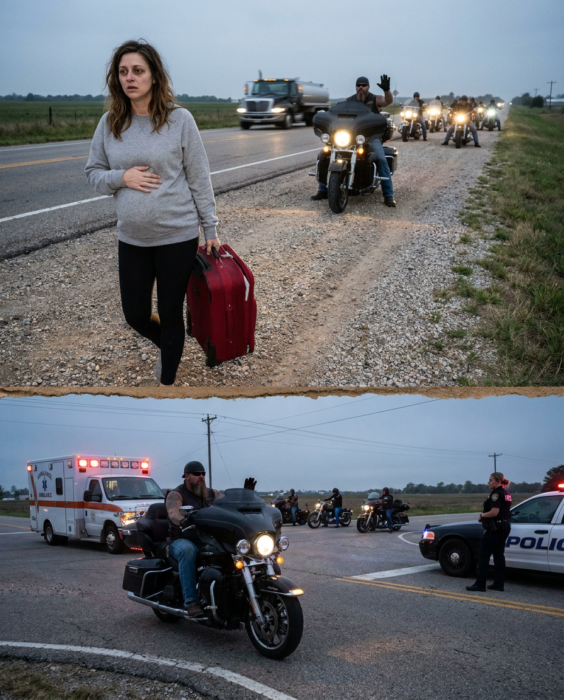
On the night we found her, Grant drank until he passed out in front of the television. Maya climbed through the bathroom window, lowered the suitcase into wet grass, and walked toward the highway.
She thought Safe Harbor was fifteen miles away.
It was closer to twenty-five.
She had no map after Grant destroyed her phone, only directions memorized from the card: follow Highway 9 west, turn at the old grain elevator, continue to the church with the blue roof, then call the number from the gas station.
She never reached the grain elevator.
When Officer Ruiz asked why she rejected our help, Maya stared at me with the tired anger of someone who had been asked to justify survival too many times.
“He helped too,” she said.
She meant Grant.
After every frightening night, he cooked breakfast. He repaired what he broke. He apologized, cried, and promised counseling. Help had become part of the same cycle as harm.
So when eleven men stopped beside her at midnight offering transportation, water, and protection, she heard the first sentence of a story whose ending she already knew.
“Men are all the same,” she said.
I did not blame her for one second.
I had been sober for nineteen years, but before that I was the kind of man who punched walls and expected my wife to praise me for not hitting her. She left before I became worse. Her departure forced me to confront what my excuses were becoming.
I never told Maya this on the highway.
A frightened woman did not need my confession. She needed me to obey her boundary.
That was why we followed at fifty yards.
The club had eleven riders that night. Bear Lawson, our sergeant-at-arms, watched traffic. Little Mike and Denny moved behind Maya whenever a truck approached. Cole carried water forward and left it where she could decide whether to take it.
Evan “Ledger” Shaw rode near the rear.
Most people meeting Ledger saw a quiet, broad-shouldered biker with a brown beard, wire-rim glasses, full sleeve tattoos, and a leather cut stretched across nearly 250 pounds. They rarely guessed he had spent eighteen years practicing family law.
Maya did not know.
Neither did she know that Ledger recorded the ride on a forward-facing motorcycle camera because a driver had recently sideswiped him. The camera captured the broken shoulder, our distance, the water left beside the reflector post—and a dark red pickup that passed us twice.
The first time, it moved east.
Twenty minutes later, it returned west.
Maya saw it and stepped behind a guardrail.
I noticed, but I did not yet understand.
The third time those headlights appeared was after she collapsed.
Officer Ruiz did.
She asked Maya what Grant drove.
“Red Ford,” Maya whispered. “One headlight fogged.”
The vehicle rounding the bend had one cloudy headlamp.
Ruiz stood.
She called for backup and ordered the ambulance crew to move Maya immediately. Bear and I positioned our motorcycles on the shoulder between the approaching pickup and the paramedics—not to confront the driver, only to create a visible barrier while the ambulance doors closed.
The pickup slowed.
It did not stop.
As it passed, the driver turned his face away.
Ledger’s camera caught the license plate.
Maya was already inside the ambulance when her husband disappeared into the dark.
Then the first hard contraction folded her body in half.
Part 3
The paramedic estimated that Maya’s contractions were six minutes apart.
The nearest maternity hospital capable of handling a premature delivery was Mercy Regional, sixty kilometers away. A smaller clinic sat closer, but it had no surgical team overnight and no neonatal unit.
Waiting was not an option.
The ambulance pulled onto Highway 9 with its lights flashing. Officer Ruiz rode in the rear beside Maya because she was the only person Maya trusted enough to touch her.
We mounted up.
Bear reached for his radio. “Formation?”
“Protect the route,” I said. “Nobody plays cop.”
That mattered.
Eleven bikers cannot simply seize intersections because an emergency feels personal. We could create a second disaster while trying to prevent the first.
Officer Ruiz contacted county dispatch from the ambulance and explained that experienced riders were available to assist only if law enforcement authorized it. The sheriff’s office had two units covering more than six hundred square miles. One deputy was responding to the red pickup. The other raced toward the hospital corridor.
Dispatch approved us to provide visibility at four intersections until patrol cars arrived, but the ambulance retained control.
Ledger divided us into teams.
Two riders accelerated ahead to the first junction, stopping on the shoulder with hazard lights on and signaling approaching drivers to yield to the ambulance. Two moved toward the next crossing. Nobody entered opposing traffic. Nobody chased motorists or ignored the officer’s directions.
The rest of us formed a staggered escort behind the ambulance.
The siren cut through the night.
Our V-twins answered beneath it.
Inside, Maya clutched Ruiz’s hand and asked whether Grant was following. The officer told her a deputy had intercepted the pickup eight miles behind us and that he could not reach her.
Maya asked again five minutes later.
Trauma does not trust an answer once.
Ruiz repeated it every time.
“He cannot reach you.”
At the first intersection, a freight truck had stopped across part of the turning lane. Bear and Denny used their headlights to guide the driver farther aside before the ambulance arrived.
It passed without braking.
At the second crossing, road construction reduced the highway to one lane. Cole had already reached the flagging station and awakened the overnight operator, who lifted the temporary barrier and held eastbound traffic.
The ambulance continued.
At the third signal, a late-night fuel tanker was beginning a turn. Two riders flashed their hazards from the shoulder. The driver saw the emergency lights, stopped, and reversed enough to clear the lane.
Still no stop.
At the fourth intersection, the signal was red and six cars blocked the route. Officer Ruiz’s call brought a Marlow police cruiser from the opposite direction. Its officer entered the junction legally, stopped cross traffic, and opened a corridor down the center.
The ambulance drove straight through.
Maya’s contractions were now three minutes apart.
A paramedic radioed the hospital.
The neonatal team assembled.
We followed until Mercy Regional appeared beyond the overpass. Then hospital security met us at the emergency entrance and ordered the motorcycles away from the ambulance bay.
Every rider obeyed.
We parked in a distant section of the lot while Maya was rushed inside.
No one discussed leaving.
Dawn found eleven bikers sitting on a concrete curb outside the maternity wing. Our leather cuts were damp with mist. Road coffee cooled in paper cups. Boots scraped pavement whenever the automatic doors opened.
At 6:42 a.m., Officer Ruiz stepped outside.
She looked exhausted.
“The baby’s alive.”
Nobody cheered yet.
Maya had suffered placental complications, and doctors performed an emergency delivery. Her daughter was premature, small, and receiving respiratory support, but her heartbeat was steady.
Maya was stable.
Then Ruiz added something else.
“She asked whether the bikers are still here.”
I stood.
“What did you tell her?”
“The truth.”
Ruiz led me upstairs but warned me not to enter the room unless Maya invited me. I waited in the hallway with my vest folded over one arm so the patches and black leather would not be the first things she saw.
Maya lay pale beneath hospital blankets. Her daughter was in the neonatal unit.
She looked smaller without the suitcase.
“You followed the ambulance,” she said.
“Yes.”
“All the way?”
“Yes.”
“Why?”
I thought of the eleven kilometers, the red pickup, the fear in her voice when she told us to stay back.
“Because you hadn’t reached somewhere safe yet.”
Maya studied me.
“What do I owe you?”
“Nothing.”
Her eyes narrowed as if she expected the real price to follow.
It did not.
I placed the shelter card Nurse Ruiz had recovered from her suitcase on the bedside table, then backed toward the door.
Before I left, Maya asked my name.
“Ray Dawson.”
“Why do they call you Hammer?”
“Bad decisions when I was younger.”
That almost made her smile.
Three days later, Safe Harbor arranged protected transportation from the hospital. Four riders escorted the vehicle, remaining behind it rather than surrounding it.
Maya named her daughter Lily Elena.
Lily for the flowers Maya’s mother once grew.
Elena for the female officer who had knelt beside her on the highway and asked permission before touching her.
The hospital delivery felt like the end.
It was not.
While Maya recovered at Safe Harbor, Grant began building a different version of the night. He told relatives she had suffered a mental break, endangered their unborn baby by leaving home, and disappeared without explanation.
He hired a respected family-law firm.
Then he filed for emergency custody.
Maya received the papers ninety-one days after walking away.
The hearing was scheduled for Friday.
On Wednesday afternoon, Safe Harbor’s legal-aid attorney withdrew because of a newly discovered conflict involving Grant’s construction company.
Maya had less than forty-eight hours.
Grant had money, witnesses, and a polished story.
Maya had seventeen dollars, a premature infant, and eleven bikers whose last names she barely knew.
Part 4
Maya called Officer Ruiz first.
Ruiz called me.
When I arrived at Safe Harbor, Maya sat at a kitchen table with Lily asleep against her chest and legal papers spread beside an untouched cup of tea. The baby had gained weight but still wore a small breathing monitor beneath her clothes.
Maya did not cry.
That worried me more.
“He says I’m unstable,” she said. “He says I stole his child.”
Ledger stood behind me reading the petition. He had come straight from court, but instead of a suit, he wore jeans, motorcycle boots, and his leather cut over a white shirt.
Maya knew him only as the quiet biker who had ridden near the back that night.
“What can we do?” I asked.
Ledger removed his glasses.
“We start with the truth.”
Maya looked at him. “Are you a lawyer?”
“Family law.”
“For how long?”
“Eighteen years.”
“Why didn’t anyone tell me?”
“You needed bikers on the road. You didn’t need résumés.”
Ledger called his office and cleared the next two days. He refused payment, although Safe Harbor’s director insisted on documenting the representation properly.
Then he began working.
Grant’s petition was carefully written. It never mentioned physical violence. It described Maya as hormonally unstable, financially irresponsible, and prone to sudden disappearances. He claimed she voluntarily left a safe home at midnight and endangered Lily by walking along a highway while heavily pregnant.
He included photographs of a tidy nursery.
He provided statements from two neighbors who had never witnessed violence.
He submitted messages Maya supposedly sent apologizing for “losing control.”
Grant’s attorney planned to argue that Maya’s behavior caused the premature birth.
The cruelty of that accusation silenced the room.
Ledger did not react outwardly. He turned a yellow legal pad sideways and began listing evidence.
Officer Ruiz had body-camera footage of Maya’s condition, injuries, and disclosure.
The ambulance had dispatch records proving active labor began after hours of walking.
Mercy Regional had documented older bruising on her ribs and upper arms, along with signs of untreated stress.
Safe Harbor had the original intake interview.
The clinic nurse had a copy of the resource card given to Maya two weeks before her escape.
My club had eleven witnesses.
Most importantly, Ledger had the motorcycle recording.
The footage showed our headlights remaining fifty yards behind Maya. It showed her refusing assistance. It showed the water placed by the reflector post. It showed the red pickup passing repeatedly.
And it showed the license plate.
The truck belonged to Grant.
The county deputy’s report confirmed he intercepted Grant eight miles from Maya after Ruiz requested assistance. Grant claimed he was looking for his wife because he was worried.
Ledger asked one question.
“How did he know which direction she went if he was asleep when she left?”
Maya looked up.
Grant had told police he awakened, found her gone, and guessed she headed toward town.
But Safe Harbor was west.
Town was east.
He had driven west.
Ledger worked through Thursday night. The clubhouse printer ran until its toner failed. Members collected certified hospital records, dispatch logs, and witness statements. Preacher drove two hours to obtain an affidavit from the construction flagger who cleared the second intersection.
Nobody contacted Grant.
Nobody threatened him.
Ledger made that rule absolute.
“We win with evidence,” he said. “Anyone approaches him, we hurt Maya.”
The courtroom opened at 8:30 Friday morning.
Grant arrived in a navy suit with two attorneys and four relatives. Maya entered through a protected corridor carrying Lily’s diaper bag while a shelter advocate carried the baby.
She expected to find me and perhaps two other riders.
Instead, sixty Black Ridge Riders had passed through security.
Every man removed his chains, pocketknives, and metal accessories before entering. Every phone was silenced. Some wore leather cuts with non-readable club patches; others wore plain dark shirts because Ledger did not want their presence mistaken for a threat.
They filled the public gallery.
No one spoke.
No one stared at Grant.
They simply sat.
The bailiff warned that any disruption would empty the room. Bishop—our president—stood and answered for all sixty.
“Yes, sir.”
Maya paused at the doorway.
For most of her marriage, Grant had convinced her that nobody would believe her and nobody would stay once the situation became inconvenient.
Now sixty men sat shoulder to shoulder without asking her to smile, thank them, or prove they were different.
Ledger approached wearing a charcoal suit. The tattoos on his hands remained visible beneath his cuffs.
“I thought you were one of the bikers,” Maya whispered.
“I am.”
He opened the courtroom door wider.
“Today I’m also your lawyer.”
Grant turned.
For the first time since the highway, Maya watched fear move in the other direction.
Part 5
The hearing lasted six hours.
The bikers did not win Maya’s case.
Evidence did.
Ledger made certain everyone understood that distinction.
Grant’s attorney began by showing photographs of the nursery and financial records demonstrating that Grant could provide a larger home, private health insurance, and full-time childcare.
Maya lived in a confidential shelter and had no current income.
On paper, the imbalance looked brutal.
Grant testified that Maya became irrational during pregnancy. He claimed she hid money, threatened to disappear, and rejected medical advice. When asked about her injuries, he said she bruised easily.
Then Ledger stood.
He spoke quietly.
A loud lawyer might have given Grant something to fight. Ledger gave him questions.
Had Grant removed the car battery?
Grant said the vehicle needed repairs.
Had he broken Maya’s phone?
It had fallen.
Had he retained her identification?
He kept important documents safe.
Had he screwed shut the spare-bedroom windows?
Grant hesitated.
His lawyer objected.
Ledger produced photographs taken by the deputy during a consent search of the farmhouse. The screws remained in the window frames.
The courtroom changed.
Grant claimed they were installed for security.
Ledger asked whether the bathroom window was also secured.
No.
That was where Maya escaped.
Next came the clinic nurse, who testified that Maya accepted a domestic-violence resource card while Grant was outside the room. The hospital physician explained that Maya’s bruises were in different stages of healing and unlikely to come from one accidental fall.
Officer Ruiz described finding Maya curled on the highway shoulder, frightened of every man present.
Grant’s attorney attacked the lack of earlier police reports.
Ruiz answered without anger.
“Many victims do not report while they remain dependent on the person harming them.”
Then Ledger played the motorcycle footage.
The courtroom watched Maya walking beneath our distant headlights. They saw eleven motorcycles remain behind. They saw my jacket left on the road. They saw Maya hide when the red pickup appeared.
The license plate became visible for less than two seconds.
It was enough.
Grant claimed he was searching out of concern.
Ledger displayed a map.
“If you believed your wife was walking toward Red Creek, why did you drive west three times?”
Grant said he was confused.
“Why did you pass her without stopping?”
“I did not see her.”
“She was illuminated by eleven motorcycles.”
Grant looked toward the gallery.
For the first time, one biker moved.
Bear folded his arms.
The judge immediately warned the spectators against gestures. Bear lowered his hands to his lap and did not move again.
Ledger’s final witness was Maya.
Before taking the stand, she handed Lily to the shelter director. Her fingers shook, and for one second she looked toward the exit.
I wanted to tell her she did not have to be afraid.
That would have been a lie.
Courage was never the absence of that fear. It was walking into it with your own name.
Maya testified.
She described the locked documents, broken phone, missing car battery, blocked bank card, and night she climbed through the bathroom window. She did not exaggerate. When she could not remember a date, she said so.
Grant’s attorney questioned why she refused help from the bikers if she was truly desperate.
Maya looked at us.
“Because my husband always offered help after he hurt me. I no longer knew what help looked like.”
The attorney asked whether any biker threatened her.
“No.”
“Touched you without permission?”
“No.”
“Forced you onto a motorcycle?”
“No.”
“Then what did they do?”
“They stayed fifty yards behind me for eleven kilometers.”
“Why?”
Maya’s eyes found mine.
“Because I asked them not to come close.”
That answer settled over the room.
The judge recessed for forty minutes.
Nobody celebrated. Temporary-custody rulings could turn on narrow legal questions, and Grant’s resources remained significant.
Maya sat in a witness room feeding Lily. Ledger reviewed notes rather than offering promises he could not guarantee.
When court resumed, the judge denied Grant’s emergency custody request. Maya retained primary physical custody under a protective order. Grant received no unsupervised access pending a full investigation and completion of a court-ordered risk assessment.
The court also ordered him to surrender firearms and barred him from approaching Safe Harbor, Mercy Regional, Officer Ruiz, or any identified club witness.
It was not a perfect ending.
Family-court cases rarely end in one day.
But Maya walked out with Lily.
Grant did not.
In the hallway, reporters attempted to photograph the bikers. Bishop ordered every member to move aside so cameras could not expose Maya or reveal the shelter advocate walking with her.
Sixty intimidating men formed a wall facing outward.
Maya passed unseen behind them.
Outside, she found Ledger near the courthouse steps.
“How much do I owe you?” she asked.
He shook his head.
“You keep asking the wrong question.”
“What’s the right one?”
“What do you want to build next?”
Maya looked down at Lily.
“A life where she never has to escape through a window.”
Ledger nodded.
“That sounds like a good place to start.”
Part 6
Maya did not return to Grant.
The divorce took eleven months. The custody order became permanent after investigators documented coercive control, financial restriction, surveillance, and repeated violence.
Grant received supervised visitation only after completing court requirements. Maya was never required to meet him alone.
She and Lily stayed at Safe Harbor until transitional housing became available.
At first, Maya distrusted every kindness.
When club members delivered a crib, she asked who had paid for it and when they expected repayment. When Bear repaired her apartment door, she stood across the room watching his hands.
Nobody took offense.
We left receipts.
We announced visits.
We never arrived unexpectedly.
If Maya said no, the answer remained no.
That mattered more than the crib.
Officer Ruiz visited whenever her shift allowed. Lily Elena recognized her voice before she learned to walk. Ruiz joked that having a baby named after her meant she finally had somebody required to listen to her stories.
Three years later, Maya began working at Safe Harbor.
She first handled meal deliveries and donation records. Then she trained as a survivor advocate. She became the person who answered the phone when women whispered from locked bathrooms, laundromats, clinic parking lots, and borrowed cars.
Maya never told them, “Just leave.”
She knew leaving was not a door.
Sometimes it was an eleven-kilometer road.
Sometimes it was a court filing.
Sometimes it was learning that help could stand fifty yards away and wait.
The club established a yearly fundraiser for Safe Harbor, but Maya set the rules. No surprise visits. No public photographs of residents. No motorcycles near the confidential entrance. All donations went through staff.
The first year, the ride raised enough to replace every exterior lock and fund emergency transportation for six families.
Ledger continued taking selected cases without charge. He never advertised them through the club. He said vulnerable clients were not decorations for a lawyer’s reputation.
Officer Ruiz taught our members how to respond to domestic-violence situations without escalating danger: do not confront the suspected abuser, do not demand disclosure, do not promise outcomes, and do not confuse protection with control.
Hammer-looking men are accustomed to stepping forward.
Ruiz taught us when to step back.
Every year, on the anniversary of that night, I rode Highway 9 alone just after midnight. I stopped at the reflector post where we had left the water and jacket.
The first two years, I found nothing there.
The third year, a small blue ribbon had been tied around the post.
No note.
No name.
Just the color of Lily Elena’s first hospital blanket moving in the wind.
I left it untouched.
Some things do not need a patch.
Part 7
Lily turned five on a warm September afternoon.
Maya held the birthday party behind Safe Harbor’s public outreach office, far from the confidential residence. Children chased bubbles across the grass while Officer Ruiz attempted to assemble a folding table without reading the instructions.
Ledger brought legal pads as a joke.
Bear brought a helmet painted with removable flower stickers, though Lily was not allowed near a running motorcycle.
I brought a small red suitcase.
Maya recognized it immediately.
It was not the suitcase she dragged along Highway 9. That one had finally broken beyond repair. This was new, light enough for a child to pull, with smooth wheels and a tag bearing only Lily’s first name.
Maya ran her hand over the handle.
“For traveling,” I said. “Not escaping.”
She looked away until her eyes cleared.
By then, she had her own apartment, a used car registered in her name, and a locked file containing every document Grant once kept from her. Lily attended kindergarten and believed sixty bikers appearing at community fundraisers was ordinary.
Near sunset, Maya asked the club to gather.
We formed a rough semicircle beneath the trees. Sixty men who once filled a courtroom now stood holding paper plates and juice boxes.
Maya told us she remembered every mile of the highway.
She remembered the engines.
She remembered looking back and seeing eleven silhouettes in black leather.
“I thought you were waiting for me to get tired,” she said.
“We were,” Bear answered.
Everyone looked at him.
He raised both hands. “That sounded better in my head.”
Maya laughed.
Then she continued.
She had assumed we wanted her tired enough to accept whatever help we offered. It took months to understand that we had been waiting for her to decide what safety meant.
“You stayed fifty yards away,” she said. “Nobody had ever respected a boundary I couldn’t enforce.”
I did not know how to answer that.
So I told her the truth.
“She said all men were the same, and I didn’t blame her for one second. We didn’t need to prove her wrong on that highway. We only needed to avoid proving her right.”
Maya walked over and hugged me.
Five years earlier, she had backed into a ditch because I stepped toward her.
Now she chose the distance herself.
After the party, we escorted Maya, Lily, and Officer Ruiz home. The motorcycles stayed behind their car, not around it.
At the old reflector post, Maya slowed.
The blue ribbon was still there, faded almost white by weather.
Lily waved through the rear window.
I raised one scarred hand.
Eleven kilometers earlier, Maya had believed every offer of help concealed a debt. Now she worked at the shelter that once waited forty kilometers ahead, teaching frightened women that they could accept protection without surrendering control.
Our headlights followed her car through the darkness.
Always behind.
Never too close.
Follow our page for more biker stories about quiet protection, earned trust, and the lives changed when strong people learn to listen.