A Little Girl Sold Every Pin From a Biker’s Leather Vest for One Dollar—The Club Knew Why He Never Asked Her to Stop
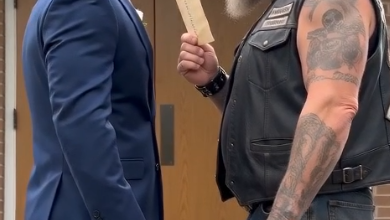
By the time the little girl pulled the seventh pin from my leather vest, every biker in the clubhouse had gone silent, and none of them dared tell her what those pieces of metal meant to me.
My name is Wade “Gravel” Mercer, and for thirty-one years, the Iron Lanterns had known one rule about my cut.
Nobody touched it.
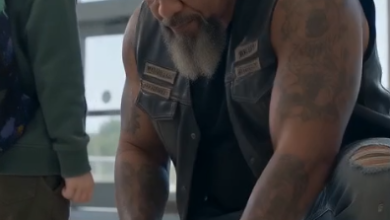
The old black leather carried rain stains from Montana, a burn mark from a motel fire in Kentucky, and enough road dust in its seams to map half the country. Across the front were sixty-three metal pins I had collected through funerals, charity rides, broken marriages, rebuilt engines, and nights when a brother needed company but could not find the words to ask.
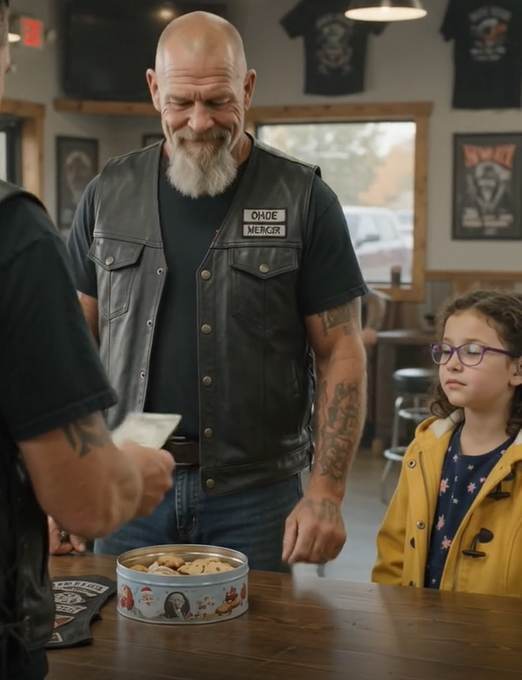
Nine-year-old Nora Bennett knew none of that when she walked into our clubhouse outside Dayton, Ohio, carrying a cardboard sign and an empty cookie tin.
She was small, with dark curls, purple glasses, a yellow coat, and two hearing aids so old that one squealed whenever she turned her head. She watched mouths carefully because most voices reached her as broken pieces.
Her sign said she was earning money for new hearing aids.
Not asking.
Earning.
Nora had sold bracelets, washed cars, carried groceries, and folded menus at her mother’s diner. After seven months, she was only sixty-three dollars short of the deposit her family needed.
She placed three handmade bookmarks on our bar and explained that each cost one dollar.
Then she noticed my vest.
The pins caught the afternoon light: eagles, highway shields, tiny motorcycles, memorial ribbons, a silver wrench, and one faded blue butterfly near my heart.
“Could I sell those?” she asked.
The room stopped breathing.
Bear lowered his coffee. Little Mike stared at the floor. Our club president, Mason Hale, looked at me as if Nora had asked to sell the gravestones behind the county church.
I should have said no.
Instead, I removed my vest, laid it across the wooden table, and asked, “How much apiece?”
“One dollar,” she said.
Mason knew exactly what I was doing. So did every brother wearing Iron Lantern colors that afternoon.
Nobody explained it to Nora.
If we had passed a hat, her mother would have refused. If we had called it charity, Nora would have returned every dollar. She had spent seven months proving that losing her hearing had not taken away her ability to work for what she needed.
So Mason reached for the first pin.
It was an old Route 50 shield I had carried since my first interstate ride. He placed one dollar in Nora’s cookie tin, then held the pin like something borrowed from a church altar.
Bear bought the second.
Little Mike bought the third.
Soon, a line of tattooed men stretched from the table to the clubhouse door. Heavy boots shifted across the concrete while Nora carefully removed pins with both hands, smiling each time another dollar landed in the tin.
I felt my history disappearing from the leather, one small hole at a time.
Then Nora touched the blue butterfly.
Her fingers stopped.
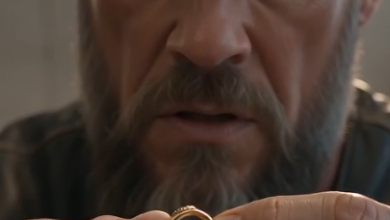
The pin had belonged to my daughter, Lucy. She was born profoundly deaf, learned to sign before she could speak, and died at seventeen before she could take the motorcycle trip we had planned together.
Even Mason looked away.
“You don’t have to sell that one,” Nora told me.
I looked at the girl’s failing hearing aid, then at sixty-two brothers waiting behind her with single dollar bills folded inside their palms.
“Yes,” I said. “That one too.”
Nora removed it gently.
But before she could offer the butterfly to the next buyer, an old biker named Bear closed her fingers around it and said something that made her stare at my bare vest.
That was when Nora counted the tiny holes in my leather, looked at the sixty-three men surrounding her, and realized this had never been an ordinary sale.
Want to know what Bear told Nora and why the blue butterfly had remained over Wade’s heart for seventeen years? Drop PINS in the comments — I’ll share more soon.