Part 2: A Little Girl in Old Clothes Was Turned Away From Her Rich Friend’s Birthday Party — Then the Gift She Left Behind Made the Whole Family Cry
Part 2
Emma Parker had not wanted to go to the party empty-handed.
That was the first thing nobody at the Whitmore house understood.
She knew Lily’s neighborhood had driveways bigger than the patch of grass behind her apartment building. She knew Lily’s mother drove a pearl-white SUV and wore bracelets that made soft gold sounds when she signed permission slips. She knew birthday parties at houses like that were not like cupcakes in a classroom or pizza on paper plates at the community center.
Still, Lily had invited her.
That mattered.
The invitation had been handed to Emma on Tuesday afternoon during reading time, folded once, then twice, then slid under the edge of her book so no one else would grab it. Lily had not made a performance of it. She had simply leaned close and whispered, “I really want you to come.”
Emma kept the invitation in her backpack for three days without letting it bend.
At home, she showed it to her grandmother, Ruth Parker, who sat at their small kitchen table sorting laundry by the window. Ruth was sixty-nine, with silver hair pulled into a low bun, hands swollen from years of cleaning hotel rooms, and the kind of eyes that could read a child’s disappointment before the child admitted it.
“It says gifts optional,” Emma said quickly, because she had already learned to protect adults from wanting to give what they could not afford.
Ruth put down a towel.
“Optional doesn’t mean you don’t bring love.”
Emma looked at the table.
“What if love looks cheap?”
Ruth was quiet for a moment.
Then she reached across and touched Emma’s hand.
“Then some people need better eyes.”
Emma did not smile, but she remembered it.
They did not go shopping for a gift because there was no money for shopping. Ruth’s check had covered rent, electricity, bus fare, and a bottle of medicine she kept hidden behind the flour because she hated Emma knowing when her knees hurt. Emma’s mother, Denise, had died two years earlier, and after that, Ruth had become the kind of grandmother who said, “We’ll manage,” so often that it sounded less like confidence and more like a prayer.
Lily knew some of this, but not all.
Children share loneliness in pieces.
Lily Whitmore lived in a house with tall windows, heated floors, a pool she rarely used, and a bedroom decorated by someone who believed childhood should match. Her father, Andrew Whitmore, ran a real estate investment firm and traveled often. Her mother, Claire, organized charity luncheons, tennis fundraisers, school committees, and the perfect birthday parties other mothers complimented afterward.
Lily had many things.
She did not have many quiet places to be herself.
That was why she liked Emma.
Emma listened without trying to fix her. When Lily said her parents argued in voices too calm to sound like arguing, Emma did not make a face. When Lily admitted she sometimes hid in the laundry room because no one looked for her there, Emma said the dryers in her building made a sound like trains and that hiding places felt safer when they had noise.
Their friendship started with a library book.
In October, Lily had left a copy of The Secret Garden on a bench outside school. Emma found it and returned it the next morning with a small paper bookmark tucked inside, drawn with vines and a key. Lily loved it so much she began asking Emma to draw more. Soon there were bookmarks, tiny folded notes, pencil sketches of birds, and one paper crown Lily wore at recess until a girl named Madison told her it looked babyish.
Lily took it off.
Emma noticed.
She never asked why.
Instead, the next day, she drew Lily a tiny castle with a door left open.
For the birthday gift, Emma decided to make something.
She used an old shoebox Ruth had saved. She covered it with brown grocery paper because wrapping paper cost too much and because Ruth said brown paper could look beautiful if tied carefully. Inside, she placed twelve handmade “brave cards,” each cut from the blank backs of old mail envelopes and decorated with colored pencil. Each card had one sentence Lily had once said to her, rewritten gently into something she could keep.
When you feel invisible, sit by the window and look for one thing that moves.
If grown-ups forget to listen, write it down until your own voice hears you.
A perfect room can still feel lonely, and that does not make you ungrateful.
You can be scared and still walk through the door.
At the bottom of the box, Emma placed the little paper castle with the open door.
Then she added one more thing, folded inside a blue envelope.
It was a drawing of Lily smiling without posing.
Emma had drawn it from memory.
Not the birthday smile. Not the school photo smile. The real one Lily had worn behind the library shelves when they talked about books, secret gardens, and the possibility of having a place where no one told you how to stand.
On Saturday, Ruth helped Emma press her yellow dress under a towel because they did not own an iron that worked properly. She cleaned Emma’s shoes with baking soda and a toothbrush. She braided Emma’s hair with a blue ribbon that had once belonged to Denise.
Emma looked in the cracked hallway mirror.
“Do I look okay?”
Ruth stood behind her.
“You look like someone who cared enough to come.”
The bus ride took forty-two minutes.
Emma held the gift in her lap with both hands.
At each stop, she checked the invitation. At the last corner, she got off and walked past houses with trimmed hedges, quiet fountains, and cars that looked freshly washed by people who did not own them. She felt the old nervousness rise in her stomach, but she kept walking because Lily had said, “I really want you to come.”
When she reached the gate, the party was already bright and loud.
A photographer stood near the patio. A table held pink cupcakes with sugar pearls. Children ran across the lawn in dresses and polo shirts. A woman checked names on a clipboard beside the gate.
Claire Whitmore was not trying to be cruel that day.
That was the uncomfortable truth.
She was trying to keep the party perfect.
Perfection can make people careless in very expensive ways.
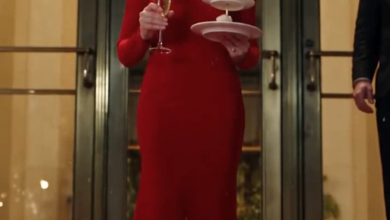
She saw Emma and saw a problem before she saw a child. The old dress. The brown-paper package. The absence of a parent stepping out of a luxury car behind her. She assumed Emma was from the neighborhood nearby, maybe someone’s younger sibling, maybe a child who had wandered toward the music and balloons.
“I’m Lily’s friend,” Emma said.
Claire heard the words, but her eyes trusted the dress more than the invitation.
“The guest list is already full.”
The sentence sounded reasonable if one did not listen to the small break it made.
Emma placed the gift on the stone pillar.
She did not throw it.
She did not beg.
She did not even say that Lily had asked her to come.
That silence would haunt Claire later.
Because Emma had given her one chance to see her.
And Claire had looked away.
Part 3
Lily noticed Emma was missing before anyone else did.
She had been standing beside the gift table while adults arranged photographs around her, one hand tucked behind her back, the other holding the edge of her pale blue dress as if it belonged to someone else. Guests kept saying she must be excited. She nodded because that was easier than explaining that excitement felt different when a party became something performed for adults.
“Smile, sweetheart,” Claire said.
Lily smiled.
The photographer clicked.
A girl from her class, Madison, leaned close and whispered, “Your party looks like a magazine.”
Lily looked toward the gate.
“Where’s Emma?”
Madison shrugged.
“Maybe she didn’t come.”
Lily’s smile faltered.
“She said she would.”
The magician began his act. The children gathered on the lawn. A dove appeared from a silver scarf. Everyone clapped. Lily clapped too, late and softly. Her eyes kept moving to the gate.
At 3:15, Claire instructed the children to gather for cake.
At 3:32, presents began.
The gifts were beautiful in the way expensive things can be beautiful without being personal. A designer backpack. A bracelet set. A tablet case. A dollhouse furniture collection. A gift card in a glitter envelope. Each time Lily opened something, adults made pleased sounds, and Lily thanked everyone properly.
Then Claire saw the brown-paper package.
It sat at the far edge of the table, separate from the others, as if even the gifts had created a social order.
“Whose is that?” Andrew asked.
Claire’s stomach tightened, though she did not yet know why.
“I’m not sure.”
Lily reached for it immediately.
Her name was written on the top in careful pencil letters: For Lily, for when the party gets too loud.
The backyard changed by one degree.
Not enough for most adults to notice.
Enough for Lily.
She froze.
“Emma came,” she whispered.
Claire’s face warmed.
Andrew looked at his wife.
“Who’s Emma?”
“My friend,” Lily said, sharper than anyone expected.
Claire stepped closer.
“Lily, maybe open that later.”
But Lily had already untied the string.
Inside was the shoebox covered in brown paper, twelve handmade cards, the tiny castle with the open door, and the blue envelope at the bottom.
At first, nobody understood what they were looking at.
Madison tilted her head.
“It’s just paper.”
Lily did not answer.
She picked up the first card.
When you feel invisible, sit by the window and look for one thing that moves.
Her face changed.
She picked up another.
A perfect room can still feel lonely, and that does not make you ungrateful.
The adults grew quiet.
Claire looked at Lily.
Not the birthday girl arranged for photos.
Her daughter.
Really looked.
Lily’s lips trembled as she lifted the next card.
If grown-ups forget to listen, write it down until your own voice hears you.
Andrew stopped breathing for a moment.
He had been gone three nights that week. He had told himself Lily understood. Children with comfortable homes were often expected to understand adult absence as part of success, as if a large house could fill the chair left empty at dinner.
Lily opened the blue envelope last.
Inside was Emma’s drawing.
It showed Lily sitting behind the school library shelves with a book open on her knees, laughing the way she did when nobody asked her to perform happiness. Around her, Emma had drawn vines, tiny keys, and a door opening into a garden.
At the bottom, in small letters, Emma had written: This is how you look when you are not trying to be perfect.
Lily pressed the drawing to her chest.
The entire backyard went silent.
That was when Claire understood the first part of what she had done.
She had turned away the child who knew her daughter better than anyone at the party.
“Mom,” Lily said, and her voice sounded strange, too calm for a ten-year-old. “Was Emma at the gate?”
Claire could have lied.
Parents sometimes lie when the truth would make them smaller in front of their children.
But the brown-paper gift lay open between them, and every handmade sentence seemed to be watching.
“Yes,” Claire said.
Lily stared at her.
“What happened?”
Claire’s mouth felt dry.
“I thought she wasn’t on the list.”
“She had an invitation.”
“I know that now.”
Lily looked toward the gate.
Her eyes filled, but she did not cry yet. That restraint hurt worse.
“You sent her away because of her dress.”
The sentence landed without volume.
Claire’s face flushed.
Madison looked down at her shoes.
One of the mothers near the cupcake table reached for her necklace as if it had suddenly become too tight.
Andrew stepped toward Claire.
“Is that true?”
Claire did not answer fast enough.
That was answer enough.
Lily stood from the chair, still holding the drawing and the cards.
“I want to go get her.”
“Honey, the party—”
“I want to go get Emma.”
No one moved.
Then Ruth Parker appeared at the gate.
She had not planned to enter.
She had come because Emma arrived home too quickly, placed her shoes neatly by the door, and went straight to the bedroom without taking off the blue ribbon. Ruth found her sitting on the bed, staring at her hands, the invitation folded beside her.
“What happened?”
Emma shook her head.
“Maybe it was too fancy.”
Ruth read the invitation. Then she saw Emma’s empty hands.
“Where’s the gift?”
“I left it.”
Ruth closed her eyes.
Not from anger first.
From the old tiredness of watching a child learn a lesson about the world too early.
She took Emma’s hand and said, “We’re going to get your gift back if they didn’t want it.”
Emma begged her not to.
Ruth came anyway.
But when she reached the gate, she saw the backyard silent, Lily holding the drawing, Claire standing pale beside the gift table, and Emma’s little paper castle open in the center of everything.
Lily saw Ruth first.
“Where’s Emma?”
Ruth’s face tightened.
“At home.”
Lily ran.
She ran across the lawn in her pale blue dress, past the cake, past the magician, past the gift table, past every child who had come to watch her have a perfect day. At the gate, she stopped in front of Ruth.
“I’m sorry,” Lily said.
Ruth studied her.
It is hard to decide how much adult pain to place on a child who did not cause it.
So Ruth simply nodded.
“She wanted you to have the box.”
“I want her here.”
Claire stepped forward then.
“Mrs. Parker, I’m Claire Whitmore. I owe you—”
Ruth lifted one hand gently, not rudely, but enough to stop her.
“My granddaughter ironed that dress with a towel this morning,” she said. “She cleaned those shoes until her fingers were white. She rode a bus across town holding that gift like it was glass. So before you apologize to me, you might want to decide what exactly you saw when she stood at your gate.”
Claire’s eyes filled.
Andrew looked at the stone pillar where the gift had been left.
The whole party heard Ruth’s words.
No one repeated them.
They did not need repeating.
Claire turned to Lily.
“Get your shoes.”
Lily shook her head.
“I’m wearing them.”
“Then we’re going.”
Andrew took his keys.
The party did not end with an announcement.
It simply stopped pretending.
Ten minutes later, Claire, Andrew, Lily, and Ruth stood outside the Parker apartment building. It was a brick building with peeling paint near the entrance, a narrow stairwell, and a row of mailboxes with names written on small pieces of tape. Claire carried the shoebox. Lily carried the drawing. Andrew carried nothing, which made his hands look useless to him for the first time in years.
Emma opened the door after Ruth knocked.
Her eyes widened when she saw Lily.
“I’m sorry,” Lily said immediately.
Emma looked past her at Claire and Andrew.
“I didn’t mean to cause trouble.”
That broke Claire.
Not loudly.
Not dramatically.
But enough that she had to put one hand against the doorframe.
“You didn’t,” Claire said. “I did.”
Emma did not know what to do with an adult admitting that.
Claire knelt, careful not to make herself look noble for doing what should have been done at the gate.
“I looked at your dress and thought I knew whether you belonged,” she said. “That was wrong. I am very sorry.”
Emma stared at her.
The hallway was quiet.
Then Lily held up the drawing.
“You drew me real.”
Emma’s chin trembled.
“You are real.”
Lily hugged her so quickly the shoebox nearly slipped from Claire’s hands.
That was the moment Andrew turned away.
He was not crying over the party, or the mistake, or even the gift.
He was crying because a child in old shoes had given his daughter language for a loneliness he had been too busy to notice.
Part 4
They did not return to the party right away.
That was Lily’s choice.
Instead, the girls sat on the Parker apartment floor with the shoebox between them while adults stood in the small kitchen pretending not to listen. Emma showed Lily how each card had been made from old envelopes, how the castle door folded open if you pressed the side, how one of the vines covered a coffee stain she could not erase.
Lily treated every explanation like it mattered.
Claire watched from the doorway.
The apartment was small but cared for. A plant grew in a chipped mug on the windowsill. A photograph of a younger woman with Emma’s smile sat beside a candle. Ruth moved through the room with quiet dignity, neither ashamed of what they had nor impressed by who had come to see it.
Andrew noticed the bus schedule pinned near the refrigerator.
He thought of Emma carrying that box across town.
He thought of the catered cupcakes stacked untouched on the patio.
For the first time all afternoon, he understood scale differently.
Not the size of a house.
The distance love is willing to travel.
When they finally returned to the Whitmore house, Emma did not want to walk through the gate.
Ruth squeezed her shoulder.
“You can leave whenever you want.”
Lily held Emma’s hand.
“Or stay beside me.”
The backyard had changed in their absence. Children were quieter. Parents spoke in lower voices. The magician had packed away half his props. The gift table looked suddenly too bright, too crowded, too much.
Madison approached first.
She looked at Emma’s dress, then at the grass.
“I shouldn’t have laughed.”
Emma said nothing.
Lily did.
“No, you shouldn’t have.”
Madison nodded, accepting the small sting because she had earned it.
Claire gathered the children near the table, but she did not make Emma stand in the center. She did not turn the moment into a lesson for guests or a public apology designed to make herself look redeemed. She simply said, “Emma brought Lily a gift she would like to share, if Emma says it’s okay.”
Emma looked at Lily.
Lily looked back, waiting.
That waiting mattered.
Emma nodded.
So Lily read three cards aloud.
Not all twelve.
Some gifts are too personal for a crowd.
She read the one about feeling invisible, the one about perfect rooms, and the one about being scared but still walking through the door. The children listened differently than they listened to adults. Adults often explain feelings from above. Children recognize them from beside.
When Lily finished, Andrew asked if he could see the tiny paper castle.
Emma handed it to him.
He opened the little door with a finger that trembled more than he expected.
“What’s inside?” he asked.
Emma shrugged shyly.
“Whatever Lily wants.”
Andrew looked at his daughter.
For years, he had given Lily rooms already finished, schedules already planned, parties already arranged, choices disguised as luxuries. Emma had given her a door.
That evening, after most guests left, Claire found the unopened expensive gifts still on the table. Lily was not beside them. She was on the porch steps with Emma, both girls eating slightly melted cake from paper plates and laughing at something too quiet for adults to own.
Ruth sat nearby in a patio chair, her hands folded over her purse.
Claire approached slowly.
“Mrs. Parker,” she said.
“Ruth is fine.”
“Ruth,” Claire repeated. “Thank you for coming back.”
Ruth looked at her.
“I came back for Emma.”
“I know.”
That was the first honest exchange between them.
Claire sat on the edge of another chair, leaving space between them.
“I grew up in a house where every mistake was hidden before guests arrived,” she said quietly. “I think I learned to treat discomfort like dirt on a rug.”
Ruth studied her face.
“And children?”
Claire looked toward Lily.
“I’m learning I may have done that too.”
Ruth did not comfort her quickly.
Some discomfort should be allowed to finish speaking.
Finally, she said, “Then don’t waste what you learned today.”
Claire nodded.
She did not.
In the weeks that followed, Claire changed things, but not in ways that looked impressive from the outside. She stopped asking Lily to smile for photographs before asking whether she was enjoying herself. She canceled two committees and made Wednesday afternoons library days. She invited Emma over again, but this time she picked her up herself and met Ruth at the door like a person, not a problem to be managed.
Andrew changed more slowly.
He still traveled. Work did not disappear because his conscience woke up at a birthday party. But he began calling Lily before bedtime instead of sending quick texts through Claire. He came home early one Friday and found Lily and Emma building paper rooms across the dining table, each with tiny doors that opened into places with names like Quiet Garden, Rain Room, and The Place Nobody Has To Pose.
He stood watching too long.
Lily noticed.
“Dad, do you want one?”
Andrew almost said he had emails.
Instead, he sat down.
Emma handed him a piece of paper.
“You have to make a door first.”
He did.
Months later, Lily’s school held a family art night. On one wall, students displayed projects about friendship. Lily and Emma made a large paper house together. It had two front doors, one fancy and one plain, both leading into the same warm room. Around it, they glued twelve small cards with sentences written in colored pencil.
Claire stood beside Ruth while people admired it.
A mother nearby said, “That’s beautiful. Where did they get the idea?”
Claire looked at Ruth.
Ruth smiled faintly.
“From a birthday party.”
Claire’s face softened.
“Yes,” she said. “From a birthday party.”
Emma never forgot being turned away.
Children do not erase moments like that simply because adults later behave better. But the memory changed shape over time. It did not become harmless, exactly. It became part of a larger story, one where Lily ran after her, Ruth spoke for her, Claire knelt in a hallway, and a brown-paper gift sat in the middle of a rich backyard making expensive things look suddenly small.
On Lily’s eleventh birthday, there was no magician.
No photographer.
No mountain of gifts.
She asked for a picnic at the public library garden with Emma, Ruth, her parents, and three classmates who understood that invitations were not decorations. Claire packed sandwiches herself, badly at first, then better after Ruth showed her how to wrap them so they did not fall apart.
Lily’s favorite gift that year came in a small envelope from Emma.
Inside was one handmade card.
It said: Some doors open late, but they still open.
Lily placed it in the original shoebox, where she kept all twelve brave cards, the paper castle, and the drawing of herself smiling without trying. The box no longer looked plain to anyone who knew what was inside.
Years later, when Lily left for college, Claire found the shoebox on the bed beside a note.
I’m taking this with me. It still helps.
Claire sat on the edge of the bed and opened the lid. The paper had softened at the corners. The cards were worn from being read. The little castle door still opened if pressed carefully. At the bottom was the drawing Emma had made, the one that had shown Lily as she was before anyone told her how to smile.
Claire touched the faded pencil line.
Then she looked out the window toward the front gate.
For a moment, she saw it again: a little girl in an old yellow dress, standing in bright afternoon light, holding a brown-paper gift with both hands, waiting for someone to see more than the clothes she wore.
This time, in memory, Claire opened the gate.
Follow this page for more heartfelt stories about kindness, dignity, and the quiet gifts that change people forever.