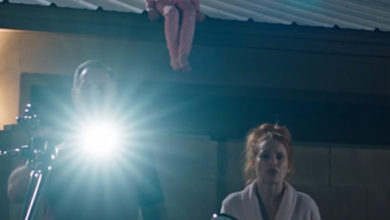
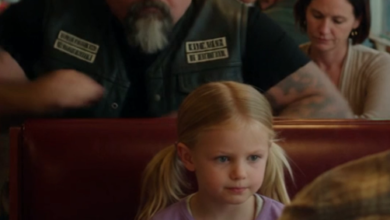
SECURITY RUSHED THE STAGE WHEN A TATTOOED BIKER GRABBED THE PRINCIPAL’S MICROPHONE IN THE MIDDLE OF GRADUATION—THEN HE READ TWO NAMES AND 800 PEOPLE TURNED AROUND.
Part 2
Eight hundred people stared at the back doors.
Gabby Castillo couldn’t move. Her hands were shaking so hard she was crumpling the fabric of her gown.
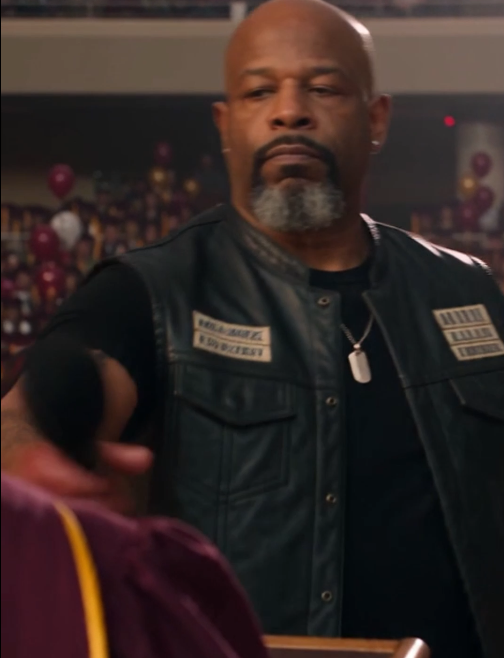
On stage, Uncle Booker lowered his arm.
He held the microphone back out to Principal Nathan Ashby.
“Thirty seconds,” he said quietly. “Thank you.”
Dr. Ashby didn’t take it. He was still staring at the two young people in maroon gowns at the back of the civic center.
“Who are they?” he asked. He said it to Booker, but it came out of the speakers. Everyone heard.
“They’re graduates,” Booker said. “Your graduates. They finished every credit. They passed every test.” He paused. “Your school just didn’t invite them.”
The crowd murmured.
Dr. Lorraine Stuckey was out of her front-row seat and climbing the stage steps before anyone else could move. She was fifty-four, with a sharp gray bob and a gray suit, the district’s director of academic services. She’d run Riverside’s commencement for eight years.
“Dr. Ashby,” she said firmly, reaching for the microphone. “I’ll handle this.”
She took it from Booker’s hand. Booker let her.
“Ladies and gentlemen, I apologize for this disruption,” she told the crowd smoothly. “These two individuals are not members of the Class of 2026. They completed the district’s alternative evening program. The commencement ceremony is reserved for the official four-year cohort. That has always been our policy.”
She turned to the security guards.
“Please escort this gentleman out.”
The guards moved toward Booker.
He didn’t resist. He started walking toward the stage steps.
Then Dr. Ashby spoke.
“Lorraine,” he said quietly, but his lapel microphone was still on, and eight hundred people heard him. “What policy?”
Dr. Stuckey turned.
“The alternative program policy,” she said. “It’s been in place for years.”
“I’ve been principal here for two years,” Dr. Ashby said slowly. “I’ve never seen that policy.”
Dr. Stuckey’s smile tightened.
“It’s an academic services matter,” she said. “It doesn’t come across your desk.”
Dr. Ashby looked down the long aisle at the two young people at the back doors.
The girl was crying now. Silently.
He held out his hand.
“Lorraine,” he said. “Give me the microphone.”
Part 3
Two years earlier, Gabby Castillo had been a junior at Riverside High School with a 3.6 grade point average.
She wanted to be a nurse. She worked weekends at a pharmacy and spent every Saturday morning in her father’s welding shop, handing him tools and listening to him sing badly to the radio.
Her father, Ray Castillo, was a welder and a member of a motorcycle club called the Red River Riders. He’d raised Gabby alone since her mother left when she was six.
In October of her junior year, Ray died in an accident at the steel fabrication plant where he worked.
Gabby was seventeen.
There was no life insurance. There was a mortgage, a car payment, and a funeral bill.
She dropped out of school in November to work overnight shifts at a warehouse distribution center. It was the only job that paid enough to keep the house.
That spring, a teacher from her old school found her. Ms. Yolanda Freeman taught night classes in the district’s evening credit-recovery program for students who’d had to leave school.
“You’re too smart to stop,” Ms. Freeman told her. “Come to class at night. Finish.”
So Gabby did.
She worked the warehouse from 11 p.m. to 7 a.m. She slept four hours. She went to class from 6 to 9 p.m. three nights a week. She studied on her breaks, sitting on a forklift pallet with a textbook.
It took her eighteen months.
She finished in April with a 3.8. Her diploma said Riverside High School, the same as everyone else’s.
In May, she got a letter from the district office, signed by Dr. Lorraine Stuckey.
Congratulations on completing your diploma requirements. Please note that alternative program completers are not eligible to participate in the Riverside High School commencement ceremony. Your diploma will be mailed to you.
Gabby read the letter in the warehouse break room and cried.
Then she called Booker Wells.
Booker had been her father’s best friend for thirty years. They’d welded side by side, ridden side by side, and were godfathers to each other’s kids. Booker had sat in the front row at Ray’s funeral in his leather jacket and hadn’t said a word.
Afterward, he’d walked up to Gabby and put his huge hand on her shoulder.
“Anything you need,” he’d said. “Anything. Ever.”
When she called him about the letter, he was quiet for a long time.
“When’s graduation?” he finally asked.
Now, in the civic center, Dr. Ashby walked to the front edge of the stage, holding the microphone.
He looked down the aisle at Gabby.
“Miss Castillo,” he said. “Mr. Washington. Would you come up here, please?”
Part 4
Gabby didn’t move.
She couldn’t.
Tyrell Washington took her hand.
Tyrell had dropped out at sixteen when his grandmother, who was raising him, had a stroke. He’d spent two years caring for her during the day and studying at night in Ms. Freeman’s program. His grandmother was sitting in a wheelchair at home tonight, watching the livestream on a tablet.
“Come on, Gabby,” he said quietly. “Let’s go.”
They walked down the long center aisle of the civic center together.
The crowd was silent at first.
Then, somewhere in the middle of the room, one person started clapping. A mother in a sundress. Then a father beside her. Then the whole row.
By the time Gabby and Tyrell reached the stage steps, eight hundred people were on their feet.
The two hundred and forty seniors in the front rows were standing too, clapping and shouting their names. Some of them had known Gabby in ninth grade. Some had sat next to her in chemistry. Most had never noticed she was gone.
Gabby climbed the steps with her legs shaking.
Dr. Ashby met them at the top. He took two empty maroon diploma covers from the stack on the table and handed one to each of them.
“Your diplomas are real,” he said into the microphone. “You earned them the hard way. On behalf of Riverside High School, I’m sorry we didn’t invite you.”
Gabby burst into tears.
The civic center roared.
Gabby looked out at the crowd, searching for one face.
She found him at the bottom of the stage steps, between the two security guards.
Uncle Booker was standing very still with his hands at his sides. He was looking up at her.
His eyes were wet.
Dr. Stuckey stood at the edge of the stage, her face white with fury.
When the applause finally died down, she turned to the security guards.
“I still want him out of the building,” she said. “And the district will be filing a trespassing complaint.”
The guards looked at each other uncertainly.
Booker didn’t argue. He nodded once at Gabby, then turned and walked quietly up the aisle toward the back doors.
Gabby watched him go.
He’d gotten her up on this stage.
And now he was going to pay for it.
Part 5
On Monday morning, the Caddo Parish School District sent Booker Wells a certified letter.
On Friday, May 22, you entered a restricted area during a school event, forcibly took a microphone from a district administrator, and caused a significant disruption in front of eight hundred attendees. The district is considering a trespass order barring you from all district property and has referred the matter to the Shreveport Police Department. To resolve this matter without further action, you are required to submit a formal written apology to the district within ten days.
It was signed by Dr. Lorraine Stuckey.
The same morning, the district posted a statement on its Facebook page.
We are aware of a disruption at Friday’s Riverside High School commencement. While we celebrate all students’ achievements, we do not condone individuals storming a stage and seizing control of a school ceremony. Our commencement policy exists to honor the four-year cohort’s unique accomplishment.
By noon, there were nine hundred comments.
Half of them were furious at the district.
The other half weren’t.
He grabbed a mic from a principal. That’s assault.
Rules are rules. If you drop out, you don’t get to walk with kids who stayed.
Of course it was a biker. No respect for anything.
Gabby read them at the warehouse during her break. Her hands were shaking.
Maybe they were right. Maybe she hadn’t really earned it. Maybe she’d ruined graduation for two hundred and forty kids who did it the normal way. And now Uncle Booker might get arrested, all because she couldn’t just accept a letter like everyone else.
She called him.
“You should just write the apology,” she said. “I don’t want you in trouble because of me.”
“I’ll write something,” Booker said.
That night, Gabby’s phone rang.
It was Ms. Yolanda Freeman, her night-school teacher.
“Gabby,” she said. “Have you seen the district’s statement?”
“Yes.”
“Then you need to know something,” Ms. Freeman said. Her voice was tight. “It’s not just you and Tyrell. It’s forty.”
Part 6
Ms. Yolanda Freeman met Gabby and Booker at a diner on Youree Drive on Tuesday evening.
She brought a binder.
“I’ve taught the evening program for nine years,” she said. “Every spring, I watch my students finish. Every spring, they get that letter.” She opened the binder. “I kept a list.”
There were forty names.
Forty students over eight years had finished their diplomas in the evening program and been told they couldn’t walk at graduation.
Next to each name, Ms. Freeman had written a few words.
Dropped out to care for younger siblings after mother’s death.
Teen mom. Finished with a baby on her hip.
Worked two jobs to support family after father’s deportation.
Homeless junior year. Lived in car. Finished anyway.
Gabby read every name.
“Did you tell anyone?” Booker asked.
“I told Dr. Stuckey,” Ms. Freeman said. “Every year. She said it was policy. I asked to see it.” She shook her head. “She never showed me.”
“Because it doesn’t exist,” Booker said quietly.
Ms. Freeman pulled out a printout.
“I asked the school board clerk this morning,” she said. “There is no board-approved policy excluding alternative program students from commencement. None. Dr. Stuckey started sending those letters eight years ago, the year she took over academic services. She made it up.”
Gabby stared at her.
“Why?” she whispered.
Ms. Freeman pulled out one more page. It was a printout from Dr. Lorraine Stuckey’s campaign website.
STUCKEY FOR SUPERINTENDENT. A Culture of Four-Year Excellence.
“She’s running for superintendent next year,” Ms. Freeman said. “Commencement is her showcase. She stands on that stage every year in front of the school board and the newspaper, talking about ‘four-year excellence.’ She doesn’t want students on that stage who took a different road.”
“But she counts them,” Booker said.
Ms. Freeman nodded.
“Every one of those forty students is counted in Riverside’s official graduation rate,” she said. “Dr. Stuckey reports that number to the state every year. It’s in her campaign materials.” She tapped the page. “She takes credit for them in the statistics. She just won’t let them be seen.”
Booker sat very still.
Then he reached into his leather jacket and pulled out a folded piece of paper.
“I wrote my apology,” he said.
Part 7
Gabby unfolded the paper.
It was one sentence, written in Booker’s big, blocky handwriting.
She read it twice.
Then she started laughing and crying at the same time.
“You can’t send this,” she said.
“Already did,” Booker said. “Certified mail. This morning.”
Ms. Freeman leaned over and read it. Her mouth fell open. Then she laughed too.
Gabby wiped her eyes.
“Uncle Booker,” she said. “Why did you really do it? You could’ve just written a letter. Called the school board. Anything.”
Booker didn’t answer right away.
He pushed up the short sleeve of his leather jacket.
On his forearm was an old tattoo, faded with age. It read CLASS OF ’87 in old-fashioned lettering, with a single straight line drawn through it.
Underneath, in newer ink, was a second line.
GED 2004.
“My daddy died my junior year too,” Booker said quietly. “Steel mill. I was sixteen. I quit school to work. Same as you.”
Gabby stared at him.
“I got my GED at thirty-three, at night, at the community college,” Booker said. “They mailed it to me in an envelope. Never walked across anything.” He touched the crossed-out line. “I got this tattoo the night I was supposed to graduate. Sat in my truck in the parking lot of the high school and listened to them read everybody else’s names over the loudspeakers.”
Gabby put her hand over her mouth.
“Your daddy knew that story,” Booker said. “He was the only one I ever told.”
He looked down at the table.
“Two days before the accident,” he said, “Ray and I were sitting in his shop. He was talking about you. Nursing school, all that. And he said, ‘Booker, whatever happens, you make sure my girl walks across that stage.'”
Booker’s voice cracked.
“Two days later, he was gone,” he said. “I wasn’t going to let some woman with a made-up rule tell me I couldn’t keep that promise.”
Gabby got up from her side of the booth, walked around, and hugged the huge biker as hard as she could.
The next week, the Caddo Parish School Board scheduled a special public meeting on commencement policy.
Dr. Lorraine Stuckey had requested it.
She wanted the trespass order against Booker Wells formally approved.
Part 8
The Caddo Parish School Board meeting room held a hundred and fifty people.
On Thursday night, three hundred came.
They filled every seat and lined the walls. They stood in the hallway and out on the front steps.
Along the back wall stood thirty members of the Red River Riders in black leather jackets. They didn’t say a word.
In the front row sat Gabby Castillo and Tyrell Washington. Tyrell’s grandmother sat beside them in her wheelchair.
Dr. Lorraine Stuckey spoke first.
She talked about order, respect, and tradition. She described a biker storming a stage and seizing a microphone in front of eight hundred people. She said commencement policy existed to honor the four-year cohort. She asked the board to approve a permanent trespass order against Booker Wells.
Then the board chair, a retired judge named Harold Benoit, nodded to Ms. Yolanda Freeman.
Ms. Freeman stood up and laid her binder on the table.
She read all forty names out loud. She read every one of them, along with what each student had overcome to finish.
It took eleven minutes.
The room was silent the whole time.
Then Ms. Freeman held up the board clerk’s printout.
“There is no board-approved policy excluding these students,” she said. “Dr. Stuckey created it herself. And every one of these forty students is counted in the graduation rate Dr. Stuckey reports to the state, and lists on her campaign website.”
The room exploded.
Judge Benoit banged his gavel.
Then Principal Nathan Ashby stood up.
“I’ve been principal at Riverside for two years,” he said. “I didn’t know about this. I should have. I’m ashamed I didn’t.” He turned to the back of the room. “Mr. Wells did more for those students in thirty seconds than our district did in eight years.”
Judge Benoit turned to Dr. Stuckey.
“Dr. Stuckey,” he said. “Is there a policy?”
Dr. Stuckey didn’t answer.
The board voted unanimously that night. There would be no trespass order against Booker Wells. Every student who earns a Riverside diploma, through any program, may walk at commencement, effective immediately.
The board placed Dr. Lorraine Stuckey on administrative leave pending a review of her graduation reporting.
Then Judge Benoit held up a single sheet of paper.
“One more thing,” he said. “The district received a written apology from Mr. Wells. I’d like to read it into the record.”
He put on his glasses.
“Mr. Wells writes: ‘I’m not sorry I said their names, but I’m sorry it took me eight years to find out there were forty more.‘”
The judge took off his glasses.
“Apology accepted,” he said.
Part 9
Here’s how the rest of it went.
Dr. Lorraine Stuckey resigned from the Caddo Parish School District three weeks later, before the review was finished. She withdrew from the superintendent race.
The district’s new director of academic services was a woman who had once dropped out of high school herself, at sixteen. She finished at night and later earned a doctorate. Her first act was to send a letter to all forty students on Ms. Freeman’s list.
It was an invitation.
That August, Riverside High School held a special commencement ceremony in the same civic center.
Thirty-four of the forty came.
Some brought spouses. Some brought kids. One brought a toddler on her hip. The young man who had once lived in his car arrived in a suit and tie. He worked as an electrician now.
Each of them walked across the stage in a maroon cap and gown.
Principal Nathan Ashby read every name.
Ms. Yolanda Freeman stood beside him and handed out every diploma cover.
Thirty members of the Red River Riders sat in the front row in black leather. They stood and cheered for every single name.
Gabby Castillo started nursing school at Northwest Louisiana Technical Community College that fall. She still works part-time at the warehouse. She keeps her maroon diploma cover on the dashboard of her car.
Tyrell Washington enrolled in a two-year engineering program. His grandmother watched him walk across the stage at the August ceremony, in person, from her wheelchair in the front row.
The next May, at the Riverside High School graduation, two hundred and fifty-eight seniors walked across the stage.
Nineteen of them had finished in the evening program.
Nobody could tell which ones.
At the end of the August ceremony, after the last name had been read, Principal Ashby leaned into the microphone.
“There’s one more name,” he said. “It’s not on our list. But I’ve been told it should be.”
He looked down at the front row.
“Booker Wells. Class of 1987.”
Booker sat frozen in his seat.
Thirty bikers turned to look at him.
Gabby stood up from her seat in the audience, walked to the front row, and took his huge hand.
“Come on, Uncle Booker,” she said. “Your turn.”
Booker Wells, fifty-six years old, walked up the stage steps in his black leather jacket. Principal Ashby put a maroon cap on his gray head and handed him an empty diploma cover.
Eight hundred people stood up.
Booker looked out at the crowd for a long moment. Then he looked up, past the lights, toward the ceiling.
“Told you, Ray,” he said quietly. “She walked.”
The next week, he went back to the tattoo shop.
Under CLASS OF ’87 and the faded line, there’s a new line of ink now.
WALKED 2026.
People see a huge, tattooed biker walk onto a graduation stage and grab the microphone, and they decide he’s drunk or dangerous before he says a word. Security rushed him. A district director demanded he be arrested. Strangers online said he had no respect. Lorraine Stuckey was the one who quietly erased forty students from a stage they had earned, while counting them in her numbers. Sometimes the person who interrupts the ceremony is the only one in the room who knows whose names are missing.
If this story stayed with you, follow our page. We share stories like this one every week, about the people who make sure no one gets left out. And if you know someone who finished the hard way, say their name out loud today.