A 6-Foot-4 Biker Wore a Tiny Jar of His Daughter’s Lost Teeth Around His Neck, but the Strange Reason He Kept Them Beside His Heart Made Strangers Stop Judging
PART 2, WHEN THE FIRST TOOTH FELL
Ruby’s first loose tooth was supposed to be happy.
At least, that was what every adult told her.
Her teacher said it meant she was becoming a big girl. Her classmates leaned close during lunch and demanded to see it wiggle. One boy claimed his tooth had fallen out during soccer and the Tooth Fairy had paid extra because it was dramatic. Another girl said she swallowed hers and still got money because her mother wrote an official explanation on a sticky note.
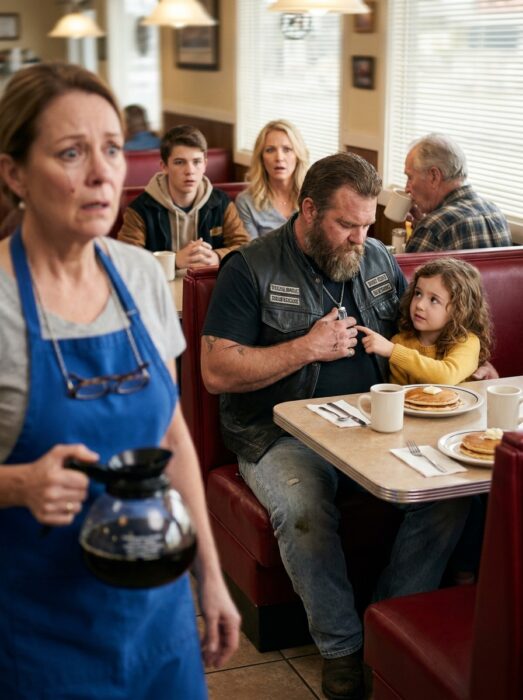
Ruby did not find any of this comforting.
The tooth wobbled for nine days.
She hated it.
Every time she brushed her teeth, she checked it in the mirror with suspicious eyes. Every time she ate toast, she took tiny bites. Every time Wyatt joked that it was almost ready to jump ship, Ruby pressed her lips together and walked away. He thought she was being stubborn at first. Children have strange loyalties. Maybe she simply liked the tooth where it was.
He did not understand until the night it fell.
It happened after bath time.
Ruby stood on her purple step stool in the bathroom, brushing carefully while Wyatt leaned against the doorframe with a towel over one shoulder. He had just gotten home from Mercer Ironworks & Cycles, the garage he ran on the edge of Asheville, where he fixed motorcycles, welded broken frames, and came home most evenings smelling like metal, gasoline, and weather.
He was tired.
Ruby was concentrating.
Then the tooth slipped free.
It landed in the sink with a tiny click.
Ruby froze.
Wyatt smiled automatically.
“There it is!”
Then he saw her face.
Ruby stared at the small white tooth near the drain as if it were not a tooth but proof of some disaster nobody else understood. Her eyes filled. Her hand flew to her mouth. She made a sound so small Wyatt almost missed it.
“Daddy?”
He stepped forward immediately.
“What’s wrong, bug?”
She pointed at the sink.
“It came out.”
“I know. That’s okay.”
“No.”
Her breathing changed.
Wyatt turned off the faucet fast and picked up the tooth before it could slip away. He placed it on a folded tissue, then crouched beside Ruby until his huge frame was nearly level with her trembling face.
“Ruby, it’s normal. Everybody loses baby teeth.”
That was the wrong thing to say.
Adults often reach for normal when children need understood.
Ruby shook her head hard.
“I don’t want to lose me.”
Wyatt went still.
His wife, Mara Mercer, a thirty-nine-year-old white American woman with fair skin, hazel eyes, dark blond hair in a loose bun, jeans, sneakers, and the tired warmth of a mother who had learned to hear fear under small sentences, appeared in the hallway.
“What did she say?”
Ruby turned toward her mother, crying now.
“My tooth is part of me. It fell out. What if all my parts fall out? What if I get smaller inside? What if I forget my baby self?”
Wyatt looked at Mara.
Mara’s face broke.
Ruby was not being silly.
Not really.
She was six years old, standing at the edge of one of childhood’s first visible losses. Adults call baby teeth milestones because adults know what comes next. Children only know that something that had always belonged to them is suddenly in a tissue, outside their body, being celebrated like a party.
Wyatt held the tiny tooth carefully.
His hands had lifted engine blocks, steadied motorcycles, broken up fights, and carried Ruby when she fell asleep on the couch. But that night, he held one baby tooth like it might answer him if he listened hard enough.
Ruby whispered, “Where does it go now?”
Wyatt did not say Tooth Fairy.
Not yet.
Because he could hear the real question.
Where do the parts of me go when I grow?
He looked at the tooth.
Then at his daughter.
“Nowhere bad,” he said softly. “Not if I can help it.”
PART 3, THE PROMISE BESIDE HIS HEART
The tiny jar was not planned.
At first, Wyatt tried the regular parent answers.
The Tooth Fairy would come. A new tooth would grow. Losing baby teeth meant Ruby was healthy and getting bigger. Nothing bad was happening. She was not falling apart. She was growing.
Ruby listened.
She nodded because she wanted to believe him.
Then she asked, “But where will that one go?”
Wyatt hesitated.
Mara said gently, “Some families save them.”
Ruby looked interested but uncertain.
“Where?”
“Boxes,” Mara said. “Little keepsake boxes.”
Ruby’s face tightened.
“In a drawer?”
“Sometimes.”
Ruby looked at the bathroom cabinet, then at her tooth on the tissue.
“A drawer is far away.”
Wyatt felt the sentence land.
To an adult, a drawer is safe. To Ruby, a drawer was dark, closed, forgotten. A drawer was where old batteries, instruction manuals, spare buttons, and things nobody needed right now went to sleep forever.
She did not want her tooth forgotten.
She wanted it close.
Wyatt sat on the edge of the bathtub, still holding the tissue.
“What would feel safe?”
Ruby sniffed.
“With you.”
Mara looked at Wyatt.
Wyatt looked down at his chest.
“With me where?”
Ruby stepped closer and pressed one small finger to his work shirt, right over his heart.
“There.”
That was how it began.
The next day, Wyatt went to a small craft store on his lunch break. He looked wildly out of place among beads, ribbons, miniature bottles, charms, and women comparing glue brands with the seriousness of engineers. A clerk named Nora Bell, a fifty-eight-year-old Black American woman with deep brown skin, silver braids, glasses, and a floral blouse, watched him stand helplessly in the jewelry aisle for several minutes.
“Can I help you find something, honey?”
Wyatt cleared his throat.
“I need a tiny jar.”
Nora smiled politely.
“For what kind of project?”
“My daughter’s tooth.”
The smile faded into caution.
Wyatt closed his eyes.
“That came out wrong.”
Nora folded her arms.
“Try again.”
He told her.
Not the whole thing. Just enough. His little girl was scared that losing teeth meant losing pieces of herself. She wanted him to keep the tooth near his heart so she knew it was not gone. He needed something safe, sealed, clean, small enough to wear, and strong enough not to break easily.
Nora’s face changed by the time he finished.
She led him to a set of small glass keepsake vials with screw caps, then helped him choose a silver one with a loop for a chain. She also made him buy a stronger cord, a backup cap, and a soft cloth pouch because, as she said, “If we’re holding a child’s fear, we’re not doing bargain-bin work.”
Wyatt paid without arguing.
That night, after cleaning the tooth carefully and sealing it in the tiny vial, Wyatt sat at the kitchen table with Ruby on his lap. Mara watched from beside the sink, pretending to fold a dish towel that did not need folding.
Wyatt held up the jar.
Ruby stared.
“It’s in there?”
“Yes.”
“It can see me?”
Wyatt smiled.
“No eyes, bug.”
She giggled once, then became serious again.
“You wear it?”
Wyatt slid the chain over his head.
The vial came to rest against his chest.
Right over his heart.
Ruby touched it with one fingertip.
Wyatt covered her hand with his huge scarred one.
“You didn’t lose anything,” he said. “I’ve got it right here.”
Ruby leaned against him.
For the first time since the tooth fell, she looked relieved.
Not because the tooth was back.
Because someone she trusted had made a place for what was gone.
PART 4, THE STRANGEST THING PEOPLE SAW
The first stranger to notice the jar was a gas station cashier.
Wyatt had stopped for coffee before work, wearing his leather vest, boots, faded jeans, and the tiny vial on its chain. It swung forward when he reached for his wallet. The cashier, a twenty-two-year-old white American man with fair skin, sandy hair, tired eyes, and a red uniform shirt, glanced down and frowned.
“Dude,” he said before he could stop himself. “Are those teeth?”
Wyatt tucked the vial back under his shirt.
“Yes.”
The cashier stared.
Wyatt paid for the coffee and left without explaining.
He did not owe every stranger the tenderest part of his daughter’s fear.
But the stares kept happening.
At the parts store, a man asked if it was some biker ritual. At the grocery store, a woman pulled her child closer. At a traffic light, another rider pointed and laughed. At the garage, Wyatt’s own mechanic, Ray Brooks, a fifty-one-year-old Black American man with deep brown skin, shaved head, gray beard, grease-stained coveralls, and a habit of teasing before thinking, noticed the jar when Wyatt bent over a workbench.
“Gravel,” Ray said, squinting. “Please tell me that is not what I think it is.”
Wyatt looked down.
“It’s Ruby’s tooth.”
Ray blinked.
“Singular?”
“For now.”
Ray stared longer.
“Brother, you know that sounds worse?”
Wyatt grunted and returned to tightening a bolt.
Ray leaned on the bench.
“You wearing baby teeth to work now?”
“My daughter asked me to.”
Ray opened his mouth, then closed it.
That answer had a way of rearranging the room.
Still, not everyone understood.
Some people mocked what they did not understand. Some called it creepy. Some called it weird. One customer at the garage refused to let Wyatt work on his motorcycle after seeing the jar, muttering something about strange men and bones. Wyatt returned the deposit without argument. Ray was more offended than he was.
“You’re really not going to explain?”
Wyatt wiped his hands.
“No.”
“Why not?”
“Because if a man needs my kid’s private fear explained before he treats me human, he can find another mechanic.”
Ray looked at him for a long second.
Then he nodded.
“Fair.”
At home, Ruby noticed every time Wyatt wore the jar.
That was the point.
She checked it in the morning before school, pressing her finger to the glass to make sure it was there. When the second tooth loosened, she panicked less. When it fell out, she cried, but only for a minute. Then she asked if there was room in the jar.
Wyatt said yes.
There was room.
The second tooth joined the first.
Then a third.
Mara worried briefly that Wyatt might be feeding Ruby’s fear instead of helping it. She said so gently one night after Ruby went to bed.
Wyatt listened.
He had learned, after years of marriage, that defensiveness is usually fear wearing boots.
Mara said, “I love what you’re doing. I just don’t want her to think growing means keeping every piece literally.”
Wyatt nodded slowly.
“I know.”
“So what are we teaching her?”
He held the vial in his hand.
“That change doesn’t mean abandonment.”
Mara’s face softened.
Wyatt continued, “One day she won’t need me to wear it. Until then, I can carry it.”
Mara sat beside him.
That was when she understood the necklace was not about teeth.
It was about transition.
A child moving forward while needing proof that the past was not being thrown away behind her.
PART 5, THE SCHOOL PARKING LOT
The moment that made the story travel began badly.
It happened outside Blue Ridge Elementary on a cold Thursday morning. Wyatt was dropping Ruby off because Mara had an early appointment. Ruby wore a purple coat, striped leggings, and a knit hat with cat ears. Her smile showed two gaps now, one on top and one on the bottom. She was doing better with the lost teeth, but school still made her nervous on days when classmates noticed.
That morning, one boy pointed at her smile and said, “You look like a jack-o’-lantern.”
He did not say it with deep cruelty.
Children do not need deep cruelty to hurt each other. Shallow cruelty works just fine when it lands in the right soft place.
Ruby’s face changed.
Wyatt saw it.
He crouched beside her near the school gate.
“Hey.”
Ruby pressed her lips closed.
“I look weird.”
Wyatt touched the tiny jar around his neck.
“You look like you’re growing.”
“I don’t like growing if people laugh.”
Wyatt glanced toward the boy, then back at Ruby.
He could have snapped. He could have scared the child. He could have become the kind of biker parents already feared when they saw him near an elementary school.
Instead, he took the little vial from under his shirt and held it where Ruby could see.
“You want to check?”
Ruby nodded.
He opened his palm.
The jar rested there, small and strange against scarred skin.
Ruby touched it.
“Still there.”
“Still there.”
Her shoulders dropped.
A mother nearby gasped.
“What is that?”
Wyatt looked up.
The woman was Dana Miller, a thirty-seven-year-old white American mother with fair skin, brown hair in a ponytail, a beige coat, and the alarmed expression of someone who had just seen a giant tattooed man show a child a jar of teeth in a school parking lot.
“That is not appropriate,” she said.
Other parents turned.
Ruby stepped closer to Wyatt.
Wyatt stood slowly, making himself less sudden than he looked.
“They’re hers,” he said.
That did not help.
Dana’s face tightened.
“Why would you have a child’s teeth around your neck?”
A few parents moved closer. Someone lifted a phone. A teacher at the gate looked over. The boy who had mocked Ruby’s smile stared with wide eyes.
Wyatt’s jaw tightened.
Ruby tugged his sleeve.
“Daddy.”
He looked down.
Her voice was small.
“Tell them.”
Wyatt did not want to.
Not because he was ashamed.
Because some things become less tender when fed to a crowd.
But Ruby was asking.
So he lifted the vial gently.
“My daughter was scared that losing teeth meant losing parts of herself,” he said. “So I keep them here until she doesn’t need me to.”
The parking lot went quiet.
Dana’s phone lowered.
Ruby looked at the ground, then at the boy who had called her a jack-o’-lantern.
Wyatt continued, voice rougher now.
“People think I’m weird. Fine. My kid isn’t afraid of growing up anymore.”
Nobody spoke.
Ruby reached up.
Wyatt bent down so she could touch the jar once more.
Then she turned toward the school doors with her chin a little higher.
PART 6, THE WOMAN AT THE CRAFT STORE
Two weeks after the parking lot incident, Wyatt returned to the craft store.
The first jar was getting crowded. Ruby had lost four teeth now, and while the tiny vial still held them, Wyatt wanted a second one ready. Not because he hoped more teeth would fall quickly, but because Ruby liked preparedness. It made her feel safe.
Nora Bell was behind the counter again.
She recognized him immediately.
“Back for another tooth jar?”
Wyatt winced.
“You say that loud.”
Nora laughed.
“Honey, I’ve heard stranger requests in this store.”
“Doubt it.”
“You have no idea what people do with dollhouses.”
Wyatt smiled despite himself.
She walked him to the same aisle.
This time, he chose a slightly larger vial with a stronger metal loop. Nora inspected it, approved the cap, and added a packet of tiny soft cloth pads to keep the contents from rattling too much.
“You still wearing the first one?”
Wyatt pulled the chain from under his shirt.
Nora looked at the jar resting against his chest.
“How’s your girl?”
“Better.”
“That’s good.”
Wyatt nodded.
“She lost one last week and didn’t cry.”
Nora’s face warmed.
“That’s big.”
“Yeah.”
He hesitated.
“She did ask if her old self could still hear her.”
Nora did not laugh.
“What did you say?”
Wyatt stared at the shelves of beads and cords.
“I said her old self was not trapped in the teeth. I said the jar just reminds us every version of her mattered.”
Nora put one hand over her heart.
“That is a good answer.”
Wyatt looked uncomfortable with praise, so she did not push it.
At checkout, she slid the new vial into a small paper bag.
“My granddaughter lost her first tooth last month,” Nora said.
Wyatt looked up.
“She okay?”
“She was excited until bedtime. Then she cried because she said her smile had a hole in it.”
Wyatt nodded.
“Kids see things straight.”
“They do.”
Nora looked at the bag, then back at him.
“I didn’t save the tooth. My daughter threw it away after the Tooth Fairy note.”
Wyatt said nothing.
Nora’s eyes shone.
“I wish we’d asked my granddaughter what she wanted.”
That was the thing Wyatt had begun to understand. Adults often treat childhood milestones like a script already written. First tooth. Tooth Fairy. Dollar under pillow. Cute photo. Done. But every child meets change differently. Some run toward it. Some laugh. Some panic. Some need a story. Some need a ritual. Some need a giant father to wear a tiny jar of teeth beside his heart until the fear loosens.
The local story spread after someone from the school parking lot posted about it online without naming Ruby. At first, people reacted exactly as expected. Some called it creepy. Some called it beautiful. Some argued about whether parents should keep baby teeth at all. Some missed the point so dramatically that Mara had to stop reading.
Wyatt ignored most of it.
Then messages started arriving at the garage.
A father said his son was afraid of haircuts because he thought cut hair meant pieces of him were being thrown away. A mother said her daughter cried when old shoes were donated because she believed memories lived in them. A grandfather said he kept his late wife’s grocery lists because they proved ordinary days had existed.
People were not really talking about teeth.
They were talking about loss.
Small loss. Growing loss. The strange grief of children and the quiet grief adults pretend they have outgrown.
Wyatt read the messages at night and said little.
But he wore the jar every morning.
And Ruby kept growing.
PART 7, NOTHING IMPORTANT GETS THROWN AWAY
By the time Ruby lost her eighth tooth, she did not cry.
She came running into the garage with a napkin held carefully in both hands, face bright with surprise.
“Daddy!”
Wyatt slid out from beneath a motorcycle lift so fast he bumped his shoulder.
“What? You okay?”
She held up the napkin.
“Tooth.”
He sat up.
“You all right?”
Ruby nodded.
“It didn’t scare me.”
Mara appeared in the garage doorway, smiling before the tears came.
Ruby climbed onto her red stool near Wyatt’s workbench and opened the napkin. The tooth was small, white, ordinary, and no longer terrifying. Wyatt placed it beside the others in the second vial while Ruby watched closely, not with fear now, but with ceremony.
When he sealed it, Ruby touched the jar.
“Can I wear it someday?”
Wyatt looked at her.
“You want to?”
“When I’m big.”
His chest tightened.
“Sure.”
Ruby thought for a moment.
“Maybe not all the time.”
“That’s okay.”
“Maybe when I forget I used to be little.”
Wyatt could not answer for a second.
Mara looked away.
That night, after Ruby slept, Wyatt removed the first vial from his chain and held it under the kitchen light. Eight tiny baby teeth rested inside, each one once a crisis, now a record. Not of weirdness. Not of fear. Of a father and daughter making a bridge across change.
Mara sat beside him.
“She won’t need you to wear them forever,” she said softly.
“I know.”
“You okay with that?”
Wyatt smiled faintly.
“No.”
Mara laughed.
He looked toward Ruby’s bedroom.
“But I’ll learn.”
That was the other side of parenting nobody warned him about. Children are not the only ones afraid of losing pieces. Parents lose versions too. The baby who slept on his chest. The toddler who mispronounced motorcycle. The preschooler who believed clouds followed cars. The six-year-old who cried over a tooth because growing felt like vanishing. Each version falls away quietly, not into sinks or napkins, but into time.
Maybe the jar had helped Ruby.
Maybe it had helped Wyatt too.
The story became part of town legend in the odd way small towns keep what they first mocked. At Maggie’s Diner, people stopped flinching when the vial showed. Some still found it strange. Wyatt did not mind. Strange was not always bad. Sometimes strange was just tenderness wearing a shape nobody expected.
When new customers asked, Ray Brooks at the garage would answer before Wyatt could.
“His daughter was scared of losing parts of herself,” Ray would say. “He keeps them close. You got a problem with that, your oil change costs extra.”
Wyatt always told him to stop.
Ray never did.
At Ruby’s school, the boy who had called her a jack-o’-lantern eventually lost his own front tooth and cried during lunch. Ruby sat beside him and said, “It feels weird, but you don’t get smaller.”
He sniffed.
“You sure?”
Ruby nodded.
“My daddy says growing means your body changes rooms, not that you disappear.”
The teacher heard that and wrote it down later because some sentences from children deserve to be saved.
Years passed.
Ruby grew taller. Her adult teeth came in uneven first, then strong. She stopped checking the jar every morning. She stopped needing Wyatt to show it to her before school. One Saturday, when she was nine, she found him still wearing it while repairing a bike and smiled.
“You know I’m not scared anymore, right?”
Wyatt wiped his hands on a rag.
“I know.”
“You still wear it.”
He looked down at the vial.
“Habit.”
Ruby walked over and touched it.
“No,” she said. “Love.”
Wyatt looked away.
She was old enough now to see when his eyes changed.
On her tenth birthday, Wyatt gave Ruby a small wooden keepsake box lined with blue velvet. Inside were the two vials, polished clean, both sealed, both labeled only with tiny colored threads Ruby had chosen years before. He placed the box in her hands like he was returning treasure borrowed from a kingdom.
“You want me to keep wearing one?” he asked.
Ruby opened the box.
Then closed it gently.
“Not every day.”
Wyatt nodded.
She stepped closer and pressed her hand to his chest, exactly where the jar used to rest.
“You already kept them.”
He covered her hand with his.
“Every little piece.”
Ruby smiled.
“I didn’t lose me.”
“No, bug.”
She hugged him then, not like a child frightened of changing, but like a girl growing strong enough to carry her own story.
And that was what strangers never understood when they saw the biker with a jar of teeth around his neck.
It was not about the teeth.
It was about a child saying, “I’m scared I’m losing myself,” and a father answering in the only language that made sense to her then.
It was about making fear visible enough to hold.
It was about refusing to laugh at a child’s strange grief.
It was about keeping the smallest things close until she learned that growing up does not mean disappearing.
Wyatt still wears the chain sometimes.
Not always.
Mostly on days when Ruby asks, or when he feels the ache of time moving too quickly. The jar rests lighter now, no longer a shield against fear, but a reminder of the promise that started it all.
Nothing important gets thrown away.
Not baby teeth.
Not old drawings.
Not strange questions.
Not small versions of children who grow faster than fathers are ready for.
When people ask Wyatt why he once wore his daughter’s lost teeth around his neck, he gives the answer plainly, in that rough biker voice that still makes strangers lean in despite themselves.
“She thought she was losing pieces of herself. I told her I’d keep every piece beside my heart until she knew she was whole.”
Then he adds the line that made Maggie’s Diner fall silent the first time.
“People thought I was weird. Fine. My kid stopped being afraid to grow.”
That was enough for him.
It would always be enough.
Follow the page for more unforgettable biker stories about devoted fathers, brave little hearts, and the rough-looking love that protects even the smallest fears children cannot explain.